
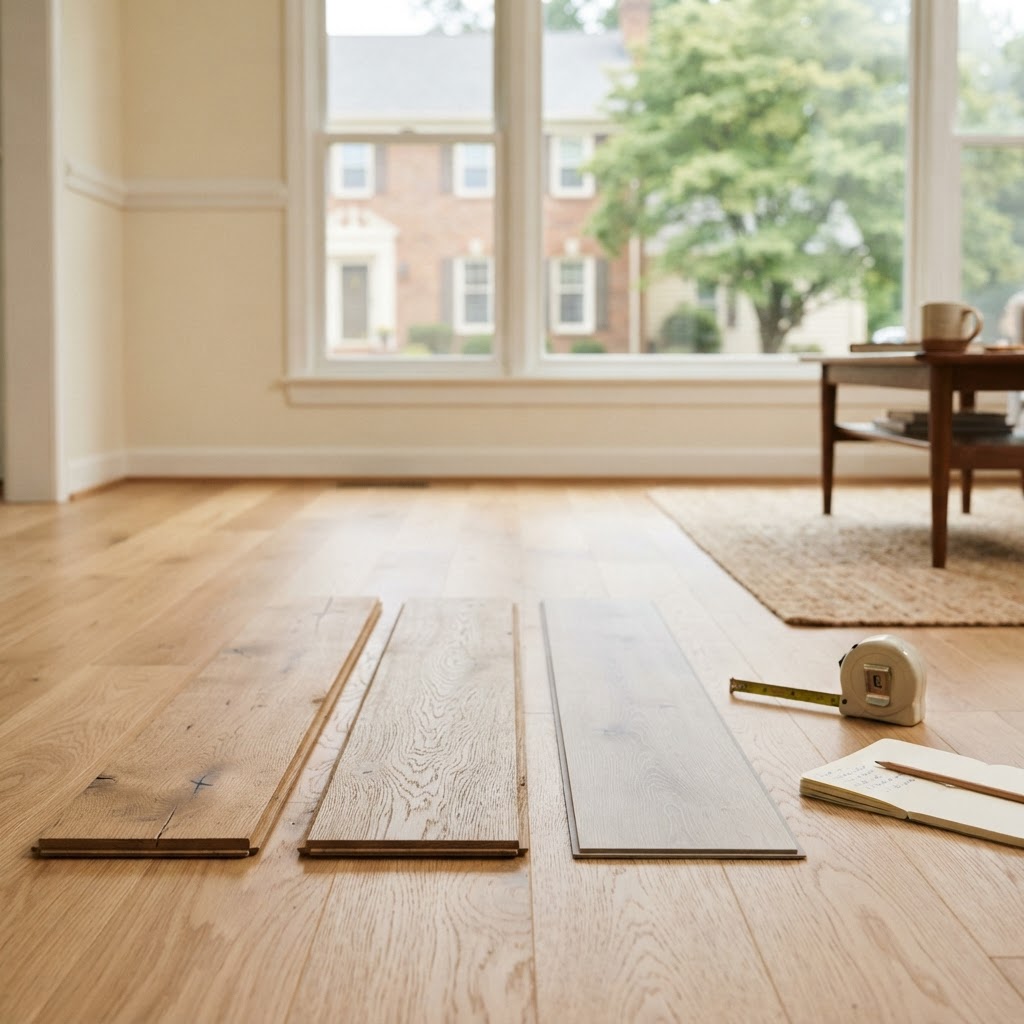
Fairfax is one of the largest and most varied housing markets in Northern Virginia. Within the City of Fairfax and the surrounding county you will find mid-century houses with original oak, townhome communities built in the 1980s and 1990s, newer infill homes and condominium buildings, and each of them has different flooring needs. Choosing a flooring company in that environment is less about finding the biggest name and more about finding the right fit: a team that understands your house, explains your options honestly, puts the scope in writing and stands behind the work. This guide from Floors and Beyond VA explains how to evaluate a flooring company in Fairfax, which floors tend to suit Fairfax homes, what a good in-home estimate looks like and what warning signs to watch for.
What "a flooring company" means
The phrase covers a wide range of businesses. Some sell materials and send customers elsewhere for installation. Some sell and install a limited range of products. Some specialize in a single service, such as refinishing, and some handle several. Understanding which kind of company you are talking to helps you ask the right questions.
A full-service flooring company evaluates your home, helps you choose a product, installs it and handles the details around it, such as removing old floors, preparing the subfloor and finishing transitions and trim. A specialty contractor may be excellent at one thing and less able to advise on others. A retail seller may have a wide selection but may use outside installers.
None of these models is automatically better. What matters is that you know who is responsible for each part of the job and that the company is clear about it.
Start with the basics
License
Virginia licenses contractors, and the license class and status can be looked up through the state. Ask for the license number and check it yourself.
Insurance
Ask for a certificate showing general liability and workers' compensation coverage. If something is damaged or someone is hurt, you do not want that exposure to fall on you.
Experience
How long has the company been working in the area? Floors and Beyond VA, for example, has been family-owned since 1987. Longevity is not a guarantee of quality, but it does mean the company has a local reputation to protect.
References and photos
Ask to see recent projects, ideally in Fairfax County. Ask whether past customers are willing to talk.
Who does the work
Ask whether the installers are employees or subcontractors. The person who sold you the job should be able to tell you exactly who will be in your home. At Floors and Beyond VA, our crews are our own employees.
Which floors suit Fairfax homes
Fairfax County has housing from many eras, and each tends to point toward certain floors.
- Older single-family homes. Many mid-century and earlier houses have original solid oak that can often be refinished. Restoring the existing floor is often the best way to keep the character of the home. Where floors are damaged beyond repair, new solid or engineered hardwood is a natural match.
- Townhomes from the 1980s through the 2000s. These often have a mix of carpet, builder-grade hardwood and vinyl. Luxury vinyl plank is a common upgrade for open main levels, while hardwood is often chosen for living areas. We discuss installation details in our guide to click lock LVP flooring.
- Newer homes and infill construction. These often have engineered or builder-grade hardwood with thin wear layers. A light refresh may be possible, while some floors will need replacement over time.
- Basements. Finished basements on slabs benefit from moisture-tolerant options, and testing is essential. Our post on moisture barriers for LVP flooring explains what to ask.
- Condominiums. Association rules on sound, work hours and approvals often shape the choice. Engineered hardwood and vinyl plank with an appropriate underlayment are common.
The right answer depends on your lifestyle as much as your house. Households with pets and children often prefer water-resistant surfaces in kitchens and entries. Others prioritize the warmth and refinishing potential of real wood. A good company helps you weigh these without pushing one option.
Hardwood, engineered hardwood or LVP?
This is the question most Fairfax homeowners ask first, so here is a short framework.
Solid hardwood is real wood from top to bottom. It can be refinished many times, it has a traditional look and it is best suited to above-grade, wood subfloor installations. It reacts to humidity changes and is not recommended for basements on slabs.
Engineered hardwood has a real wood top layer over a layered core. It is more stable than solid wood and can go over concrete in many cases. It can be refinished if the wear layer is thick enough, as we explain in our post on engineered hardwood floor refinishing.
Luxury vinyl plank is a water-resistant synthetic floor that looks like wood, installs quickly and handles spills well. It cannot be refinished, but it is durable in busy rooms. Our guide to what LVP flooring is covers the basics.
Many homes use more than one. A common pattern is hardwood in living areas, vinyl in kitchens, mudrooms and basements. Our comparison of hardwood versus LVP in Northern Virginia goes into the trade-offs.
The in-home estimate
An estimate sight unseen is a guess. A reliable company comes to your home and looks at the actual conditions.
- They measure the rooms, including closets, stairs and transitions.
- They look at the subfloor and the existing floor, checking for moisture, levelness, squeaks, damage and anything that could affect the new floor.
- They ask about how you use the space, including pets, children, furniture, sunlight and cleaning habits.
- They explain your options and the trade-offs, including when an existing floor can be preserved rather than replaced.
- They discuss the details around the floor, such as baseboards, thresholds, doors and appliances.
- They put the scope in writing.
What a good written estimate includes
A written estimate should be specific enough to compare with another contractor's.
- The rooms and areas included, with square footage.
- The product, including brand, line, color and key specifications, such as wear layer for vinyl or species and thickness for hardwood.
- Preparation work, such as removing old flooring, leveling and moisture testing.
- Underlayment or barriers, with the product named.
- Installation method.
- Trim, baseboards, transitions and stair details.
- Furniture handling, and who moves what.
- Disposal of old flooring and debris.
- Schedule, with start and expected completion dates.
- Payment terms, tied to progress.
- Warranty on materials and workmanship, with a clear description of what is covered.
If an estimate leaves these out, ask for them. Compare scope as well as the total, because two estimates may not include the same work.
Questions to ask any flooring company
Who will install my floor, and are they your employees? What preparation is included, and what happens if you find a problem under the old floor? How do you handle moisture on a slab? What is the plan for dust, protection of the home and cleanup? What is the schedule, and how do you handle delays? What is covered by the warranty, and who do I call if there is an issue? Can I speak with a recent customer?
A company that answers these clearly and specifically is easier to trust than one that offers general reassurance.
Thinking about your own floors? Floors and Beyond VA offers in-home estimates across Northern Virginia. Schedule yours at [floorsandbeyondva.com/Contact](/contact) or call (703) 906-5698.
Red flags
Be cautious of the following.
- No license or insurance, or reluctance to show proof.
- An estimate without a visit.
- Vague descriptions of the product or the work.
- Pressure to sign immediately, or deals that expire the same day.
- A request for a large payment up front, or a preference for cash with no paperwork.
- Promises that sound too good to be true, such as a perfect, dust-free job in a day.
- No written warranty.
- Inability to name who will do the work.
Fairfax-specific considerations
Homeowners associations and condominium rules
Many Fairfax communities have rules about work hours, noise, parking and approvals. Ask whether your company has worked in your community before and can help with paperwork.
Older homes
Houses built before 1978 may involve lead-safe practices when work disturbs painted surfaces. Ask how the company handles this.
Seasonal humidity
Northern Virginia swings from humid summers to dry winters, and floors respond. Ask how the company accounts for acclimation and moisture, and read our guide on how long flooring should acclimate.
Access and parking
Many neighborhoods have limited street parking or narrow driveways, and condos have elevators and loading rules. Plan these details with your contractor.
Planning the project: a simple sequence
Homeowners who plan their flooring in a clear order tend to have smoother projects. First, decide the goals for each room: durability, comfort, look and how long you plan to stay in the home. Second, check any association or community rules and gather the paperwork. Third, invite a flooring company for an in-home visit so that the recommendations reflect the real conditions of your floors and subfloors. Fourth, compare written scopes and ask about anything that differs. Fifth, choose the product with physical samples in your own lighting. Sixth, agree on a schedule that works for your household, including how furniture will be moved and where pets will stay. Finally, keep the documents, including the product information, the warranty and the care instructions, so that future repairs and maintenance are easy. Following this sequence prevents the most common surprises.
How to compare estimates fairly
When two or more companies give you written estimates, it is tempting to look at a single total and decide. A better method is to line up the scopes side by side. Check that each estimate covers the same rooms and square footage. Confirm that both name the same product or a clearly comparable one. See whether the preparation work is the same, including removal of old flooring, leveling and moisture testing. Look at what each says about trim, transitions and stairs. Compare how each handles furniture and debris. Look at warranty language and who stands behind the work. If one estimate is much simpler than the others, it may be leaving things out rather than being more efficient. Ask the companies to explain any differences in scope, and choose the one whose answers are clear, specific and consistent.
Communication during the project
A good flooring company keeps you informed. You should know who is arriving each day, what they will be doing and when they expect to finish. If they find a problem under the old floor, such as damaged subfloor or moisture, they should tell you right away, explain the options and agree on any change in writing before proceeding. At the end, you should receive care instructions and a walkthrough. Companies that communicate well before the job usually do so during it. Notice how quickly and clearly a company answers your questions at the estimate stage, because it is a good preview of the experience.
The questions Fairfax homeowners ask most
Across Fairfax, Oakton, Burke and Annandale, the same few questions come up again and again. Can I keep my original hardwood floors? Often yes, if there is enough wood left to refinish and the damage is not severe. Is vinyl plank a good choice for my basement? It can be, once the slab has been tested for moisture and prepared properly. What should I put in a kitchen? Many homeowners choose a water-resistant floor for the kitchen and entry, and wood for the living areas, though real hardwood in kitchens is also common when it is cared for. How long will the project take? It depends on the product and the preparation, and a written schedule from your contractor is the best answer. Will you move the furniture? That should be spelled out in the scope. Having these questions in mind before the estimate makes the conversation more productive.
After the installation
A good flooring company does not disappear when the last plank goes down. You should receive care instructions for your specific floor, information about the warranty, and a point of contact if something looks wrong. Keep the product name, the color and lot number, and a few spare planks or boards if possible, since they make future repairs much easier. Floors and Beyond VA gives homeowners this information at the end of every project, and we are glad to answer questions afterward.
How Floors and Beyond VA works in Fairfax
Floors and Beyond VA is a family-owned company that has served Northern Virginia since 1987. We work in Fairfax, Oakton, Vienna, Burke, Annandale and the surrounding communities, as well as across Loudoun, Prince William and Arlington counties. Our crews are our own employees. We take a refinish-first approach, which means we try to preserve and renew existing hardwood before recommending replacement. We start with an in-person visit, explain what we see, recommend the option that suits your home and put the scope in writing.
If you are looking for a flooring company in Fairfax, VA, you can learn more about us on that page. For specific services, see our LVP flooring in Fairfax, VA and floor restoration in Fairfax, VA pages. For a shorter version of this checklist, see our NoVA Guide entry on how to choose a flooring company in Fairfax, VA.
A note on timing and seasons
Northern Virginia's seasons affect flooring projects. Spring and fall are popular because the weather is mild, and busy companies may book weeks ahead in those periods, so it helps to start the conversation early. Summer humidity matters for wood floors and for finishes, and winter dryness affects how wood behaves, so a good company plans for acclimation and conditions. If you have a deadline, such as a move, a holiday or a sale, share it at the first visit so that the schedule can be built around it with a margin for drying, curing and any surprises.
Frequently asked questions
How do I choose a flooring company in Fairfax?
Confirm license and insurance, ask who does the work, see recent projects, get an in-home estimate and compare written scopes.
Should I get more than one estimate?
Two or three is reasonable. Compare scope and approach, not only the total.
Can I keep my existing hardwood floors?
Often yes. Many floors can be refinished or restored rather than replaced. An in-person evaluation tells you.
Is vinyl plank or hardwood better for a Fairfax townhome?
It depends on the room and your priorities. Vinyl handles spills well. Hardwood can be refinished. Many homes use both.
Do I need permission from my association?
Possibly, for condominiums and some communities. Check your governing documents.
How long will a project take?
It depends on the product and the area. Your contractor should give you a written schedule.
What if you find a problem under my old floor?
A good company explains how hidden issues are handled before work begins.
Talk to Floors and Beyond VA
If you are comparing flooring options in Fairfax, we would be glad to look at your home and explain what suits it. Floors and Beyond VA will evaluate your floors, answer your questions and give you a written plan. Schedule an in-home estimate at [floorsandbeyondva.com/Contact](/contact) or call (703) 906-5698.
Get a Free Estimate



