
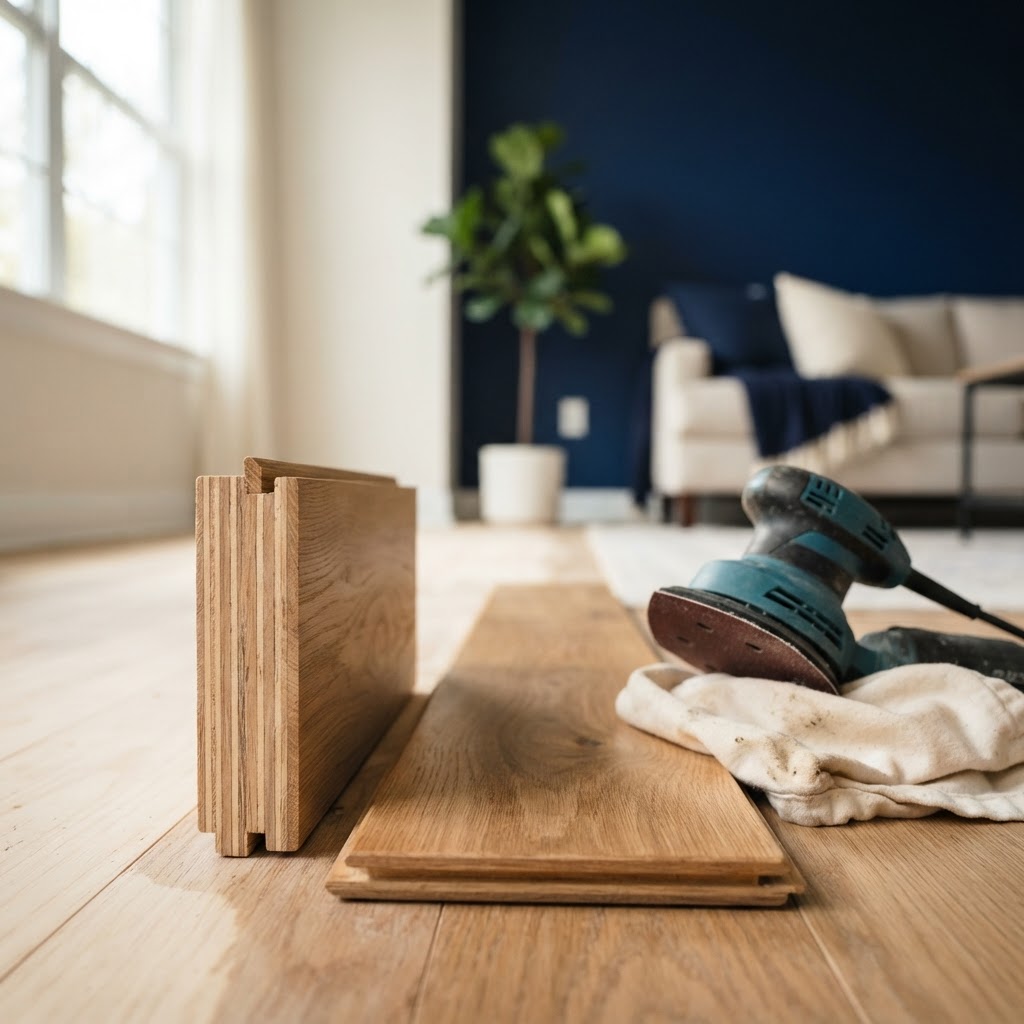
Engineered hardwood is everywhere in Northern Virginia, from high-rise condos in Tysons to new townhomes in Ashburn to renovated kitchens in Arlington. It looks like solid wood because the top layer is real wood. But because that top layer is much thinner than a solid plank, homeowners often ask the same question when the floor starts to look tired: can engineered hardwood be refinished? The honest answer is that it often can, but not always, and not as many times as solid wood.
This guide from Floors and Beyond VA explains how engineered flooring is built, what decides whether it can be sanded, how many times refinishing is realistic, which alternatives exist when sanding is not an option, and how to protect the floor so it stays beautiful longer. If you are choosing between products in the first place, start with our hardwood flooring page.
How engineered hardwood is built
A solid hardwood plank is one piece of wood from top to bottom, usually about three-quarters of an inch thick. An engineered plank is made of layers. The top layer, called the wear layer or veneer, is real hardwood such as oak, hickory, maple or walnut. Beneath it is a core made of plywood or similar layers of wood arranged in alternating directions, and sometimes a backing layer.
The layered construction makes engineered flooring more stable than solid wood. The alternating grain directions resist expanding and shrinking when humidity changes, which is why engineered hardwood is often chosen for basements, over concrete slabs, over radiant heat and in condos where solid wood might not be allowed or practical. It can be glued down, nailed or floated, depending on the product.
The part that matters for refinishing is the wear layer. Wear layers vary widely. Some are thin enough that sanding is not recommended at all. Others are thick enough to be sanded and refinished one or more times, in some cases similar to solid wood. The thickness is not usually obvious by looking at the floor, and it is not always printed on the plank, so it has to be checked.
The key question: how thick is the wear layer?
The wear layer is measured in millimeters. Very thin wear layers, the kind found in many entry-level products, cannot be sanded without going through to the core. Moderate wear layers may allow a light sanding or a single refinish. Thick wear layers, found in premium engineered flooring, may allow several.
There are several ways to find out what you have.
Check the paperwork. If you kept the product information, the specification sheet usually lists the wear layer thickness. Manufacturers also list whether refinishing is recommended and how many times.
Look at the edge. Pull up a removable floor vent, look at a transition piece or inspect the edge at a doorway or a threshold where the plank edge may be visible. The layers can often be seen in cross section, and the top layer looks different from the core.
Ask a professional. An experienced flooring contractor can evaluate the plank, check the edges and compare it against known product lines. In some cases, a small sample or test is taken in a hidden area. This is the most reliable path, because the answer decides whether sanding is safe.
If the wear layer is uncertain, it is better to stop than to guess. Sanding through the veneer exposes the core. That damage cannot be repaired by sanding or finishing, and the affected boards would need to be replaced.
How many times can engineered hardwood be refinished?
There is no single answer, because the number depends on the wear layer and on the way the floor has been treated.
Thin wear layers. Often no sanding is advisable. A screen and recoat, which lightly abrades the finish and applies a new coat, may still be possible. Surface repairs may also be possible.
Moderate wear layers. One light sanding may be possible, often with a lighter touch than on solid wood. Each sanding removes a small amount of wood, and a floor that has been refinished once already may have little margin left.
Thick wear layers. One or more sandings are possible. A floor with a thick veneer can behave much like solid wood for refinishing, although the manufacturer's guidance still applies.
In every case, a careful contractor is not trying to maximize the number of sandings. They are trying to preserve what is there. A floor that can be renewed with a lighter process should be treated with the lighter process, and full sanding should be saved for when the floor truly needs it. For a closer look at what full refinishing involves on any wood floor, read our guide to hardwood floor refinishing in Northern Virginia.
Signs your engineered floor may be a candidate for refinishing
Dull finish in traffic areas. The finish has worn through in the paths where people walk, even though the wood is intact.
Surface scratches. Fine scratches that remain in the finish layer rather than the wood can often be addressed without deep sanding.
Faded or uneven color. Sun exposure and age can change the look of wood.
An old, outdated stain. If you want a different color, a full sanding is needed, and that requires enough wear layer.
Minor surface damage. Shallow marks and small areas of finish wear may be correctable.
Signs refinishing may not be possible
Very thin veneer. If the top layer is thin, sanding may be unsafe.
Previous refinishing. If the floor has been sanded before, there may be little wood left to remove.
Deep gouges. Damage that goes through the wear layer cannot be sanded out.
Water damage. Cupped, swollen or delaminating boards, where layers are separating, usually need repair or replacement rather than refinishing.
Bevels and wire-brushed or heavily textured surfaces. Some factory surface treatments cannot be reproduced after sanding, and the floor may look different when it is finished.
Click-lock or floating engineered floors. Some floating products have thin veneers and a profile that does not suit sanding. Check the manufacturer's instructions.
What are the options?
When a homeowner is unhappy with an engineered floor, there are usually several paths. The right one depends on the wear layer, the condition of the finish and what you want.
Option one: clean and maintain. Sometimes a floor looks dull because of residue from the wrong cleaner. A professional cleaning with a product approved for the finish can restore much of its appearance. This is the gentlest option, and it is where we start when the floor is otherwise sound.
Option two: screen and recoat. A light abrasion of the finish followed by a fresh coat renews the surface protection and the sheen without removing much wood. It does not change the color or fix deep scratches. This is often the best choice for floors with thin or moderate wear layers, as long as the existing finish is compatible. We explain this approach in more detail in our post on sandless hardwood floor refinishing.
Option three: full sanding and refinishing. When the wear layer is thick enough and the floor needs a new color or deeper correction, a full sanding can restore the surface. The contractor uses fine abrasives and a careful touch, because the margin for error is smaller than with solid wood.
Option four: repair boards. Individual damaged boards may be repaired or replaced, which can be an alternative to treating the entire floor. Matching can be a challenge, so this works best when spare planks or a close match are available.
Option five: replace the floor. If the wear layer is gone, the floor is damaged by water or it is a thin product that cannot be renewed, replacement may be the practical path. In that case, you can choose engineered hardwood, solid hardwood or luxury vinyl plank depending on the space.
How a careful contractor evaluates your floor
The assessment is the most important part of engineered floor work. At Floors and Beyond VA, we evaluate the following.
- The product and the wear layer, using records, edge inspection and tests.
- How the floor is installed, whether glued, nailed or floating, since this affects how it handles sanding and repairs.
- The condition of the finish and how it has been maintained, including any wax, polish or coatings that could interfere with a new finish.
- Surface damage, depth of scratches, gouges and wear.
- Moisture, cupping, gaps and signs of movement.
- The substrate and any radiant heating.
- Your goals, such as refreshing the existing look, changing color or fixing a specific problem.
Then we explain what we find and recommend the lightest process that will give a good result. If sanding is not safe, we say so.
Thinking about your own floors? Floors and Beyond VA offers in-home estimates across Northern Virginia. Schedule yours or call (703) 906-5698.
The process for a safe engineered refinish
When the floor is a candidate for full refinishing, the work is done with extra care.
Preparation. Furniture is moved, the room is protected and the floor is cleaned. Loose boards or nail heads are addressed.
Controlled sanding. Sanding is done in stages with finer abrasives, avoiding aggressive cuts. Edges and corners are handled with specialty tools. The goal is to remove only what is necessary.
Dust management. Fine dust is controlled with vacuum-connected equipment and thorough cleaning. No system captures everything, and we plan for that.
Staining, if desired. Stain is applied evenly, and the species and grain affect how color appears. We recommend testing a sample in a hidden area first.
Finishing. Multiple coats of finish are applied with light abrading between coats and enough drying time for proper cure.
Curing and care. Furniture and rugs return after the recommended time, and we give clear care instructions.
Throughout the process, the crew at Floors and Beyond VA checks that the wear layer is not being compromised.
Matching new and old floors
A common situation in Northern Virginia is a home where engineered hardwood meets solid oak. A kitchen addition, a finished basement stair or a renovated family room may use engineered planks beside original floors. When one floor is refinished and the other is not, the difference in color and sheen shows. A careful plan treats the connected areas together where possible, or places transitions at natural breaks such as doorways. Different species, different stain absorption and different ages of wood mean a perfect match is rarely possible, but a skilled contractor can bring the two much closer by testing samples on both floors before committing to a color.
Questions to ask before anyone sands engineered flooring
Ask how the contractor will determine the wear layer thickness, and ask them to show you. Ask what the manufacturer says about refinishing the specific product. Ask what the plan is if the veneer turns out thinner than expected. Ask whether a screen and recoat could achieve your goal with less risk. Ask for a sample area or test patch in a hidden spot. Ask how many passes they expect and what grit sequence they will use. A contractor who answers confidently and specifically is more trustworthy than one who simply says engineered floors are no different from solid. For more guidance on choosing a company, read our post on how to choose a hardwood floor refinishing contractor in Northern Virginia.
When replacement makes more sense than refinishing
Refinish-first does not mean refinish-always. Sometimes the honest recommendation is to replace. If the wear layer is paper thin, if water has caused widespread cupping or delamination, or if the floor has been sanded to the limit, repeated repairs may only delay the inevitable. In those cases we help homeowners compare replacing the floor with new engineered or solid hardwood, or with luxury vinyl plank in rooms that see moisture. The goal is to give you a clear picture of what is realistic so you can decide with confidence, and Floors and Beyond VA would rather tell you that plainly than sell a refinishing job that will not hold up. Our NoVA Guide post on refinishing versus replacement walks through that decision.
Protecting an engineered floor so it lasts longer
Because engineered floors have limited sanding capacity, prevention is especially valuable.
- Use felt pads under furniture, and lift rather than drag.
- Place mats at entries to catch grit, which acts like sandpaper underfoot.
- Keep pet nails trimmed.
- Wipe spills promptly and avoid wet mopping. Use a cleaning product approved for your floor and avoid steam cleaners.
- Maintain indoor humidity within a moderate range. Northern Virginia's dry winters and humid summers can stress any wood floor, and engineered products are more stable but not immune. Our post on why hardwood floors gap in winter explains the seasonal effect.
- Control sunlight with window treatments to reduce fading.
- Recoat before the finish is worn through. Renewing the finish before the bare wood is exposed is the best way to extend the life of the floor and the best use of a limited wear layer.
Engineered hardwood in Northern Virginia homes
The region's housing offers many examples. In high-rise and mid-rise condos around Tysons, Reston and Arlington, engineered flooring is common because it can be installed over concrete and meets sound requirements, and associations often have rules for any work. In newer townhomes across Loudoun and Prince William counties, builders frequently install engineered or builder-grade wood that may have a thinner wear layer. In renovated older homes in Arlington, Alexandria and Falls Church, engineered hardwood is often used in additions or kitchens next to original solid oak floors, and matching the two can be a challenge.
In homes with radiant heat, engineered flooring is often the preferred product because of its stability, and refinishing should respect the heat system and the manufacturer's guidance.
We are a family-owned company that has served Northern Virginia since 1987. Our crews are our own employees, and we take a refinish-first approach: we would rather renew a floor that can be saved than replace it. If your home is in the Tysons area, you can learn more about our hardwood flooring services in Tysons, VA.
A word on floors with radiant heat and slabs
Engineered hardwood over radiant heat or directly on concrete is common in condominiums and in finished lower levels across the region. These installations add considerations for refinishing. Heat systems should be turned down or off as the manufacturer directs before and after finishing, since rapid temperature changes can affect both the wood and the finish as it cures. Floors glued to a slab respond differently to sanding than floating floors, and any hollow spots or loose planks should be found and addressed beforehand. If moisture is a concern, it is better to test and correct it than to finish over a problem that will return.
Want the short answer first? Our NoVA Guide entry on whether engineered hardwood can be refinished and how many times covers the wear-layer thresholds at a glance.
Frequently asked questions
Can all engineered hardwood be refinished?
No. It depends on the wear layer thickness, the floor's condition and the manufacturer's guidance. A professional can check.
How many times can it be refinished?
Anywhere from none to several times. Thin wear layers may not allow sanding, and thicker ones may allow multiple sandings.
What if my engineered floor has been sanded before?
It may have limited wear layer left. A careful evaluation will determine if more sanding is safe.
Can I change the color of engineered hardwood?
Changing color requires sanding to bare wood, so it depends on having enough wear layer.
Is a screen and recoat safe for engineered floors?
Often yes, because it removes very little material. Compatibility with the existing finish matters, and it should be tested.
What happens if the veneer is sanded through?
The core is exposed and the damage cannot be repaired by finishing. Boards may need to be replaced.
Is engineered hardwood better than solid?
They are different. Engineered is more stable and suits slabs and basements. Solid wood can generally be sanded more times. Our guide on what engineered hardwood flooring is covers the comparison.
Talk to Floors and Beyond VA
If you are wondering whether your engineered hardwood can be refinished, we would be glad to take a look and give you a straight answer. Floors and Beyond VA will check the wear layer, evaluate the finish and explain your options before any work begins.
Schedule an in-home estimate at floorsandbeyondva.com/Contact or call (703) 906-5698. For local background, see our hardwood flooring services in Tysons, VA page, and to learn how we work, read about our team as a flooring company in Tysons.




