
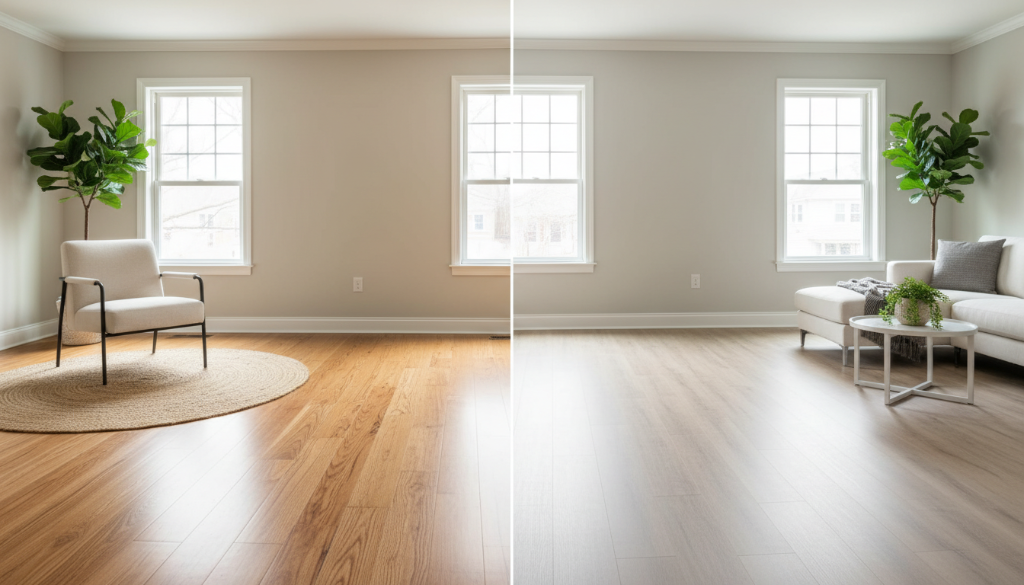
40 Years. Thousands of Floors. One Honest Answer.
The Truth About
Hardwood vs. LVP
Nobody Tells You
We've installed both across Northern Virginia since 1987. Here's what we've actually learned — including the mistakes we've watched homeowners regret.
Most flooring articles will give you a comparison chart. Pros and cons. A tidy verdict. We've read them too — and honestly, most of them could have been written by someone who has never installed a floor in their life. After nearly four decades working in homes across Fairfax, Loudoun, Prince William, and the broader DC Metro area, we've developed some opinions that don't fit neatly into a table.
This isn't a buyer's guide. It's what we'd tell a neighbor — or a family member — who asked us the question we hear more than any other: "Should I go with hardwood or LVP?"
The floor that looks best in the showroom is not always the floor that survives your life.
— Floors and Beyond, serving Northern Virginia since 1987
Both Products Are Better Than They've Ever Been
Let's start with something important: if you're agonizing over this decision, you cannot make a truly bad choice. Hardwood floors today benefit from better finishing technology, improved moisture-resistant coatings, and wider plank options that feel genuinely contemporary. And LVP in 2026 is not the cheap, hollow-sounding vinyl of ten years ago. The embossing, color variation, and texture on premium LVP products have become extraordinarily convincing.
We say this not to dodge the question — but because the anxiety many homeowners feel is disproportionate to the actual stakes. What matters far more than which product you choose is how it's installed and whether it's the right fit for that specific room. We've seen gorgeous hardwood fail in six months because of a moisture problem nobody caught. We've seen entry-level LVP look brand new a decade later because the installation was done right and the product matched the environment.
What We've Seen From the Field
A Common Scenario
"We get calls every year from homeowners who installed hardwood in their basement — sometimes against a contractor's advice, sometimes without being warned at all. Northern Virginia's water table and seasonal humidity make below-grade hardwood a genuine risk. It's one of the most preventable flooring regrets we see."
We've refinished 80-year-old hardwood floors that were breathtaking. We've also ripped out hardwood that was installed five years ago and destroyed by humidity nobody managed.
— Floors and Beyond
What Hardwood Does That Nothing Else Can
We won't pretend to be neutral here. Hardwood floors have a quality that remains unmatched — not just visually, but physically. The solidity underfoot, the way sound behaves differently in a room with real wood, the warmth on bare feet in the morning. These are things you feel, not just see. And they matter.
More practically: hardwood can be refinished. That's not a minor footnote — it's a fundamental difference in what you're buying. When LVP shows its age, you replace it. When hardwood shows its age, you sand it down and it looks new again. We've refinished floors in McLean and Great Falls that were original to homes built in the 1940s. The floor your grandchildren walk on can be the same floor you're standing on today, if it's hardwood and it's maintained.
There's also the resale reality of Northern Virginia's real estate market. Buyers here — particularly in Fairfax County and the communities around it — respond to hardwood. It registers as quality. It photographs well. And for homeowners preparing to sell, the return on hardwood installation or refinishing tends to be meaningful.
What We Hear From Homeowners
"I just want to do it right the first time. I've moved three times and had to replace cheap flooring every single time. I'm done with that."
That's the mindset that leads people to hardwood — and it's a sound one, as long as hardwood is appropriate for the space. The key phrase being: appropriate for the space.
What LVP Does That Hardwood Simply Cannot
Here is the single most important thing to understand about LVP: it is waterproof. Not water-resistant. Not moisture-tolerant. Waterproof. And in a region with Northern Virginia's humidity profile — hot, humid summers, cold dry winters, and homes that experience all of it — that matters more than most product specs.
LVP does not expand and contract the way hardwood does across seasons. It doesn't cup at the edges when a dog's water bowl overflows. It doesn't gap in January when your heat runs constantly and the indoor air gets dry. For families with young children, pets, or simply a busy kitchen, LVP absorbs the chaos of daily life without blinking.
And then there's the basement question. Finished basements represent some of the most valuable square footage in a Northern Virginia home. They're increasingly used as rental suites, in-law apartments, home offices, and recreation rooms. Hardwood below grade is a liability. LVP below grade is exactly what belongs there — and the right LVP product can look stunning.
What We've Learned Over 40 Years
"If a home has a finished basement and young kids, we will almost always steer the conversation toward LVP — at least for the lower level. Not because it's cheaper. Because it's the right tool for the environment."
The Question We Wish More People Asked Us
Most homeowners walk into the conversation asking: "Which one should I get?" The better question is: "Which one is right for each room in my specific home?"
The answer is often both. A home where the main living areas get hardwood, the kitchen and bathrooms get LVP, and the finished basement gets LVP is a very well-done home. The products are designed for different environments. Matching them to those environments is what separates a flooring project that lasts from one that disappoints.
We also wish more people asked about their existing floors before buying anything new. In Northern Virginia's older housing stock — particularly in communities built in the 1950s through 1980s — a significant number of homes have original hardwood floors hiding under carpet that the current owners have never seen. Before you budget for new flooring, it's worth finding out what you already have. Refinishing original hardwood costs far less than new material and installation, and the result is often more beautiful than anything you can buy today.
Before you budget for new flooring, find out what you already have. We've uncovered original hardwood under carpet in homes all across Northern Virginia — floors the owners didn't even know existed.
— Floors and Beyond
Our Actual Recommendation
Choose Hardwood When:
You want longevity above all else. You're preparing to sell and want maximum buyer appeal. The room is above grade with stable humidity. You value the authenticity and feel of real wood and are committed to maintaining it properly.
Choose LVP When:
The room is in a basement or any below-grade space. Water exposure is a realistic concern — kitchen, bathroom, laundry, mudroom. You have pets or young children and want peace of mind. Your budget is constrained and you want a high-quality result without the full investment of hardwood.
When You're Genuinely Unsure:
Call us. We'll come out, look at your subfloor, talk about how you actually use the space, and give you an honest recommendation — not a sales pitch. That's what nearly 40 years in this business looks like.
The right floor isn't the most expensive one. It's the one that fits your home, your family, and your life — installed correctly, by people who know what they're doing.
Get an Honest Opinion — Free
We'll visit your home, assess your space, and tell you exactly what we'd put in if it were our house. No pressure. No upsell. Just straight talk from a team that's been doing this since 1987.




