
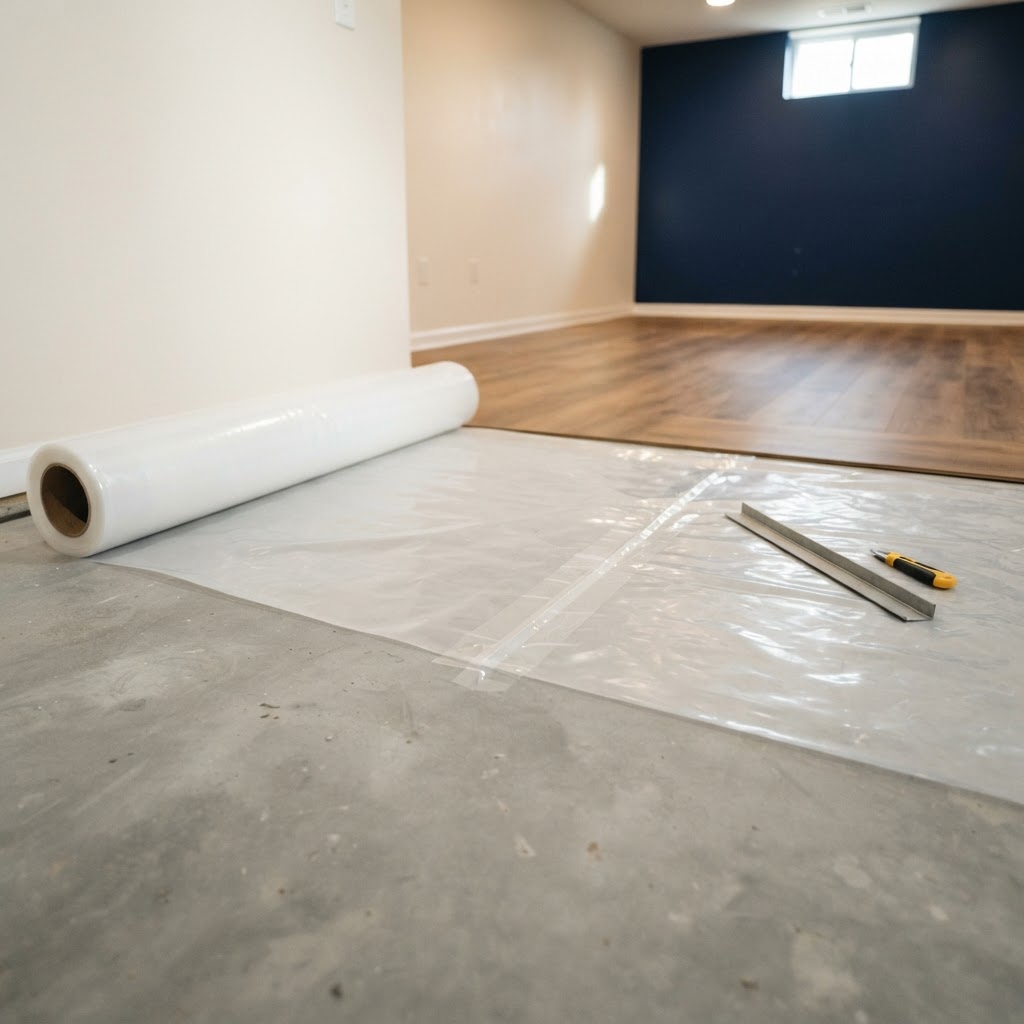
Luxury vinyl plank is sold as a water-resistant floor, and that phrase leads many homeowners to a reasonable but incomplete conclusion: if the planks cannot be damaged by water, nothing under them matters. In practice, moisture under a vinyl floor causes problems even though the planks themselves do not rot. Trapped vapor can lead to musty odors, mold or mildew on the underside of the planks and the surface below, adhesive failure on glued products, discolored seams and, in some cases, a voided warranty. This guide from Floors and Beyond VA explains when LVP flooring needs a moisture barrier, how moisture is actually measured, which kinds of barriers and underlayments are used, and what homeowners in Ashburn, Leesburg and the rest of Northern Virginia should ask before a vinyl floor goes over a basement slab or any other questionable surface.
Why moisture matters under a water-resistant floor
Water-resistant means the planks tolerate spills on the surface. It says very little about what happens when moisture rises from below. Concrete is porous, and even a slab that looks and feels dry can release water vapor continuously. When a vinyl floor covers the slab, that vapor has nowhere to go. It collects between the planks and the concrete.
Over time, trapped moisture can cause several kinds of trouble. The first is odor. A floor that smells musty after a humid week is often a floor with moisture underneath. The second is mold or mildew growth on the back of the planks, on an attached pad or on the slab surface. You may not see it, but you may smell it, and some people react to it. The third is failure of adhesive on glue-down installations, because many flooring adhesives soften or release when exposed to high moisture or high alkalinity from the slab. The fourth is warranty trouble. Most vinyl manufacturers publish moisture limits for the subfloor, and a floor installed over a slab that exceeds those limits may not be covered.
That is why moisture is not an optional topic. It is part of the manufacturer's installation requirements, and a professional installer treats it as a pass-or-fail check before any plank is opened.
What a moisture barrier actually is
A moisture barrier, sometimes called a vapor barrier or vapor retarder, is a layer that slows the movement of water vapor from the subfloor into the flooring. In vinyl plank installations, it takes a few common forms.
A polyethylene sheet laid over the slab is the simplest version. The sheet is rolled across the floor with overlapping seams that are taped, and it is usually turned up slightly at the walls. Not every vinyl manufacturer allows a loose sheet under its floor, so this has to be confirmed in the installation instructions.
Some underlayments are made with an integrated vapor barrier film. These products combine cushioning and sound reduction with a moisture-resistant layer, and they are common under floating floors on concrete.
Some planks come with an attached pad that is designed to meet the manufacturer's own requirements. Even then, the manufacturer may require a separate barrier over concrete when moisture readings are above a certain level.
Liquid-applied moisture mitigation systems are a different category. They are coatings applied to the concrete surface to reduce vapor emission, and they are used when readings are high. This is a specialty step, and it needs to be specified and applied correctly by someone who has done it before.
The details differ from product to product, and that is the point. A barrier is not a generic add-on. It has to be one that the plank manufacturer accepts, installed the way they specify.
Does your LVP need one? Start with the subfloor
The answer depends mostly on what is under the floor.
Concrete slabs on or below grade. Basements and ground-level slabs are the highest-risk surfaces, because the concrete is in contact with soil. Most manufacturers require moisture testing and often require a barrier or a moisture-rated underlayment on these slabs.
Upper-level concrete. Condominium floors above ground are generally drier than basement slabs, but new concrete can still hold moisture for a long time, and some buildings have radiant heating or other conditions that complicate things. Testing is still wise.
Plywood and OSB subfloors. Wood subfloors over a conditioned living space usually do not need a vapor barrier for vinyl plank, though they do need to be dry, flat and sound. The concern here is liquid water, such as a plumbing leak or a past flood, rather than vapor.
Crawlspaces. Floors over a crawlspace can be affected by ground moisture rising into the space. A properly sealed and conditioned crawlspace matters more than any barrier on top of the floor.
Existing flooring. A vinyl plank installed over old vinyl, tile or other flooring has the same moisture rules as the surface beneath it. If the old floor was sitting on a damp slab, the new floor will be too.
Many homeowners assume the basement is the only place to worry. In truth, the rule is simple: if the floor sits on or near concrete that touches the ground, assume moisture needs to be tested.
How moisture is tested
Guessing is not testing. A slab that looks pale and feels dry can still emit vapor, and a slab that looks damp may be fine once the weather changes. There are standard ways to measure it.
Relative humidity probe testing. Small holes are drilled into the slab, and sensors are placed inside to measure the humidity in the concrete itself. The sensors are left for a period of time to settle, then read. This is widely considered the most reliable method for slabs, and manufacturers often publish a maximum percentage.
Calcium chloride testing. A sealed dish of calcium chloride is placed on the slab under a cover for a set number of days. The weight gain shows how much vapor the surface releases. This method measures emission at the surface and is also referenced by many flooring manufacturers.
Moisture meters. Handheld meters give quick surface readings. They are useful for screening and for finding wet spots, but they are not a replacement for a standardized test when the manufacturer requires one.
Plastic sheet test. Taping a small square of clear plastic to the slab for a day or two and checking for condensation can reveal a serious problem. It is an informal check and should not be used in place of proper testing.
Ask your installer which method they use, what the reading was and what limit the plank manufacturer requires. A professional can show you the numbers. If an installer tells you the slab "looks fine" and offers no measurements, that is a warning sign.
Northern Virginia conditions that affect moisture
Our region has features that make moisture a real consideration, especially in newer neighborhoods like those across Ashburn and Loudoun County.
Finished basements are common. Builders in Northern Virginia routinely finish lower levels, and many homeowners finish their own. Basement slabs are in direct contact with soil, and in many parts of the region the soil is clay-heavy and holds water. After heavy rain, water can build up against foundation walls and push vapor through the slab.
Humid summers raise indoor humidity. Basements without good dehumidification or ventilation can hold damp air for weeks. A basement that tests dry in February may read higher in August.
Grading and drainage vary. Gutters, downspouts, grading around the house and sump systems all affect how much water reaches the foundation. A moisture problem in a slab often starts outside the house. Fixing downspouts or regrading may do more than any product laid on top of the floor.
New construction slabs. Concrete takes time to dry. Houses in fast-growing communities are sometimes finished soon after the slab is poured, and the concrete may still be releasing built-in moisture. Waiting, or using a mitigation system, may be necessary.
Seasonal swings. Northern Virginia moves from humid heat to dry cold. A floor installed in one season will live through the others, so conditions across the year matter.
The takeaway is not that every basement floor has a problem. It is that testing before installing is reliable protection against a problem that is very hard to fix after the floor is down.
Thinking about your own floors? Floors and Beyond VA offers in-home estimates across Northern Virginia. Schedule yours at floorsandbeyondva.com/Contact or call (703) 906-5698.
Barriers, pads and underlayment: what is the difference?
Homeowners often hear these terms used interchangeably, and they are not the same thing.
A moisture barrier slows vapor. A sound underlayment or pad reduces noise and adds a little cushion. A leveling product smooths out minor surface variations. A single product can combine some of these functions, and others cannot.
If your planks come with an attached pad, you generally should not add a second pad on top of the subfloor, because the floor can become too soft and the locking edges can be stressed. If the attached pad does not include a vapor barrier and the slab requires one, the manufacturer may specify a thin barrier film that is allowed under the pad, or they may specify a different plank. Always follow the written instructions for your exact product. We cover the sound-control side of this in our guide to click lock LVP flooring, and a closer look at what goes under the planks is coming to the blog soon.
The biggest mistakes we see
Skipping the test. The most common mistake is assuming a basement is dry because it looks dry.
Using the wrong product. A generic plastic sheet or a pad that the manufacturer does not approve can void a warranty or trap moisture where it should not.
Layering pads. Stacking a barrier, a pad and a plank with an attached pad can create a soft, unstable floor.
Ignoring the source. A barrier is not a cure for a leak or a drainage problem. If water is entering the house, the water has to be dealt with first.
Sealing the perimeter badly. Barriers need overlapping, taped seams and should extend to the wall edges as directed. Gaps defeat the purpose.
Installing before the house is ready. Flooring should be installed after the building is enclosed, the heating and cooling system is running and the humidity is in a normal range.
Forgetting expansion gaps. A floating floor still needs its perimeter gap. We cover this in our guide to click lock LVP flooring.
When moisture is too high
If a test shows readings above the manufacturer's limit, there are choices. They are worth understanding, because the right answer is not always the most elaborate one.
Wait and retest. For new slabs, time may solve the problem. Concrete continues to dry for months.
Improve the environment. A dehumidifier, better ventilation or fixing exterior drainage can lower readings.
Add an approved barrier or mitigation system. Depending on the reading and the product, the manufacturer may allow a moisture-rated underlayment or require a liquid-applied system.
Choose a different installation method. In some cases a different type of product, such as a rigid core plank rated for the condition, may be approved. Again, the plank manufacturer's documentation decides.
Choose a different floor. Where moisture is a chronic problem, the better answer may be to use a material that handles it, or to leave the space unfinished until the problem is corrected.
An honest installer will walk you through these choices rather than sell a barrier as a cure-all.
What to ask your installer
How do you test the slab, and what were the readings? What is the manufacturer's limit for this plank? Is a moisture barrier required, and which product will be used? Does the plank have an attached pad, and does that satisfy the manufacturer? How will you seal the seams and edges? What happens if the test fails? Is any of this covered in the written scope of work? Who is responsible if moisture causes a problem later? A contractor who answers these questions clearly and in writing is one you can trust with a floor that will sit on a slab for years.
What a sound moisture plan looks like on paper
A good installer should be able to hand you a simple moisture plan before the work begins. It names the subfloor type, the test method, the reading, the manufacturer's limit and the product that will go under the plank. It states what happens if the reading is too high, and it says who decides. Having this on paper protects you, because it turns a vague promise into a specific commitment. It also protects the installer, because everyone agrees on the conditions before the floor goes down. If you are comparing two contractors, ask each one for this level of detail and notice who is willing to provide it. Floors and Beyond VA includes the moisture details in the written scope for every slab installation we quote.
Maintaining a healthy basement after the floor is down
Installation is not the end of the story. Keep the downspouts clear and pointed away from the foundation, keep grading sloped away from the house, and check the sump pump before the rainy season. Run a dehumidifier in humid months and keep indoor humidity in a moderate range. If you notice a musty smell, damp spots at the wall or planks that feel cold and clammy, investigate early. Catching a problem in the first weeks is far easier than discovering it after years of trapped moisture.
How Floors and Beyond VA approaches moisture
Floors and Beyond VA is a family-owned company that has served Northern Virginia since 1987, and our crews are our own employees. Before we recommend an LVP installation on a slab, we look at the space, ask about the history of water in the room and check the manufacturer's requirements for the plank we are discussing. If testing is required, we explain the results in plain language and tell you what they mean for the floor. If the slab is not ready, we say so, and we describe the options instead of installing over a problem.
If you live in Ashburn or elsewhere in Loudoun County and are planning a basement or lower-level floor, you can read about our LVP flooring in Ashburn, VA. We also work in Leesburg, Reston, Fairfax and across Prince William County, and you can find more about us as a flooring company in Ashburn.
For the shorter version of this question, read the companion NoVA Guide entry: Does LVP need a moisture barrier over a Northern Virginia basement slab?
Frequently asked questions
Does every LVP floor need a moisture barrier?
No. Wood subfloors in conditioned spaces often do not. Concrete slabs, especially those on or below grade, usually need testing and often need a barrier or moisture-rated underlayment, depending on the plank manufacturer's rules.
Can I use plastic sheeting from a hardware store?
Only if the plank manufacturer allows it. Some do not. Using an unapproved product can affect the warranty.
Is waterproof LVP immune to moisture problems?
No. The planks may be waterproof, but moisture under the floor can still cause odor, mold on the underside or slab, and issues with seams or adhesives.
How long should a new slab dry before installing?
It depends on the slab and the conditions, and some slabs need months. Testing, not a calendar, should decide.
Can I install LVP in a basement that sometimes gets damp?
Possibly, if the source of water is fixed and the slab tests within the manufacturer's limits. Chronic dampness or flooding is a reason to correct the problem first.
Will a dehumidifier help?
It can lower indoor humidity and help keep conditions stable, and it is often a good idea in basements. It does not replace testing or a required barrier.
Does a barrier make a floor quieter?
Not necessarily. A barrier controls vapor. Sound control comes from the underlayment or pad.
Talk to Floors and Beyond VA
If you are planning an LVP floor over a slab and want to know whether it needs a moisture barrier, we would be glad to take a look. Floors and Beyond VA will check the space, explain what the manufacturer requires and give you a clear plan. Schedule an in-home estimate at floorsandbeyondva.com/Contact or call (703) 906-5698.




