
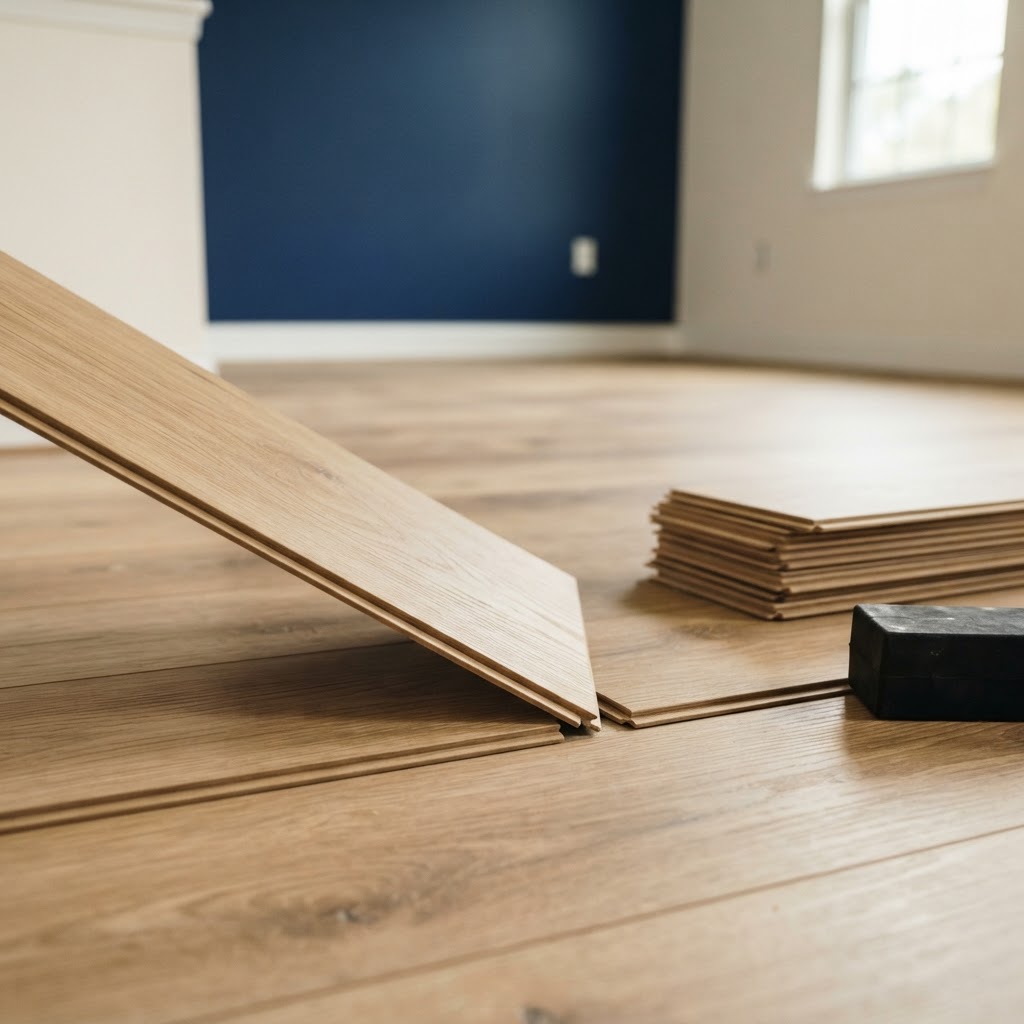
Click lock luxury vinyl plank, often shortened to click LVP, is the most common type of vinyl plank sold today. Each plank has a tongue and groove profile that snaps together with the neighboring planks, so the floor is held together by its own edges rather than by glue across the whole surface. It is popular in Northern Virginia townhomes, condos and single-family houses because it looks like wood, handles daily life well and can be installed over many existing floors when the conditions are right.
This guide from Floors and Beyond VA explains how click lock LVP works, where it performs best, what the subfloor needs to look like, how installation actually goes, and the mistakes we see most often in homes across Fairfax, Arlington, Loudoun and Prince William counties. If you would rather start with the products, our LVP flooring page covers what we install.
What click lock means
A click lock floor is a floating floor. The planks connect to one another, and the assembled floor rests on the subfloor without being fastened to it. The planks have a profile along the long edge and the short edge. One plank is angled into the next and pressed down until the edges lock, or in some products it is tapped into place with a block.
Because the floor floats, it can expand and contract slightly with temperature as a single unit. Installers leave a small gap around the perimeter, hidden under baseboards and trim, to allow this movement. That gap is one of the most important details in the installation, and we return to it below.
Click lock is different from glue-down vinyl plank, where each plank is adhered to the subfloor, and from loose lay products that rely on friction. Each system has its place. Click lock is the one most homeowners meet first, and for many homes it is the right choice. If you want the broader background on the material itself, see our guide to what LVP flooring is.
Why click lock is so popular
There are several reasons homeowners choose click lock LVP.
It is water-resistant. The planks themselves are not damaged by spills, pet accidents or a wet mop. That makes click lock a good fit for kitchens, entries, mudrooms, basements and bathrooms. Water-resistant is not the same as waterproof for the whole installation, because water can still get through seams at the edges or under the floor if it pools for long enough. Fast cleanup is still the best policy.
It looks like wood. Modern planks have realistic grain, texture and color variation. Many have embossed surfaces that line up with the printed pattern, which makes the floor look much less uniform than early vinyl did.
It is comfortable to live with. Compared with tile or stone, vinyl plank is softer underfoot and quieter, especially when it has an attached underlayment pad.
It is relatively quick to install. A floating floor does not need adhesive spread across the room or long cure times. In many homes, rooms can be completed in a day or two and used soon after.
It handles daily wear. A good wear layer resists scuffs and scratches from household traffic. Pets with long nails can still leave marks over time, and heavy furniture dragged across the floor can damage any surface.
It can go over many existing floors when they are properly prepared. This can reduce demolition in some homes, although it is not a universal shortcut.
Where click lock LVP works best
Townhomes and condos. Many Northern Virginia townhomes have open main levels, with kitchen, dining and living areas flowing together. Click lock gives a continuous look across those spaces. In condos, the sound-reducing underlayment matters, and you should always check association requirements about acoustic ratings before choosing a product.
Basements. Finished basements are common in the region, and many sit on concrete slabs that can feel cold and damp. Click lock vinyl is a popular choice here because the planks are not damaged by moisture in the way solid wood can be. The slab still needs to be tested and prepared, and we cover that later.
Kitchens and entries. These areas see spills, boots and busy foot traffic. The water-resistant surface and the wear layer make click lock a practical choice.
Rental and resale properties. Because the floor installs quickly and wears evenly, it is a common choice when a property needs to be updated between occupants.
Where it may not be the best choice
Click lock is not right for every space. It is worth being honest about the limits.
Very large rooms with direct sunlight. Vinyl can expand when it heats up. In rooms with large south-facing windows or glass doors, sunlight can warm the floor surface significantly, and some floors have limits on the size of the open area before expansion breaks are needed. Check the manufacturer's installation instructions for the maximum run length and for sun exposure.
Floors with significant movement or damage. A floating floor does not fix an uneven or unstable subfloor. If the structure underneath is bouncing, sagging or badly out of level, it needs to be corrected first.
Homes where hardwood is the goal. If you love the feel and the long-term refinishing potential of real wood, vinyl will not replace it. Our post on hardwood versus LVP in Northern Virginia walks through that decision.
The subfloor: the part you do not see
The most common reason a click lock floor fails is not the plank. It is the surface under it. Because the planks lock into each other, any dip, hump or debris beneath can stress the joints. Over time that can lead to separated seams, peaking, where the edges lift into a ridge, or a clicking or creaking sound underfoot.
Flatness. Most manufacturers specify how flat the subfloor must be, commonly expressed as a small variation over a span of several feet. High spots are ground or sanded down. Low spots are filled with an appropriate patching or leveling compound. Ask your installer how they check flatness and what they do about low areas.
Cleanliness. Old adhesive, paint, drywall compound and debris must be removed. A single hard bump under a plank can create a visible ridge or a hollow spot.
Dryness. Concrete slabs, in particular, should be tested for moisture before installation. Basements in Northern Virginia can see seasonal moisture, and a slab that looks dry on the surface can still release vapor. A moisture barrier or a different approach may be needed.
Soundness. Loose plywood, squeaky boards or damaged areas should be secured or replaced. A floating floor will not hide a subfloor that moves.
Existing flooring. Click lock can sometimes be installed over existing vinyl, tile or hardwood, but it depends on the condition and the manufacturer's rules. Heavily textured tile, for example, can telegraph through the planks unless it is filled or leveled. Carpet always comes out.
Many homeowners focus on choosing a color and forget that preparation decides how the floor will look and perform in five years. That is why our team treats subfloor evaluation as the first step of every LVP project. For more on why the layers under a floor matter, read our post on why underlayment matters more than the floor.
Underlayment: attached pads and separate layers
Many click lock planks come with an underlayment pad attached to the back. This pad adds a little cushion, reduces sound and can help smooth tiny imperfections. In other cases, a separate underlayment is installed first.
The rule to remember is not to double up. If your planks already have an attached pad, adding another pad on top of the subfloor can make the floor too soft and put stress on the locking edges. Always follow the manufacturer's instructions about what is allowed. In condominiums, your association may require a specific sound rating, and your installer should confirm which product meets it.
How a click lock installation goes
Understanding the process makes it easier to judge whether the work is being done well.
First, the planks are acclimated. The boxes are brought into the home and allowed to adjust to the room's temperature, usually for a period specified by the manufacturer. The home should be kept at normal living temperatures during this time and afterwards.
Second, the subfloor is prepared. Old flooring is removed if needed, the surface is cleaned, high spots are leveled, low spots are filled and moisture is addressed.
Third, the layout is planned. A good installer plans the starting wall and the direction of the planks so that the last row is not a sliver. They also plan how the floor will meet doorways, stairs, vents and other flooring.
Fourth, the planks are installed row by row. Seams are staggered so that end joints do not line up in neighboring rows, and planks from several boxes are mixed to blend color and pattern. The installer leaves an expansion gap around the perimeter and around fixed objects such as pipes, kitchen cabinets that are already installed and fireplace hearths.
Fifth, the details are finished. Baseboards or quarter round are installed to cover the expansion gap, and transitions are fitted at doorways and where the floor meets other surfaces. Finally, the floor is cleaned and inspected.
Thinking about your own floors? Floors and Beyond VA offers in-home estimates across Northern Virginia. Schedule yours or call (703) 906-5698.
Expansion gaps and why they matter
Because a floating floor moves slightly with temperature, it needs room to do so. If planks are pushed tight against walls, cabinets or door frames, the floor can buckle or peak when it expands. The gap is usually hidden under baseboards, so you will not see it in a finished floor, but it is one of the first things we check when we inspect a floor that has problems.
Heavy items such as kitchen islands and built-in cabinets should not be installed on top of a floating floor in a way that pins it down. They should be installed first, with the floor run up to them and a gap left, or the floor should be installed in a way that allows movement as recommended by the manufacturer.
Northern Virginia sees large seasonal swings, from humid summers to dry winters, and homes with large windows can have significant temperature differences from room to room. A well-installed floor allows for that movement, which is how Floors and Beyond VA plans every floating floor.
Stairs, transitions and practical details
Click lock planks are made for floors, and stairs need special treatment. Stair noses and risers are available for many product lines, and installing vinyl on stairs is more detailed work than flat floor. If your project includes stairs, ask how they will be handled and whether the stair parts match the planks. We walk through the specifics in our NoVA Guide post on LVP on townhouse stairs and landings.
Transitions between rooms and between different flooring types should be planned in advance. T-moldings, reducers and thresholds should be chosen so the floor can move and so there is no tripping hazard.
Cabinets and appliances. In kitchens, installers must decide whether the floor runs under or up to cabinets. Floating floors are generally installed up to the cabinets, not under them, so that the floor can move. Appliances that are heavy can sit on the floor, but you should follow the manufacturer's guidance.
Thresholds at exterior doors. Doorways to patios and decks should be sealed and detailed so water does not run under the floor.
Choosing a click lock product
When comparing products, look at the details that matter in daily life rather than only the photo on the box.
Wear layer. This is the clear protective top surface. A thicker wear layer generally resists scratches and wear better. Households with pets, children or heavy traffic benefit from a stronger wear layer.
Core. Click lock planks have a core that gives them rigidity. Cores vary by product. Ask your installer what the core is made of and how that affects stability, sound and how well it handles temperature changes.
Thickness. Thicker planks are generally more stable and can bridge small imperfections better, though they are not a substitute for proper preparation.
Attached pad. Decide whether you want a pad attached and check that it meets any condo rules.
Warranty terms. Read what is covered and what is required to keep the warranty valid, such as subfloor requirements, humidity ranges and approved cleaning methods.
Color and pattern variation. Look at several planks, not only one. Variation makes the floor look more natural, and a floor with only a few repeated patterns can look artificial.
Caring for a click lock floor
Click lock floors are easy to care for. Sweep or vacuum with a soft attachment, and avoid beater bars that can scratch. Clean with a product approved by the manufacturer, and avoid harsh abrasives or wax. Wipe up spills promptly, even if the planks are water-resistant. Use felt pads under furniture, and lift rather than drag heavy pieces. Place mats at the entry to catch grit and keep sunlight from fading or overheating large areas with window treatments if needed.
If a plank is damaged, individual planks can sometimes be replaced, depending on how the floor is installed and whether you kept spare planks. We recommend that homeowners keep a few extra boxes of the same lot, because colors can vary between production runs.
Common mistakes we see
Skipping subfloor preparation. A floor installed over bumps or debris will show problems later.
Ignoring moisture. Concrete slabs and crawlspaces must be evaluated, and the right barrier chosen when needed.
Pinning the floor down. Fastening trim to the floor, installing heavy cabinets on top of it or leaving no expansion gap can cause buckling.
Doubling the underlayment. An extra pad under planks that already have one can weaken the joints.
Mixing boxes poorly. Planks from different lots can differ slightly in color. Mixing them as you install blends the variation.
Hiring on the quote alone without comparing scope. Two estimates can include very different amounts of preparation and trim work. Compare what is included before choosing.
Choosing a product only by photo. Look at physical samples in your own lighting.
Click lock LVP in Northern Virginia homes
Our region has housing from every era, and each type presents its own conditions. In a 1990s townhome in Centreville or Ashburn, the subfloor is often plywood over joists and fairly flat, so the work is straightforward. In an older Arlington or Alexandria house, floors may be out of level after decades of settling, and old layers may need to be removed. In basements across Fairfax and Prince William counties, slab moisture and floor flatness often require careful evaluation. In condos around Tysons and Reston, acoustic requirements and building rules shape the product choice.
Floors and Beyond VA has been family-owned since 1987, and our own crews install the floors we sell. We evaluate the subfloor, explain what we see and recommend an approach that suits the home. If you are comparing options in Fairfax, you can learn more about our LVP flooring in Fairfax, VA.
Choosing between products for a townhome? Our NoVA Guide answer to is click-lock LVP good for a townhome covers the subfloor, stair and association checks we do first.
Frequently asked questions
Is click lock LVP waterproof?
The planks are water-resistant, and many are described as waterproof, but the installation as a whole can still be affected if water sits at the seams or under the floor. Clean spills quickly and keep the edges protected.
Can click lock LVP be installed over existing floors?
Sometimes. The existing floor must be flat, sound, clean and dry, and the manufacturer must allow it. We evaluate every case in person.
Does click lock LVP need glue?
No. Planks lock to each other. Some products use adhesive at transitions or on stairs, as the manufacturer directs.
How long does installation take?
It depends on the size of the area and the preparation needed. Many rooms are completed in a day or two, and larger projects take longer.
Can it go in a basement?
Yes, in many cases, after the slab has been tested and prepared properly.
Will it dent?
Heavy point loads, such as furniture legs without pads, can dent vinyl. Use pads and avoid dragging.
Is it better than hardwood?
They serve different needs. Vinyl is water-resistant and easy to maintain, and hardwood can be refinished and has a traditional look. Our hardwood versus LVP in Northern Virginia guide helps you compare.
Talk to Floors and Beyond VA
If you are considering click lock LVP for your home, we would be glad to inspect the space, talk through the options and explain what the installation will involve. Floors and Beyond VA serves homeowners across Northern Virginia.
Schedule an in-home estimate at floorsandbeyondva.com/Contact or call (703) 906-5698. If you are in Fairfax, start with LVP flooring in Fairfax, VA, and for more about how we work, read about our team as a flooring company in Fairfax.




