
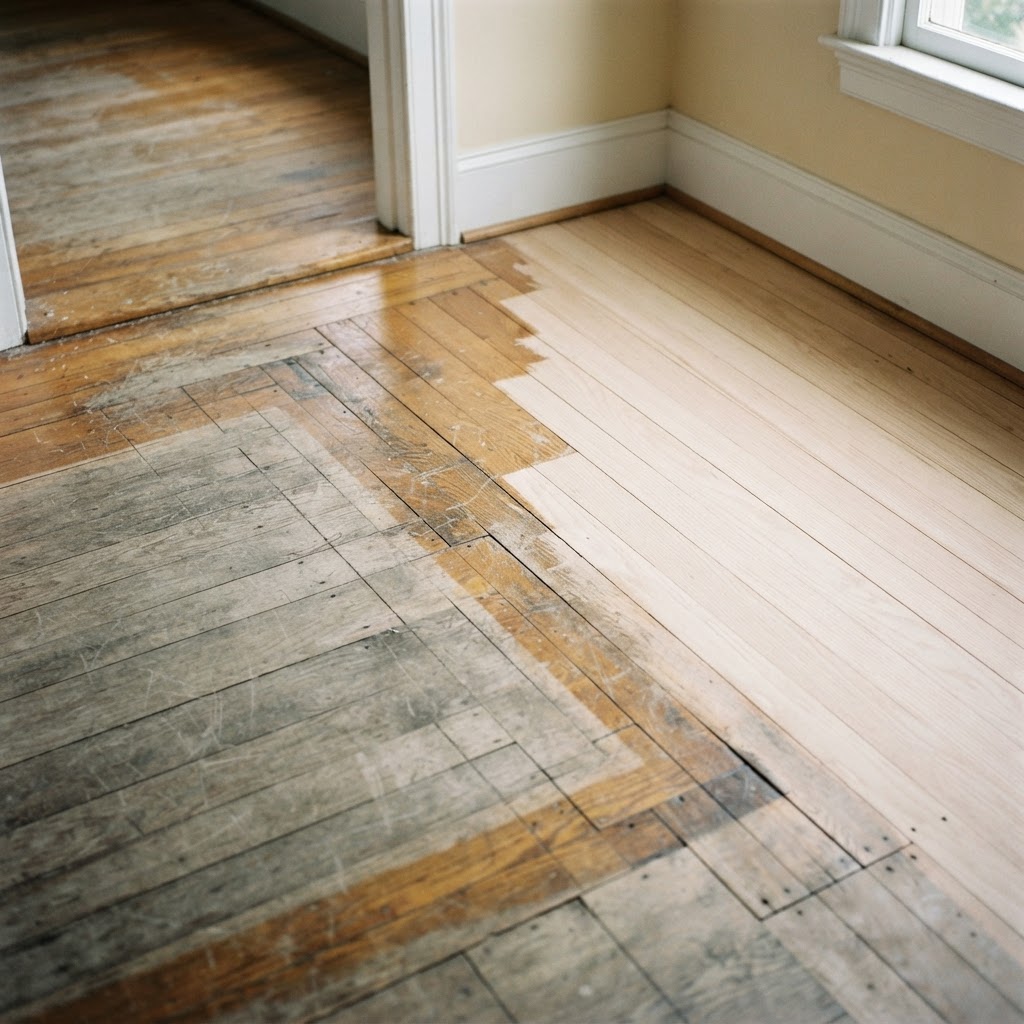
Most homeowners who search for wood floor restoration are standing over a floor that looks worse than they hoped. It might be gray and dull near the door, scratched by years of dogs and furniture, patched by a previous owner or hidden under carpet that finally has to go. The question underneath is simple: is this floor worth saving, or should it be replaced?
The answer is yes more often than people expect, but not always, and the difference comes down to how much good wood is left and what is wrong with it. This guide from Floors and Beyond VA focuses on that decision. It explains what wood floor restoration is, how to tell whether your floor is a candidate, which problems are fixable and which are not, how the process unfolds in practice and what homeowners in Manassas, Prince William County and across Northern Virginia should expect from older and newer homes. If you want the service overview first, see our floor restoration page.
What wood floor restoration means
Restoration is the process of bringing a worn or damaged wood floor back to a sound, attractive condition. It is broader than simply refinishing the surface. A restoration may include repairing or replacing damaged boards, securing loose ones, filling gaps, treating stains, removing old coatings, sanding the whole floor and applying new stain and finish so the repaired areas blend with the rest. A floor that only needs a fresh protective coat is a refinishing job. A floor with real damage, age or neglect is a restoration job.
You will often hear the two words used interchangeably, and some contractors use restoration as a marketing term for any refinishing work. What matters is not the label but the scope: what will actually be done to your floor, in what order, and what results can honestly be expected. If you want a step-by-step breakdown, our guide to what floor restoration includes goes through each stage in detail. This post focuses on a different question, which is whether to restore at all. There is also a short explanation of the distinction in our NoVA Guide answer to what wood floor restoration is and how it differs from refinishing.
Start with what you have
Before deciding anything, find out what the floor is made of. This sounds obvious, but many homeowners do not know whether they have solid hardwood, engineered hardwood, a laminate that looks like wood or something else. The answer changes everything.
- Solid hardwood is a single piece of wood from top to bottom, usually about three-quarters of an inch thick. It can often be sanded and refinished several times.
- Engineered hardwood has a real wood top layer over a layered core. Whether it can be restored depends on the thickness of that top layer. We explain how this works in our post on engineered hardwood floor refinishing.
- Laminate looks like wood but is a photographic layer over a composite board. It cannot be sanded or refinished, and it is not a candidate for restoration.
- Softwood floors, such as pine or fir, are common in some older homes. They are softer and dent more easily, but they can often be restored with care.
The quickest ways to tell are to look at the edge of a floor register or vent, check a transition strip or pull up a corner of carpet in a closet. A solid board shows continuous wood from top to bottom. An engineered board shows layers. A laminate shows a thin printed top over a fiberboard core.
The five questions that decide it
Whether a floor is worth saving usually comes down to five questions.
How much wood is left?
Every sanding removes a thin layer. A floor that has been sanded many times may be down to the tongue and groove, leaving little margin. A floor that has been refinished only once or twice usually has plenty.
How deep is the damage?
Surface scratches, worn finish and light stains are usually fixable. Deep gouges, burns, and heavily soaked stains are harder. Rot and structural damage may be beyond restoration.
Is the structure sound?
Boards need to be firmly attached to a solid subfloor. Squeaks and loose boards can be fixed. A rotted or collapsing subfloor is a larger problem.
Is there an ongoing moisture problem?
Water damage that is still happening must be fixed before any restoration. If the source is resolved and the wood has dried and stabilized, many floors can be saved.
What do you want the room to look like?
Restoration returns a floor to a renewed version of itself, not to a different material or pattern. If you want a different look altogether, replacement may fit better.
A floor with plenty of wood, limited damage, sound structure and no active moisture is an excellent candidate. A floor that fails several of these tests may not be.
Signs your floor is a good candidate
Worth restoring
- The finish is worn but the wood underneath is sound. Gray patches near doors and in traffic paths are usually worn finish, not rot.
- Scratches and scuffs cover the surface but are not deeply carved.
- The floor has been under carpet for years. Floors under carpet are often better preserved than floors that were exposed, because carpet protected them. Tack strip holes and staples can be repaired.
- The boards are solid and tight, with only small gaps or minor squeaks.
- The color is outdated, such as an orange tone from an old finish, and you want to change it. A full sanding makes that possible.
- A previous owner covered the floor with paint, a rug, vinyl or an old coating. These are often removable.
- Stains are limited to a few spots, and the wood around them is intact.
Restoration may not fit
- Widespread black staining across the floor from long-term water or pet damage.
- Cupped, crowned or buckled boards that do not settle after the moisture is fixed.
- Rot, mold or insect damage in the wood or the subfloor.
- A floor that has been sanded so many times that the nails are close to the surface.
- Very thin engineered veneer that cannot be sanded.
- Laminate or another non-wood product.
- A floor with so many patches and mismatched boards that blending would be unrealistic.
In the cases on the right, partial replacement of damaged sections or a new floor may make more sense, and an honest contractor will say so. The goal is to match the solution to the real condition of the floor.
How restoration unfolds
While every project is different, most follow a similar arc.
- Assessment An in-person evaluation identifies the species, thickness, finish and damage, and a decision is made on scope.
- Preparation Furniture is moved, the room is protected, and baseboards or shoe molding are removed or protected.
- Repairs Loose boards are secured, nails are set, damaged boards are replaced and gaps and holes are addressed.
- Sanding The floor is sanded in stages with progressively finer abrasives, and edges and stairs are done with specialty tools.
- Stain, if used The floor is stained after sanding, with samples tested first.
- Finish Several coats of finish are applied with light abrading between coats and drying time for each.
- Curing and care Light foot traffic comes first, followed by furniture and finally rugs, with a clear care plan.
The repairs come before the sanding because the sanding is what blends the repaired areas into the surrounding floor. Skipping or rushing the repairs is the most common reason a restored floor looks patchy.
What restoration can deliver
When the floor is a good candidate, restoration can be remarkably effective. It can bring back the warmth and depth of aged wood, remove years of scratches and dullness, replace a failing finish with a modern protective one and make a mismatched floor look unified. It can also reveal character that was hidden under carpet or layers of old coating. Many homeowners find that the original floors in an older house are the best feature of the home once they are restored.
It cannot make a thin floor thick, remove every deep stain or erase every trace of age. Part of the appeal of an old floor is its history, and a good restoration respects that history instead of trying to erase it.
How long does it take?
The schedule depends on the size of the area, the amount of repair and the finish. A single room may take a few days, and a whole house with stairs takes longer. Drying time between coats is part of the schedule and cannot be rushed. Our post on how long it takes to refinish hardwood floors explains the timing in detail.
The option of partial restoration
Not every project needs to include the entire house. Some homeowners restore the main living areas and leave bedrooms for later. Others replace damaged sections and blend them in. Planning the project in stages is possible, but it is important to choose natural breaks, such as doorways, so that different areas do not look mismatched. A good contractor will help you plan the boundaries. Our overview of hardwood floor refinishing in Northern Virginia shows how these boundaries are chosen in local homes.
What to expect in Manassas and Prince William County homes
Manassas and the surrounding communities include historic homes near Old Town, mid-century houses and large areas of townhomes and single-family homes built in recent decades. Older houses may have original oak or pine floors that have been through many changes, including carpet, vinyl, painted floors and repeated refinishing. These homes often reward restoration with a dramatic change. Newer homes more often have builder-grade or engineered floors, where the question is usually whether the wear layer allows sanding and whether a screen and recoat will do the job.
Finished basements are common in the area, and wood floors on slabs are usually engineered products. Moisture matters there, and the same slab considerations we describe in our guide to moisture barriers for LVP flooring apply to wood on concrete.
Houses built before 1978 may involve lead-safe practices around painted surfaces during renovation. It is a good question to raise with any contractor in an older home.
Thinking about your own floors? Floors and Beyond VA offers in-home estimates across Northern Virginia. Schedule yours at [floorsandbeyondva.com/Contact](/contact) or call (703) 906-5698.
What a restored floor needs afterward
A restored floor is a renewed floor, and it benefits from a little attention to stay that way. Keep mats at the entrances to stop grit, put felt pads under furniture, and clean with a product made for hardwood finishes. Avoid steam cleaners and soaking wet mops. Keep indoor humidity in a moderate range through the seasons, because the repaired and replaced boards will move with the rest of the floor. Plan a maintenance coat before the finish wears through, which is far lighter than another full sanding and preserves the wood you just worked to save. These habits protect the investment of time and effort that restoration represents.
Hidden surprises and how they are handled
Old floors sometimes hold surprises. Pulling up carpet can reveal patched sections, mismatched boards, old pet stains, painted borders or evidence of a long-ago leak. Sanding can reveal nail heads that need setting, areas of thin wood or boards that were replaced with a different species. None of this is unusual in older homes, and a good contractor expects it. What matters is how it is handled. The crew should stop, show you what they found, explain the options and agree on any change to the scope in writing before continuing. A clear conversation at that point prevents misunderstandings and keeps the project on course.
How much character to keep
Restoration involves a choice about how perfect you want the floor to look. Some homeowners want a floor that looks nearly new. Others prefer to keep the signs of age, such as slight color variation, small marks and the patina of a century-old floor. Neither approach is wrong, but it helps to talk about it before the work starts. A floor sanded more aggressively to remove every mark loses more wood, while a lighter touch preserves wood and character. Tell your contractor which direction you prefer, and they will tailor the approach.
How to choose a restoration contractor
Restoration is a skill-based job. A few checks improve your odds.
- Confirm the Virginia license and ask for a certificate of insurance.
- Ask who will do the work, and whether they are employees or subcontractors.
- Ask to see photos of recent restoration projects, especially in homes like yours.
- Ask how they handle repairs and blending, and how they match stain.
- Ask what they do when they find hidden damage.
- Ask for the scope in writing, including rooms, repairs, approach, finish, coats and schedule.
Our guide to choosing a hardwood floor refinishing contractor covers these questions in more depth.
Do not skip the assessment
If you take only one thing from this guide, make it this: have the floor evaluated in person before you decide. Photos and descriptions rarely tell the full story. The contractor needs to see the wood in different light, check the edges, feel for movement and test the finish. The assessment is where honest advice begins, and it often reveals that the floor is in better shape than you feared.
How Floors and Beyond VA approaches restoration
Floors and Beyond VA is family-owned and has served Northern Virginia since 1987. Our crews are our own employees. We take a refinish-first approach, which means we try to preserve and renew the floors you have before suggesting replacement. We start with an in-person evaluation, explain what we see and give you a straight answer about whether your floor is worth saving. If it is, we put the scope in writing and do the work carefully. If it is not, we tell you that too.
OLD AND WIDE-PLANK FLOORS IN LEESBURG, MIDDLEBURG AND WESTERN LOUDOUN
Western Loudoun has some of the oldest houses in Northern Virginia: stone farmhouses, log additions, brick townhouses in Leesburg's historic district and renovated barns. Their floors are different from the suburban oak of newer neighborhoods. Wide pine, oak and chestnut boards, sometimes more than ten inches across, may run through rooms laid over rough-hewn joists. They have been sanded by hand scrapers, covered with paint and lifted for plumbing. Restoring them means working with irregular surfaces, sizeable gaps and a wide range of species, and it often means choosing a lighter touch than a modern refinish. Here is how we approach it.
Start with the cause of wear. Rugs, doors and traffic patterns tell the story of how the floor was used. Moisture from a basement or crawl space tells you what is moving the boards now.
Keep the character. Old floors have tool marks, patina and nail patterns. Many owners prefer a restoration that cleans and stabilizes the floor while leaving the age visible. A flat, uniform surface is not always the goal.
Match carefully when replacing. Missing or rotted sections should be replaced with reclaimed wood of the same species and width, not new stock. Reclaimed boards from barns, mills and demolished houses are the best match, and salvage sources in the region can often supply them.
Control moisture. Wide boards move with the seasons. A dehumidifier in a damp basement, a vapor barrier in a crawl space and steady indoor humidity reduce cupping and gaps.
Test before sanding. Old floors may have wax, paint or finishes that behave unpredictably. A test patch in a closet shows how the wood responds.
Use the right sanders. A drum sander can chatter on uneven wide boards. Many restorers use orbital sanders and scrapers for the first pass, then step through finer grits.
Consider a screen and recoat. If the wood is thin or the surface is sound, cleaning and recoating protects the floor without removing any wood.
THE FIVE-QUESTION TEST FOR AN OLD FLOOR
1. Is there enough wood left above the nails or tongues to sand? 2. Are the boards solid, or loose and rotted in places? 3. Is the subfloor sound and dry? 4. Are the stains and damage limited to certain areas? 5. Can missing sections be matched? If the answer is yes to most, the floor can usually be saved. If not, a partial replacement may be the better answer. An in-home look settles this faster than any article can.
WHAT TO EXPECT IN THE FINISHED FLOOR
A restored old floor should feel solid, look cared for and read as one surface. Some dents, nail heads and gaps will remain, and they belong to the floor's history. Patches should blend. Color should be even enough to look intentional. If a contractor promises a perfect factory surface on a century-old floor, that is a promise the wood cannot keep.
Old floors reward patience and a careful hand. If you have a historic or older floor in Leesburg, Middleburg, Purcellville or anywhere in Loudoun, Fairfax or Prince William County, Floors and Beyond VA can look at it and tell you honestly what can be saved. Schedule an in-home estimate at [floorsandbeyondva.com/Contact](/contact) or call (703) 906-5698.
Frequently asked questions
What is wood floor restoration?
It is the process of bringing a worn or damaged wood floor back to good condition, often including repairs, sanding, staining and finishing.
How do I know if my floor can be restored?
An in-person evaluation checks the type of wood, the thickness, the damage and the structure. Many floors can be saved.
Can floors under carpet be restored?
Often yes. They are frequently in good shape, though tack strip holes and staples need repair.
Can severely stained floors be saved?
Some stains sand out and some do not. Deep black stains may require replacing boards.
Is restoration the same as refinishing?
Refinishing is part of restoration. Restoration also includes repairs and blending.
Can engineered floors be restored?
It depends on the wear layer. Thin ones may only accept a screen and recoat.
Should I restore or replace?
If there is enough wood left and the structure is sound, restoration is usually worth considering. An honest evaluation helps you decide.
Talk to Floors and Beyond VA
If you are wondering whether your floors are worth saving, we would be glad to look at them. Floors and Beyond VA will evaluate the wood, tell you what is realistic and give you a written plan. As a flooring company in Manassas, we work across Prince William and Loudoun counties and the rest of Northern Virginia. Schedule an in-home estimate at [floorsandbeyondva.com/Contact](/contact) or call (703) 906-5698.
Have your floor looked at before you decide
An in-person evaluation tells you what photos cannot: how much wood is left, what the finish is doing and whether restoration will actually pay off.
See Floor Restoration in ManassasRead the short answer first: what is wood floor restoration, and how is it different from refinishing?




