
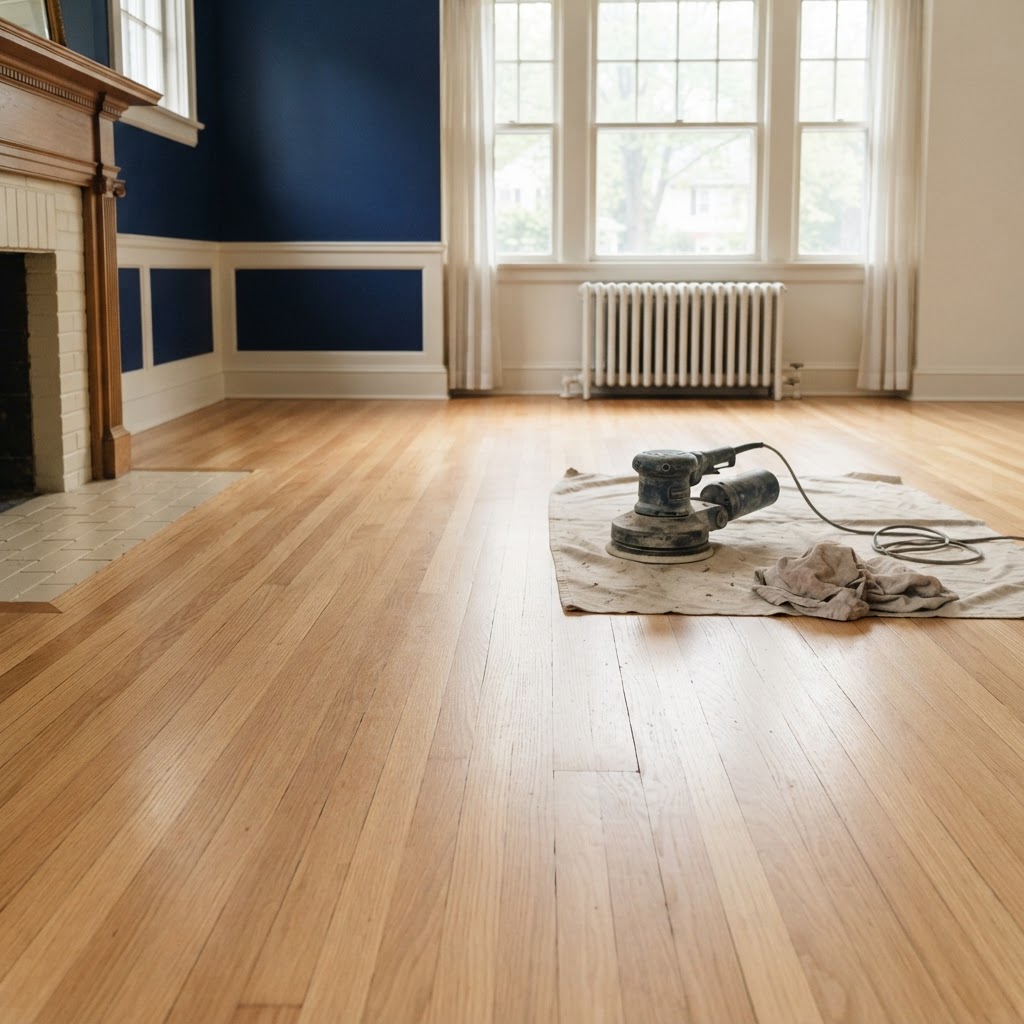
When a homeowner searches for floor restoration, the results mix together several different jobs: refinishing, repairing, deep cleaning, recoating and even full replacement. The word restoration sounds like a single service, but it covers a range of work, and the right amount depends entirely on the condition of the floor. This guide from Floors and Beyond VA explains what floor restoration includes, how it differs from refinishing, which steps happen in what order, what can and cannot be restored, and what to expect if you live in an older Arlington, Alexandria or Falls Church home with original wood floors.
Restoration versus refinishing
The two terms overlap, and contractors use them differently, so it helps to define them.
Refinishing generally means renewing the finish on a wood floor. That can be as light as cleaning and applying a fresh coat, or as thorough as sanding to bare wood, staining and applying new finish.
Restoration is the broader idea of bringing a floor back to good condition. It usually includes assessment and repairs in addition to refinishing. A restoration project might involve replacing damaged boards, securing loose ones, filling gaps, addressing stains, removing old coatings, and then refinishing the whole surface so the repaired areas blend in.
Put simply, refinishing is a part of restoration. A floor in good structural shape that only needs a new finish is a refinishing job. A floor with damage, history or neglect is a restoration job. Many homeowners do not know which they have until someone looks at the floor, which is why the first step matters so much.
Step one: assessment
Every sound restoration starts with an in-person assessment. The contractor identifies the species of wood, estimates how thick the boards are and how much wear layer remains, checks the condition of the finish and looks closely at damage. They look for water stains, pet stains, cupping, gaps, loose boards, squeaks, popped nails, burns, deep gouges and signs of previous repairs. They also ask about the history of the floor, such as how it was cleaned and whether wax or polish was used, because that affects which finish will bond.
The assessment determines the plan. It tells you whether the floor needs a gentle renewal or a major intervention, and whether anything about it will limit the result. For example, a floor that has already been sanded many times may not tolerate another full sanding. We discuss how the decision is made in our post on sandless hardwood floor refinishing.
Step two: preparation and protection
Before any work starts, the room is prepared. Furniture is moved or relocated, rugs are removed and the area is cleaned. Surrounding rooms, doorways, vents and fixtures are protected from dust and from damage. Baseboards and shoe molding are examined, and in some projects they are carefully removed and reinstalled, which allows the floor to be sanded closer to the wall.
If the house was built before 1978, lead-safe practices apply to certain kinds of renovation work on painted surfaces. This is a topic to raise with any contractor in an older home.
Step three: repairs
Repairs are what separate restoration from simple refinishing. They come before sanding because sanding blends repairs into the surrounding floor.
Securing loose boards and quieting squeaks. Boards that move can be fastened to the subfloor. Squeaks are often caused by boards rubbing on nails or on each other, and the right fix depends on access to the underside.
Setting nails and replacing damaged fasteners. Nail heads that sit high will tear sandpaper and leave marks.
Replacing damaged boards. Boards that are cracked, badly stained, burned or water damaged can be cut out and replaced with matching wood. Matching species, width and age is a skill, and new boards will take stain differently from old ones, which is part of why restoration is judged on the blending.
Filling gaps and holes. Narrow gaps between boards are normal with seasonal movement. Larger gaps can be filled with strips of wood or a flexible filler, depending on the situation. We explain why gaps appear in our post on why hardwood floors gap in winter.
Treating stains. Surface stains can sometimes be removed by sanding. Dark stains from water or pet urine may have penetrated deep into the wood. Some can be reduced and some cannot, and an honest contractor tells you before the work begins.
Repairing transitions and thresholds. Where the floor meets another surface, the edge may be worn or uneven and may need to be rebuilt.
Step four: sanding
Sanding removes the old finish and a thin layer of wood to leave a smooth, even surface. It is done in stages, beginning with coarser abrasives and moving to finer ones. Each pass removes the scratches from the pass before it. Edges, corners and stairs need specialty tools because the main machine cannot reach them.
The goal is to remove only what is necessary. A skilled operator keeps the machine moving, follows the grain and checks the floor often. Over-sanding can cause waves, divots and thin spots, and it removes wood that cannot be replaced. This is why an experienced crew matters as much as the equipment.
Dust control is part of the plan. Most professionals use machines connected to vacuum systems that capture much of the dust, though no system captures all of it.
Step five: staining or natural color
After sanding, the floor is bare wood. This is the moment when the color is chosen. Some homeowners prefer a natural look that shows the wood's own tone. Others choose a stain to deepen the color, to match another floor or to update the style. Different species take stain differently, and a sample in a hidden area is the best way to see what you will get.
The stain is applied evenly and allowed to dry. Because stain raises the grain slightly on some woods, an additional light abrasion may be done before finish.
Step six: finish
The finish protects the wood and determines the sheen. Common choices include water-based polyurethane, which dries faster and has lower odor, and oil-based polyurethane, which tends to add a warmer amber tone and takes longer to cure. There are other finish systems as well. Each has trade-offs in durability, appearance, odor and drying time, and your contractor should explain why they recommend one.
Usually two or three coats are applied with light abrading between them. Sheen can range from matte to semi-gloss. Matte and satin are popular because they hide minor wear and dust better than high gloss.
Step seven: curing and care
A finished floor is dry to the touch long before it is fully cured. Light foot traffic in socks is usually possible after a day or so, furniture should wait longer, and rugs longer still, because covering a floor too early can trap solvents and mark the finish. Your contractor should give you specific timing for the product they used. Afterward, you will want to know how to clean the floor, which products to avoid and when to schedule a maintenance coat.
What else can be part of restoration
Stairs. Treads, risers and handrails can be restored along with the floors. Stairs take more handwork and are often the part of a project that looks the most dramatic afterward.
Uncovering floors under carpet. Many older homes have original hardwood hiding under carpet. Pulling up a corner in a closet is the quickest way to find out. Floors under carpet are often in better shape than expected, though tack strip holes, staples and stains may need repair.
Parquet and patterned floors. Patterned floors need careful handling during sanding, because the grain runs in different directions.
Screen and recoat. When the wood is in good shape and only the finish has worn, restoration may be as simple as a lighter process.
Matching additions. Where a new room or doorway has been added, new wood may be blended with old.
Thinking about your own floors? Floors and Beyond VA offers in-home estimates across Northern Virginia. Schedule yours at floorsandbeyondva.com/Contact or call (703) 906-5698.
What restoration cannot do
Honesty about limits is part of good service. Restoration cannot make a floor thicker than it is. A floor that has been sanded to its limit cannot be sanded again safely. It cannot remove every stain, because some stains penetrate deep. It cannot always make old and new boards identical. And it cannot fix a structural problem in the subfloor or a moisture source without addressing the cause.
When a floor is beyond reasonable restoration, the better answer may be partial replacement of damaged sections, or replacement of the whole floor with new hardwood, engineered hardwood or luxury vinyl plank in rooms that see moisture. Our approach at Floors and Beyond VA is to restore what can be restored and to tell you clearly when something cannot be.
For the broader process, see our guide to hardwood floor refinishing in Northern Virginia.
Restoration versus replacement: how to decide
The decision between restoring and replacing usually comes down to three questions. First, how much wood is left above the nails or the tongue? A floor with plenty of thickness can be sanded again. Second, is the damage local or widespread? A few damaged boards can be replaced, while pervasive water damage may not be worth saving. Third, what do you want the room to look like? If you want a different material altogether, restoration is not the route. An honest evaluation covers all three and explains the trade-offs so that you can choose with confidence.
How long does restoration take?
The schedule depends on the amount of repair, the size of the area, the number of coats and the weather. A simple project in a single room may take a few days, and a whole-house project with repairs and stairs takes longer. Drying time between coats is part of the schedule and cannot be rushed. We explain the typical timeline in our post on how long refinishing takes. A written schedule from your contractor is the best way to plan.
What you can expect in older Northern Virginia homes
Arlington, Alexandria, Falls Church and parts of Fairfax County have many homes built from the early twentieth century through the middle of the century. Their floors are often thinner strip oak that has been refinished several times, and they may sit over older framing. Restoration there is a balancing act: preserving the wood that remains while getting the look the homeowner wants.
Some of these floors have lived under carpet or layers of paint for decades. Others have been waxed for years, which complicates refinishing. Many have gaps that open and close with the seasons. A contractor who has worked on older homes knows to expect surprises, such as patched areas, mismatched boards and nails of different eras, and to plan for them.
Condominiums and newer townhomes in the area are a different case. Floors there may be engineered hardwood or builder-grade solid oak, and associations may have rules about work hours and noise. The process is similar, but the planning is not.
Common myths about floor restoration
Myth: restoration always means sanding everything down. In fact, many floors need only cleaning and a fresh finish, and sanding removes wood that cannot be replaced. Myth: any stain can be removed. Surface marks usually sand out, but deep dark stains from water or pet accidents may remain visible. Myth: old floors cannot be saved. Many original floors under carpet or worn finish are excellent candidates. Myth: the new finish will make the floor look brand new. A restored floor looks renewed, but the character of an old floor, including its color variation and small marks, is part of what makes it worth keeping. Myth: one contractor's process is the same as another's. The assessment, the repair skill and the care taken at the edges vary widely.
How to prepare for a restoration assessment
You can help the evaluation go well with a few simple steps. Clear some of the floor so the contractor can see it. Note where problems are, such as squeaks, gaps, stains and soft spots. Gather any history you have, including past refinishing dates and the cleaning products you use. Check a closet corner or a vent opening to see the thickness of the boards if you can. Think about the look you want, whether that is a natural tone, a darker stain or a match to another floor. Come with questions. A thorough assessment at Floors and Beyond VA takes time, and the more you can tell us, the better the plan.
Stairs in more detail
Stairs are often the most visible part of a restoration and the most labor-intensive. Each tread and riser must be sanded by hand or with small tools, loose treads need securing, and worn edges need attention. Handrails and balusters may be cleaned or refinished to match. Because stairs take heavy wear, a durable finish is worth discussing, and some homeowners add stair runners afterward. Plan extra time and make sure the scope states clearly whether the stairs are included.
How Floors and Beyond VA approaches restoration
We have been family-owned since 1987, and our crews are our own employees. We take a refinish-first approach, especially in the older neighborhoods where original oak is a major part of a home's character. We start with an in-person evaluation, tell you what we find and recommend the lightest process that will give a good result. We put the scope in writing so you know what is included.
If you live in Arlington and are wondering about the floors in your home, you can learn more about our floor restoration services in Arlington, VA, and more about us as a flooring company in Arlington. We also work in Alexandria, Falls Church, Tysons, McLean and surrounding communities.
For the short version of this question, read the companion NoVA Guide entry: What does floor restoration include?
Frequently asked questions
Is restoration the same as refinishing?
Not exactly. Refinishing renews the finish. Restoration is broader and can include repairs, board replacement and stain treatment in addition to refinishing.
Do I need to replace my floors instead?
Often not. Most solid hardwood floors can be restored. Floors with severe water damage, rot or insufficient wood left may need partial or full replacement.
Can water-damaged floors be restored?
Sometimes. Mild damage may sand out. Cupped or blackened boards often need replacement. It depends on how deep the damage goes.
Can original floors under carpet be restored?
Frequently, yes. Check a closet corner or a transition to see the condition.
Will the repaired boards match?
A skilled contractor will blend them as closely as possible, and sanding and staining the entire floor helps. A perfect match is not always achievable, and you should be told that in advance.
How often should a floor be restored?
It depends on traffic and care. Regular cleaning and a maintenance recoat before the finish wears through can extend the time between major work.
Can I stay in my home during the work?
Usually, but the work areas are off limits and the project creates noise and dust.
Talk to Floors and Beyond VA
If you are not sure whether your floors need a refresh or a full restoration, we would be glad to look at them. Floors and Beyond VA will evaluate the wood, explain your options and give you a written plan. Schedule an in-home estimate at floorsandbeyondva.com/Contact or call (703) 906-5698.




