
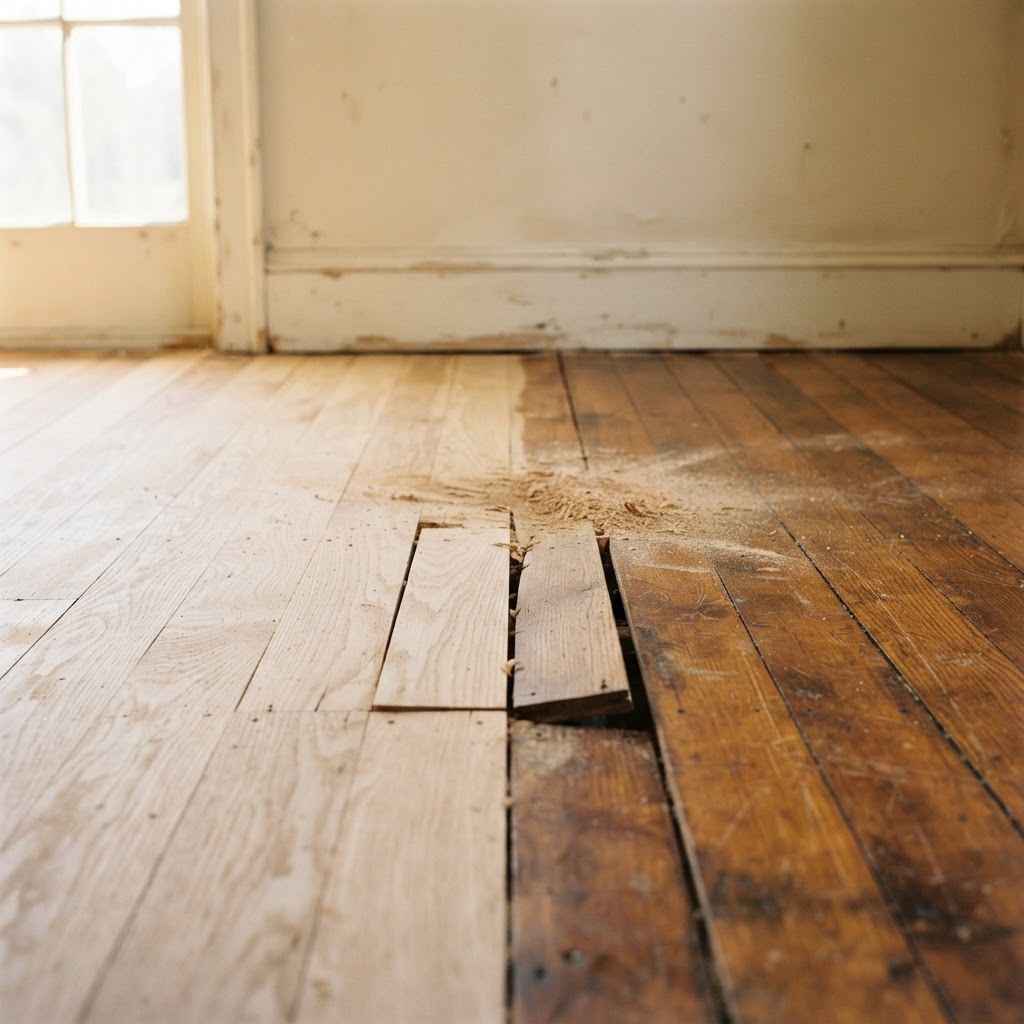
Wood floor restoration brings a worn or damaged floor back to sound condition, usually with repairs, sanding, staining and finish. Refinishing is one part of it and focuses on renewing the finish. Floors and Beyond VA evaluates each floor in person to tell you which one yours needs.
The two words get used interchangeably, which causes real confusion when you are comparing quotes. One contractor says refinish, another says restore, and the prices differ by thousands. They are not the same scope, and knowing the difference helps you judge whether the estimate in front of you actually covers what your floor needs.
How they differ
Refinishing renews the protective finish, from a light screen and recoat to a full sanding with new stain. Restoration is broader. It adds repairs such as securing loose boards, replacing damaged boards, filling gaps and treating stains, so the repaired areas blend into the finished floor. A sound floor with a tired finish is a refinishing job. A floor with damage, age or neglect is a restoration job.
| Refinishing | Restoration | |
|---|---|---|
| What it targets | The worn finish and surface | The floor as a whole structure and appearance |
| Repairs included | No | Yes: loose boards, damaged boards, gaps, stains |
| Sand depth | Light screen only, or a full sand | Staged sanding after repairs |
| Best for | A sound floor with a dull, scratched surface | A floor with damage, gaps, pet stains or decades of wear |
| Time on site | Shorter | Longer, because repairs come first |
| Cost | Lower | Higher, in line with the repair work |
In practice, restoration contains refinishing. If a contractor quotes refinishing on a floor that has cupped boards and a black pet stain, ask how those areas will be handled, because sanding alone will not fix them.
Is your floor worth restoring?
Five questions decide it: how much wood is left, how deep the damage is, whether the structure is sound, whether moisture is still a problem and what look you want. Floors with plenty of wood, limited damage and a sound structure are excellent candidates. Floors under old carpet are often better preserved than expected.
- How much wood is left? Sanding removes a thin layer each time. A floor already sanded down close to the nails or staples has little left to give.
- How deep is the damage? Surface scratches and dullness sand out. Deep gouges, burns and black stains may need boards replaced instead.
- Is the structure sound? Squeaks, soft spots and movement point to subfloor or joist issues that should be fixed before any finish goes down.
- Is moisture still a problem? Cupping that does not settle after the cause is corrected, or a damp basement, means the floor will move again after refinishing.
- What look do you want? A different stain color, a matte versus satin sheen, or a natural finish all influence the plan.
When restoration may not be the answer
Widespread black staining, cupped boards that do not settle, rot, a floor sanded close to the nails, thin engineered veneer and laminate are the usual reasons to repair in sections or replace. Laminate cannot be sanded or refinished at all. Engineered wood can sometimes be screened or lightly sanded, but only if the wear layer is thick enough, and a thin veneer will not survive a full sand.
The process
- Assessment. An in-person evaluation checks wood thickness, damage depth, structure, moisture and the look you want.
- Preparation. The area is sealed, vents are covered and furniture is protected.
- Repairs. Loose boards are secured, damaged boards replaced, gaps filled and stains treated so they blend after sanding.
- Staged sanding. Coarse to fine passes remove the old finish and level the surface.
- Optional stain. Color is applied and adjusted before the finish coats.
- Finish coats. Several coats build the protective layer, with light screening between coats.
- Cure and care. The floor cures for a period before heavy use, with clear care instructions for afterward.
Repairs come before sanding because sanding blends them in. A board replaced after the final pass will never match.
Northern Virginia specifics
Older homes in Arlington, Alexandria, Falls Church and Manassas often have original oak or pine that has been refinished, carpeted or painted over, and restoration can bring out their character. Newer homes and condos often have builder-grade or engineered floors, where wear layer thickness decides the options. In condominiums, the association's rules on noise and work hours shape the schedule as much as the floor does.
How Floors and Beyond VA approaches it
Floors and Beyond VA takes a refinish-first approach, which means we try to preserve and renew the floor you have before suggesting replacement. We begin with an in-person evaluation, explain what we see and put the scope in writing. If a floor is not worth saving, we tell you that plainly. At Floors and Beyond VA, our crews are our own employees.
We are family-owned and have served Northern Virginia since 1987. You can read the long version in our guide to wood floor restoration in Northern Virginia, and see what we do in Manassas on our floor restoration in Manassas, VA page.
Frequently asked questions
Can floors under carpet be restored?
Often yes, though tack strip holes and staples need repair.
Can deep stains be removed?
Some sand out. Deep black stains may need board replacement.
Can engineered floors be restored?
It depends on the wear layer thickness.
When to call a professional
If you are not sure whether your floor needs a refresh or a full restoration, have it evaluated before deciding. Floors and Beyond VA is family-owned and has served Northern Virginia since 1987. Schedule an in-home estimate at floorsandbeyondva.com/Contact or call (703) 906-5698.
Find out which one your floor needs
An evaluation tells you how much wood is left, what the damage really is and whether restoration will pay off, before you commit to either.
Floor Restoration in Manassas, VARead the full guide: wood floor restoration in Northern Virginia




