
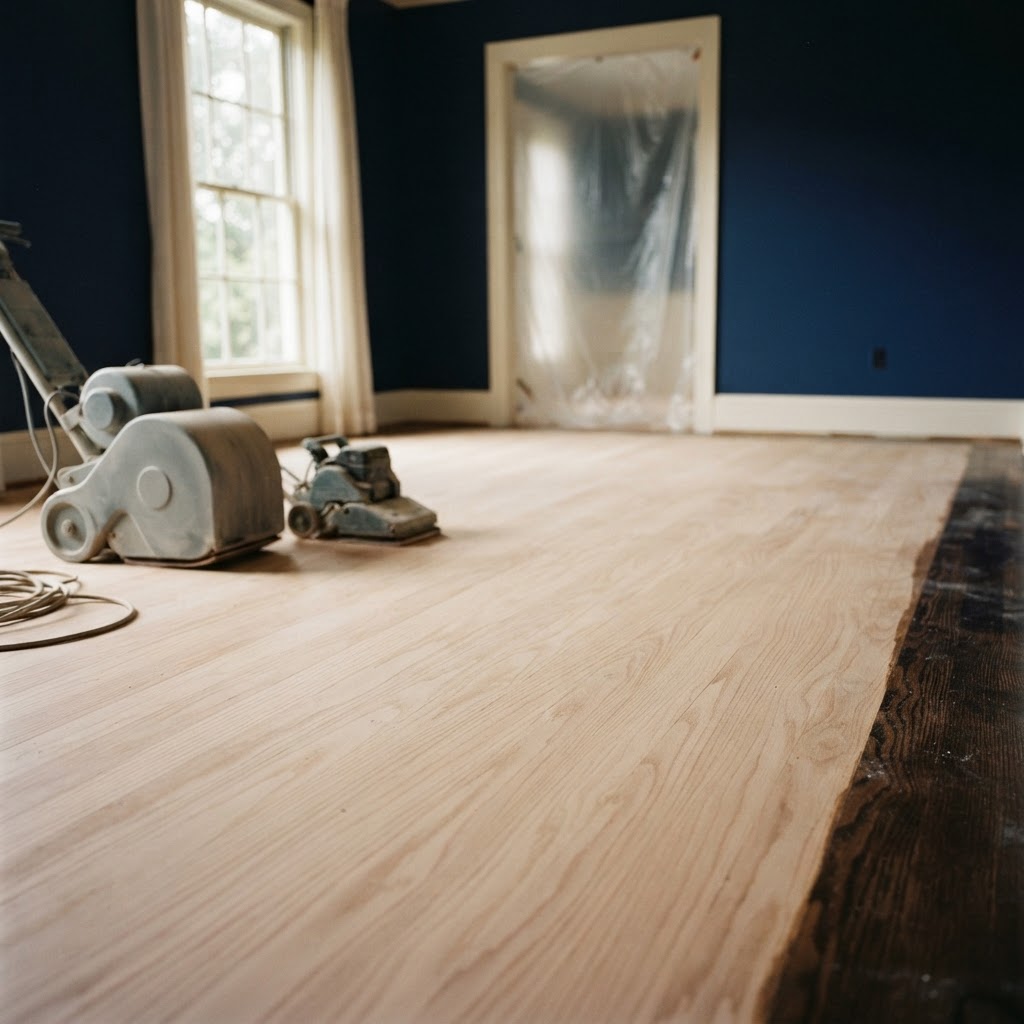
Refinishing a hardwood floor is one of the few home projects that can change the look of an entire house in a few days, and it is also one of the few that is very hard to undo if it is done badly. A sander that cuts too deep removes wood that cannot be put back. A finish that is applied over dust, or in the wrong conditions, can bubble, peel or turn cloudy. That is why the choice of contractor matters more than almost anything else about the job.
This guide from Floors and Beyond VA explains how to evaluate a hardwood floor refinishing contractor in Northern Virginia, what a good in-person assessment and written estimate should include, which questions reveal real experience, and which warning signs should make you walk away. If you already know you want the work done, our floor restoration services page is the place to start.
What a refinishing contractor actually does
Many homeowners assume refinishing is a simple matter of running a sander across the floor. In practice, a skilled contractor is making dozens of judgments before, during and after the work. For the full sequence from bare wood to final coat, see our guide to hardwood floor refinishing in Northern Virginia.
The first step is assessment. The contractor identifies the wood species and the thickness of the wear layer, checks for moisture, inspects the condition of the existing finish and looks for loose boards, popped nails, gaps and damage. This decides whether the floor needs a full sanding, a lighter screen and recoat, or repairs before any finish goes down.
The next step is preparation and repair. Loose boards are secured, nails are set, gaps and holes are filled or replaced, and the room is prepared. Furniture and fixtures are moved, and the surrounding areas are protected.
Sanding follows, usually in several passes with progressively finer abrasives. The first passes remove the old finish and level the surface. The final passes leave a smooth, even surface that will take stain evenly. Edges, corners and stairs are sanded with specialty tools, because the large machine cannot reach them.
If you want a new color, the stain is applied and allowed to dry. Then comes the finish, usually in two or three coats, with light abrading and cleaning between coats. The final stage is curing, cleanup and a walkthrough with the homeowner.
Each step requires judgment. A contractor who understands wood knows when to stop sanding to preserve the floor, how to match stain on a floor that has aged unevenly, and how to adjust for humidity and temperature in your home.
Start with the basics: license, insurance and experience
Before you compare estimates, confirm the fundamentals.
License. Virginia requires contractors to hold a license for work above a modest dollar threshold, and the Virginia Department of Professional and Occupational Regulation lets you look up a license and see its class and status. Ask for the license number and check it yourself. A company that cannot provide one, or that dodges the question, is telling you something.
Insurance. A contractor working in your home should carry general liability insurance and workers' compensation coverage for employees. Ask for a certificate of insurance. If someone is injured or something is damaged, you do not want the burden to land on your homeowner's policy.
Experience with your type of floor. Refinishing a modern three-quarter-inch red oak floor in a newer townhome is different from refinishing a century-old floor in an Arlington bungalow with thin boards, old nails and layers of wax. Ask how many floors like yours the contractor has worked on and ask to see photos of finished projects, ideally from nearby communities.
How long they have been in business. A company with decades in the area has weathered changing building codes, changing products and plenty of customer feedback. Floors and Beyond VA, for example, has been family-owned since 1987, and the owner has roughly four decades of experience in flooring. Longevity is not a guarantee of quality, but it does mean the company has a reputation to protect.
Who actually does the work
This is a question most homeowners forget to ask. Some flooring companies sell the job and then send subcontractors to do it. The person you met at the estimate may not be the person who sands your floors. That is not always bad, but it adds a layer of separation between the promise and the work.
At Floors and Beyond VA, our crews are our own employees. The people who evaluate your floors are the people who work in your home. That makes quality easier to control, and it makes someone directly accountable if there is a problem. Whatever company you hire, ask who will be on site, how long they have worked for the company and whether anyone from the company will oversee the work. We go deeper on this in our NoVA Guide post on choosing a hardwood floor contractor in Northern Virginia.
The in-person assessment
An estimate given over the phone or by email, sight unseen, is a guess. A trustworthy contractor will come to your home, walk the floors with you and take the time to look carefully. Here is what a good assessment includes.
The contractor looks at the floor in good light, preferably natural light, at different angles. They check for gray or black stains that suggest water damage, for worn-through finish, for deep scratches and gouges, and for separated or cupped boards.
They ask about the history of the floor, including previous refinishing, waxing and the products used for cleaning. This matters because wax and certain polishes can interfere with a new finish.
They measure the area, including closets, stairs and transitions, and ask what you want the result to look like. They explain the options for finish type and sheen, and for staining or leaving the natural color.
They check how thick the wear layer is, if possible, to confirm the floor can be sanded safely. This is especially important for engineered floors and for older floors that have been sanded many times already. Ask specifically about engineered boards, because a thin wear layer changes what is possible.
They explain honestly whether a full sanding is necessary or whether a lighter option such as a screen and recoat would work. In our post on sandless hardwood floor refinishing, we explain how that decision is made. A contractor who recommends the most extensive option for every floor may be selling a bigger job than you need.
What a good written estimate should include
A written estimate should be specific enough that you could hand it to another contractor and get a comparable quote. Look for these items.
- Scope of work, listing each room, hallway, closet and staircase that is included.
- The approach for each area, such as full sanding, screen and recoat, or repair first.
- The repairs included, such as securing loose boards, replacing damaged boards or filling gaps, and what happens if hidden damage is found.
- The stain color or the natural option, the type of finish, the brand or product line and the number of coats.
- The sheen, such as matte, satin or semi-gloss.
- Dust control methods, including whether the contractor uses sanders connected to vacuum systems and how they will protect the rest of the house.
- Furniture handling, including who moves what and whether items such as pianos and large appliances are included.
- The schedule, including start date, expected duration and cure times, with the understanding that weather and humidity can shift drying times.
- Payment terms, which should be reasonable and tied to the progress of the work.
- Warranty or guarantee on workmanship, with a clear description of what is covered and for how long.
- Cleanup and disposal, so you know what condition the house will be in at the end.
If an estimate leaves out these details, ask for them. If a contractor will not put the details in writing, that is a reason to keep looking.
Thinking about your own floors? Floors and Beyond VA offers in-home estimates across Northern Virginia. Schedule yours or call (703) 906-5698.
Understanding dust control
Sanding creates fine dust, and no system captures all of it. Many professionals now use sanders connected to dust-containment systems that capture most of the dust at the machine. These systems greatly reduce the mess, but they do not eliminate it, and edges, corners and stairs may still produce some dust.
Be cautious about promises of a completely dust-free job. A better question is how the contractor contains and cleans up dust, how the rest of the house is protected and what happens with return air vents and doorways. A contractor who gives you an honest answer is more trustworthy than one who promises perfection.
Homes built before 1978
If your house was built before 1978, painted surfaces in the home, including trim, doors and windows, may contain lead-based paint. Floor sanding itself is not the same as paint removal, but refinishing work often involves preparing baseboards, shoe molding and trim. Ask how the contractor handles lead-safe practices in older homes and whether the company follows the relevant federal rules for renovation work in pre-1978 housing. This is a quiet but important question for homeowners in older neighborhoods across Arlington, Alexandria and Falls Church.
Red flags to watch for
Some warning signs should make you pause.
- No license or insurance, or an unwillingness to show proof of either.
- An estimate without a visit, or a very quick walk-through with no inspection.
- A refusal to name the finish product, or vague answers about what will be used.
- Pressure to sign immediately or a deal that is only good today.
- A request for a very large payment up front, or a preference for cash with no paperwork.
- A promise to refinish a floor that is clearly too thin, damaged or heavily waxed without any caveats.
- A timeline that seems too short. Sanding, staining and multiple coats of finish need time to dry. A contractor who promises to finish and let you walk on the floor the same day should be asked to explain how.
- No photos of past work, no references and no online presence of any kind.
Questions that reveal real experience
You do not need to be an expert to hire a good contractor. A few direct questions are enough.
How many sanding passes will you do, and with what grits? A skilled contractor can explain the sequence and why it matters.
What will you do if you discover the floor is too thin to sand safely? There should be a plan, not a shrug.
How do you handle edges, corners and stairs? Stairs and edges are where amateurs show.
What finish will you use, and what are its advantages and trade-offs? A good answer covers durability, odor, drying time and appearance.
How do you protect the home from dust and from damage?
Can I speak with a recent customer, or see photos of recent jobs in my area?
What is the care plan after the job? You should know when you can walk on the floor, when furniture and rugs can go back and how to clean the floor.
What to expect during the project
Although the exact schedule depends on the size of the floor and the products used, most full refinishing projects follow a predictable rhythm. The first day or two involve preparation, repairs and sanding. Staining, if any, follows. The finish goes on in coats, with drying time between coats. Light foot traffic in socks is usually possible after the final coat has dried for a day or so, but furniture should wait longer and rugs longer still, because the finish keeps hardening for days or weeks. We give homeowners a written schedule so there are no surprises.
You will usually be able to stay in the home during the project, but the work areas will be unavailable and there will be noise, and odor depending on the products used. Pets and children should be kept away from the work area. If you are sensitive to odors, tell your contractor so that they can choose lower-odor products and ventilate carefully.
Condos and townhomes
Many Northern Virginia homes are condos or townhomes, and associations often have rules about work hours, noise, odor, elevator use and the protection of common areas. Before you schedule a refinish, check the rules and give your contractor any forms or certificates the association requires. A contractor who works in condominiums regularly will know what to ask for, and will plan the work to fit the building's rules.
Timing and the Northern Virginia climate
Humidity and temperature affect how finishes dry and how wood behaves. Refinishing during a stretch of very humid weather can slow drying and make curing less predictable. Very dry conditions can also stress the wood. A professional will monitor conditions in the home and adjust products and timing accordingly. If your home has experienced heavy seasonal movement, such as gaps in winter, it is better to address those issues before refinishing. We explain why gaps form in our post on why hardwood floors gap in winter.
How Floors and Beyond VA approaches refinishing
We take a refinish-first approach, especially in the pre-war neighborhoods where original oak floors are often the best part of a home. Whenever a floor can be preserved and renewed, we would rather do that than replace it. We start with an in-person evaluation. We tell you plainly whether a floor needs a full sanding, a lighter recoat or repairs first. Our crews, who are our own employees, handle the work from preparation to cleanup. And we stand behind the result.
If you live in Fairfax, Vienna, Oakton, Annandale or any of the surrounding communities, you can learn more about our floor restoration services in Fairfax, VA. We also serve homeowners across Arlington, Loudoun and Prince William counties.
Frequently asked questions
Should I get more than one estimate?
It is reasonable to get two or three. Compare scope and approach, not just the bottom line, because different estimates may not cover the same work.
How long does a full refinish take?
It depends on the size of the area, the number of coats and drying times. Most projects take several days. Your contractor should give you a schedule in writing.
Do I have to leave my home?
Usually not, but the work areas will be off limits, and you may prefer to keep children and pets elsewhere during the work.
Can any hardwood floor be refinished?
Most solid hardwood can be refinished several times. Engineered hardwood depends on the thickness of its top layer. Floors that are already very thin, or that have severe damage, may need repair or replacement instead.
Can I change the color?
Yes, with a full sanding, since new stain needs bare wood. A screen and recoat does not change color.
How soon can I put furniture and rugs back?
Furniture often goes back after a day or two, and rugs usually wait longer. Your contractor should give you specific times for the products used.
Talk to Floors and Beyond VA
If you are looking for a hardwood floor refinishing contractor in Northern Virginia, we would be glad to look at your floors and tell you what they need. Floors and Beyond VA will evaluate the floors in person, explain your options and give you a written plan.
Schedule an in-home estimate at floorsandbeyondva.com/Contact or call (703) 906-5698. If you are in Fairfax, start with floor restoration services in Fairfax, VA, and for more about how we work, read about our team as a flooring company in Fairfax.




