
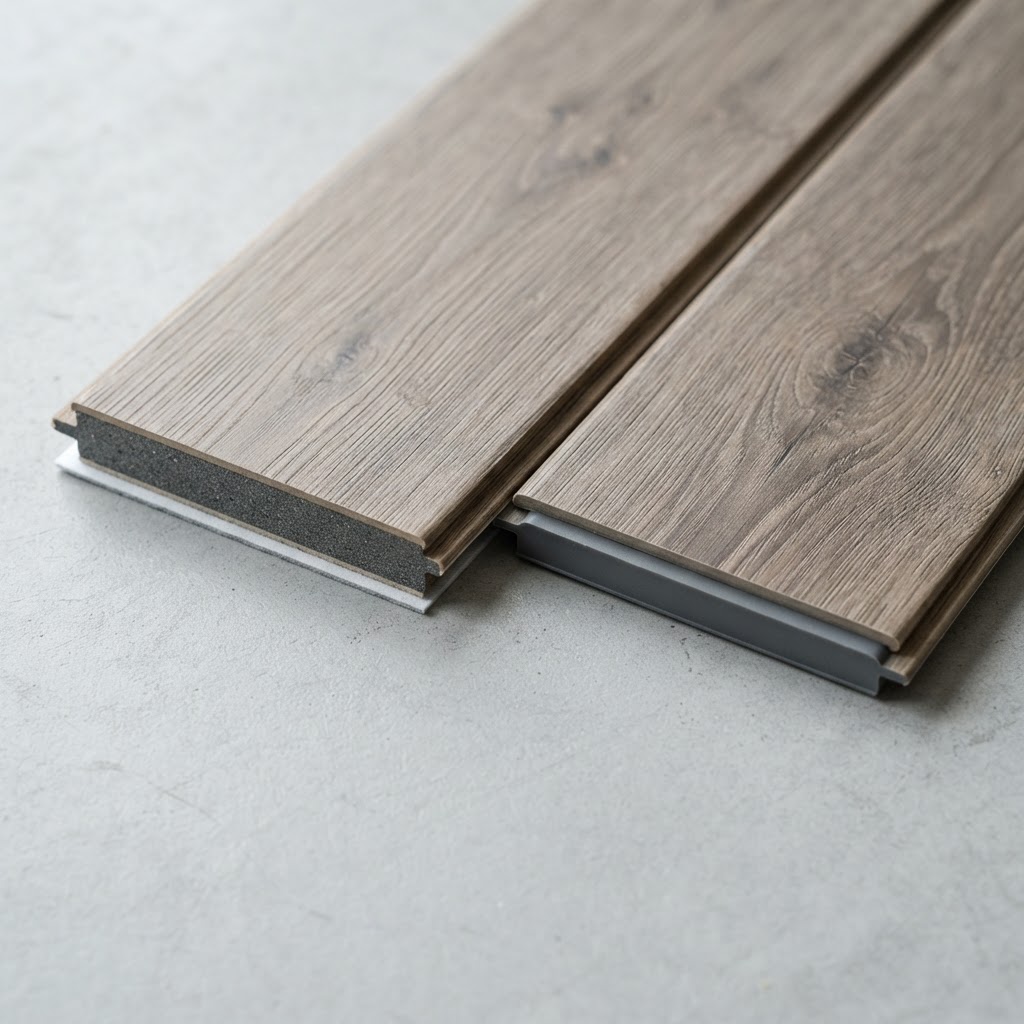
SPC and LVP are often presented as two competing products, but SPC is actually a type of luxury vinyl plank. LVP is the broad category of vinyl planks that look like wood. SPC, which stands for stone plastic composite or stone polymer composite, is a rigid-core version of LVP built around a dense, stone-powder core. Other LVP products use flexible cores or a different rigid core called WPC, for wood plastic composite. Homeowners in Leesburg, Ashburn, Reston and across Northern Virginia see all of these terms on samples and websites, and the labels can be confusing. This guide explains what SPC is, how it differs from other LVP, how the differences show up in a real home, where each type fits and what to ask before you buy. At Floors and Beyond VA, we install luxury vinyl plank in many forms, and we help homeowners choose by the room, not the label.
WHAT LVP MEANS
LVP stands for luxury vinyl plank. It is a plank-shaped vinyl floor with a printed wood-look layer under a clear wear layer. The category includes many constructions. Some planks are flexible and glue down to the subfloor. Others are flexible with click-lock edges. Others have rigid cores. All of them are LVP in the broad sense. If you are new to the topic, our guide on what LVP flooring is explains the basics, and our guide on how thick LVP flooring is explains the measurements.
WHAT SPC MEANS
SPC refers to the core. An SPC plank has a core made of limestone powder, polyvinyl chloride and stabilizers, pressed into a dense, rigid board. On top of that core sit the printed layer, the wear layer and often a coating. Underneath there may be an attached pad. The result is a thin, hard, stable plank. Because the core is so dense, SPC planks resist denting and indentation, and they tend to be thinner than other rigid-core types for the same stability.
WHAT WPC MEANS
WPC stands for wood plastic composite, though the name is slightly misleading since the core usually contains no actual wood. A WPC core is made from foamed PVC and other materials, which makes it thicker, softer and more cushioned than SPC. WPC planks feel warmer and quieter underfoot but are less resistant to dents from heavy objects. They are often thicker overall.
HOW SPC AND OTHER LVP COMPARE
Dent resistance. SPC is the most dent resistant, thanks to its dense core. Flexible LVP is the least, and WPC falls in between. If you have heavy furniture, appliances, high heels or pets, this matters.
Comfort. WPC and flexible LVP feel softer and warmer. SPC feels harder, although an attached pad or underlayment helps. For standing in a kitchen for long periods, comfort differences may matter to you.
Stability with temperature. Rigid cores resist expansion and contraction better than flexible ones, and SPC is the most stable of all. This helps in rooms with big windows, sunrooms and entries where temperatures swing.
Subfloor tolerance. Rigid planks span small imperfections better than flexible ones, but they are less forgiving of significant dips, because a rigid plank can flex at its click joints. Flexible planks follow the subfloor more closely but may telegraph imperfections. In every case, the subfloor should meet the manufacturer's flatness standard.
Sound. A softer core and an attached pad reduce impact sound. SPC can sound harder, particularly without a pad. In condos and multi-story homes, the underlayment and building requirements matter more than the core type. Our guide to underlayment for LVP flooring explains the choices.
Water resistance. Both SPC and WPC cores are generally waterproof in themselves. Water can still enter through seams, edges and the subfloor, so standing water should be cleaned up promptly.
Thickness. SPC planks are often thinner than WPC planks, and wear layer thickness is separate. Our guide on the 12 mil wear layer explains the difference.
Repair. Because rigid planks click together, a damaged plank may require releasing the surrounding planks or cutting out the damaged one. Glue-down flexible planks are cut out and replaced. Either way, keeping spare planks from the same production run helps.
WHERE SPC FITS BEST
SPC suits rooms with heavy furniture, high traffic and temperature swings. Kitchens, entryways, sunrooms, home offices and finished basements are good candidates. It is a popular choice for rental properties because of its durability. It also suits large open areas where stability matters, within the manufacturer's maximum run length. For concrete slabs, it works well once moisture testing has been done and the slab is flat.
WHERE OTHER LVP TYPES MAY FIT BETTER
WPC or thicker, softer rigid-core planks fit bedrooms, family rooms and other places where comfort and warmth matter. Flexible glue-down LVP suits large commercial-style spaces and areas where bonding to the subfloor is preferred. Our guide on glue down LVP flooring explains when bonding is the better choice. For stairs, the plank must be approved for stair use, and installation is glued or fastened. Our guide to LVP for stairs explains it. The right type depends on the room and the household.
TALK TO A SPECIALIST BEFORE YOU CHOOSE
Labels like SPC and WPC are marketing shorthand, and they do not tell you how a floor will perform in your house. The best way to choose is to see samples, feel them and discuss your rooms with someone who installs them. Floors and Beyond VA offers in-home estimates across Leesburg, Ashburn, Reston, Fairfax and the rest of Northern Virginia. Schedule an in-home estimate at floorsandbeyondva.com/Contact or call (703) 906-5698, and we will bring samples, check your subfloor and explain which type suits each room.
HOW TO COMPARE PRODUCTS FAIRLY
When you compare two planks, look at the same specifications. Ask for the core type, total thickness, wear layer in mil, whether padding is attached, the warranty terms, the installation method, the approved uses such as stairs or radiant heat, and the manufacturer's maximum run length for floating installation. Ask for full-size samples and look at them in your own light. Compare the edge profile, the texture and the way the pattern repeats. A product with better specifications on paper may not look better in your room, and a good-looking product with poor specifications may disappoint. Look at both.
THE ROLE OF THE ATTACHED PAD
Many rigid-core planks have an attached pad of foam or cork. The pad adds comfort and reduces sound, and it can help with minor subfloor imperfections. An attached pad is included in the manufacturer's design, and adding another underlayment on top can void the warranty. Some planks do not have a pad and require a separate underlayment, which may add moisture protection and sound reduction. The correct approach depends on the product. In condos, a documented sound-rated assembly may be required. Ask your installer how the pad fits the building's rules.
SPC, WPC AND RADIANT HEAT
Rigid-core planks are often chosen for homes with radiant heating because they are stable. Not all products are approved, and temperature limits apply. The system must be brought up and down gradually. Confirm approval with the manufacturer before ordering, and make sure the installer follows the instructions.
SUNLIGHT, TEMPERATURE AND MOVEMENT
All vinyl products respond to temperature, and strong direct sunlight can heat the surface. Rigid cores resist movement better, but they still need expansion gaps at the edges. Windows with strong sun may need curtains or film to protect floors and keep temperatures within the manufacturer's range. In very cold weather, floors can contract slightly. Following the installation instructions and keeping the home within the recommended temperature range keeps the floor stable.
LEESBURG, ASHBURN AND LOUDOUN COUNTY HOMES
Loudoun County has many newer homes with open main levels, large windows and finished basements on concrete. SPC is a popular choice for these spaces because of its stability and dent resistance. Open layouts raise the question of how far a floating floor can run before a break is required, and the manufacturer's limit applies. Large windows mean sun exposure. Basements call for moisture testing. Older homes in Leesburg's historic district and surrounding areas may have uneven subfloors that need attention before any rigid plank is laid. A site visit helps identify these conditions.
COMMON MISTAKES TO AVOID
Choosing by label alone. Ignoring the subfloor flatness requirement. Skipping the expansion gap. Doubling up underlayment on a plank with an attached pad. Assuming any plank is approved for stairs. Overlooking sound requirements in condos. Buying planks from different production runs without checking color. Ordering too little extra for cuts and repairs. Each of these can be avoided with a short conversation before you buy.
CARE AND MAINTENANCE
SPC and other LVP are easy to care for. Sweep or vacuum with a hard-floor setting, mop with a damp mop and a manufacturer-approved cleaner and wipe spills promptly. Avoid steam mops unless the manufacturer allows them, and avoid abrasive pads and wax. Use felt pads under furniture and wide casters on chairs. Our guide on how to clean LVP flooring explains the routine.
HOW FLOORS AND BEYOND VA APPROACHES THE CHOICE
Floors and Beyond VA starts with the room, the subfloor and the household. We bring samples of different constructions, explain the practical differences and recommend what suits each space. We follow the manufacturer's instructions for installation, prepare documents for condo associations when needed and use our own crews. If hardwood or restoration of your existing floor would serve you better, we say so.
SPC VS LVP IN A KITCHEN
Kitchens test a floor harder than almost any other room. There are dropped pans, spilled liquids, heavy appliances and long hours on your feet. SPC handles the first three well. Its dense core resists the point loads of a refrigerator or range, and the surface shrugs off most spills. Standing comfort is where a softer core or an attached pad gives some relief, and anti-fatigue mats near the sink and stove close the gap. If you plan to install under cabinets, ask your installer whether the floor will run under them or stop at the cabinet base. Floating floors need room to move, and boxing them in with cabinets can cause problems. Most installers run the plank up to the cabinets and leave the expansion gap hidden behind trim.
SPC VS LVP IN A BASEMENT
Basements on concrete are where rigid cores are most popular. A concrete slab can hold moisture, can be slightly uneven and can feel cold. A rigid plank with an attached pad bridges small flaws, does not absorb water and adds a thin layer of insulation. Before any vinyl goes down, the slab should be tested for moisture vapor and checked for flatness, and cracks or low spots should be repaired. Flexible glue-down LVP can also work on slabs, but the adhesive must be rated for the moisture level. If a basement has ever flooded, tell your installer, because that history affects the choice of product and the preparation.
SPC VS LVP IN A BEDROOM OR FAMILY ROOM
In rooms where you walk barefoot and spend long periods, comfort and warmth matter more than dent resistance. A thicker, softer rigid core or a plank with a good attached pad feels better underfoot. Sound matters too in upstairs rooms, where footsteps travel to the room below. In these spaces, the underlayment and the plank's sound rating deserve as much attention as the core type. Many homeowners are surprised how much the feel of a floor changes with the pad, so walk on samples with the pad attached if you can.
HOW THE PLANKS ARE JOINED
Rigid-core planks are almost always click-lock. The edges have a tongue and groove that snap together, either by angling the plank into place or by tapping it flat. The joint is part of what holds the floor together, so the quality of the locking profile matters. Poorly made profiles can separate over time, especially in rooms with heavy traffic or temperature swings. Flexible planks may be click-lock or glue down. Ask to see the joint profile on the sample, and ask how the manufacturer rates it. Our guide on click-lock LVP flooring explains how these joints work and what to look for.
WHAT THE WARRANTY TELLS YOU
Warranties are a useful comparison tool, but only if you read the conditions. Residential warranties on good rigid-core planks often run for decades, while commercial warranties are shorter. Conditions typically cover installation per the instructions, subfloor flatness, moisture limits, maintenance and approved cleaning products. A warranty can be voided by installing over the wrong subfloor, skipping the expansion gap or using the wrong underlayment. A professional installer who follows the instructions protects your warranty. Keep your paperwork, the production lot numbers and a few spare planks.
QUESTIONS TO ASK ANY RETAILER OR INSTALLER
Is this plank SPC, WPC or flexible, and what is the total thickness? What is the wear layer in mil? Is a pad attached, and is it approved for my building? What subfloor flatness does the manufacturer require? What is the maximum run length for floating installation? Is the product approved for stairs, radiant heat and basements? What is the warranty, and what voids it? How many extra planks should I order? Do your crews do this work, or do you subcontract? A clear answer to each question is a good sign. Vague answers are a reason to keep looking.
LIVING WITH THE FLOOR AFTER INSTALLATION
Once the floor is down, give it a day or two before moving heavy furniture back, and use felt pads under every leg. Keep the home at a steady temperature, because large swings strain any vinyl floor. Place mats at exterior doors to catch grit, which is the main thing that dulls a wear layer. If you notice a plank lifting or a gap opening at a joint, call your installer early, since small issues are easy to correct and larger ones are not. A rigid-core floor installed correctly should need very little attention beyond regular cleaning, and that low upkeep is a big part of why homeowners choose it.
FREQUENTLY ASKED QUESTIONS
Is SPC better than LVP? SPC is a type of LVP. It is more dent resistant and stable, while other types may feel softer and warmer. Better depends on the room.
Is SPC waterproof? The core is waterproof. The floor as a system depends on seams, edges and the subfloor.
Is SPC harder to install? Not usually, though the subfloor must meet the flatness standard and the plank must be handled according to the instructions.
Does SPC feel cold? It can feel cooler and harder than softer cores. An attached pad or underlayment helps.
Can SPC go over radiant heat? Some products are approved within temperature limits. Check the manufacturer's instructions.
Can SPC be used on stairs? Only if the product is approved for stairs and installed with the proper method.
Which is better for pets? Many owners choose SPC for dent resistance, but the wear layer and topcoat matter for scratches.
READY TO CHOOSE YOUR FLOOR?
If you are comparing SPC and other LVP for your Northern Virginia home, the best next step is to see samples in your own rooms. Floors and Beyond VA is a family-owned flooring company serving Fairfax, Loudoun, Prince William and Arlington counties since 1987. Schedule an in-home estimate at floorsandbeyondva.com/Contact or call (703) 906-5698.




