
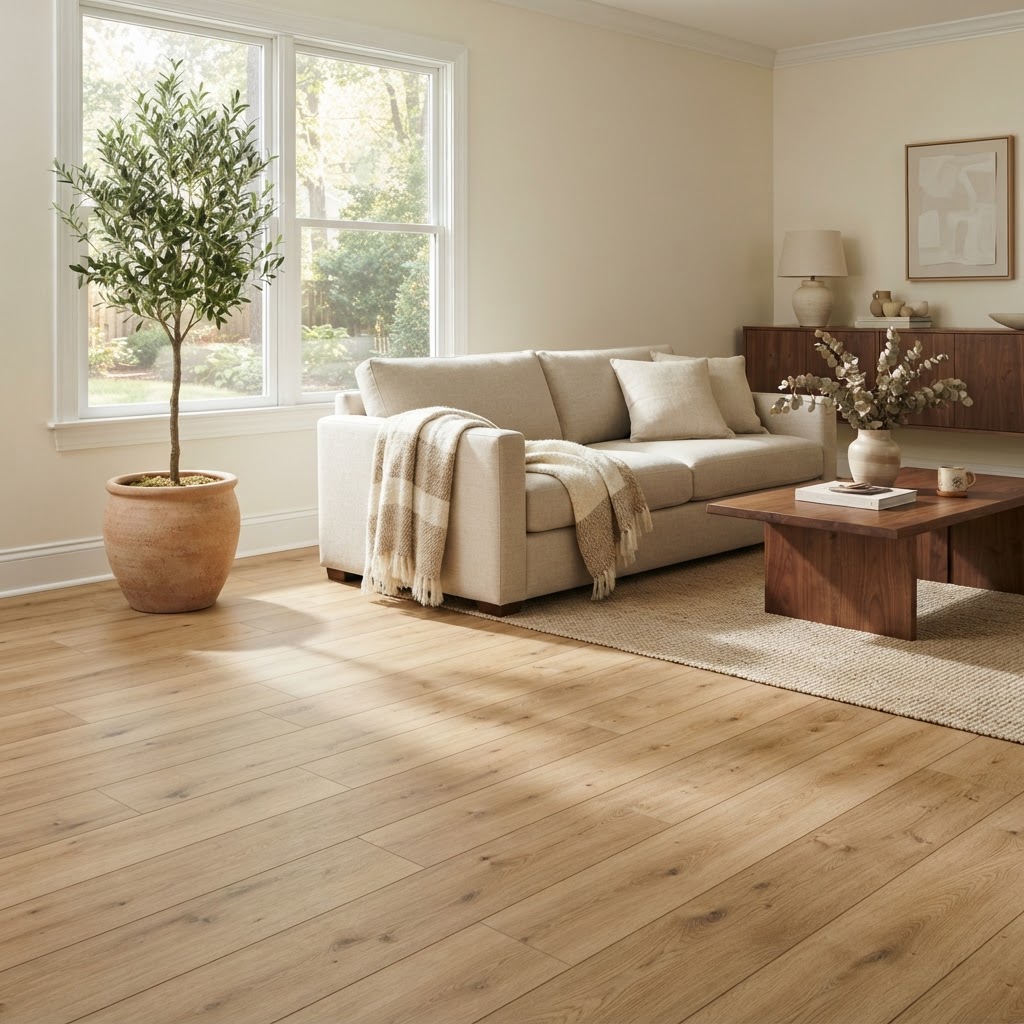
A 12 mil LVP flooring wear layer is a transparent protective coating about twelve thousandths of an inch thick that sits on top of the printed design of a luxury vinyl plank. It is a common choice for busy family homes because it offers a solid level of resistance to scratches, scuffs and everyday wear. The number can be confusing, since shoppers often see 6 mil, 8 mil, 12 mil, 20 mil and even higher figures, and many people assume that bigger is always better. This guide explains what a mil is, what the wear layer does, how different thicknesses compare, what else matters besides that one number and how to choose for your own home. At Floors and Beyond VA, we help Northern Virginia homeowners make this choice every week, and the answer depends on how the floor will be used.
WHAT A MIL IS
A mil is one thousandth of an inch. It is not a millimeter, which is a common mix-up. A 12 mil wear layer is therefore 0.012 inches thick, roughly the thickness of a few sheets of paper. When a plank is described as 12 mil, that number refers only to the clear wear layer on top, not to the total thickness of the plank. The overall plank might be 5 millimeters or 8 millimeters or more, and that is a separate measurement. Our guide on how thick LVP flooring is explains total thickness and why it matters for installation and comfort.
WHAT THE WEAR LAYER DOES
An LVP plank is built in layers. At the bottom is a backing. Above it is the core, which gives the plank its structure and can be flexible vinyl or a rigid composite. Above the core is a printed film that carries the wood or stone pattern. On top is the clear wear layer, and often a thin protective coating over that. The wear layer is what your shoes, pet nails, furniture legs and cleaning tools actually touch. It protects the printed film from abrasion, helps resist scratches and scuffs, and gives the floor its surface texture and sheen.
When the wear layer eventually wears through, the printed pattern beneath it is exposed and cannot be repaired by refinishing. That is the key difference between vinyl and hardwood. A hardwood floor can be sanded and refinished many times, while a vinyl plank cannot. Our guide to hardwood floor refinishing explains the contrast. For vinyl, the wear layer is the durability reserve, so the question is how much of it your floor needs.
THE COMMON THICKNESS TIERS
While the exact terminology varies by manufacturer, wear layers are generally grouped like this.
Around 6 mil. A thinner layer is often found in lighter-duty products and is typically intended for low-traffic spaces such as a guest bedroom or a rarely used room. It may show wear sooner in busy areas.
Around 8 to 12 mil. This is a common range for residential use. A 12 mil wear layer is a popular middle ground for living rooms, bedrooms, hallways, kitchens and family spaces with normal activity, including children and pets.
Around 20 mil and above. Thicker layers are generally intended for heavy traffic and commercial use, such as offices, retail spaces and busy entryways. Some homeowners choose them for very active households or high-wear areas.
These tiers are guidelines rather than rules. Different brands and product lines use different standards, and the wear layer is only one part of how a floor performs.
WHY 12 MIL IS SO COMMON IN HOMES
For most Northern Virginia households, a 12 mil wear layer lands in a sensible spot. It is thick enough to stand up to the normal wear of a family home, including shoes, play, pet nails and furniture movement, and it is widely available across many styles and colors, so you are not limited in design. A house in McLean or Vienna with two children and a dog, for example, will generally be well served by a quality 12 mil product in the main living areas, as long as the rest of the plank is well built.
WHY THE WEAR LAYER IS NOT THE WHOLE STORY
It is tempting to treat the mil number as a shorthand for quality, but a thick wear layer on a poorly made plank does not make a good floor. Several other factors matter.
The core. Rigid core products such as stone-plastic composite and wood-plastic composite planks resist denting and indentation better than flexible cores, and they hold their shape through changes in temperature. The core also affects how well the floor handles small imperfections in the subfloor.
The surface coating. Many planks have an additional protective coating over the wear layer, such as a ceramic-bead or urethane topcoat, which adds scratch and stain resistance and helps maintain the finish.
Total thickness. A thicker plank can feel more solid underfoot and bridge small subfloor imperfections, but it is a different measurement from the wear layer.
Attached padding. Some planks have an attached underlayment that adds comfort and reduces sound. Our guide to underlayment for LVP flooring explains when it is needed and when an attached pad is already included.
Construction quality. The manufacturer's reputation, the consistency of the printed film and the strength of the click-lock system matter.
The warranty. Residential and commercial warranties vary, and the details of what they cover, including wear-through, are worth reading.
HOW TO CHOOSE FOR YOUR HOME
Think about how each room is actually used.
Main living areas and kitchens. Families with children, pets and frequent guests do well with 12 mil or higher. These rooms see the most foot traffic and the most dragging of chairs.
Entryways and mudrooms. Grit and moisture from shoes make these the hardest-wearing rooms in a house. A thicker wear layer, a textured surface and good mats are all worth considering.
Bedrooms and low-traffic rooms. A somewhat thinner wear layer can be perfectly adequate when traffic is light, though many homeowners choose the same product throughout for a consistent look.
Homes with large dogs. Pet nails are tough on any hard surface. A thicker wear layer, a textured finish and trimmed nails help. Our guide on how to clean LVP flooring includes care tips that protect the surface.
Rental or investment properties. Higher turnover and more varied use may justify a thicker wear layer.
Stairs. Stairs concentrate wear, and the plank needs to be approved for stair use. Our guide to LVP flooring for stairs covers the specifics.
TALK TO A SPECIALIST ABOUT YOUR SPACE
Numbers on a box only tell part of the story, and the right product depends on the room, the subfloor and the way your household lives. Floors and Beyond VA offers in-home estimates throughout Northern Virginia, including McLean, Tysons, Vienna, Reston and Fairfax. We bring samples, look at your subfloor and talk through the options. Schedule an in-home estimate at floorsandbeyondva.com/Contact or call (703) 906-5698, and we will help you choose a floor that fits the way you live.
HOW TO READ A PRODUCT SPECIFICATION
When you compare products, look for the wear layer thickness in mil, the total plank thickness in millimeters, the core type, whether padding is attached, the residential and commercial warranty terms, the installation method, whether the product is approved for stairs, radiant heat or basements, and any certifications about indoor air quality. Different manufacturers present these in different places, and you may need to ask your installer to find them.
Be cautious when a product lists a thickness without saying what it refers to. A plank described as 8 mm may have a wear layer of 6 mil or 20 mil, and a plank with a 20 mil wear layer may be thin overall. Asking for both numbers avoids confusion.
WEAR LAYER AND INSTALLATION
The wear layer does not change how the floor is installed, but it should not be ignored in the planning. A thick-wear, rigid-core plank may be heavier and can need a closer eye on subfloor flatness, because the plank does not flex to follow dips the way a thinner product does. Floating click-lock floors need expansion gaps at the edges, while glue down planks are bonded to the subfloor. Our guides on click-lock LVP flooring and glue down LVP flooring compare the two methods.
For concrete slabs, moisture testing is important whatever the wear layer. Our guide to moisture barriers for LVP flooring explains why. And for any installation, the floor should be given time to adjust to the room before work begins. Our overview of how long flooring needs to acclimate covers the general idea.
MAINTAINING THE WEAR LAYER
Whatever thickness you choose, you can extend the life of the wear layer with a few simple habits. Use mats at entrances to catch grit. Put felt pads under furniture legs and use wide, soft casters on chairs. Sweep or vacuum with a hard-floor setting regularly, because grit acts like sandpaper. Clean with a manufacturer-approved cleaner and avoid abrasive pads, wax and harsh chemicals. Keep pet nails trimmed. Wipe up spills promptly. Protect floors from direct strong sunlight when possible, since long exposure can fade some products.
COMMON MISCONCEPTIONS
A thicker wear layer does not make a floor waterproof. Water resistance depends on the core, the seams and the installation. A thicker wear layer does not make a floor scratch-proof either, since no vinyl surface is immune to scratches. A thicker wear layer does not guarantee a longer warranty or a better look. And a very thin wear layer is not automatically a bad product, as long as it is matched to a space that does not need more.
HOW FLOORS AND BEYOND VA APPROACHES LVP SELECTION
Floors and Beyond VA does not push one wear layer for every home. We begin with the room, the household, the subfloor and the installation method, and then we show samples that fit. For a busy family space, we usually point toward a quality 12 mil or thicker product with a rigid core. For a quiet bedroom, we may suggest something lighter. If your project involves stairs, a basement slab or radiant heat, we check the product's approvals before recommending it. Our crews are our own employees, so the person who helps you choose is part of the team that installs.
WEAR LAYER AND THE ROOMS OF A TYPICAL MCLEAN OR TYSONS HOME
It helps to picture how a real house works. In a single-family home in McLean or Vienna, the main level often sees the most use, with the kitchen, the family room and the entry carrying most of the foot traffic. A 12 mil wear layer on a rigid core is a sensible fit there. Upstairs bedrooms see lighter traffic, and the same product works well for a consistent look. A finished basement used as a playroom or gym may deserve a closer look at the subfloor and moisture as much as the wear layer. In a Tysons condo, the main concerns often shift to sound and building approval, with the wear layer chosen to match the household and the pad chosen to match the building. Our guide to LVP flooring in Tysons condos covers that conversation.
QUESTIONS TO ASK WHEN YOU SHOP
When you look at samples, ask a few direct questions. What is the wear layer in mil, and what is the total thickness in millimeters? What kind of core does the plank have? Is there a topcoat over the wear layer, and what does it do? Is padding attached, and if so, what is its rating? What are the residential and commercial warranty terms, and do they cover wear-through? Is the plank approved for the installation method, stairs and any special conditions in your home? Can I see a full plank and a cut edge, so I can see the layers? A knowledgeable salesperson or installer can answer these easily, and if they cannot, that tells you something too.
KEEPING PERSPECTIVE
The wear layer is a useful number, but it should not be the only number you consider. A floor that is well installed over a properly prepared subfloor, cared for with the right cleaners and protected from grit will last longer than a thicker floor that is installed carelessly. The best result comes from choosing a quality product, matching it to the room and having it installed by people who follow the manufacturer's instructions from the first step to the last.
A QUICK RULE OF THUMB
If you are still unsure after reading all of this, a simple rule helps. For busy family areas, aim for a 12 mil wear layer or thicker on a rigid core with a quality topcoat. For lighter-use rooms, a somewhat thinner layer can be perfectly adequate. For commercial-style or very heavy use, look at 20 mil and above. Then confirm the product is approved for your installation method, and have the subfloor checked before you order. Those few steps prevent most of the disappointments people have with vinyl plank.
SEEING SAMPLES IN YOUR OWN LIGHT
Whatever wear layer you choose, look at samples in your own home before you decide. Natural and artificial light change how a plank looks, and the sheen of the surface can appear quite different in a bright Northern Virginia living room than it does under showroom lighting. Lay a full plank on the floor, step back and look at it at different times of day. It is a small step that helps you feel confident in the final choice.
THREE THICKNESS NUMBERS ON EVERY SAMPLE
Wear layer. Measured in mil, where one mil is one thousandth of an inch. This is the transparent layer above the printed wood pattern. It is what resists scuffs, scratches and traffic. Common residential grades run from 6 mil to 20 mil or more.
Total thickness. Measured in millimeters, from the top of the plank to the bottom of the core or pad. Common planks run from about 4 mm to 8 mm or more. It affects comfort, how the plank handles small subfloor flaws and how high the floor sits at doors and stairs.
Core type. Flexible vinyl, rigid SPC (stone plastic composite) or rigid WPC (wood plastic composite). The core determines dent resistance, stability and how the floor feels underfoot. Our guide on SPC vs LVP flooring compares the core types.
A plank can have a thick core and a thin wear layer, or the reverse. A 8 mm plank with a 6 mil wear layer will feel solid but scratch sooner than a 5 mm plank with a 20 mil wear layer. When you compare samples, compare all three numbers.
WHICH WEAR LAYER SUITS WHICH ROOM
6 to 8 mil. Light residential use. Guest rooms, closets and low-traffic bedrooms.
12 mil. A solid residential choice for most rooms, including living areas and kitchens in households without heavy wear.
20 mil and above. Heavy traffic and homes with large dogs, kids, rolling chairs or frequent entertaining. Also common in rental properties and light commercial spaces.
These are guidelines, not rules. Finish quality matters too. A good topcoat, such as a ceramic-bead or urethane finish, extends the life of any wear layer. Ask about both.
DOES A THICKER PLANK MEAN A BETTER FLOOR?
Not automatically. A thicker core can feel more solid and hide minor subfloor imperfections, but it cannot replace flatness. A thicker plank also raises the floor, which can create height differences at doorways, appliances and stairs. A thinner plank with a high-quality wear layer can outperform a thick one with a weak wear layer. The best plank is the one matched to the room: enough core for comfort and stability, a wear layer that fits the traffic and a topcoat that resists scuffing.
THICKNESS AND SUBFLOOR PREPARATION
Whatever thickness you choose, the subfloor must be flat, clean and dry. Thicker planks tolerate small flaws better, but manufacturers still require flatness, often within about three-sixteenths of an inch over ten feet. Concrete slabs should be tested for moisture. A plank that is too thin over a rough subfloor will show every bump, and a thick plank over a loose subfloor will still flex. Preparation protects the warranty, and an installer who checks and corrects the subfloor is protecting your investment.
THICKNESS, HEIGHT AND TRANSITIONS
Adding a floor adds height. Before you order, consider the door clearances, the height of appliances such as dishwashers, the stair risers and the transitions to rooms with different flooring. Thin planks are easier to fit under doors. Thicker planks may need doors trimmed or special reducers. Planning this at the estimate stage avoids surprises on installation day.
QUESTIONS TO ASK BEFORE YOU BUY
What is the wear layer in mil, and what is the topcoat? What is the total thickness, and is a pad attached? What is the core type? What is the warranty for residential use, and does it cover scratches? Does the product have approval for stairs, basements or radiant heat? What subfloor flatness does the manufacturer require? Clear answers let you compare two floors on equal terms.
FREQUENTLY ASKED QUESTIONS
Is 12 mil LVP good for homes with pets? Generally yes for normal household use, especially with a protective topcoat and trimmed nails. Very large or very active dogs may justify a thicker layer.
Is 12 mil enough for a kitchen? For most residential kitchens, yes. A rigid core and a quality topcoat matter as much as the number.
What is the difference between 12 mil and 20 mil? A 20 mil layer is thicker and is often rated for commercial or very heavy use. For a typical home, the difference may not be noticeable in daily life.
Can I refinish an LVP floor that has worn through? No. Once the wear layer is gone, the plank has to be replaced.
Does a thicker wear layer make the floor feel different? Not much. Feel is driven more by the total thickness, the core and the underlayment.
How long will a 12 mil floor last? It depends on use, care and the product. Warranty terms give a sense of the manufacturer's expectations, but daily habits matter a great deal.
Is wear layer the same as the finish? Not exactly. The wear layer is the clear vinyl layer, and many planks add a separate coating on top.
READY TO CHOOSE YOUR LVP?
If you are comparing LVP wear layers for a home in Northern Virginia, the quickest way to a confident choice is to see samples in your own space. Floors and Beyond VA is a family-owned flooring company that has served Fairfax, Loudoun, Prince William and Arlington counties since 1987. Schedule an in-home estimate at floorsandbeyondva.com/Contact or call (703) 906-5698.




