
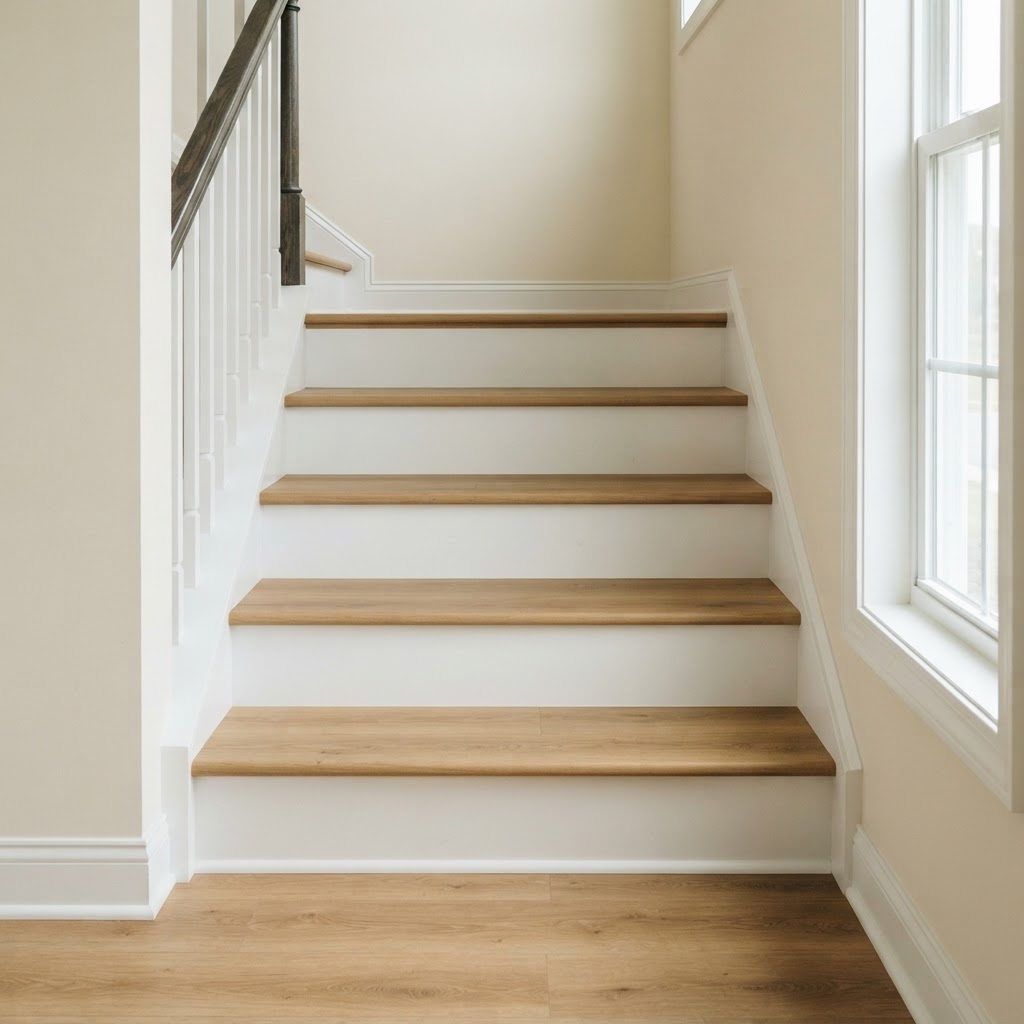
Many homeowners who install luxury vinyl plank on a main level eventually look at the staircase and wonder whether the same floor can continue up the stairs. It is a natural idea. A continuous look from the entry to the second floor feels finished, and vinyl is durable and easy to clean.
The answer is yes, LVP can be installed on stairs, but stairs are not simply a vertical version of a floor. They involve precise cuts, special parts, safety considerations and a very different installation method from the floating floor in the rest of the room. This guide from Floors and Beyond VA explains how LVP is installed on stairs, which products are suited to the job, what the parts are called, what can go wrong and what homeowners in Fairfax, Vienna, Reston and across Northern Virginia should ask before putting vinyl on their stairs. If you are still sorting out the product itself, start with what LVP flooring is and the different build types behind LVP flooring.
Why stairs are different
A floor is flat, forgiving and installed as a single large surface. A staircase is a series of small, precise surfaces that people step on every day, often in socks, often carrying things. Several things make stairs more demanding than a floor.
- Safety. A slippery, uneven or poorly secured stair tread is a fall risk. Stairs must be stable and consistent from step to step.
- Wear. Stair noses take concentrated wear and impact, especially on the leading edge where feet land.
- Precision. Every tread and riser must be cut and fitted individually, and small errors add up.
- Dimensions. Adding material to a stair changes its height and depth slightly. If the treads and risers become uneven, the staircase can feel unsafe and may not meet code.
- Fastening. Floating click-lock installation is not used on stairs. Planks must be secured in place.
These differences are why stair installations take more time and skill than the same area of flat floor.
The parts of a stair installation
Understanding the vocabulary helps you read an estimate and ask the right questions.
Many vinyl plank manufacturers sell matching stair parts, such as stair nose pieces, in colors designed to coordinate with their planks. Using the manufacturer's matching parts, where available, helps ensure a consistent look and fit.
How LVP is installed on stairs
Vinyl on stairs is typically glued or otherwise fastened, not floated. The details depend on the product and the manufacturer's instructions, but a general sequence looks like this.
- Evaluate the existing stairs The treads and risers must be solid, level and secure. Loose treads, squeaks and damaged surfaces need repair first. Existing carpet, padding, staples and tack strip must be removed. If the stairs have hardwood or another finish, the manufacturer's guidance determines whether it can be covered or needs to be removed.
- Prepare the surface The treads and risers need to be clean, dry and smooth. Old adhesive, paint or finish may need to be removed. Gaps and holes are filled.
- Measure and cut Each tread and riser is measured separately, because stairs are rarely perfectly uniform. The planks are cut to fit, with attention to the width and depth.
- Install the risers Riser pieces are cut and adhered or fastened in place, depending on the product.
- Install the treads and nosing Treads are cut and adhered, and the stair nose is installed along the front edge, using adhesive and, where recommended, fasteners. The nosing must be secure and flush.
- Finish and clean Joints, edges and any exposed fasteners are finished, adhesive is cleaned up, and the staircase is left to cure before use.
The adhesive must be one that the manufacturer approves, applied as directed, and given the specified time to set before anyone walks on the stairs.
Some products are designed specifically for stairs, such as pre-formed stair treads with an attached nose. These can speed up installation and give a consistent result, though they must still be installed correctly.
Which planks suit stairs?
Not every vinyl plank is a good match for stairs. Several factors matter.
What to look for
- Flexibility. Flexible planks tend to be easier to cut and wrap around the nose. Rigid-core planks are firmer and may require special stair parts and careful cutting. Always check what the manufacturer recommends for stairs.
- Wear layer. Stairs take concentrated wear, so a stronger wear layer is worth considering.
- Matching parts. Availability of matching stair noses and trims in the same color and finish simplifies the project and improves the look.
- Warranty. Check whether the manufacturer's warranty covers stair installations and what conditions apply.
What to check before you commit
- Whether the plank is approved for stair use at all. Not every line is.
- What the total thickness adds to each step, since that changes riser height.
- Whether the surface texture has enough grip in socks.
- Whether matching stair parts exist in your color, or whether you will be hunting for a reasonable match.
If the plank you want for the floor is not recommended for stairs, you may need a different product or a transition in a different place.
Traction and safety
Vinyl can be smoother than carpet and, depending on the surface texture, can be slippery in socks. Stairs are the last place to compromise on traction.
- Choose a surface with some texture. Embossed-in-register surfaces can feel less slippery than very smooth ones.
- Make sure the stair nose is secure and has a profile that gives a clear edge.
- Consider a stair runner, which can add traction and soften noise. If you use one, make sure it is secured properly and uses a backing safe for vinyl.
- Check lighting. Good lighting helps everyone see the edges of the steps.
- Keep the stairs clear. Clutter on stairs is a common cause of falls.
About building codes
Stairs are covered by building codes, which specify things such as maximum riser height, minimum tread depth and uniformity between steps. Adding flooring material to treads and risers changes these dimensions slightly. If one step ends up noticeably different from the others, it can be a trip hazard and may not meet code. The requirements can vary by jurisdiction and by the age of the home, so it is worth asking your contractor how they will keep the steps uniform and whether a permit or inspection is required for your project. A professional familiar with local requirements will plan the work with this in mind.
Handrails and balusters
Stairs often have handrails, newel posts and balusters. Installing new flooring may affect how these meet the treads. Cuts must be neat around balusters and posts. If you plan to refinish or replace the handrails, it helps to coordinate the timing with the flooring so that finishes do not get damaged.
LVP on stairs versus other options
LVP is one of several options for stairs, and it is helpful to compare them honestly.
- Carpet. Soft, quiet and good for traction, but it holds dirt, wears and can be harder to keep clean.
- Hardwood. Traditional and durable, and it can be refinished, but stairs take a lot of handwork and can be slippery without a runner. If your stairs already have hardwood, restoring them may be better than covering them. Our guide to what floor restoration includes explains how stairs are handled in a restoration.
- Vinyl plank. Easy to clean, consistent in look with a vinyl floor and durable, but it requires careful installation and attention to traction.
The best choice depends on your home, your household and your goals. Many homes use a combination, such as vinyl on the main level and hardwood or carpet on the stairs.
Stair nose options in more detail
The stair nose is the most visible and most stressed part of a vinyl stair installation, so the choice deserves care. Some systems use a one-piece stair tread with an integrated nose that covers the whole step. Others use a separate flush or overlapping nose piece along the front edge, with planks cut for the tread and riser. Overlapping noses wrap over the edge of the tread and give a finished profile, while flush noses sit level with the tread surface and suit certain installations. Whichever type is used, it should match the plank color and finish, be secured with the adhesive and fasteners the manufacturer specifies and be installed square and tight to the riser. Ask to see the actual part and a sample of it with your plank before you commit.
Preparing existing stairs
Preparation decides how long a stair installation lasts. If your stairs are carpeted, the carpet, padding, staples and tack strip must come out, and the wood underneath may need patching and smoothing. If the stairs are hardwood with a finish, the manufacturer's guidance determines whether vinyl may be installed over it or whether the surface needs to be abraded or removed. Loose treads should be fastened, squeaks addressed and any damaged boards repaired. Gaps along the sides and back of each tread should be filled so that the planks sit on a stable, even surface. Dust and debris must be vacuumed away so that the adhesive can bond. Skipping this stage is the most common reason a stair installation fails prematurely.
Sound and comfort on stairs
Stairs transmit sound through the whole house, and hard surfaces can make footsteps louder than carpet. Vinyl on stairs is typically bonded directly to the wood, so there is little cushioning. If noise is a concern, a runner with a vinyl-safe backing can soften it, and the right plank and adhesive help the stairs feel solid and quiet. In townhomes where the stairs share a wall with a neighbor, noise is worth considering before you choose a surface.
Maintaining vinyl stairs
Stairs collect dust and grit like any other floor, and vinyl treads need the same gentle care. Vacuum with a soft brush attachment, wipe with a damp microfiber cloth and an approved cleaner and avoid wax or slippery products. Check the stair nose periodically for any looseness, and have it repaired promptly if you notice movement. Keep the stairs well lit and free of clutter. Our guide to how to clean and maintain LVP flooring explains the cleaning routine in detail.
Common mistakes
What goes wrong
- Using a floating method on stairs. Click-lock planks are not meant to float on stair treads.
- Skipping the stair nose. A finished, secure nose is essential for safety and durability.
- Not using approved adhesive. The wrong adhesive can fail or damage the planks.
- Ignoring uneven steps. Differences in riser height from one step to another are a safety hazard and can create code issues.
- Poor cutting. Gaps and rough edges are both unattractive and a place for dirt and wear.
- Not allowing cure time. Walking on the stairs before the adhesive sets can ruin the work.
- Choosing a slippery product. Texture matters, particularly in homes with children, older adults or pets.
Getting the click-lock detail right
Click-lock planks are the most common LVP choice for a main level, and the fold-down or drop-lock joint is what makes a floating floor fast. On stairs that joint still matters, but the plank is bonded rather than floated, so the locking edge is used for alignment along the tread and the adhesive holds it.
Our guide to click lock LVP flooring covers how these joints behave and where the method stops working, which is exactly the point where a stair run begins.
What we see in Northern Virginia homes
Townhomes across Fairfax, Loudoun and Prince William counties often have stairs that run along a wall, sometimes with an open side and a baluster rail, and they frequently have carpet as the original covering. In older houses in Arlington and Alexandria, stairs may be hardwood or painted wood, and they may not be perfectly uniform because of age and settling. Basement stairs are often simpler but may have moisture concerns. Condominiums may have internal stairs with their own rules.
In many of these homes, homeowners choose LVP for the main level and then decide whether to carry it up the stairs. Often the best answer depends on how the stairs are built and what you want them to feel like.
When to choose something other than vinyl for stairs
Sometimes the honest recommendation is to leave vinyl off the stairs. If your staircase has original hardwood treads in good condition, restoring them may give a more durable and more characterful result than covering them. If the stairs are very steep, narrow or irregular, a surface with more natural grip, such as carpet or a textured product with a runner, may be safer. If the treads and risers are badly out of level or the structure needs repair, that work should come first. We would rather tell you what suits your staircase than install something that will frustrate you.
Questions to ask before stairs are quoted
Ask whether the plank you chose is approved for stair use and what parts are required. Ask how the installer will keep the steps uniform. Ask which adhesive and fasteners will be used and how long the stairs must stay closed afterward. Ask how handrails, balusters and newel posts will be handled. Ask whether the scope covers the landing and the transitions at the top and bottom. And ask what the plan is if the stairs turn out to be uneven once the old covering is removed. Clear answers to these questions are a sign that the installer has done stairs before.
How Floors and Beyond VA approaches stairs
Floors and Beyond VA is family-owned and has served Northern Virginia since 1987. Our crews are our own employees. For a stair project, we look at the staircase in person, check that the treads and risers are sound and uniform and discuss the options with you, including the product, the stair nose and the traction. We use the adhesives and parts the manufacturer specifies and tell you honestly if a staircase is better suited to a different material.
If you live in Fairfax or nearby, you can learn more about our LVP flooring in Fairfax, VA. We also work in Vienna, Reston, Tysons, Ashburn and across Northern Virginia.
Floors and Beyond VA also advises homeowners to plan the order of work. If the main level and the stairs are being done together, the stair parts and the transition at the top and bottom should be chosen at the beginning so that the heights and colors line up. Doing the stairs last, with the same crew, keeps the look consistent and protects the new floor from the traffic of the stair work.
Frequently asked questions
Can LVP be installed on stairs?
Yes, with the right product, parts and installation method. It requires careful fitting and secure fastening.
Is vinyl plank slippery on stairs?
It can be, depending on the surface texture. Choose a textured product and consider a runner.
Do I need a stair nose?
Yes. A secure nose provides a finished, safe, durable edge.
Can click-lock planks be used on stairs?
Generally not as a floating floor. Stairs require glued or fastened installation per the manufacturer.
Will the stairs still meet code?
They should, if the steps remain uniform. A professional plans the work to keep dimensions consistent.
Can I put LVP over carpeted stairs?
The carpet and padding must be removed first.
How long does a stair installation take?
It depends on the number of steps and the preparation, and adhesive needs time to cure before use.
Can I install it myself?
It is possible for experienced do-it-yourselfers, but the precision required makes stairs one of the harder parts of a flooring project.
Talk to Floors and Beyond VA
If you are considering LVP on your stairs, we would be glad to look at the staircase and explain your options. As a flooring company in Fairfax, Floors and Beyond VA will check the stairs, discuss traction and parts and give you a written plan. Schedule an in-home estimate at [floorsandbeyondva.com/Contact](/contact) or call (703) 906-5698.
Have your staircase looked at first
Tread condition, uniformity and the right stair nose decide whether vinyl works on your stairs. We check all three before quoting.
See LVP Flooring in Fairfax, VAQuick answer first: can LVP be installed on stairs in a townhome?




