
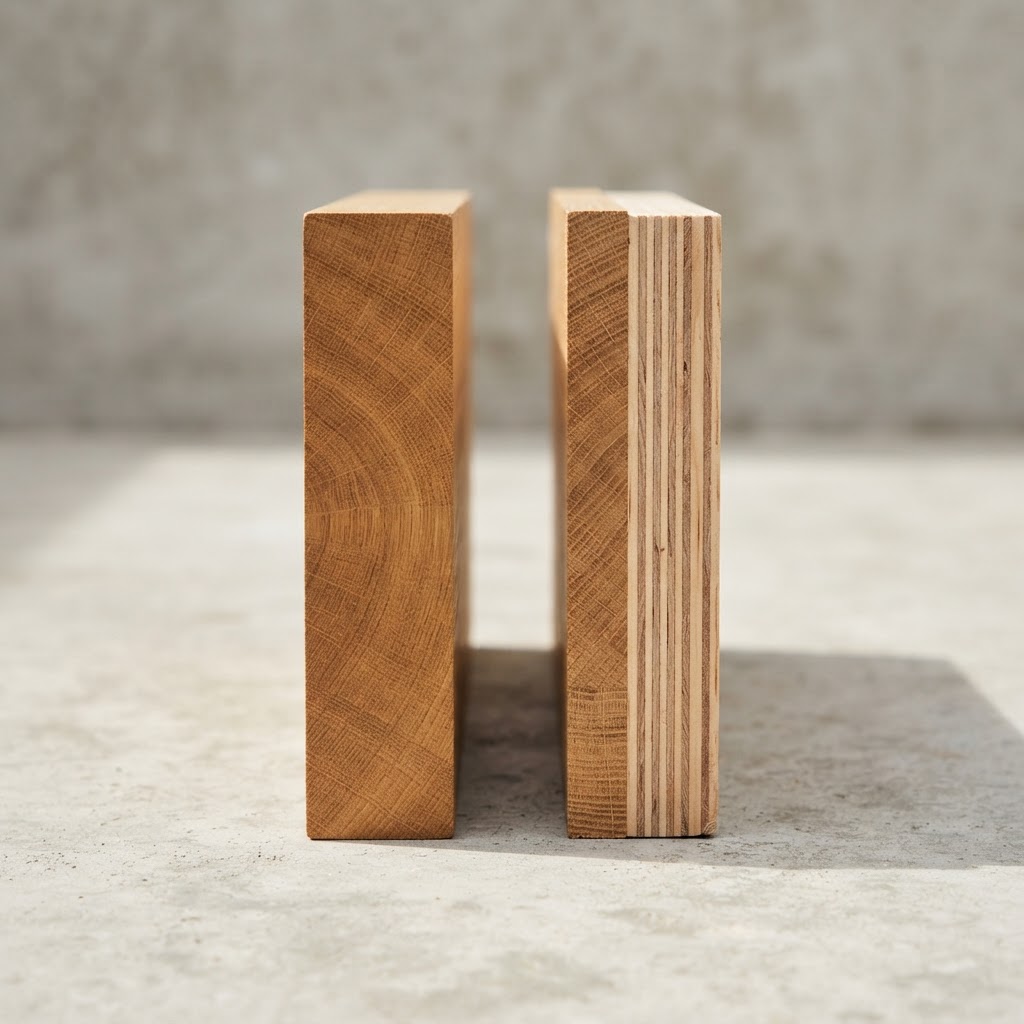
The difference between engineered and solid hardwood flooring comes down to construction. Solid hardwood is a single piece of wood from top to bottom, usually three-quarters of an inch thick. Engineered hardwood has a real wood top layer glued to a core of plywood or similar material, which makes it more stable when humidity changes. Both are real wood on top, both can be beautiful and both have a place in Northern Virginia homes. The right choice depends on your subfloor, your room, your climate and what you want from the floor over the next twenty or thirty years. This guide explains how each is made, how they compare on stability, refinishing, installation, moisture, sound and appearance, where each fits best and what to ask before you decide. At Floors and Beyond VA, we install both and also refinish and restore existing floors, so we have no reason to push one over the other.
HOW SOLID HARDWOOD IS MADE
Solid hardwood is milled from a single board of lumber. The standard thickness is three-quarters of an inch, though thinner solid products exist. Because it is solid wood throughout, it can be sanded and refinished many times over its life, which is why some solid hardwood floors last a century or more. Solid hardwood is installed by nailing or stapling to a wood subfloor. It responds to humidity by expanding and contracting, mostly across the width of the board, and it is generally not recommended for installation below grade or directly over concrete.
HOW ENGINEERED HARDWOOD IS MADE
Engineered hardwood is built in layers. A veneer of real wood, called the wear layer, sits on top. Beneath it are several layers of plywood or another stable core, with the grain of each layer running at right angles to the one above. This cross-ply construction makes the plank much more stable when humidity changes, so it expands and contracts less than solid wood. Wear layers range from a fraction of a millimeter to several millimeters, and the thickness determines how many times the floor can be sanded. Engineered planks can be glued down, floated or, in many cases, nailed.
STABILITY AND HUMIDITY
This is the main practical difference. Northern Virginia has humid summers and dry winters, and wood responds to both. Solid hardwood shows the effect through seasonal gaps and, in extreme cases, cupping. Engineered hardwood resists these changes better because of its layered core. If you have a home with large swings in humidity, a basement or a radiant heating system, engineered hardwood is often the safer choice. Solid hardwood can perform very well in homes with stable conditions and good humidity control. Our guide on why hardwood floors gap in winter explains the movement.
REFINISHING
Solid hardwood can usually be sanded several times, which makes it a long-term investment. Engineered hardwood varies from no sanding to several, depending on the wear layer. A plank with a thick wear layer can be refinished once or more, while a plank with a thin veneer cannot be sanded at all. If refinishing is important to you, ask for the wear layer thickness and the manufacturer's guidance. Our guide to engineered hardwood floor refinishing explains how to tell what you have, and our guide on how often hardwood floors need refinishing explains maintenance.
SUBFLOORS AND WHERE EACH CAN GO
Solid hardwood needs a wood subfloor. It cannot generally be installed over concrete slabs, in basements or below grade, because moisture from the concrete can damage it. Engineered hardwood can go over wood subfloors and over concrete, with proper moisture testing and the right method, and many products are approved for basements. Condos, which often sit on concrete, are a natural fit for engineered hardwood. Houses with wood subfloors can take either. Our guide to engineered hardwood installation explains the three installation methods.
MOISTURE
Neither type is waterproof. Solid hardwood is more vulnerable to moisture from below and to humidity swings. Engineered hardwood tolerates humidity better but can still be damaged by standing water, leaks or high moisture in a slab. In kitchens, baths and basements, careful planning matters whichever you choose. Moisture sources should be fixed first, and slabs tested.
SOUND AND FEEL
Solid hardwood nailed to a wood subfloor feels solid and sounds natural. Engineered hardwood glued to a slab feels similar. Floating engineered floors can sound slightly hollow without a quality underlayment. In condos, the sound requirements of the building often drive the underlayment choice for either type. Ask about rated assemblies if you live in a building with rules.
APPEARANCE AND CHOICES
Both types come in many species, colors, widths and finishes. Engineered hardwood can be made in very wide planks and long lengths with greater stability than solid wood, which is why it is popular for modern looks. Solid hardwood is available in site-finished versions, where the floor is sanded and finished in your home, and in prefinished versions. Site-finished solid hardwood offers a seamless look with no beveled edges and complete control over stain and finish. Engineered floors are mostly prefinished, with a factory finish that is durable and consistent. Look at full-size samples in your own light.
TALK TO A SPECIALIST BEFORE YOU DECIDE
The best choice depends on details you can only see in person, such as your subfloor, your humidity conditions and the way you use the room. Floors and Beyond VA offers in-home estimates in Arlington, Alexandria, Fairfax, Tysons and throughout Northern Virginia. Schedule an in-home estimate at floorsandbeyondva.com/Contact or call (703) 906-5698, and we will check the subfloor, bring samples and explain which type suits each space.
HOW EACH PERFORMS OVER TIME
Solid hardwood, properly installed and maintained, can last generations. Its ability to be sanded repeatedly means it can be renewed again and again. Engineered hardwood with a thick wear layer can last decades and be refinished at least once. Engineered hardwood with a thin veneer lasts as long as its finish and wear layer hold up, and then it must be replaced. Both depend on care, humidity control and protection from water. A floor that is cared for will outlast one that is neglected, whatever its construction.
WHEN SOLID HARDWOOD IS THE BETTER FIT
Solid hardwood tends to suit houses with wood subfloors above grade and stable humidity. It suits owners who want the longest possible life and the option to sand repeatedly. It is also a natural fit for historic and older houses where matching existing floors matters. If you already have solid hardwood in part of the house and want to continue it, solid planks of the same species and width will blend best.
WHEN ENGINEERED HARDWOOD IS THE BETTER FIT
Engineered hardwood tends to suit condos, basements and slab-on-grade homes, houses with radiant heat and spaces with humidity swings. It suits owners who want wide planks and long lengths and who prize stability. It also suits floating installations over uneven or existing floors, where nailing is not possible. If you want the look of hardwood in a space where solid wood would be risky, engineered is the practical answer.
ARLINGTON, ALEXANDRIA AND OLDER HOMES
Many Arlington and Alexandria houses already have solid oak floors, often under carpet. If yours do, restoring them is often a better path than replacing, and our guide on whether refinishing hardwood floors is worth it explains the decision. Where floors cannot be saved, or in additions and renovated spaces, a new floor may be needed. In those cases, matching the existing floor's height and look matters. Condos and townhomes in the area often have concrete or lightweight concrete over wood, and engineered hardwood is common there.
COMMON MISTAKES TO AVOID
Installing solid hardwood over concrete or below grade. Skipping moisture testing for engineered floors on slabs. Ignoring acclimation. Choosing a very wide plank without considering humidity. Buying an engineered floor with a thin veneer and expecting to refinish it. Overlooking condo sound rules. Forgetting stair parts and transitions. Ignoring radiant heat limits. Each of these is avoidable with a short conversation before you order.
CARE FOR BOTH TYPES
Care is similar. Use mats, felt pads and a hardwood cleaner. Avoid excess water and steam mops. Keep humidity moderate. Protect floors from strong sun. Trim pet nails. A screen and recoat can renew the finish before it wears through, which preserves the wood. Our guide on how to repair scratches in hardwood floors explains what to do about damage.
HOW FLOORS AND BEYOND VA APPROACHES THE DECISION
Floors and Beyond VA starts by asking what you already have and whether it can be saved. If you need a new floor, we check the subfloor, test moisture where needed and discuss your humidity conditions, your household and your goals. We show samples of both types and explain the trade-offs honestly. We follow the manufacturer's instructions, prepare condo documents when needed and use our own crews. Our refinish-first approach means we will tell you if your current floor can be restored.
THE WEAR LAYER IN DETAIL
The wear layer is the part of an engineered plank that you can sand. It is measured in millimeters, and the number tells you a lot. A wear layer under one millimeter is essentially a veneer. It looks like hardwood, but sanding is not an option, and when the finish wears through, the board is done. A wear layer of two millimeters can usually be screened and recoated and may take a light sanding. A wear layer of three to six millimeters can be sanded once or several times, depending on the product, in a way that approaches solid hardwood. Always ask for the number, and ask the manufacturer or installer what refinishing is recommended. Do not assume that engineered means sandable.
INSTALLATION METHODS COMPARED
Solid hardwood is nailed or stapled to a wood subfloor. The installer uses a flooring nailer at an angle through the tongue, so the fastener is hidden. Face nailing is used at edges and in tight places. This method is strong and well established.
Engineered hardwood has three options. Floating planks are joined with glue or click-lock and rest on an underlayment without being attached to the subfloor. Glue down planks are bonded to the subfloor with a flooring adhesive. Nail down planks, where the product allows, are fastened like solid wood. The best method depends on the subfloor, the building rules and the product. Glue down is often favored on concrete because it gives a solid feel and reduces hollow sound. Floating is favored over existing floors and in places where nailing or gluing is not practical.
ACCLIMATION AND JOBSITE CONDITIONS
Both types of hardwood need time to adjust to the home before installation. Planks are stored in the house, in the rooms where they will be installed, for the period the manufacturer recommends. The home should be at normal living temperature and humidity, with the heating or cooling running. Concrete should be fully cured and tested, and wood subfloors should be dry. Skipping these steps is one of the main reasons new floors gap, cup or buckle in the first year. A careful installer checks moisture in both the wood and the subfloor and records the numbers.
LIFETIME COMPARISON
Species, width, grade and finish all change what a floor takes to install, and we do not quote ranges in an article. What matters more is how the investment relates to lifespan. A solid floor that is refinished every couple of decades can serve a family for generations, which spreads the original outlay across a very long time. An engineered floor with a thick wear layer can do the same for a shorter span. A thin engineered floor may be the right answer for a rental or a short-term home, where the goal is a good look without the longest life. Think about how long you plan to stay and what the floor needs to do.
STAIRS, NOSINGS AND TRANSITIONS
Stair parts for solid hardwood are widely available in matching species. For engineered floors, matching stair nosings, thresholds and reducers depend on the manufacturer, and some products have limited trim. If you are doing stairs, ask whether matching parts are available in your plank and whether the product is approved for stair use. Transitions between rooms and between flooring types should be planned too, since engineered planks may be slightly thinner or thicker than solid ones and the heights need to meet.
WHAT ABOUT A FLOOR YOU ALREADY HAVE?
Many Northern Virginia homeowners ask this question while looking at a floor they already own. If you have solid hardwood in decent shape, refinishing is nearly always the better path than replacing it, and it is typically a fraction of the work and mess. If you have an engineered floor, the wear layer decides whether refinishing is possible. If you have carpet over unknown flooring, it is worth lifting a corner to look, because many homes have sound hardwood waiting underneath. An estimate visit can answer these questions in an hour.
LOOKING AT SAMPLES IN YOUR HOME
Whatever you pick, look at full-length samples in your own light. Hold them against your cabinets, trim and wall colors. Look at them in the morning and in the evening. Step on them. Check the edges, the texture and the way the finish reflects light. Ask for a sample of the exact finish and sheen, not just the species. The photograph on a website cannot show how a floor will look in a room with western windows, and the sample on a store shelf is under lights chosen to flatter it.
A NOTE ON MATCHING AND ADDITIONS
If you are adding a room, finishing a basement or expanding a kitchen, matching new flooring to existing hardwood is a common request. Solid and engineered products can both be stained or selected to blend with old floors, but exact matches are difficult because aged wood changes color over time. Often the cleanest result comes from refinishing the existing floor together with the new area so the whole space receives one finish. We discuss this option during estimates because it avoids visible seams between old and new.
FREQUENTLY ASKED QUESTIONS
Is engineered hardwood real wood? Yes. The top layer is real wood. The core is plywood or similar material.
Which lasts longer? Solid hardwood can be sanded many times. Engineered with a thick wear layer can last decades. A thin veneer lasts less.
Can solid hardwood go in a basement? Generally not. Engineered products approved for below grade are better.
Which is better for pets? Both can scratch. A durable finish, a matte sheen and trimmed nails matter more than construction.
Which is better over radiant heat? Engineered, if the product is approved and the instructions are followed.
Can I mix them in one house? Yes, with attention to height and look at the transitions.
Do I need underlayment? Floating engineered floors do. Glue down and nail down usually do not. Follow the manufacturer.
READY TO CHOOSE?
If you are deciding between engineered and solid hardwood, the quickest way to a confident answer is to have your space evaluated. Floors and Beyond VA is a family-owned flooring company serving Northern Virginia since 1987. Schedule an in-home estimate at floorsandbeyondva.com/Contact or call (703) 906-5698.




