
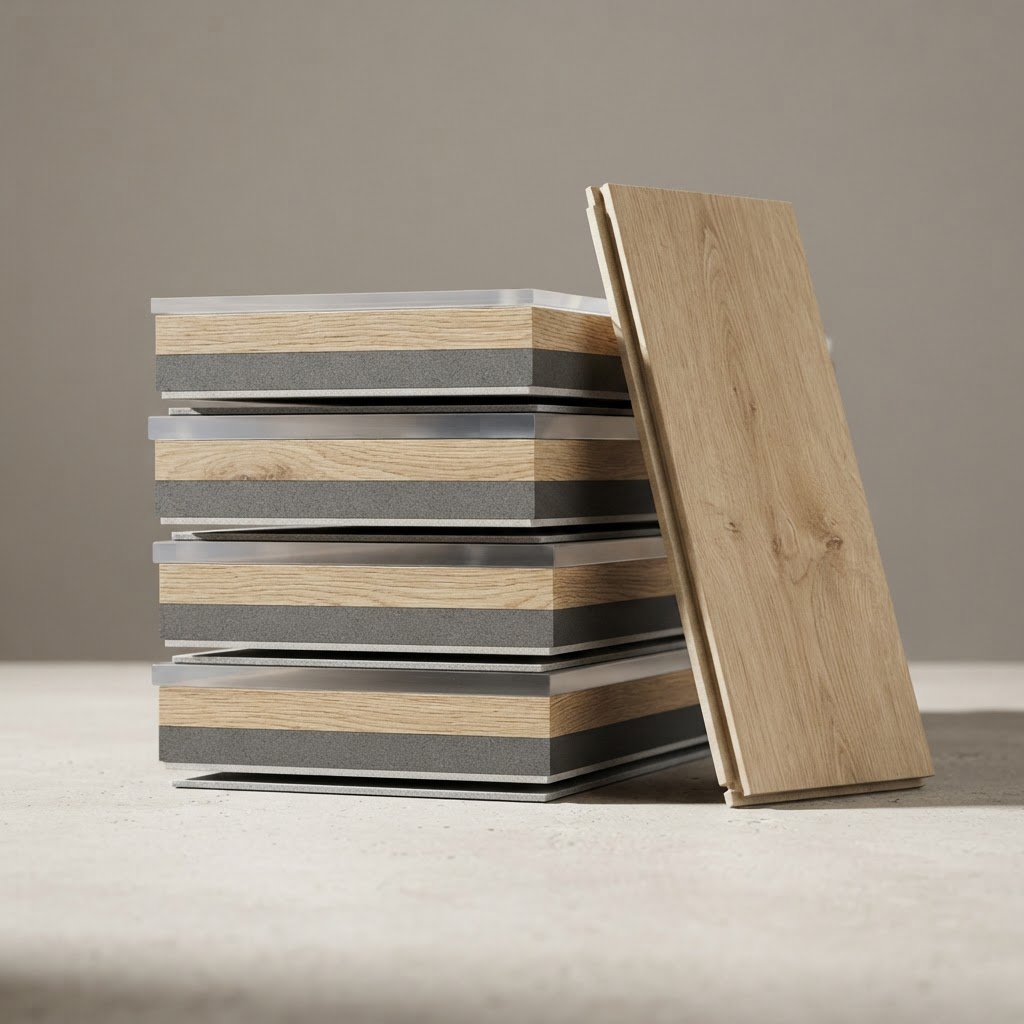
When homeowners start shopping for luxury vinyl plank, they quickly run into a confusing set of numbers. One sample says 5 millimeters. Another says 12 mil. A third talks about a 20 mil wear layer, and a fourth advertises a thicker plank with an attached pad. It is hard to know which number matters and which one is marketing. The short version is that LVP has two different thicknesses that people often mix up: the total thickness of the plank, measured in millimeters, and the thickness of the clear wear layer on top, measured in mils. They do different jobs, and confusing them is one of the most common mistakes in shopping for vinyl. This guide from Floors and Beyond VA explains both measurements in plain language, shows how each affects durability, comfort, sound and installation, and helps homeowners in McLean, Tysons and across Northern Virginia decide what thickness actually suits their home.
TWO DIFFERENT MEASUREMENTS
The first measurement is total thickness. It describes how thick the whole plank is, from the bottom to the top surface, and it is usually given in millimeters. In some listings, it is given in fractions of an inch. Total thickness includes the core, the printed layer, the wear layer and sometimes an attached pad, although manufacturers differ on whether the pad is included in the advertised number. This is worth checking, because a plank advertised as 8 millimeters including a pad is not the same as 8 millimeters of plank without one.
The second measurement is wear layer thickness. The wear layer is the clear protective coating on top of the printed design. It is what resists scratches, scuffs and daily traffic. Its thickness is measured in mils, and a mil is one thousandth of an inch. It is not the same as a millimeter, and it is much, much smaller. A 12 mil wear layer is about three tenths of a millimeter. A 20 mil wear layer is about half a millimeter.
This is the single most useful fact in vinyl shopping: millimeters describe how thick the plank is, and mils describe how well the surface will resist wear. A very thick plank can have a thin wear layer, and a thin plank can have a thick one. Thickness alone tells you very little about how a floor will hold up to dogs, children and chairs.
HOW THICK ARE TYPICAL LVP PLANKS?
Total thickness varies widely by product type. As a general guide, flexible vinyl planks tend to be thinner, often in the range of a few millimeters. Rigid-core planks, which have a firmer core that locks together, are commonly thicker, often somewhere from about 4 millimeters up to 8 millimeters or more, depending on the product and whether a pad is attached. Glue-down planks are usually on the thinner end because they are bonded directly to the subfloor and do not need a rigid core to hold together.
These are general ranges, not standards. There is no single industry definition of what counts as thick or thin, and manufacturers set their own specifications. The only reliable way to know is to read the specification sheet for the exact product and to see whether the number includes an attached pad.
HOW THICK ARE TYPICAL WEAR LAYERS?
Wear layers commonly run from about 6 mil at the light end to 20 mil or more at the heavy end. As a rough guide, thinner wear layers are often used in products intended for light residential use. Mid-range wear layers around 12 mil are common in homes. Thicker wear layers of 20 mil or more are often described as suited to heavy residential or light commercial use. Some products go beyond that.
The right wear layer depends on how the floor will be used. A guest bedroom with little traffic does not need the same protection as a kitchen and mudroom that see dogs, strollers and grit every day. A thicker wear layer gives more protection against scratches and scuffs, but it does not make the floor indestructible. Heavy furniture dragged across any vinyl floor can still damage it, and pet claws can still leave marks over time.
DOES A THICKER PLANK MEAN A BETTER FLOOR?
Not automatically. A thicker plank has some real advantages, but it is not a quality guarantee.
Stability. Thicker rigid-core planks are generally more stable and less likely to flex or telegraph small imperfections in the subfloor. This is one reason many installers prefer them for floating installations.
Comfort and sound. Added thickness and an attached pad can make a floor feel a little softer underfoot and can reduce impact noise. This matters most in townhomes and condominiums.
Bridging small flaws. A thicker plank can hide very minor subfloor imperfections better than a very thin one, although it is not a substitute for proper preparation. A subfloor that is out of level or has bumps needs to be corrected, because the planks will eventually stress at the joints. We cover this in our guide to click lock LVP flooring.
Installation height. A thicker floor sits higher, and that affects doors, thresholds, appliances and transitions. We discuss this below.
On the other hand, a thick plank with a thin wear layer will look substantial but may scratch easily. A thin plank with a good wear layer, installed properly, can perform very well. The core material, the locking system, the quality of the print and the manufacturer's warranty all matter as much as the thickness number.
WHICH MATTERS MORE: TOTAL THICKNESS OR WEAR LAYER?
For daily durability, the wear layer matters more, because it is the part of the floor that takes the abuse. For installation, comfort and stability, the total thickness and the core matter more. A sensible approach is to choose the wear layer first, based on how the room is used, and then choose a total thickness that suits the subfloor, the transitions and the sound requirements.
For example, a busy family kitchen might call for a stronger wear layer, with a plank thick enough to be stable. A basement guest suite might do well with a moderate wear layer, and attention to moisture is far more important than thickness. A condo with sound rules might focus on the attached pad and sound rating more than the plank thickness itself.
THICKNESS AND THE SUBFLOOR
Thickness is sometimes presented as the cure for an imperfect subfloor. It is not. Most manufacturers require the subfloor to be flat within a stated tolerance, and thicker planks do not change that requirement. If the subfloor has dips, humps or loose areas, they need to be corrected before installation. High spots can be ground or sanded. Low spots can be filled with an appropriate leveling or patching compound. Debris and old adhesive must be removed.
A modest increase in thickness can make a floor feel more forgiving, but it will not stop locking joints from stressing if the floor beneath them moves. We make the preparation step a standard part of every vinyl project, and we explain in our post on why underlayment matters more than the floor how the layers below affect the layers above.
THICKNESS, DOORS AND TRANSITIONS
Floor height is a practical detail that homeowners often overlook. Every layer you add raises the floor. That can affect several things.
Door clearance. Doors must still swing over the new floor. If the new floor is thicker than the old one, doors may need to be trimmed.
Transitions. Where vinyl meets another floor, such as tile, hardwood or carpet, the difference in height needs to be managed with a threshold, reducer or T-molding. A big difference can create a tripping hazard or an awkward look.
Appliances. Dishwashers and refrigerators sit in openings that were built for a specific floor height. A thicker floor can make it harder to slide an appliance in or out, and in some cases, appliances may need to be adjusted.
Stairs and landings. Where the floor meets stairs, the nosing and the first riser height need to be considered so that step heights remain consistent.
Cabinets and toe kicks. Floors that run close to cabinets may require trim adjustments.
These are the sort of details that a thorough in-home evaluation covers, and they are better dealt with before you order materials.
THICKNESS AND SOUND
Hard floors can be noisy, and a thicker plank with an attached pad can reduce the sound of footsteps, especially in the room below. This matters in townhomes and condominiums, and many associations have written sound requirements. The pad matters more than the plank thickness, and the rating applies to the whole assembly of plank, pad and subfloor. If your building has a sound rule, get it in writing and check the product's documentation before buying. We discuss this further in our upcoming post on underlayment for LVP flooring.
THICKNESS AND WARMTH
Vinyl planks over a cold concrete slab can feel cool underfoot, especially in winter. A pad can help a little, and so can a thicker core, but neither turns vinyl into carpet. If the floor will be on a basement slab, moisture is a larger concern than warmth. Our guide to moisture barriers for LVP flooring explains what to test and what to ask your installer.
WHAT FLOORS AND BEYOND VA CHECKS BEFORE RECOMMENDING A THICKNESS
When Floors and Beyond VA recommends a plank, thickness is one of several things we weigh, and we start with the room instead of the sample. We check the flatness of the subfloor, the height of door thresholds and appliances, the way the floor will meet other surfaces, the sound requirements of the building and the way the household uses the space. A thicker plank is not automatically better, and a thinner one is not automatically worse. The right number is the one that suits the subfloor, the transitions and the installation method.
TALK TO A SPECIALIST BEFORE YOU ORDER
The numbers on a sample can be confusing, and the best choice depends on your actual rooms. Floors and Beyond VA offers in-home estimates across McLean, Tysons, Vienna, Reston, Fairfax and the rest of Northern Virginia. Schedule an in-home estimate at floorsandbeyondva.com/Contact or call (703) 906-5698, and we will measure, check the subfloor, show samples in your light and explain which thickness fits.
A SIMPLE WAY TO USE THE NUMBERS
Think of the numbers as answers to different questions. Total thickness in millimeters tells you how the plank will feel, how it will behave over a slightly imperfect subfloor and how high the new floor will sit. Wear layer in mil tells you how long the surface will resist everyday abrasion. Core type tells you how stable and dent-resistant the plank is. An attached pad tells you about comfort and sound. When you look at a sample, ask for each of these separately, and ask which one matters most in the room you are working on.
HOW TO READ A SPEC SHEET
When you compare products, look at these items together rather than a single number.
Total thickness, and whether it includes an attached pad.
Wear layer thickness in mils.
Core type, such as flexible, rigid or composite.
Attached pad, and what it is made of.
Locking system, and whether it is intended for floating installation.
Warranty terms, including residential and commercial coverage, and any conditions about subfloor flatness, moisture and humidity.
Subfloor requirements, such as flatness tolerance and moisture limits.
Installation methods allowed, such as floating or glue-down.
If a salesperson only gives you one of these numbers, ask for the rest.
COMMON MISTAKES WHEN CHOOSING THICKNESS
Mixing up mm and mil. This is the most frequent confusion. A product with a 20 mil wear layer is not a 20 millimeter plank.
Assuming thicker is always better. A thick plank with a thin wear layer may look and feel substantial but wear faster than a thinner plank with a stronger wear layer.
Ignoring the height change. Doors, appliances and transitions can all be affected.
Skipping subfloor preparation. Thickness does not replace flatness.
Adding extra pads. If the plank has an attached pad, another one on top can make the floor too soft and strain the joints.
Choosing based on one sample. Look at the full specification and ask for a physical sample to see in your home's lighting.
WHAT WE SEE IN NORTHERN VIRGINIA HOMES
The right choice depends on the home. In newer townhomes across Fairfax, Loudoun and Prince William counties, the main level is often plywood over joists, and a mid-range rigid plank with an attached pad is a common choice for open layouts. In older homes in McLean, Arlington and Alexandria, subfloors may have settled or been patched over the years, which puts the emphasis on preparation and on a plank that is stable enough to handle small imperfections after leveling. In basements, moisture testing comes first, and thickness comes second. In condominiums in Tysons and Reston, the association's sound requirement often drives the choice more than thickness.
The same logic applies to wear layers. Busy households with pets and children tend to benefit from stronger wear layers in kitchens, entries and family rooms. Lower-traffic rooms can use lighter ones.
HOW FLOORS AND BEYOND VA HELPS YOU CHOOSE
Floors and Beyond VA is a family-owned company that has served Northern Virginia since 1987, and our crews are our own employees. When we visit a home, we look at the subfloor, the transitions and the way the room is used. Then we explain which thickness, wear layer and core make sense and why. We do not push the thickest product or the thinnest. We aim to match the floor to the room, and we put the product details in the written scope so you know exactly what is being installed.
If you live in McLean or nearby and are comparing vinyl plank options, you can learn more about our LVP flooring in McLean, VA. We also serve Tysons, Vienna, Arlington, Fairfax and the surrounding communities.
FREQUENTLY ASKED QUESTIONS
How thick is LVP flooring? Total plank thickness commonly ranges from a few millimeters for thin products to around 8 millimeters or more for rigid-core planks, and the wear layer usually runs from about 6 mil to 20 mil or more. Check the specification for your product.
What is a mil? A mil is one thousandth of an inch. It is a unit used for the wear layer, and it is much smaller than a millimeter.
What wear layer do I need for a home with dogs? A stronger wear layer generally offers more protection from scratches, though no vinyl is scratch-proof. Keep nails trimmed and use mats.
Is 12 mil enough for a home? Many homes use 12 mil wear layers successfully, especially in moderate-traffic rooms. Busy areas may benefit from more.
Is thicker LVP warmer or quieter? A thicker plank and an attached pad can make a floor feel a little softer and reduce impact sound. Neither replaces proper insulation or approved sound underlayment.
Do I need a thicker plank for an uneven floor? No. The subfloor should be corrected to meet the manufacturer's flatness requirement.
Will thicker LVP be a problem at my doors? It can be. A higher floor may require trimming doors or adjusting transitions and appliance openings.
THE BOTTOM LINE ON THICKNESS
For most Northern Virginia homes, a plank in the mid-range of total thickness with a wear layer suited to the room, a rigid core and a flat, well-prepared subfloor will perform well for many years. Extra thickness helps in some situations, but it cannot make up for a poorly prepared subfloor or a wrong installation method. If you are unsure, an in-person evaluation will settle the question quickly.
TALK TO FLOORS AND BEYOND VA
If you are comparing LVP products and want help reading the numbers, we would be glad to look at your space and explain what suits it. Floors and Beyond VA will check your subfloor, review the transitions and recommend a plank that fits the room. Schedule an in-home estimate at floorsandbeyondva.com/Contact or call (703) 906-5698.




