
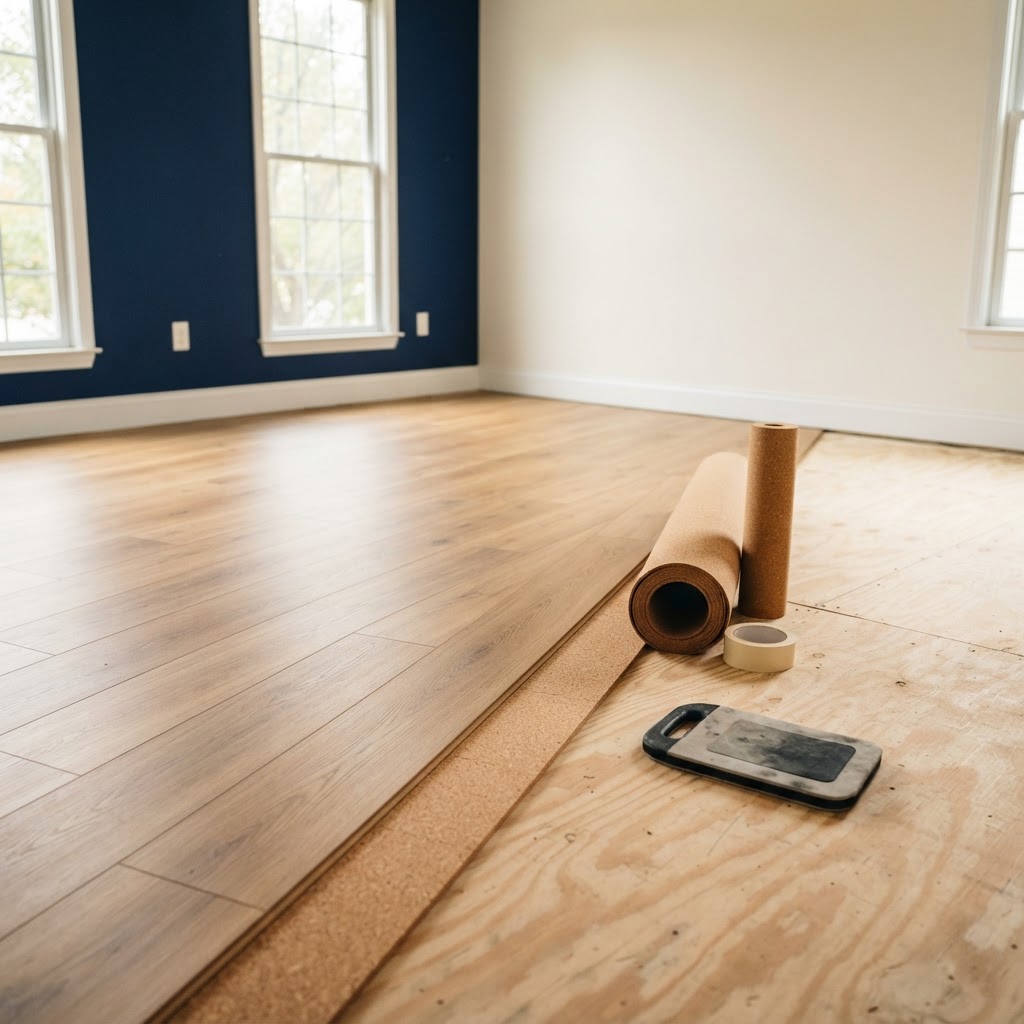
Underlayment is the layer between a floating vinyl plank floor and the subfloor, and it is one of the most misunderstood parts of an installation. Some planks come with a pad already attached, some require a separate layer, and some should have none at all. Choosing the wrong one can make a floor feel hollow, wear its joints out early or break a warranty. This guide from Floors and Beyond VA explains what underlayment does for LVP, when you need it, when you should not add it, how condominium sound rules affect the choice, and how homeowners in Leesburg, Ashburn and across Northern Virginia can avoid the most common mistakes.
If you are still deciding on the floor itself, start with our overview of LVP flooring before you get to what goes underneath it.
What underlayment does
Underlayment can serve several purposes, and it helps to separate them.
Sound control. A layer under a hard floor can reduce the noise made by footsteps and furniture, both in the room and in the room below. This matters most in condominiums, townhomes and any house where the floor is above living space.
Comfort. A modest layer of cushioning can make a floor feel slightly softer underfoot.
Minor smoothing. A thin layer can help bridge tiny imperfections in the subfloor, but it does not fix a floor that is out of level or damaged.
Moisture control. Some underlayments include a vapor barrier film for use over concrete. We discuss this in detail in our post on moisture barriers for LVP flooring.
Thermal insulation. Some products add a small amount of insulation against a cold subfloor.
No single underlayment does all of these well, and the best choice depends on what the floor needs most.
The first question: does your plank already have a pad?
Many modern click lock planks come with an underlayment pad attached to the back. This pad is designed as part of the plank, and the manufacturer has tested the combination. If your planks have an attached pad, the general rule is simple: do not add a second pad on top of the subfloor unless the manufacturer specifically says to.
The reason is structural. A click lock floor holds together at its edges. If there is too much soft material beneath, the planks can flex more than the locking system is designed to handle, and the joints can stress, open or peak over time. The floor can also feel spongy, and heavy furniture can leave deeper impressions.
If your planks do not have an attached pad, the manufacturer's instructions will say whether an underlayment is required, allowed or prohibited. Never assume.
Glue-down vinyl plank is different. It is adhered directly to the subfloor and usually does not use a separate cushioning underlayment, because the adhesive bond needs a firm surface.
When a separate underlayment makes sense
There are situations where a separate underlayment is appropriate, provided the plank manufacturer approves it.
Planks without a pad. Some products are sold bare, and a manufacturer-approved underlayment is part of the system.
Added sound control. In some cases the manufacturer allows a specific sound-reducing underlayment under planks that do not have an attached pad, in order to meet an association's requirement.
Concrete with a vapor barrier requirement. Where moisture is a concern, an underlayment with an integrated barrier film may be specified.
Uneven but sound subfloors. A thin approved product can help with small variations, though it is not a substitute for proper preparation.
The key word is approved. Using an underlayment that the plank manufacturer does not accept can void the warranty.
Types of underlayment you may encounter
Foam underlayment. Thin foam is common and lightweight, and it provides modest cushion. Many foam products are not suitable for use under rigid vinyl planks, which need firmer support, so check compatibility.
Cork underlayment. Cork is a natural material valued for sound absorption and some thermal insulation. It is denser than basic foam and is often used when sound control is a priority.
Rubber underlayment. Rubber products are dense and good at damping sound and impact noise, often used in multifamily buildings. They are heavier and can be a better match for rigid planks.
Felt or fiber underlayment. Recycled-fiber products are firm and offer sound reduction and some thermal benefits. They are common under floating floors.
Combination products. Some underlayments pair a firm layer with a vapor barrier film, aiming to meet both sound and moisture needs on concrete.
Attached pads. IXPE foam, cork and other materials are sometimes bonded to the plank back at the factory. These are designed to work with that plank.
Each type has strengths and limits, and the right one depends on the plank. The plank's installation guide is the final authority.
Condos and townhomes: sound rules matter
If you live in a condominium or a building with an association, the underlayment is not only about comfort. It may be a rule. Many buildings require that a floor covering meet a minimum level of sound insulation, so that footsteps and furniture noise do not disturb the unit below. These requirements are often described in terms of impact and airborne sound ratings.
Before you buy anything, ask management for the written requirement. Then check whether the plank, the pad and the subfloor combination can meet it. A rating applies to a specific assembly, not to a loose product, so the underlayment, the plank and the concrete or framing all matter. Some buildings require a test report or a product data sheet to be submitted for approval, and some will inspect after installation.
In Northern Virginia, condominium buildings from Tysons to Reston to Arlington commonly have such rules, as do many townhome communities. If your project is in a building with an association, get the approval process started early, because it can affect your schedule. A contractor who has worked in these buildings will know what documentation to ask for.
What underlayment cannot do
It cannot level a floor. Dips and humps in the subfloor need to be corrected with grinding or patching compound. A pad will not hide them, and they will eventually stress the planks.
It cannot solve a moisture problem. An underlayment with a barrier can slow vapor, but it does not fix a leak or a drainage issue.
It cannot make a bad plank good. A plank's quality, core and locking system matter more than the layer underneath.
It cannot replace proper acclimation and expansion gaps. These are separate parts of the installation.
For more on how the layers beneath a floor affect performance, read our post on why underlayment matters more than the floor.
Common underlayment mistakes
Doubling up. Adding a second pad to planks that already have one is the most common mistake. It can overstress the locking joints and soften the floor.
Using the wrong density. A very soft underlayment under a rigid plank can allow flexing. A firm product is usually better.
Ignoring the manufacturer's list. Warranties often specify approved underlayments or maximum thickness. Using something else can leave you without coverage.
Skipping the sound requirement. In a condo, installing a floor that fails the association's requirement can mean removal at your expense.
Leaving gaps or overlaps. Underlayment should lie flat, with seams butted or overlapped as directed, and taped where required. Wrinkles and overlaps can telegraph through the planks.
Forgetting the perimeter. The pad should not be crushed against walls in a way that blocks the expansion gap, and the floor still needs its room to move. We cover this in our guide to click lock LVP flooring.
Trapping debris. A small stone or screw head left on the subfloor can create a bump under the plank. The subfloor must be swept and vacuumed before the underlayment goes down.
Thinking about your own floors? Floors and Beyond VA offers in-home estimates across Northern Virginia. Schedule yours at floorsandbeyondva.com/Contact or call (703) 906-5698.
Reading the installation guide like a professional
Every plank manufacturer publishes an installation guide, and the underlayment section is usually short but specific. Look for words such as required, approved, maximum thickness and not recommended. Note whether a vapor barrier is mentioned for concrete and whether the guide lists specific brands. Check the subfloor flatness tolerance, because it determines how much preparation comes before the underlayment. Keep a copy of the guide with your records. If an installer suggests something that the guide does not mention, ask them to show you where the manufacturer allows it. A professional will not mind the question, and the answer protects your warranty.
How to choose
Start with the plank. Read the manufacturer's installation guide, or have your installer do so, and see what is required, allowed and prohibited.
Consider the space. Is it a basement slab, a second floor over living space, a condominium or a ground-level plywood subfloor? Each has different needs.
Check the rules. If you have an association, get the sound requirement in writing.
Consider moisture. If the subfloor is concrete, ask whether a vapor barrier is needed, and whether the underlayment can include it.
Ask your installer to put the product name and thickness in the written scope of work, so there is no confusion later.
Testing the result before you finish the room
Before baseboards and trim go on, walk the floor and listen. A properly supported floating floor should feel solid and quiet. Hollow sounds, clicking at the seams or noticeable flex suggest that something underneath needs attention, whether it is a high spot, a missed bit of debris or the wrong underlayment. Fixing it at this stage means lifting only a few rows instead of an entire room. Ask your installer to do this check with you, and take a few photos of the underlayment before it is covered, so that you have a record of exactly what is under your floor.
Leesburg and Loudoun County conditions
Leesburg combines historic homes near the old town center with large newer neighborhoods in surrounding Loudoun County. Older houses may have uneven or aged subfloors that need preparation before any underlayment goes down. Newer homes often have plywood subfloors that are relatively flat, along with finished basements on slabs where moisture and cold are factors. Townhomes and condominiums add the question of sound rules.
Seasonal conditions matter too. Humid summers and cold winters change how floors behave, and a basement slab can be cold underfoot in winter. A thoughtful underlayment choice can improve comfort, but it should never replace the testing and preparation that make a floor last.
Underlayment by subfloor type
The surface under the underlayment changes what the underlayment needs to do. Over a plywood or OSB subfloor on an upper level, the main goals are usually sound control and a firm, quiet feel. Squeaks in the subfloor should be fixed first, because a pad will not silence them. Over a concrete slab at or below grade, moisture control becomes a priority, and the underlayment may need a vapor barrier film that the plank manufacturer accepts. Over an existing floor, such as old vinyl or tile, the existing surface must be flat, clean and sound, and the underlayment decision follows the manufacturer's rules for installing over that surface. Over radiant heat, only products approved for use with heated floors should be used, because some pads insulate too much and others cannot tolerate the temperature.
Stairs, transitions and thresholds
Underlayment usually stops where the floating floor stops. On stairs, vinyl is typically fastened or glued with the manufacturer's stair parts and does not use a floating pad. At doorways and transitions, the underlayment should be cut cleanly so that T-moldings and reducers sit properly and the floor can still move. Where the new floor meets a thicker or thinner neighboring floor, the combined height of plank and pad determines which transition piece is needed. Planning this before the materials are ordered avoids tripping hazards and awkward gaps.
A simple decision path
Begin with the plank's installation guide and find the underlayment section. If the planks have an attached pad, note whether the manufacturer permits any additional layer. Check the subfloor type and whether moisture testing is required. Ask whether an association has a sound requirement and get it in writing. Choose a product that satisfies the plank manufacturer first and the building rules second, then confirm that the two do not conflict. Finally, write the exact product and thickness into your scope of work. Following this order keeps the decision grounded in documents rather than guesswork.
When a floor needs repairing later
Floating floors with the right underlayment can usually be lifted and repaired more easily than glued floors, as long as the locking system and the underlayment allow it. Keep spare planks from the same lot and record the underlayment product name. If you ever need to replace a section, the installer will need to know what is underneath. Homeowners who keep the installation paperwork save themselves a great deal of guesswork years later, and Floors and Beyond VA gives every customer a clear record of what was installed.
How Floors and Beyond VA approaches it
Floors and Beyond VA has been family-owned since 1987, and our crews are our own employees. Before a vinyl plank project, we look at the subfloor, ask about the space above or below and check the manufacturer's requirements for the plank we are discussing. We tell you whether an underlayment is needed, which one meets the plank's rules and whether any association requirements apply. We include the product in the written scope so you know exactly what is going under your floor.
If you live in Leesburg or elsewhere in Loudoun County, you can learn more about our LVP flooring in Leesburg, VA, and more about us as a flooring company in Leesburg. We also work in Ashburn, Fairfax, Reston and across Prince William County.
For the short answer to this question, read the companion NoVA Guide entry: Do you need underlayment under LVP, and which kind suits a condo?
Frequently asked questions
Do I need underlayment for LVP?
It depends on the plank. Many planks have an attached pad and need nothing more. Others require a separate approved underlayment. Follow the manufacturer's guide.
Can I put a second pad over an attached one?
Generally no, unless the manufacturer says so. It can stress the locking joints and soften the floor.
What underlayment is best for sound?
Dense products such as cork, rubber and firm fiber underlayments are commonly used for sound control, but the plank manufacturer must approve the choice, and a condo's rules may require a specific rating.
Is underlayment the same as a moisture barrier?
No. A barrier controls vapor. Some underlayments include one, but sound control and moisture control are separate functions.
Do I need underlayment for glue-down LVP?
Usually not. Glue-down products bond directly to the subfloor.
Will underlayment fix an uneven floor?
No. Subfloor problems should be corrected before installation.
Can underlayment affect my warranty?
Yes. Using an unapproved product can void coverage, so confirm before installing.
Does underlayment make the floor warmer?
A little, depending on the material. It does not replace insulation or a proper heating system.
Talk to Floors and Beyond VA
If you are planning an LVP floor and are not sure what should go underneath, we would be glad to help. Floors and Beyond VA will check the subfloor, review the plank requirements and any association rules, and give you a clear recommendation. Schedule an in-home estimate at floorsandbeyondva.com/Contact or call (703) 906-5698.




