
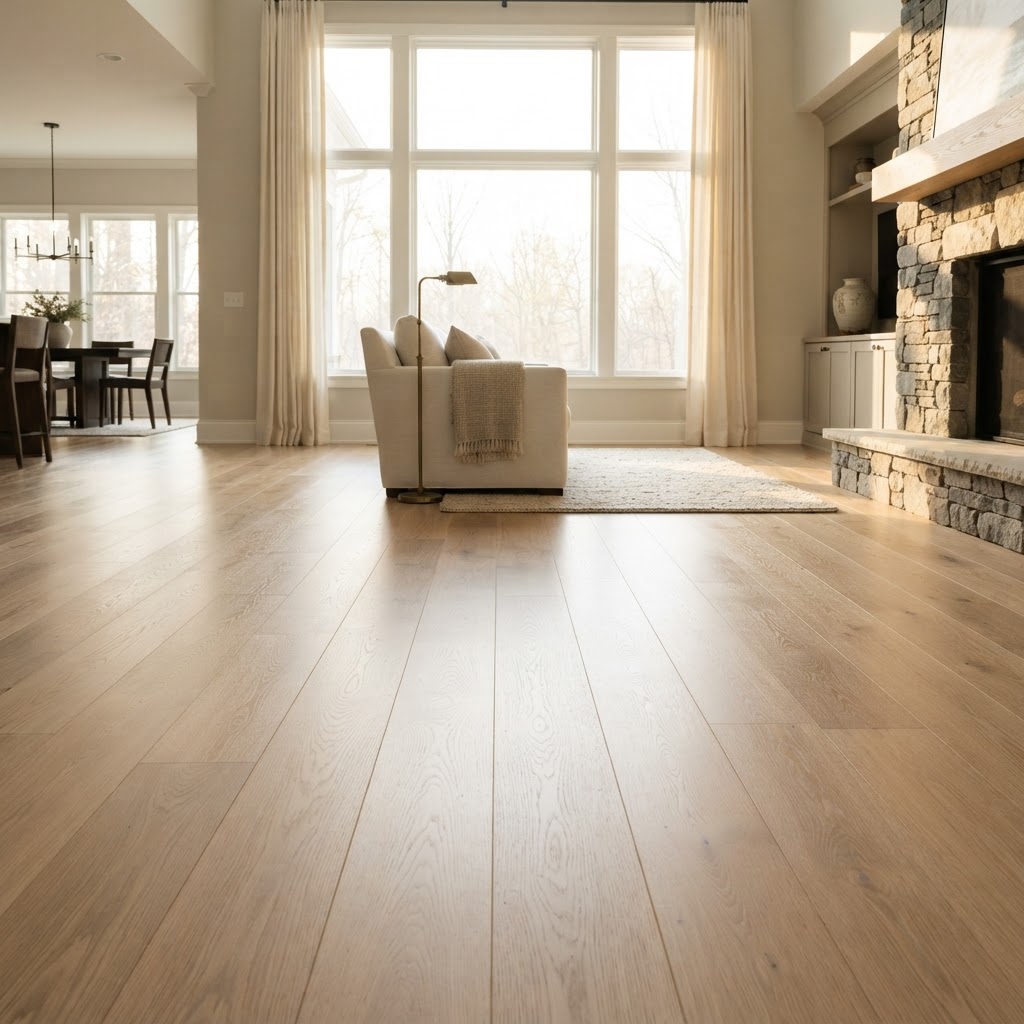
Hardwood floor refinishing in McLean means renewing the finish and, when needed, the surface of the wood in homes that range from mid-century ramblers to large custom houses built in the last twenty years. McLean homeowners tend to ask more detailed questions than most. They want to know how the floor was made, how much wood is left, what finish will last, how the work affects the rest of the house and who exactly will be working in it. This guide answers those questions. It explains how to judge your floors, what the refinishing process involves, how McLean's mix of housing affects the decision, how to handle stairs and open layouts, and how to choose a crew you can trust. At Floors and Beyond VA, we have refinished and restored floors across Fairfax County since 1987.
THE TYPES OF FLOORS YOU FIND IN MCLEAN
McLean has an unusual variety of housing for its size. Understanding which kind of floor you have is the first step.
Mid-century and postwar houses. Many McLean homes were built in the 1950s through the 1970s with solid three-quarter-inch oak floors. These floors are generally thick, dense and well suited to refinishing. Some have been refinished once or twice, and others have spent decades under carpet.
Houses from the 1980s and 1990s. These often have solid oak or builder-grade hardwood, sometimes with a factory finish that has worn through in the traffic paths. They usually refinish well.
Newer custom homes. Large homes built in the past two decades may have wide-plank solid hardwood, engineered hardwood or a mix. Engineered floors vary widely in how much can be sanded, so the wear layer must be checked first. Our guide to engineered hardwood floor refinishing explains this.
Townhomes and condos. McLean and nearby Tysons have attached homes and condominiums with their own rules and often thinner wood. Association requirements may apply.
HOW TO JUDGE YOUR FLOORS BEFORE YOU CALL ANYONE
You can learn a lot with a few simple observations. Look at the finish in the traffic paths. If it is dull but still sealed, a screen and recoat may be enough. Put a drop of water on a hidden spot. If it beads, the finish is intact. If it soaks in or darkens the wood, the finish has failed. Look at the color of the wood in the worn areas. Gray or dark patches mean the finish has worn through and moisture or dirt has reached the wood. Look at the edges at a vent or threshold to see the board thickness. Look for gaps, cupping and squeaks, which may point to moisture or fastening issues rather than finish problems. Our guide on how often hardwood floors need refinishing explains how to read these signs.
SCREEN AND RECOAT OR FULL REFINISH?
Many McLean floors need less than a full sanding. A screen and recoat lightly abrades the existing finish and applies a fresh coat, renewing protection without removing much wood. It works when the finish is worn but the wood is sealed and intact. A full refinish sands to bare wood and is needed when the finish has failed, scratches are in the wood, damage is present or you want a new color. The honest answer depends on the floor, and a contractor who recommends the lighter process when it will work is protecting the thickness of your wood. Our guide on spot refinishing explains when localized repairs are possible.
THE REFINISHING PROCESS
A full refinish follows a consistent sequence. The crew protects the home, covers vents and seals openings. Repairs are made to loose boards, gaps and damaged areas. The floor is sanded in stages, starting with coarser abrasives to level the surface and remove the old finish, then moving to finer grits to refine it. Edges and corners are done with specialized equipment. Dust is collected and the floor is cleaned. If you want a new color, stain is applied and allowed to dry. Several coats of finish follow, with drying time between them. The floor then cures before furniture returns. Our article on how long refinishing takes explains the schedule, and our article on dustless refinishing explains dust control.
OPEN LAYOUTS AND LARGE HOMES
Many McLean homes have large, open main levels where the kitchen, family room, dining room and entry flow together. In these homes, the floor is one continuous surface, and refinishing part of it can leave visible lines. A good contractor plans the work so that the finish is applied across connected areas in a way that avoids lap marks, which usually means finishing the whole open area in one session. Sheen consistency matters as well, since different areas that were finished at different times can look slightly different.
In large homes, scheduling also matters. Floors may need to be done in sections so the family can keep using part of the house. Ask about the plan and how access to kitchens, bathrooms and bedrooms will be maintained.
STAIRS AND TRANSITIONS
Stairs are the most detailed part of a refinishing project. Treads and risers must be sanded and finished by hand or with specialized tools, and the work takes time. Many homeowners choose to refinish stairs along with the floors for a consistent look, and some prefer to paint risers for contrast. Ask how the contractor handles stair nosings, balusters and handrails, and how long the stairs will be out of use. Transitions between rooms and between hardwood and other flooring deserve attention as well, since an uneven edge is both a visual and a safety issue.
TALK TO A SPECIALIST BEFORE YOU COMMIT
The details of your floors, your layout and your schedule shape the plan, and they are hard to judge from the outside. Floors and Beyond VA provides in-home estimates in McLean and throughout Fairfax, Loudoun, Prince William and Arlington counties. Schedule an in-home estimate at floorsandbeyondva.com/Contact or call (703) 906-5698, and we will inspect the floor, discuss your goals and put a clear scope in writing.
FINISH AND COLOR CHOICES
McLean homeowners often want a refined, natural look. Lighter and more neutral tones remain popular, and many people choose a clear or lightly tinted finish that shows the grain of the wood. Darker tones are also common in traditional homes. Water-based finishes tend to keep the wood lighter and clearer and dry faster, while oil-based finishes bring out a warmer tone and cure more slowly. Matte and satin sheens hide scratches and dust better than high gloss. The right choice depends on the species, the light in the room and the style of the house, and a good contractor shows you samples on your own wood. Remember that the existing stain can limit how light a floor can go, since some colors do not fully sand out.
PETS, CHILDREN AND DAILY LIFE
A busy household puts different demands on a floor than an empty one. Pets scratch, children drag toys and furniture, and everyone brings in grit from outside. A durable finish, entry mats, felt pads under furniture and trimmed pet nails all help the finish last. If you have allergies or infants in the home, tell your contractor and consider staying elsewhere during sanding and finishing, since odors and fine dust are part of the process.
HISTORIC AND OLDER FEATURES
Some McLean houses have features that deserve special care, such as parquet borders, inlays, wide old boards and stair parts that were made to last. These floors can be spectacular when restored, but they require patience and experience. Parquet and patterned floors have grain running in different directions, and sanding them requires technique to avoid visible marks. If your house has features like these, ask the contractor about similar projects they have done.
MOISTURE AND SEASONAL MOVEMENT
Northern Virginia's humid summers and dry winters move wood through the year. Gaps may open in winter and close in summer, and slight cupping can appear during humid spells. These changes are normal in many floors and do not by themselves mean the floor needs replacing. Persistent cupping, crowning or buckling usually points to a moisture problem that needs attention before any refinishing. Our guide on why hardwood floors gap in winter explains what is normal.
HOW TO CHOOSE A CREW
Ask who will do the work and whether they are employees or subcontractors. Ask how dust will be controlled. Ask what finish is proposed and why. Ask for a written scope that lists the rooms, the process, the number of coats and what happens with baseboards, stairs and furniture. Ask for proof of license and insurance. And pay attention to how the estimator treats your questions. Our guide on choosing a hardwood floor refinishing company explains these points in more depth.
HOW FLOORS AND BEYOND VA APPROACHES MCLEAN FLOORS
Floors and Beyond VA is a refinish-first company. In McLean, that means we begin by asking what the floor is, how much wood remains and whether a lighter process will do. We inspect, test the finish, discuss color and sheen with samples, and plan the work around your household. We use our own crews, we control dust with vacuum-connected equipment and we put every recommendation in writing. If your floor needs repairs or a different approach, we explain why.
PREPARING YOUR MCLEAN HOME FOR REFINISHING
A little preparation makes the work easier. Decide what will be moved out and what the crew will move. Pack fragile items and wall hangings that might be shaken. Plan where pets will stay and where family members will sleep and eat. If you have a security system, tell the contractor about motion sensors. Tell your neighbors, especially if the house is close to others or if you live in a townhome. If the work includes stairs, plan how people will move between floors. And decide on the color and sheen before the day the finish goes on, since changing your mind late can affect the schedule.
WHAT HAPPENS TO YOUR FURNITURE
Furniture has to leave the rooms being refinished. Some homeowners move it themselves into rooms that will not be sanded, and others ask the contractor to move it. Heavy pieces should be moved carefully to avoid scratching the floor or damaging the item. After the finish has cured, furniture returns with felt pads. Ask your contractor whether furniture moving is included in the scope and what the process is for returning it.
A PLANNING TIMELINE
A typical McLean main-level refinishing project follows a rough pattern. The first day or two involve protection, repairs and sanding. Stain, if used, follows. Finish coats take another day or two, with drying time between them. After the last coat, the floor needs time to cure before furniture and rugs return. In total, a main level often takes about a week from start to finish, though it varies with size, repairs, finish and weather. Our article on how long refinishing takes explains the details. Build in some flexibility, especially if you have a deadline such as a move-in date or an event.
THE FIRST WEEKS AFTER REFINISHING
After refinishing, treat the floor gently while the finish cures. Avoid dragging furniture, wear socks or soft shoes and keep pets' nails trimmed. Wait to place rugs until the contractor says it is safe, since rugs can trap moisture and affect curing. Clean only with the products your contractor recommends. A small amount of settling or minor roughness can occur, and a responsible contractor addresses it promptly.
COMMON MISTAKES TO AVOID
Choosing a contractor without an in-person inspection. Skipping the conversation about color and sample testing. Refinishing before painting or other messy work is finished. Allowing furniture back too soon. Using the wrong cleaner afterward. Ignoring a moisture problem that caused the damage in the first place. Each of these can reduce the life of a refinished floor, and each is avoidable with planning.
WHEN TO CALL A PROFESSIONAL
If your floors show worn paths, gray areas, deep scratches or a finish that no longer repels water, it is time for an evaluation. If you are not sure whether a recoat or a full refinish is needed, an inspection will tell you. Early attention often keeps the job lighter and protects the wood.
HOW REFINISHING FITS WITH OTHER PROJECTS
McLean homeowners often combine floor work with other improvements, such as painting, kitchen updates or built-ins. The order matters. Painting, drywall repair and trim work are usually done first, since they create dust and drips that can damage a new finish. Cabinet installation and other heavy work should be finished before the final coats go on. If you are planning a larger renovation, tell your contractor so the floor work can be scheduled at the right moment. If you are planning to replace rather than refinish in some rooms, discuss how the two will meet, since new flooring and refinished hardwood have to match in height and look.
KEEPING THE FLOOR LOOKING GOOD
A refinished floor lasts longest when it is maintained. Sweep or vacuum regularly with a hard-floor setting, wipe spills promptly and use a hardwood-safe cleaner. Place mats at entrances and felt pads under furniture. Keep the humidity moderate, since very dry air can shrink wood and open gaps. Consider a screen and recoat before the finish wears through, which renews protection and avoids the need to sand to bare wood. Regular care is the best way to stretch the interval between full refinishes.
THE BOTTOM LINE FOR MCLEAN HOMEOWNERS
Most McLean floors can be renewed, and many need less work than their owners expect. The key is to start with an honest inspection, choose the lightest process that will give the result you want and work with a crew that explains each step and puts the plan in writing. With that foundation, refinishing is one of the most rewarding improvements you can make to a home, and it protects the wood for years to come.
FREQUENTLY ASKED QUESTIONS
How long does refinishing take in a typical McLean home? It depends on the size, the finish and the weather. A typical main level can take several days including drying and cure time.
Can I stay in the house? Usually, though some rooms will be off limits, and people with allergies or infants may prefer to stay elsewhere during sanding.
Will refinishing remove all scratches? Many scratches in the finish disappear, and shallow ones in the wood often sand out. Deep gouges may need repair.
Can you match my existing stain? Often closely, especially if the whole floor is done at once.
Can the stairs be done at the same time? Yes, and it often looks best.
What if my floor is engineered? The wear layer determines whether it can be sanded. An inspection tells you.
READY FOR A CLEARER PLAN?
If you are planning hardwood floor refinishing in McLean, the quickest way to a clear answer is to have the floors inspected. Floors and Beyond VA is a family-owned flooring company serving Northern Virginia since 1987. Schedule an in-home estimate at floorsandbeyondva.com/Contact or call (703) 906-5698.




