
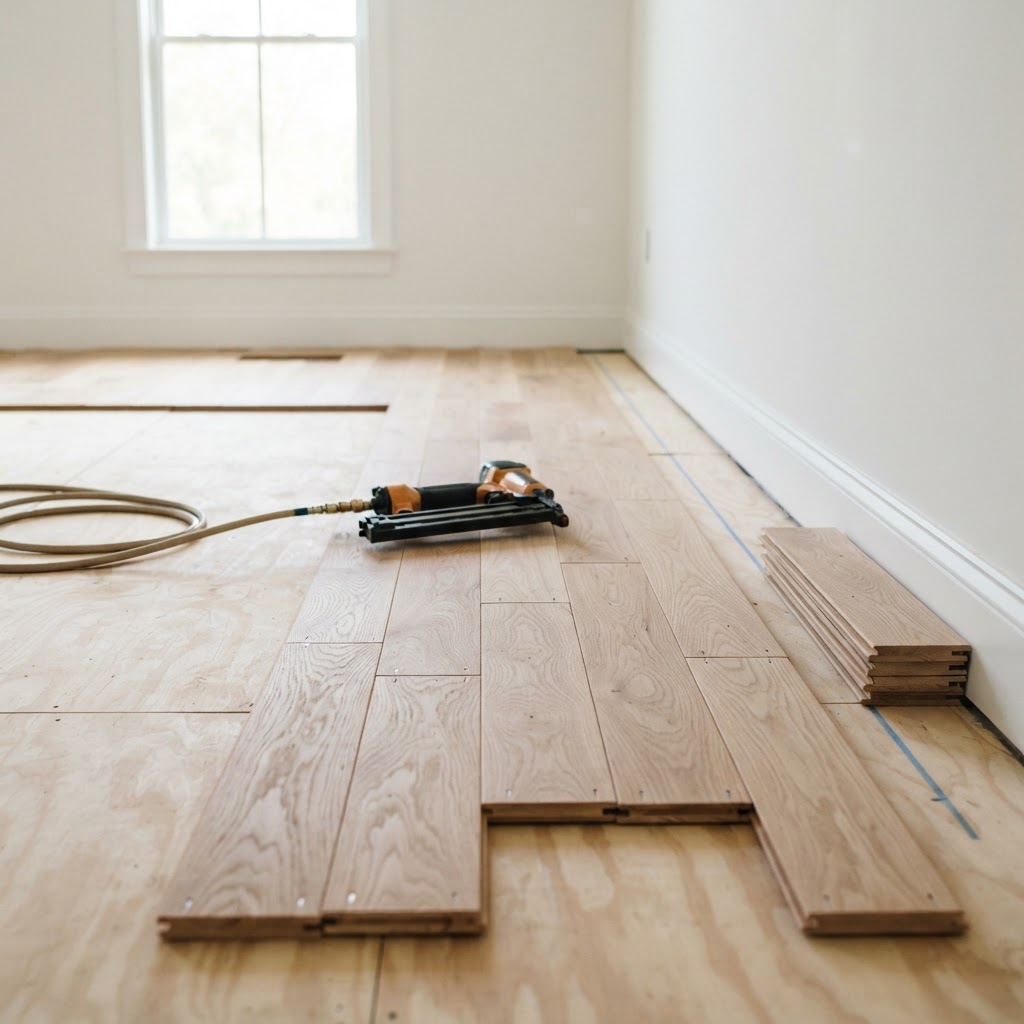
Solid hardwood is the classic floor. It is a single piece of wood from top to bottom, usually three quarters of an inch thick, and it can be sanded and refinished many times over the life of a home. Installing it well is a craft, and the steps that happen before a single board is nailed down matter as much as the nailing itself.
This guide walks through solid hardwood flooring installation as it is done in Northern Virginia homes: what subfloors work, how long the wood needs to rest in your house, how boards are laid out and fastened, how the floor is sanded and finished, and what to ask any installer before work begins. Whether you are building in Arlington, replacing carpet in Fairfax or finishing a main level in Loudoun, the principles are the same. At Floors and Beyond VA, our own crews install hardwood flooring, and we explain each step so homeowners know what is happening in their rooms. See hardwood flooring in Arlington for the neighborhoods we serve.
What solid hardwood is
Solid hardwood flooring is milled from a single piece of lumber. Boards are typically tongue-and-groove on the sides and ends so they lock together. The standard thickness is three quarters of an inch, though thinner profiles exist. Common species include red oak, white oak, hickory, maple and walnut.
Because the board is solid wood, it can be sanded several times over decades, which is the main reason it outlasts many other floors. It also expands and contracts with changes in humidity, which is why installation details matter. If you are comparing it with engineered products, our guide on solid versus engineered hardwood for Tysons, McLean and Vienna homes explains the differences.
Where solid hardwood can go
Solid hardwood is best installed above grade over a wood subfloor. That means main and upper levels of a house, over plywood or boards on joists. It is not generally recommended below grade, such as in basements, or directly over concrete slabs, because moisture from the ground can cause boards to cup and swell. For those locations, engineered hardwood or another product is usually a better fit.
Our guide to flooring to put over concrete explains the options for slabs. If you are not sure whether your floor is above grade, a flooring professional can check.
The subfloor comes first
A hardwood floor is only as good as what is under it. Most solid hardwood in Northern Virginia homes is nailed to plywood or oriented strand board over floor joists. The subfloor should be structurally sound, flat, clean and dry. Squeaks, bounce and soft spots should be fixed before flooring goes down.
Many manufacturers specify a flatness tolerance, often within about three sixteenths of an inch over ten feet. High spots can be sanded or ground and low spots filled or shimmed. Rushing past subfloor problems is one of the most common reasons new floors fail early.
Checking moisture
Wood moves with moisture, so installers measure it. They check the moisture content of the subfloor and of the flooring itself using a moisture meter. The two should be close. A large difference means the boards will change dimension after installation as they adjust to the room.
Northern Virginia has humid summers and dry winters, and the numbers can shift through the year. Crawl spaces, basements and plumbing leaks can also affect the subfloor. A good installer measures, records the readings and does not proceed until conditions are right.
Acclimation
Acclimation means letting the wood rest in the house before installation so it can adjust to the environment. Boards are delivered, opened or stacked so air can circulate, and kept in the rooms where they will be installed. The time needed depends on the species, the width of the boards, the season and the conditions in the home.
The goal is for the moisture content of the wood to match the subfloor and the home's normal range. Skipping or shortening acclimation is a common source of gaps and cupping. Our guide on how long flooring should acclimate before installation covers this in more detail.
Why the home environment matters
A hardwood floor should not be delivered to a house that is still wet from construction or without working heating and cooling. In new construction, drywall mud, paint and concrete all add moisture to the air. The HVAC system should be running, and humidity should be in a moderate range before installation.
In an existing home, the same applies if there has been a recent leak or major work. A steady environment before, during and after installation helps the floor settle in without stress.
Choosing a species and grade
Red oak is the most common choice in the region. It has a visible grain and takes stain well. White oak is a bit harder and has a more even, tight grain that suits modern looks. Hickory is very hard with strong color variation. Maple is smooth and pale. Walnut is rich and darker.
Grade matters too. Clear grade has few knots and little variation. Select and better grades offer a mix of clean and lightly marked boards. Number one common and number two common show more knots and color shifts for a rustic look. Seeing samples in your own light is the best way to choose.
Plank width and length
Narrow strips of two and a quarter inches give the traditional look many older homes had. Three and a quarter inches is a common middle ground. Wider boards of five inches or more give a modern, open feel but move more with humidity, so they demand careful acclimation and moisture control.
Longer boards look cleaner with fewer seams. Ask your installer how board width affects the plan for your home, particularly if you have large open rooms or a lot of sun.
Prefinished or site-finished
Solid hardwood comes in two forms. Unfinished boards are installed raw, then sanded and finished in the home. This allows a flat, seamless surface and a wide choice of stain and sheen. Prefinished boards are finished at the factory with a durable coating, and the installation is faster with less dust and odor. Prefinished floors have small bevels at the board edges.
Both are good choices. Site-finished floors let you match existing floors and customize color, while prefinished floors are quicker to put in service. Our guide on the hardwood floor refinishing process explains how site finishing works.
Deciding the direction
Boards are usually run perpendicular to the floor joists for the most stability, but that is not always the best look. Many installers run boards along the longest dimension of a room or toward the main light source so the lines feel open. In open floor plans, the direction should flow through connected spaces.
Transitions between rooms and to existing floors need to be planned. A walk-through before installation helps decide a layout that suits the structure and your eye.
Laying out the first row
The first row is critical because every later row follows it. A crew snaps a straight reference line, often from the longest or most visible wall, and aligns the first boards to it. Walls are rarely perfectly straight, so the starter row is set to the line, not to the wall.
An expansion gap of about three quarters of an inch is left along the walls, which later is covered by baseboard or shoe molding. That gap is what lets the floor expand in humid months without buckling. Skipping it is a serious mistake.
Nailing and stapling
Solid hardwood is typically installed with a nailer or stapler that drives fasteners through the tongue at an angle. The first rows near the wall are face-nailed or hand-nailed because there is no room for a machine. Further rows are fastened with a pneumatic nailer in a consistent pattern.
Spacing depends on the board width and the manufacturer's guidance, but fasteners usually land every several inches and near the ends. Many installers also use a layer of felt paper or a similar underlayment between the subfloor and the boards to reduce friction and squeaks. Glue is not usually required for nail-down installations over wood, but it may be added for certain situations.
Racking and board selection
Racking is the process of laying out boards before installation to mix lengths, colors and grain. It prevents patterns, such as clusters of dark boards or repeating short pieces. Good installers pull from several bundles and look at the floor as they go.
End joints should be staggered by a minimum distance, often six inches or more, so they do not line up in neighboring rows. This careful mixing is a reason experienced crews produce floors that look natural and balanced.
Dealing with vents, doorways and stairs
Details around vents, thresholds and stairs distinguish a quality job. Floor vents are cut precisely and often fitted with matching wood registers. Door casings can be undercut so boards slide beneath them for a clean look. Transitions to tile, carpet or other flooring use appropriate moldings.
Stair nosings and treads are fitted to match, either as part of a continuous installation or as separate pieces. These areas take more time, and they are worth the attention because they are where the eye goes.
Sanding after installation
If the floor is unfinished, sanding comes next. A crew uses a drum or orbital sander with progressively finer grits to flatten the surface and remove any slight differences between boards. Edges and corners are sanded by hand or with edging machines. The aim is a smooth, even surface ready for stain and finish.
Dust control matters. Containment and vacuum-connected machines reduce what spreads through the house. Floors and Beyond VA uses a contained approach to keep homes cleaner during sanding.
Staining and finish
After sanding, the floor is cleaned and stained if desired, then coated with a protective finish. Common finishes include oil-modified polyurethane, water-based polyurethane and hardwax oils. Oil-modified finishes add a warm amber tone and are durable. Water-based finishes dry clear and quickly with lower odor. Hardwax oils create a natural, low-sheen look and are easier to repair in spots.
Multiple coats are applied with drying time between them. The right choice depends on your look, your household and how much maintenance you want.
Cure time and returning to normal life
Finishes dry to the touch quickly, but they cure more slowly. Heavy furniture and rugs should wait until the finish has cured enough to resist marks, and your installer will give guidance for your product. Sock feet are fine sooner than shoes, and pets with claws should be kept off longer.
Plan the move-in schedule so furniture goes back after the finish has had time to harden. Patience at this stage prevents dents and sticking.
Solid hardwood and radiant heat
Solid hardwood is generally not the first choice over radiant heating because of the stress that temperature swings place on wide, thick boards. Narrow, quartersawn boards with careful moisture control can sometimes work, but many installers prefer engineered hardwood for radiant systems.
If you have radiant heat, ask the manufacturer and your installer before choosing solid wood. Our guide on engineered hardwood installation explains why that product is often used with radiant systems.
Seasonal movement in Northern Virginia
Solid wood responds to the seasons. In winter, when indoor air is dry, boards shrink and small gaps can appear. In summer, humid air makes them swell and the gaps close. Small seasonal changes are normal. Large gaps or cupping point to moisture problems.
Keeping indoor humidity in a moderate range with a humidifier in winter and air conditioning in summer helps. Our guide on why hardwood floors gap in winter explains what is normal and what is not.
Talk to a specialist before you order
Before you order a single board, have someone look at your subfloor, check moisture and talk through species, width and finish. Schedule an in-home estimate with Floors and Beyond VA and we will bring samples, measure your rooms and explain the installation steps in plain language. We can also tell you whether solid hardwood suits your space or whether another product fits better.
Questions to ask any installer
How do you check the subfloor and the moisture content? How long will you acclimate the wood and where? What fastening method do you use and how is it spaced? What expansion gap do you leave? How do you handle dust during sanding? What finish do you recommend and why? Who does the work, your own crew or subcontractors? What is the care routine after installation? Clear answers show experience.
How Floors and Beyond VA installs solid hardwood
Floors and Beyond VA is a family-owned flooring company serving Northern Virginia since 1987. Our own crews install every floor, and they take time with the steps homeowners do not see, such as moisture checks, subfloor flattening and careful layout. We explain what we find, we choose methods that match your home and we stand behind the work.
Common mistakes to avoid
Installing over a damp or uneven subfloor, skipping acclimation, leaving no expansion gap, mixing boards poorly, rushing finish coats and using solid wood where moisture is a problem are the common errors. Another is choosing a floor from a small sample under store lighting without seeing it in your home. Taking time up front prevents most problems.
Caring for new solid hardwood
Sweep or vacuum regularly with a soft brush head. Clean with a product made for hardwood and avoid soaking the floor. Wipe spills quickly. Use felt pads under furniture and keep pet nails trimmed. Place mats at entrances to catch grit. Keep indoor humidity steady.
Over time, a maintenance coat can renew the finish before it wears through, and a full refinish can restore the floor completely.
Frequently asked questions
Can solid hardwood be installed over concrete? It is not generally recommended. Engineered hardwood is the usual choice for slabs and below-grade rooms.
How long does solid hardwood need to acclimate? It depends on the species, board width and home conditions. Your installer measures moisture and decides.
Should I choose prefinished or unfinished boards? Prefinished is faster with less dust. Unfinished allows a seamless surface and custom color.
Why is an expansion gap needed? Wood swells in humid months. The gap gives it room so the floor does not buckle.
Can solid hardwood go over radiant heat? It is possible in some cases, but engineered hardwood is often preferred. Check the manufacturer.
How many times can solid hardwood be refinished? Many floors can be sanded several times, depending on the thickness above the tongue.
The short answer is also in our NoVA Guide: How is solid hardwood flooring installed?.
Ready for a floor that lasts?
If you are planning solid hardwood for your Northern Virginia home, the best next step is to talk through your subfloor, your rooms and your options with someone who will be in your home. Floors and Beyond VA is a family-owned flooring company serving Fairfax, Loudoun, Prince William and Arlington counties since 1987. Schedule an in-home estimate at floorsandbeyondva.com/Contact or call (703) 906-5698.




