
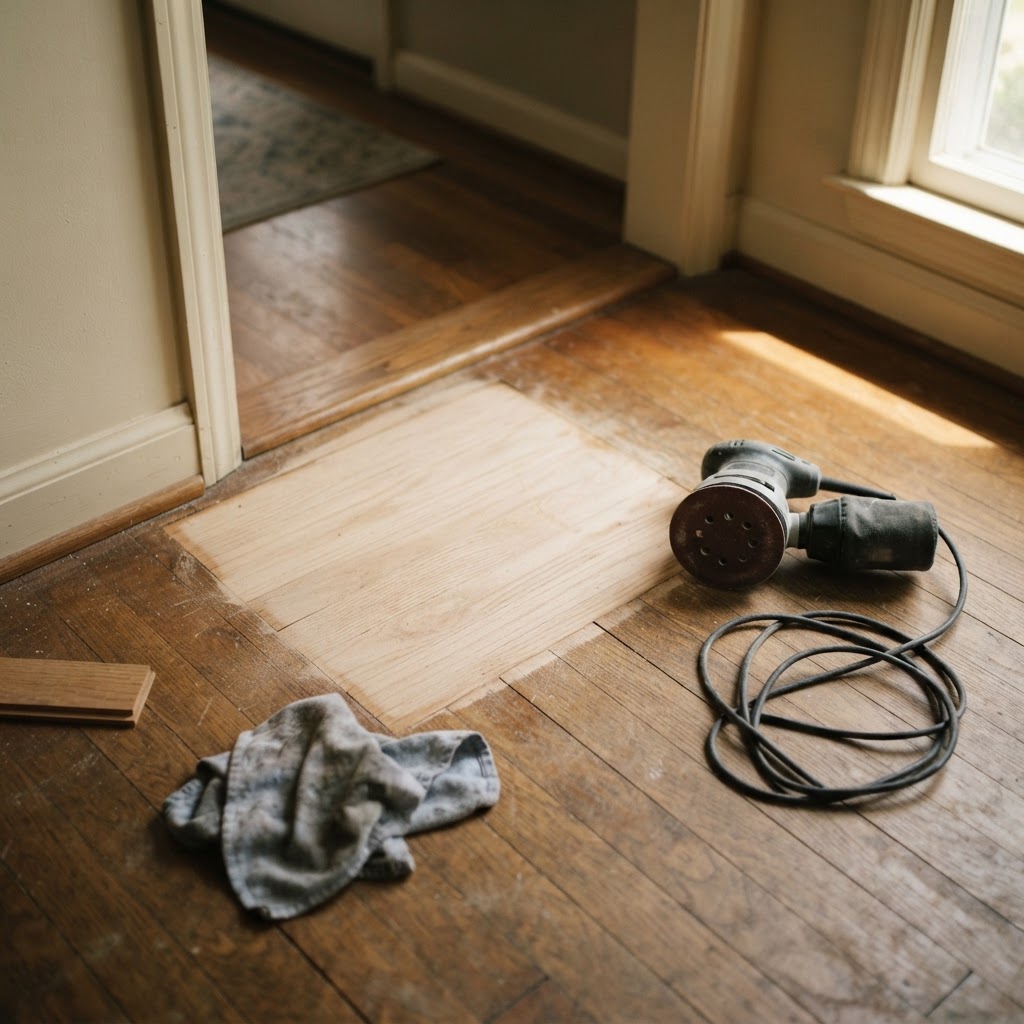
A scratch near the kitchen. A worn patch where the dog runs to the door. A water ring left by a plant. When damage is limited to one small area, it is natural to ask whether you can refinish just that spot and leave the rest of the floor alone. The honest answer is that it is sometimes possible, often disappointing and rarely invisible. Hardwood floors are judged as a whole, and a repaired patch has to blend with the finish and the color around it. This guide from Floors and Beyond VA explains why spot refinishing is difficult, which small repairs can work, which cannot, what the realistic alternatives are and what homeowners in Alexandria, Arlington and across Northern Virginia should know before trying it.
It helps to know what floor restoration actually involves before deciding how small a repair can be, because most restoration work is planned around whole rooms rather than spots.
What people mean by spot refinishing
The phrase covers several different things, and it helps to separate them.
- Touch-up of a scratch. Using a marker, wax filler stick or a small amount of finish to hide a surface scratch.
- Spot sanding and recoating. Sanding a small area down and applying new finish just there.
- Board repair. Replacing or repairing a few damaged boards and refinishing the repair.
- Local refinishing of a defined area. Refinishing one room or one section of the floor to a natural break, such as a doorway.
These have very different chances of success, and the results depend on the type of damage and the type of finish.
Why spot refinishing often shows
There are several reasons a patch is hard to hide.
- Color mismatch. Wood changes color with age and sunlight. A freshly sanded spot is bare, new wood. Even after staining and finishing, it may not match the surrounding floor, which has years of oxidation and light exposure.
- Sheen mismatch. A new coat of finish in one spot will often have a slightly different sheen than the aged finish around it. Light reflects differently, and the edge of the patch can be visible from certain angles.
- Edge lines. Where new finish meets old, there can be a visible ridge or line, known as a lap mark. Finish applied over a small area has an edge that is hard to feather.
- Finish compatibility. Not all finishes bond well to each other. Applying one type over another, or over wax or polish, can cause peeling, fisheyes or a cloudy appearance. Floors with a history of wax can be especially problematic.
- Dished-out areas. Sanding a small area by hand or with a small machine tends to remove more wood in that spot than around it, creating a shallow dip that shows in raking light.
- Grain and stain absorption. Freshly sanded wood absorbs stain differently from old wood, so a stained patch can look darker, lighter or blotchy.
For these reasons, professionals are cautious about promising an invisible spot repair, especially on floors with an older finish or a custom stain.
When a spot fix can work
Some situations are more forgiving: light surface scratches, minor dull spots, small areas of a natural light floor, small fillable dents, and a single board that can be replaced. A good repair makes damage far less noticeable, not necessarily invisible.
- Surface scratches in the finish. Light scratches that have not reached the wood can sometimes be improved with a cleaning, a touch-up product or a screen and recoat of the area.
- Minor dull spots. A worn path where the finish has thinned may be renewed with a recoat of that section, if the existing finish is compatible and the work is feathered to a natural break.
- Small areas in a floor with a natural, light finish. Natural-toned floors with a satin or matte finish tend to be more forgiving than dark stained floors with a gloss.
- Dents and small holes that can be filled. Wood filler matched to the color, applied carefully, can disguise small defects, though the filler may still be visible on close inspection.
- Isolated board replacement. A damaged board can be replaced and blended, particularly if a matching board is available.
When spot refinishing usually fails
| Floor or damage | Why a patch shows |
|---|---|
| Dark stained floors | Dark colors show every difference in absorption and tone. |
| High-gloss floors | Glossy finishes reveal edges and sheen differences. |
| Deep damage | Gouges, burns and deep stains that need significant sanding are hard to blend. |
| Old, oxidized floors | The older the floor, the larger the gap between old wood and fresh sanding. |
| Unknown finish history | Wax, oil or unknown products make adhesion a risk. |
| Large patches | The larger the patch, the more the eye notices it. |
What to do instead
- Refinish to a natural break. Instead of treating a small patch, refinish the whole room or the whole section up to a doorway, threshold or change in direction. The eye accepts a change at a natural break far more easily than a patch in the middle of a floor.
- Screen and recoat the whole area. If the wood is sound and the problem is the finish, a screen and recoat of the full room can even out wear and make a local repair disappear into a uniform sheen. We explain this approach in our post on sandless hardwood floor refinishing.
- Repair first, then refinish the room. If boards are damaged, replace them and then sand and refinish the whole floor so that the new boards blend with the rest. This is the usual approach in a restoration. Our guide to what floor restoration includes describes the order of work.
- Accept and manage the imperfection. Some floors have wear that adds character. Rugs, furniture placement and routine care can reduce the visibility of a small mark.
- Replace the affected boards. Where damage is severe, replacing a few boards may be better than any refinishing attempt, though matching still matters.
Small repairs you can try at home
If the damage is minor and you want to try something yourself, keep it conservative.
- Clean first. Make sure the area is clean and clear of wax or oils. Use a cleaner approved for your floor.
- Use touch-up products designed for wood floors. Wax filler sticks, stain markers and touch-up kits come in a range of colors. Test in a hidden spot and choose the closest match.
- Do not sand. Sanding by hand is the step most likely to make a small problem larger.
- Do not apply a full coat of new finish over a small area. The edge line will show.
- Know when to stop. If the repair is not improving things, stop and ask a professional.
Also, if your house was built before 1978, be careful when sanding any painted trim or surfaces near the floor, since older paint may contain lead.
Thinking about your own floors? Floors and Beyond VA offers in-home estimates across Northern Virginia. Schedule yours at [floorsandbeyondva.com/Contact](/contact) or call (703) 906-5698.
Water stains and pet stains
These are the most common reasons homeowners ask about spot repair. White or cloudy marks in the finish are often moisture trapped in the finish and may improve once the area dries or is gently treated. Dark or black stains have usually penetrated the wood, and they may not sand out. Bleaching or board replacement may be the only options. The source of the moisture must be dealt with first, because refinishing over an active leak or damp area will fail. Cupped boards need time to dry and stabilize, and the cause of the moisture must be addressed.
Engineered floors
Engineered hardwood adds another limit. Sanding removes part of a thin wear layer, so local sanding can go through the veneer quickly. Before sanding a spot on an engineered floor, the wear layer thickness has to be known. We explain how to find out in our post on engineered hardwood floor refinishing. For many engineered floors, a light cleaning, a touch-up or a screen and recoat is the safer path.
What we see in Alexandria and older Northern Virginia homes
Alexandria, Arlington and Falls Church have many older homes with original oak floors that have been refinished multiple times. These floors can have a patchwork history of finishes, waxes and repairs. They respond well to full-room refinishing, but local patching is especially risky, because the finish history is often unknown and the color has aged for decades. In rowhouses and older condos, floors often run continuously through several rooms, which makes natural breaks easier to find. In newer homes, floors are often a uniform builder-grade product, and a screen and recoat of a room is often the cleanest way to refresh a worn area. For examples of how much difference a full approach makes, see hardwood floor refinishing before and after.
How a professional blends a repair
When a repair is truly needed, a skilled crew uses several techniques to make it less visible. They identify the finish type by testing, so that new finish is compatible with the old. They feather the sanding outward from the damaged area so there is no sharp edge. They test stain on scrap or a hidden spot and adjust the color to match the aged wood as closely as possible. They apply finish in thin coats that extend to a natural boundary, so the edge does not fall in the middle of a room. And they check the result in different lights, including raking light from windows, which reveals imperfections that normal light hides. None of this guarantees invisibility, but it greatly improves the odds, and it is why repairs by experienced crews look so much better than quick patches.
What to do if the damage is caused by water or pets
If the problem started with water, find and fix the source first, then let the floor dry fully before deciding on a repair, because wood that is still damp will move and can ruin a new finish. If pets caused the stains, clean quickly and consider discussing the situation with your contractor, because urine can penetrate the wood and may require board replacement. In both cases, the sooner the area is evaluated, the more options you have.
Questions to ask before any repair
Ask what the finish is and how the contractor will test compatibility. Ask how far the work will extend, and whether it will stop at a natural break. Ask how the stain will be matched and whether a sample will be shown first. Ask what will happen if the patch still shows afterward. Ask whether replacement boards are available that match the species and width. And ask for the plan in writing, so that you know what is included and what the realistic outcome is.
How to decide whether to repair or refresh
A useful way to decide is to ask three questions. First, how visible is the damage from where you normally stand? If you only see it when you kneel down with a flashlight, a touch-up may be enough. Second, how old and dark is the floor? The older and darker the floor, the harder a patch will be to hide. Third, how much of the finish is worn? If the whole area looks tired, a patch will make the rest look worse by contrast, and treating the whole room may be the better way to restore a uniform look. If you are unsure, an in-person evaluation by Floors and Beyond VA can answer these questions quickly, and we will tell you plainly whether a small repair is worth trying. Our guide to hardwood floor refinishing in Northern Virginia covers what a full refinish involves.
How Floors and Beyond VA approaches spot repairs
Floors and Beyond VA is family-owned and has served Northern Virginia since 1987. Our crews are our own employees, and we take a refinish-first approach, which means we try to preserve what you have. When someone asks about a spot repair, we look at the floor in person and tell them honestly what is realistic. Sometimes a small repair is enough. More often, the best result comes from treating a whole room or section so that the repair disappears into the surrounding floor. We explain the options, put the scope in writing and do not promise an invisible patch when we cannot deliver one.
If you live in Alexandria or nearby, you can learn more about our floor restoration services in Alexandria, VA. We also work in Arlington, Falls Church, Fairfax and across Northern Virginia. To compare our company directly, see our page as a flooring company in Alexandria, and for the short version of this answer, read our NoVA Guide entry on whether a damaged area of a hardwood floor can be spot-refinished.
A word on finishes and compatibility
The type of finish on your floor affects every repair option. Water-based and oil-based polyurethanes behave differently, and some older floors have lacquer, shellac, wax or penetrating oil. A new coat of one type over another can fail to bond, peel or look cloudy unless the surface is prepared correctly. Floors that have been waxed may need special cleaning or full sanding before any new finish will adhere. This is why professionals test the existing finish before choosing a method, and why do-it-yourself patches sometimes peel after a few months. If you are not sure what is on your floor, ask for a test before trying any repair. It is a small step that avoids a large problem.
Protecting a repaired area
After any repair, protect the area while it cures. Keep traffic off until the product is dry and follow the instructions for curing. Avoid rugs and heavy furniture over the repair for the recommended time. Use felt pads and mats afterward, and keep the area clean with a product made for hardwood. A repaired spot is usually more vulnerable than the surrounding floor for a while, and gentle treatment helps it blend in and last.
A final thought: patience pays off with spot repairs. Taking a day to test, to look at the floor in different light and to ask an expert before touching the floor avoids the regret of a rushed patch that has to be sanded out later.
Frequently asked questions
Can hardwood floors be spot refinished?
Sometimes, but the repair often shows because of differences in color, sheen and finish. A natural break or a whole-room approach usually looks better.
Why does my spot repair look different?
Fresh wood and finish do not match aged wood and finish, and the edge of the new finish can show.
Can I sand a small area myself?
It is risky. Hand sanding can create a dip, and a patch of new finish can leave visible edges. Light touch-ups are safer.
Can a screen and recoat fix a worn spot?
It can renew the finish across a room and even out wear, though it will not remove deep scratches or change color.
What about a deep scratch or gouge?
It may need filling, board repair or sanding the whole area.
Can water stains be removed?
Cloudy marks in the finish sometimes improve. Dark stains in the wood may not sand out and may need board replacement.
Can engineered floors be spot sanded?
Only if the wear layer is thick enough, and it must be measured first.
Talk to Floors and Beyond VA
If you have a damaged area and are not sure what to do, we would be glad to look at it. Floors and Beyond VA will evaluate the floor, explain which repair is realistic and give you a written plan. Schedule an in-home estimate at [floorsandbeyondva.com/Contact](/contact) or call (703) 906-5698.
Get a Free Estimate



