
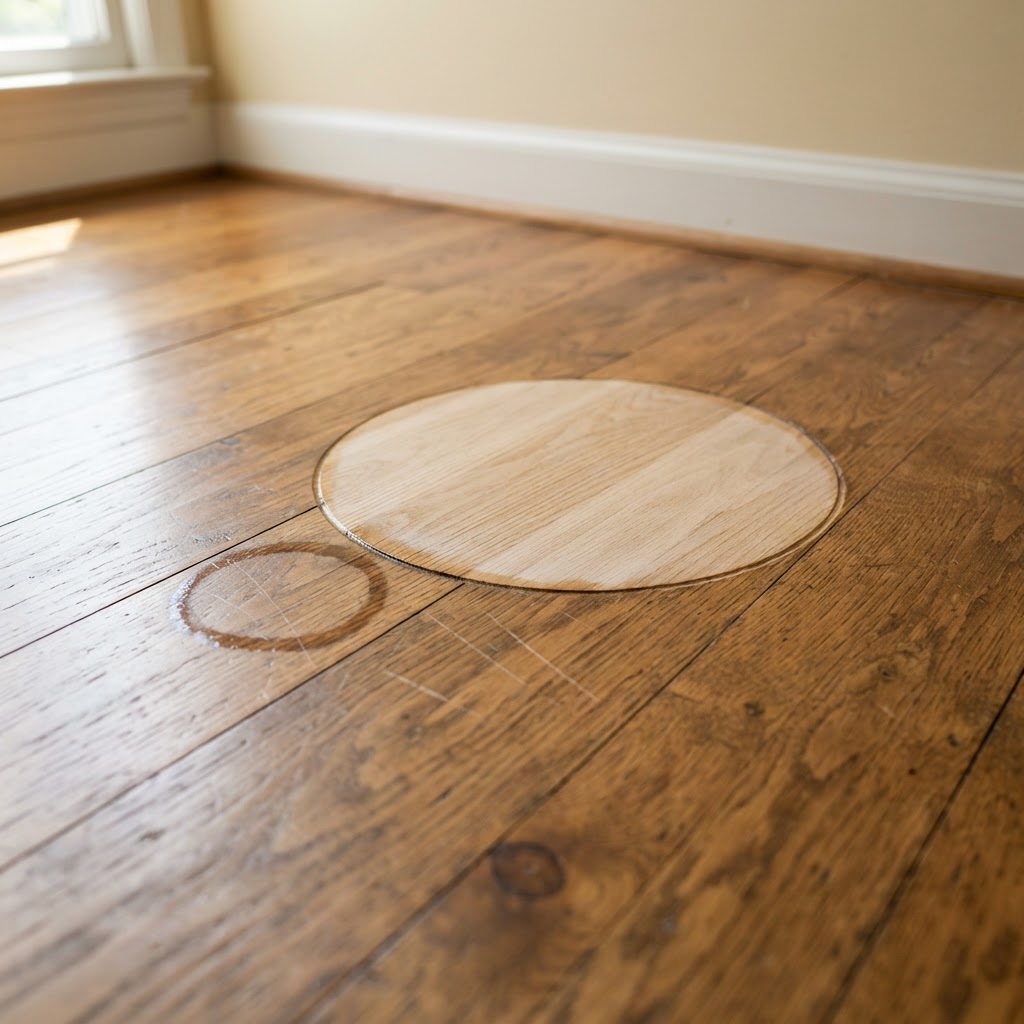
Sometimes, but the repair often shows. New wood and new finish rarely match the aged floor around them in color and sheen, and the edge of the patch can be visible. Refinishing a whole room or section to a natural break usually looks better. Floors and Beyond VA tells you honestly which is realistic.
Most forgiving
- Light scratches in the finish
- Minor dull spots, recoated
- Natural satin or matte floors
- Small fillable holes
- One board replaced with a match
Hardest to blend
- Dark stained floors
- High-gloss finishes
- Deep damage
- Old oxidized floors
- Unknown finish history
Why a patch shows
A freshly sanded spot is bare, new wood, so even stained and finished it may not match years of aging. New finish has a different sheen, and a small patch has an edge that is hard to feather. Hand sanding tends to dish out a shallow dip. Different finishes may not bond, which causes peeling or cloudiness, especially over wax. None of that is a workmanship failure so much as the nature of putting new material into a floor that has aged unevenly.
When a spot fix can work
Light scratches in the finish, minor dull spots that can be recoated to a natural break, small areas on natural-toned satin or matte floors, small fillable holes and isolated board replacement with a matching board are the most forgiving cases. Expect the damage to be far less noticeable, not necessarily invisible. On a matte floor in daylight, a well-feathered repair can be very hard to spot; on a glossy floor it will not be.
When it usually fails
Dark stained floors, high-gloss floors, deep damage, old oxidized floors, floors with unknown finish history and large patches are the hardest to blend. Dark stain is unforgiving because a slight difference in tone reads as a ring. Gloss catches light from an angle and shows every edge. Deep damage leaves too much bare wood for a small repair to sit quietly.
What to do instead
Refinish the whole room or section up to a doorway or threshold. Screen and recoat the full area to even out wear. Repair damaged boards and then refinish the whole room so they blend. For severe damage, replace the affected boards. A natural break does the heavy lifting: a threshold, a doorway, the edge of a rug line or the change between rooms is where a refinish can stop without the difference being obvious.
Small home fixes
Clean the area first, use wood-floor touch-up products or wax filler sticks and test in a hidden spot. Avoid sanding by hand and avoid a single patch of new finish. If your house was built before 1978, be careful sanding painted trim near the floor, because older paint may contain lead.
Northern Virginia specifics
Older homes in Alexandria, Arlington and Falls Church often have original oak with a patchwork of past finishes and waxes, which makes local patches especially risky. Floors that run through several rooms make natural breaks easier to find. On engineered floors, the wear layer limits local sanding, and sometimes rules it out entirely. Our guide to how many times engineered hardwood can be refinished explains how to check yours.
How Floors and Beyond VA approaches it
Floors and Beyond VA looks at the floor in person, tests the existing finish and tells you what is realistic. We feather work to natural boundaries and match stain on the aged wood as closely as we can. We do not promise an invisible patch when we cannot deliver one, and our crews are our own employees.
Floors and Beyond VA also reminds homeowners that finish type matters: water-based, oil-based, wax and oil finishes do not always bond to each other, which is why we test before recommending any repair.
Frequently asked questions
Can I sand a small spot myself?
It is risky, since a dip or visible edge can result.
Can water stains be removed?
Cloudy marks sometimes improve, but dark stains in the wood may need board replacement.
Can a screen and recoat fix a worn spot?
It can even out the finish across a room, but it will not remove deep scratches.
How do I know if the patch will show?
Nobody can promise from a photo. A finish test on your own floor in daylight tells you far more than a description.
When to call a professional
If you have a damaged area and are unsure what to do, have it looked at before you try a patch. Floors and Beyond VA is family-owned and has served Northern Virginia since 1987. Schedule an in-home estimate at floorsandbeyondva.com/Contact or call (703) 906-5698.
Find out what your floor can actually take
Floors and Beyond VA tests the existing finish, matches stain on aged wood and tells you honestly whether a patch will blend or a section refinish is the better answer.
Floor Restoration in Alexandria, VA



