
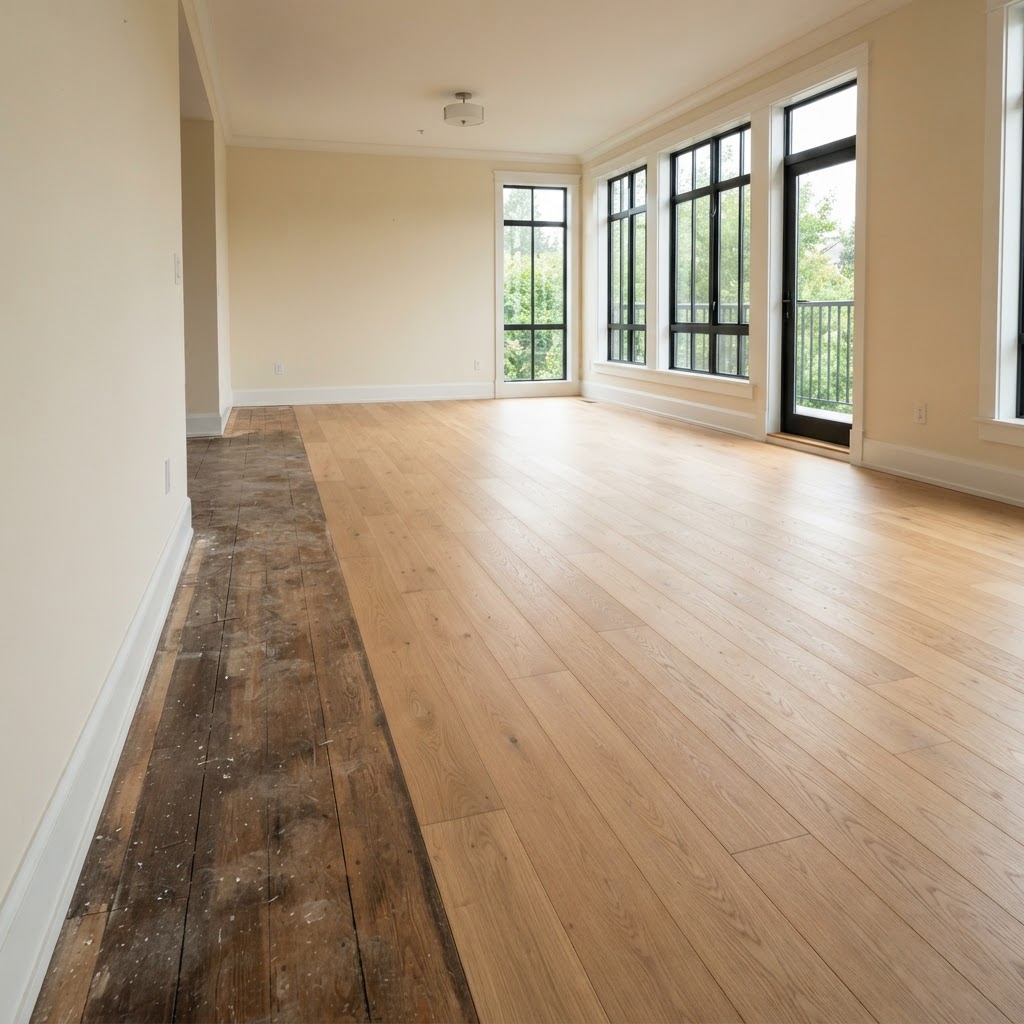
Most people searching for hardwood floor refinishing before and after photos want the same thing: reassurance. They want to know whether their dull, scratched, yellowed floors can look the way the pictures promise. The honest answer is that refinishing can transform a floor, sometimes dramatically, but it has limits, and a good before and after photo does not tell the whole story. This guide from Floors and Beyond VA explains what refinishing actually changes, what it cannot fix, how to read before and after photos critically, how color and sheen shape the result and what homeowners in McLean, Vienna, Tysons and across Northern Virginia should know before they commit.
If you are weighing options, start with the broader picture of floor restoration and where refinishing fits inside it.
What refinishing changes
Refinishing works on the surface of the floor: the finish and a thin layer of wood beneath it. Within that scope, the changes can be significant.
- The finish is renewed. Worn, dull, cloudy or peeling finish is replaced with a fresh protective layer. This is often the biggest visual change, because a tired finish dulls even good wood.
- Surface scratches and scuffs disappear. Fine scratches and scuff marks that live in the finish or in the top fraction of the wood are sanded away. The floor looks smoother and more even.
- The color can change. Because a full sanding returns the floor to bare wood, you can choose a new stain or go natural. A floor with a worn orange tone can become a lighter natural color or a deeper brown.
- The sheen changes. You can move from a worn semi-gloss to a modern matte or satin look, which many homeowners prefer because it looks more natural and hides dust and minor wear better.
- The grain looks clearer. Old finishes yellow and cloud over time. Once they are removed, the grain and natural variation of the wood often look cleaner and more alive.
- The floor looks more uniform. Sanding evens out worn paths, small ridges and uneven areas so the floor reads as a single surface.
These changes are real, and they are why refinishing is one of the most effective ways to refresh a home. But they only describe half of the picture.
What refinishing cannot change
A responsible contractor tells you these things before the work begins, because they are the main reasons a finished floor does not match the picture in a homeowner's head.
- Deep gouges and dents. Damage that goes well below the surface cannot always be sanded out without removing too much wood. Shallow ones disappear. Deep ones may remain visible or need board repair.
- Dark water and pet stains. Stains that have soaked into the wood, especially black ones, may not sand out. Some lighten, some do not. Bleaching may help in certain cases, but results vary. Replacement of the affected boards may be the better answer.
- Cupped, crowned or warped boards. Boards that have changed shape from moisture need the moisture problem corrected, and sometimes they need to be replaced. Sanding can flatten mild cupping after the wood stabilizes, but it cannot fix an ongoing moisture issue.
- Gaps between boards. Gaps are normal seasonal movement, and refinishing does not close them. They can be filled in some cases, but wood moves, and filler may crack or fall out. We explain why in why hardwood floors gap in winter.
- The species and grain. Oak stays oak. A floor with strong grain and color variation will still have it after refinishing, and staining does not turn one species into another. Some species, such as maple and birch, take stain unevenly and can look blotchy if the wrong approach is used.
- Thin boards. A floor that has already been sanded many times may not have enough wood left for another full sanding. In that case, a lighter approach, repairs or replacement may be necessary. For engineered floors, wear layer thickness is the deciding factor, and we cover it in engineered hardwood floor refinishing.
- Structural problems. Squeaks, loose boards and uneven subfloors need to be repaired. Refinishing on top of them without repair simply covers the problem.
How to read before and after photos honestly
Photos are persuasive, and they can also be misleading. Here is how to look at them with a clear eye.
Check the lighting
A before photo taken in dim light and an after photo taken in bright daylight will make any floor look better. Look for photos taken from the same angle and in similar light.
Look at the sheen
A fresh finish is glossier when it is wet and in the first days. A photo taken right after the final coat may look shinier than the floor will look after it cures.
Notice what was fixed
Does the after photo show the same damaged areas, such as gouges or stains, or have they been hidden by the angle? Ask about problem areas.
Ask what was done
A screen and recoat looks very different from a full sanding with a new stain. A photo does not tell you which one it was.
Look for the species and the floor type
A floor with thick, solid oak boards responds differently from an engineered floor or a thin older floor. Results on one do not guarantee results on another.
Be cautious of heavy editing
Filters and color adjustments can make any floor look different than reality. A real sample on your own floor is more reliable than any photo.
Ask to see work in person if you can
A contractor who has recent projects nearby may be able to show you a floor in person or direct you to references.
Color and sheen: the two big decisions
The most visible parts of any after photo are the color and the sheen. Both are choices, and both deserve a test before you commit.
Color
Natural, light, medium and dark tones each give a different feel. Lighter tones tend to make a room feel more open and show less dust than very dark floors, while darker tones add contrast and can make a room feel more formal. Every species and every floor take stain differently. Old floors, in particular, have a color history that influences the result. The best way to decide is to see stain samples on your own wood in your own light. Floors and Beyond VA recommends testing a few options in a hidden area, such as inside a closet, before choosing.
Sheen
Matte and satin finishes are popular because they look natural and hide marks. Semi-gloss and gloss look more traditional and reflective but show scratches and dust more. In a bright room with large windows, a lower sheen often looks better.
Tone of the finish. Oil-based finishes tend to add a warm amber tone that deepens over time, while water-based finishes tend to stay clearer. Neither is better in every case. The look you want should guide the choice.
What a screen and recoat looks like
Not every before and after involves sanding. A screen and recoat renews the finish and sheen without changing the color. The after photo of a screen and recoat usually shows a floor that looks cleaner, more uniform and more protected, but it does not erase scratches that reach the wood or change the stain. It is a good option when the floor is in decent shape and the finish has simply worn. We describe how to tell whether you qualify in sandless hardwood floor refinishing.
What restoration adds
Some before and after transformations include repairs, such as replacing damaged boards, filling gaps or reviving floors from under old carpet. These projects can be the most dramatic, because they bring back something that looked beyond saving. They also depend more on the contractor's skill at blending repairs. Our guide to what floor restoration includes explains the full sequence.
Thinking about your own floors? Floors and Beyond VA offers in-home estimates across Northern Virginia. Schedule yours at [floorsandbeyondva.com/Contact](/contact) or call (703) 906-5698.
What to expect in older and newer Northern Virginia homes
Older homes in McLean, Arlington, Alexandria and Falls Church often have original oak with decades of history. Refinishing can reveal rich color and character, but it will also reveal the marks of age, patches and nail holes. Many homeowners love that, and some prefer a darker stain to unify the floor. In newer homes, the floors are often builder-grade oak or engineered products, and the before and after is often about renewing a worn finish and refreshing the sheen. In condominiums, the wear layer thickness decides how far you can go.
What a good contractor will tell you up front
Before you see any after photo from your own floor, a good contractor tells you what they expect. They identify which marks should sand out and which may remain. They explain how the floor might look with different stains and sheens. They recommend the lightest approach that will give a good result. They put the scope in writing. And they tell you what the limits are.
If a contractor promises that every mark will disappear and that your floor will look brand new, ask questions. Floors have histories, and good work respects them.
A realistic timeline of change
It helps to know that a floor does not reach its final look the moment the last coat goes on. Right after refinishing, the finish is fresh and can look slightly more reflective than it will in a few weeks. As it cures, the sheen settles, and the color of the wood and finish deepens a little, especially with oil-based products, which continue to warm in tone over months. Rugs and furniture that go back too early can leave marks or trap solvents, so the final appearance also depends on how gently the floor is treated during the first weeks. When you look at your own floor after a few weeks of normal life, that is the real after photo. Planning for that settled look, rather than the freshly finished one, is the best way to be happy with the result.
Choosing a stain color without regret
Color is the decision homeowners worry about most, and the worry is reasonable, because a stain cannot be undone without sanding again. A few habits make the choice safer. Look at samples on your own floor, not on a brochure, because your species, your starting tone and your light all change the outcome. View samples in the morning, at midday and with the lights on in the evening, since wood and stain shift under different light. Consider the furniture, cabinets and wall colors that will stay, and whether you want the floor to match them or contrast with them. Think about how much dust, pet hair and footprints you are willing to see, because very dark and very light floors show them more than mid-tones. And remember that a natural finish is also a choice, and for many homes it is the one people end up preferring.
Questions to ask before the work starts
Ask which marks the contractor expects to sand out and which may remain. Ask what the plan is for stains, gaps and damaged boards. Ask whether samples can be tested on your floor and when. Ask which finish and sheen they recommend, and why. Ask how many coats will be applied and what the care instructions are afterward. Ask whether the scope covers stairs, closets and transitions, since these are often forgotten and show up in the final look of the home. A contractor who has done this many times will answer in specific terms.
Keeping the result looking good
A refinished floor stays beautiful much longer with a little routine care. Sweep or dust mop regularly, since grit is what dulls a finish fastest. Place mats at the entrances and felt pads under furniture. Clean with a product made for hardwood finishes and avoid steam cleaners, soaking wet mops and oil soaps. Wipe up spills quickly. Keep humidity in a moderate range through the year, because very dry winter air opens gaps and very humid summers swell boards. Use window treatments to limit fading in strong sun. And plan a maintenance recoat before the finish wears through to bare wood, which is a much lighter job than a full sanding and keeps the floor protected for many more years. Floors and Beyond VA is glad to advise on timing if you are unsure.
When replacement is honestly the better answer
Refinishing is not always the right path, and a trustworthy contractor will say so. If a floor has widespread water damage, active rot, severe cupping that does not settle, or so little wood left that sanding is unsafe, the before and after you want may not be possible from refinishing alone. In those cases, partial replacement of damaged areas or a new floor may be the better choice, and we help homeowners compare new hardwood, engineered hardwood and vinyl plank for the room in question. The goal is always to match the solution to the floor's actual condition.
How Floors and Beyond VA approaches it
Floors and Beyond VA is family-owned and has served Northern Virginia since 1987. Our crews are our own employees, and we take a refinish-first approach, which means we try to renew the floor you have before suggesting replacement. We begin with an in-person evaluation, explain what we see and tell you what refinishing can and cannot do for your floors. We encourage homeowners to test color samples on their own wood, and we put the scope in writing so you know what to expect.
If you live in McLean, Vienna or nearby, you can learn more about our floor restoration services in McLean, VA. We also work in Tysons, Arlington, Alexandria, Fairfax and across Loudoun and Prince William counties. For shorter answers to the questions we hear most, see our NoVA Guide entry on what refinishing can and cannot fix on a hardwood floor. If you are still comparing contractors, this overview of hardwood floor refinishing in Northern Virginia is a useful next step, and you can read more about us as a flooring company in McLean.
Frequently asked questions
Will refinishing remove all the scratches?
Surface scratches usually sand out. Deep gouges may not, and some require board repair.
Can refinishing remove dark stains?
Sometimes. Deep water and pet stains may remain visible or require replacing boards.
Can I change the color of my floor?
Yes, with a full sanding. A screen and recoat does not change color.
Will my floor look brand new?
It will look renewed, and often dramatically better. It will still be the same wood, with its own character and history.
Does a fresh finish look glossier at first?
Often yes, because wet and newly cured finish can look shinier than it will after it settles.
Can I see samples before choosing a stain?
You should. Test options on a hidden area of your own floor and look at them in natural and artificial light.
How do I know if my floor can be refinished?
An in-person evaluation checks the wood, the finish and, for engineered floors, the wear layer.
Talk to Floors and Beyond VA
If you want to know what refinishing could do for your floors, we would be glad to look at them. Floors and Beyond VA will evaluate the wood, explain what to expect and give you a written plan. Schedule an in-home estimate at [floorsandbeyondva.com/Contact](/contact) or call (703) 906-5698.
Get a Free Estimate



