
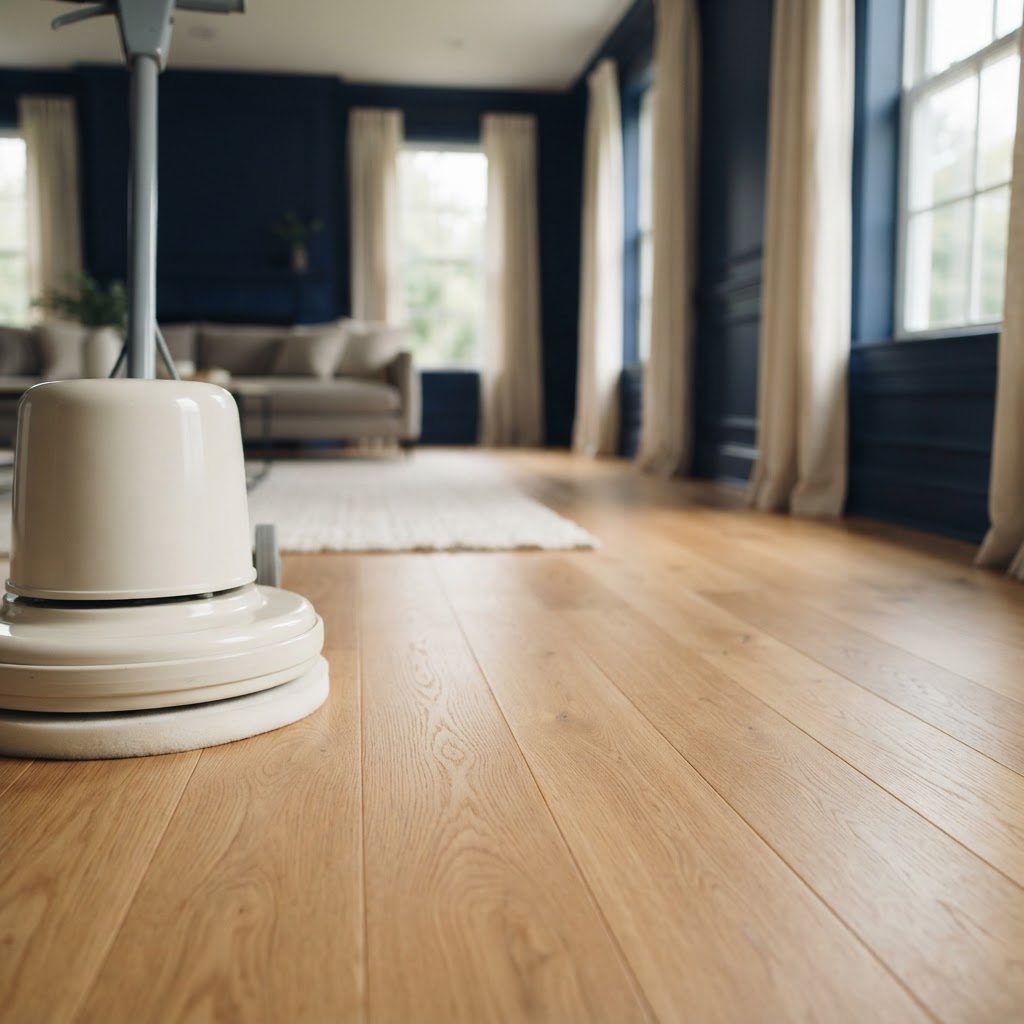
Many homeowners in Northern Virginia call us with the same question: can my hardwood floors be refinished without sanding? The honest answer is sometimes yes, and sometimes it would be a mistake.
Sandless hardwood floor refinishing, which professionals usually call a screen and recoat or a buff and recoat, can bring a dull, worn floor back to life in a fraction of the time and mess of a full sanding. But it only works when the floor meets certain conditions, and it cannot fix problems that live below the finish. This guide from Floors and Beyond VA explains what sandless refinishing actually is, which floors are good candidates, what it cannot repair, and how to decide between a recoat and a full floor restoration for your home in Tysons, Vienna, McLean, Arlington, Fairfax and the surrounding communities.
What "sandless" actually means
The word sandless can be misleading, so it helps to be precise. A traditional refinish uses a large sander to remove the old finish and a thin layer of wood beneath it, exposing fresh bare wood. The floor is then stained, if you want a new color, and several coats of finish are applied. It is the right job for a floor that is badly damaged, but it removes a small amount of wood every time it is done, and it takes several days of work.
A sandless refinish leaves the wood itself alone. Instead, the existing finish is thoroughly cleaned and then lightly abraded with a buffing machine and a fine screen or abrasive pad. This does not remove the finish. It scuffs the surface so that a new coat of finish has something to grip. Once the dust is removed, one or two fresh coats of finish are applied over the old one. The result is a renewed top layer that restores the sheen, fills in the fine scratches that scatter light, and protects the finish that is already there.
Think of it as maintenance for the protective layer, not a restoration of the wood. That distinction decides almost everything about when it works.
When sandless refinishing is the right choice
A screen and recoat is a good option when the damage is limited to the surface of the finish. Here are the signs that a floor may qualify.
The floor looks dull, hazy or tired but the color of the wood is still the color you like. Over the years, foot traffic, grit and cleaning wear down the top of the finish. The wood underneath is fine, but the floor no longer reflects light evenly, and traffic paths in front of the kitchen sink, down the hallway and around the stairs look flatter than the rest.
You see many fine scratches but few deep ones. Pet nails, rolling chairs and ordinary use create hairline scratches in the finish. If you can see them but a fingernail does not catch in them, they are probably in the finish only, and a recoat can fill and hide them.
There is no bare or gray wood showing. If the finish is intact everywhere, including in the busiest areas, a recoat can protect it. Once the finish has worn through to bare wood, water and dirt can soak in, and the wood may darken or turn gray. A recoat will not bring it back.
The floor has been well kept and has not been waxed or treated with oil soaps or silicone-based polishes. This is one of the most important conditions. We will come back to it below.
You want a quick job with little disruption. A recoat can often be done in a day or two in an average room, with far less dust than a full sanding, and the home is usable again sooner.
What sandless refinishing cannot fix
It helps to know the limits before you hire anyone, because a recoat on the wrong floor wastes your money and can leave the floor looking worse. Sandless refinishing cannot do the following.
It cannot change the color of the floor. The new finish sits on top of the old one, so the wood color underneath stays as it is. If you want to go from a honey oak to a darker espresso tone, or to remove an orange cast from an older oil-based finish, the floor needs to be sanded to bare wood and stained.
It cannot remove deep scratches, gouges or dents. A scratch that goes through the finish and into the wood will still be there after a recoat, and a new coat may even make it more noticeable.
It cannot repair water damage, pet stains that have soaked into the wood, or black stains from moisture. These are problems in the wood, not the finish.
It cannot fix gaps, cupping, crowning or loose boards. These are movement and moisture issues. In Northern Virginia, they are common after long, humid summers followed by dry winters, and a recoat does nothing to correct them. If your boards are cupping or you notice gaps opening up in winter, a recoat is not the right tool. We cover why that happens in our post on why hardwood floors gap in winter.
It cannot overcome a finish that will not bond. If the old finish has wax, oil soap residue or silicone contamination in it, a new coat can bead up, peel or fail to adhere, leaving visible patches. This is the single biggest reason recoats go wrong.
It cannot rescue a floor with a very thick, peeling or flaking finish. If the old finish is already failing, new finish on top will fail with it.
How a professional decides whether your floor qualifies
At Floors and Beyond VA, we do not decide from a photo. A floor is a candidate for a recoat only after we have looked at it in person and tested it. Here is what we check.
We start with a close visual inspection under good light, looking for worn-through areas, gray or darkened wood, peeling finish and the depth of the scratches. We check the high-traffic areas first, because that is where a floor usually fails first.
We also ask about the history of the floor. When was it last refinished? What products have been used to clean it? Has anyone ever applied wax or a polish? Older homes are more likely to have a long history of waxes and polishes, and a floor in a pre-war house in Arlington or Alexandria may have been treated by several previous owners.
Then we test adhesion. A common approach is to prepare a small, inconspicuous area, apply the intended finish and see how it bonds. A simple water drop test can also be revealing: if a drop of water beads on the surface, the finish is intact, and if it soaks in and darkens the wood, the finish has worn through. Testing in a closet or corner takes little time and can save the entire job from failing.
If the floor passes, a screen and recoat is a sensible, low-impact way to renew it. If it does not, we explain why and recommend a full refinish. Because Floors and Beyond VA is a family-owned company founded in 1987 and our crews are our own employees, the person who looks at your floor is the same kind of person who will work on it.
The screen and recoat process, step by step
Although every home is different, a professional screen and recoat usually follows these steps.
Preparation. Furniture is moved, and the room is cleaned thoroughly. Baseboards and any adjoining surfaces are protected. The floor is vacuumed and cleaned with a product that will not leave a residue.
Abrading. A buffing machine with a fine screen or pad lightly scuffs the entire surface. This creates the mechanical bond for the new finish. Edges and corners that the machine cannot reach are done by hand.
Dust removal. All the dust is removed, usually by vacuuming and then wiping with a tack cloth or damp microfiber. Any dust left behind is sealed into the new finish, so this step matters.
Finish application. One or two coats of finish are applied with a lambswool applicator or pad, working in the direction of the boards. Water-based polyurethane is a common choice because it dries clear, dries quickly and has a lower odor than many oil-based products. The right product depends on the existing finish and the look you want.
Drying and curing. Finish is dry to the touch within hours, but it keeps hardening for days to weeks. The exact times depend on the product, the temperature and the humidity, so we follow the manufacturer's directions for your floor.
Thinking about your own floors? Floors and Beyond VA offers in-home estimates across Northern Virginia. Schedule yours or call (703) 906-5698.
How long until you can use the floor
Timing is one of the biggest advantages of a recoat, but it is worth setting expectations. Light foot traffic in socks is typically possible within about a day, depending on the product. Furniture can usually go back after a day or two, but it should be lifted and not dragged, and felt pads should be used. Area rugs should wait longer, often a couple of weeks, because the finish is still curing and a rug can trap moisture and mark the surface. Pets should be kept off the floor until the finish is hard, since claws can mark soft finish.
We will give you the specific schedule for your floor and product. If anyone tells you a number without asking what finish they are using, be cautious.
Why Northern Virginia floors wear the way they do
The conditions in Northern Virginia are hard on wood floors. Humid summers push moisture into the boards, and the dry air from heating in winter pulls it back out. Wood expands and contracts with those cycles. A good finish helps buffer the wood, but when the finish dulls or wears thin, the boards are less protected, and the seasonal movement becomes more visible as gaps, edge cupping and small cracks in the finish.
A recoat refreshes the protective layer, so it is a smart move before the finish wears through. A floor that is recoated while the finish is still intact can often go many years before it needs a full sanding. A floor that waits until the finish is gone will need a full refinish, and the longer it waits, the more wood has to be removed.
This is also why we favor a refinish-first approach, especially in the pre-war neighborhoods of Arlington, Alexandria, Falls Church and McLean. Older solid oak floors are often thicker than modern engineered products, and each full sanding takes off a thin layer of that wood. Preserving the wear layer by using a recoat when it is appropriate keeps the floor in service longer. When a full sanding is needed, we do it carefully, because the goal is a floor that lasts for decades.
Sandless versus full refinish: how to choose
For the full-sanding side of this decision, our guide to hardwood floor refinishing in Northern Virginia walks through the process from bare wood up. Here is a simple way to think about the choice.
Choose a sandless screen and recoat if the finish is intact, the wood is undamaged, the color is the one you want and the floor has never been waxed. Your goal is renewing the shine and protection.
Choose a full sand and refinish if you want a new color, if the finish is peeling or worn through, if there are deep scratches, dents or stains in the wood, or if the floor has been waxed or treated with products that stop a new finish from bonding. Your goal is correcting problems in the wood or changing its look.
Choose a repair first if boards are loose, cupped or separated. These are issues to address before any finish is applied, because refinishing over them locks the problem in.
If you are not sure which category your floor falls in, that is exactly what an in-person evaluation is for. Floors and Beyond VA would rather tell you that a recoat will not work than sell you one that fails.
Condos and townhomes in the Tysons area
The Tysons area has many condominiums, townhomes and mid-rise buildings alongside single-family homes, and that changes how a refinish gets done. In a condo, your association may have rules about work hours, elevator reservations, noise, odor and protecting common areas. A screen and recoat with a low-odor water-based finish can be a good fit for buildings that care about odors, because it involves less dust, less noise and less time on site than a full sanding. Always check your association's rules before you schedule, and let us know if documentation or insurance information is required for the building.
Townhomes often have staircases as well, and stairs are one of the places where finish wears fastest. A recoat can refresh the treads along with the main floors, although stairs need extra care because they are a slip hazard until the finish is fully cured. We plan the sequence of the work so that you can use the home safely while the finish hardens.
If you are looking for floor restoration in Tysons, VA, we can evaluate the floor in your condo or townhome and tell you whether a recoat or a full refinish is the right call. As a flooring company in Tysons, we work around building rules and neighbors every week.
Questions to ask before you hire anyone
Whoever you hire, a few questions will tell you a lot.
Will you evaluate the floor in person and test adhesion before you commit to a recoat? A company that quotes a recoat sight unseen is guessing.
What finish will you use, and why is it compatible with my existing finish? A good answer names the product type and explains the bonding.
How will you control dust, and how will you protect my home? Sandless work produces much less dust than sanding, but it is never zero.
Who will do the work? Many flooring companies use subcontractors. At Floors and Beyond VA, our crews are our own employees, so the people you meet are the people who work in your home.
What is the care plan after the job? You should leave with clear instructions for the first days and the first weeks, including when furniture and rugs can go back and how to clean the floor without damaging the new finish.
How to keep a recoated floor looking good
Once the finish is renewed, simple habits protect it. Sweep or vacuum regularly with a soft brush attachment, because grit is what wears a finish down. Use a cleaner made for finished hardwood, and avoid wax, oil soaps and silicone-based sprays, which can make future recoating impossible. Put felt pads under furniture, keep pet nails trimmed, use mats at the entrances to catch sand and salt, and wipe up spills quickly. Keep indoor humidity within a stable range through the year, since swings are what open gaps. A floor kept in good condition can be recoated again before the finish wears through, and that cycle can extend the time between full sandings significantly.
Not sure whether your floor qualifies for a recoat? Our NoVA Guide answer to can hardwood floors be refinished without sanding explains how we test a floor before recommending it.
Frequently asked questions
Is sandless refinishing the same as a screen and recoat?
Yes. Sandless refinishing, screen and recoat and buff and recoat are different names for the same basic process: cleaning the floor, lightly abrading the finish and applying a new coat.
Can a sandless refinish change the color of my floors?
No. Because the wood is not exposed, the stain color cannot change. A color change requires sanding to bare wood.
Will a recoat get rid of deep scratches?
No. It can hide fine scratches in the finish, but deep scratches and gouges in the wood remain.
How often can I recoat a hardwood floor?
As long as the finish is intact, a floor can be recoated several times. The right interval depends on traffic, the finish and how well the floor is cared for. We can evaluate your floor and suggest a schedule.
Is sandless refinishing a good idea for a floor that has been waxed?
Usually not. Wax prevents a new finish from bonding. A floor with a history of wax typically needs a full sanding.
Does a recoat work on engineered hardwood?
It can, depending on the construction and the finish. Ask us to check the wear layer before you book a recoat, because engineered boards with a very thin wear layer should not be abraded.
Talk to Floors and Beyond VA about your floors
If your hardwood floors look dull and worn but are otherwise sound, a screen and recoat may be exactly what they need. If they have deeper problems, we will tell you that, too, and show you the best way to fix them. Floors and Beyond VA has been serving Northern Virginia homeowners since 1987, with our own crews and a refinish-first approach to the floors in the homes we work on.
To schedule an in-home estimate, visit our contact page or call (703) 906-5698. If you are in the Tysons area, start with floor restoration in Tysons, VA.




