
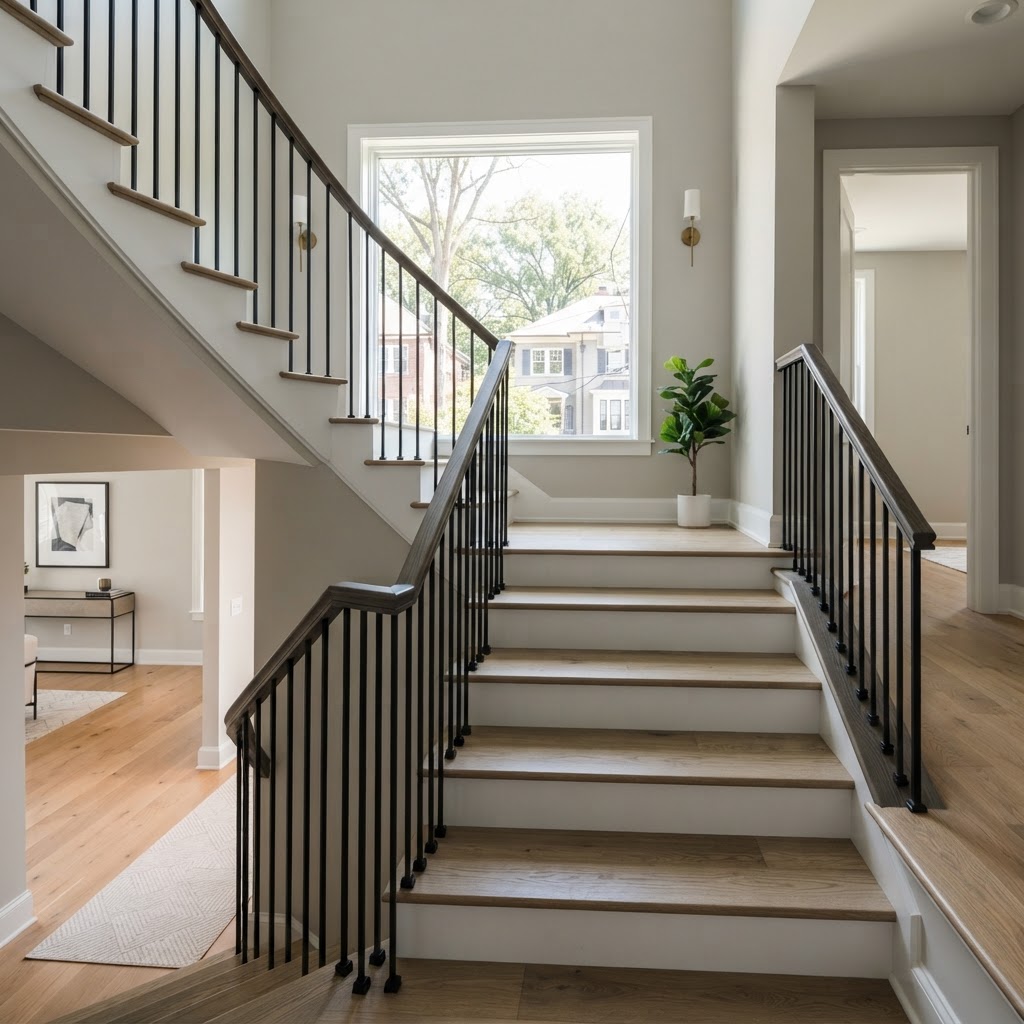
What should Arlington homeowners know about LVP on townhouse stairs and landings?
Luxury vinyl plank (LVP) can be installed on stairs and landings in Arlington townhouses, but it is a detail-intensive application that depends on the stair structure, the right nosing and trim components, a product that is approved for stair use, secure adhesive or mechanical installation, careful transitions at the top and bottom of the flight and attention to riser heights, traction and consistent appearance with the LVP on the floors above and below. It is not simply laying planks on a staircase. The treads and risers must be solid and uniform, the stair nosing must be matched to the plank and the installation method must follow the manufacturer's instructions, because stairs are a safety-critical surface where mistakes can cause slips and falls. Floors and Beyond VA, a family-owned Northern Virginia flooring and remodeling contractor serving Fairfax, Loudoun, Prince William and Arlington counties since 1987, installs vinyl flooring with in-house crews and no subcontractors, and we evaluate every staircase during a free in-home consultation to confirm whether LVP is appropriate before recommending it.
Townhouses are a defining feature of Arlington housing. Rowhouses and townhomes line the streets in Clarendon, Courthouse, Ballston, Shirlington, Pentagon City, Crystal City and along the Columbia Pike corridor, and townhome communities throughout the county often have three or four levels connected by narrow, steep stairs. In these homes, flooring decisions affect not only rooms but the stairs that link them, and homeowners who choose LVP for the main level, bedrooms or basement frequently ask whether the same product can continue up the stairs for a seamless look. The answer is often yes, but the details matter. This guide explains what to know before putting LVP on stairs and landings: how stairs are built, how nosings and transitions work, what products are compatible, how installation is secured and how to achieve a consistent appearance throughout the home. For our services, see our vinyl flooring page.
Why stairs are different from floors
Stairs are not flat floors. They are a series of treads and risers with nosings that project over the riser below. People step on them in a specific way, often without looking, and a small variation in height or traction can cause a fall. Building codes and safety standards regulate stair geometry because inconsistencies are hazardous.
When flooring is installed on stairs, it changes the dimensions. It adds thickness to treads and risers, alters the nosing projection and can change riser heights. Installers must account for these changes so that every step remains uniform. LVP is relatively thin, which helps, but the combination of plank, adhesive, underlayment (if any) and nosing can still alter step dimensions slightly. A skilled installer measures and plans the entire flight.
LVP is also a hard, smooth surface. Unlike carpet, it offers little natural grip, so traction is an important consideration. Product surface texture, nosing design and sometimes added traction strips matter.
Anatomy of a staircase
Understanding the parts helps you follow the discussion.
Treads. The horizontal surfaces you step on.
Risers. The vertical faces between treads.
Nosing. The front edge of the tread that projects past the riser. It is the most worn and most visible part of the stair.
Stringers. The structural supports on either side.
Landings. Flat platforms at the top, bottom or midpoint of a flight, where stairs turn or pause.
Winders. Wedge-shaped treads that turn a corner in some townhouses.
Balusters, newel posts and railings. The guard and handrail system.
Skirt boards. Trim along the wall side of the stairs.
In many Arlington townhouses, stairs were originally built with carpet in mind. The treads may be plywood or softwood with exposed edges, and the risers may be painted or covered. Converting to LVP often means preparing or replacing these surfaces.
Stair nosings: the critical component
The nosing is where most stair flooring succeeds or fails.
Why it matters. The nosing is the most abused part of the stair. It takes direct impact from feet, shoes and moving objects. A weak nosing chips, peels or lifts, creating hazards.
Nosing types. There are several approaches. A separate stair nose molding is a prefabricated piece, often matched to the plank in color and profile, that wraps the front of the tread. Types include flush stair nose, which sits flush with the plank surface and extends down over the riser, and overlapping stair nose, which sits on top of the plank and overhangs the edge. A one-piece or integrated stair tread is a factory-made stair component with an attached nosing, often matched to the flooring line. A square or bullnose profile is selected for appearance and safety.
Matching. The nosing should match the LVP in color and pattern. Some manufacturers offer matched nosings. If they do not, stair parts may be a close match only, which affects consistency.
Securing. Nosings are typically secured with adhesive, mechanical fasteners or both, according to the manufacturer's instructions. A loose nosing is a hazard.
Traction. Some nosings include grooves or inserts that improve grip. Smooth, polished surfaces are slippery.
Compatibility. The nosing profile must work with the plank thickness and the stair geometry. Not every nosing fits every product.
Choosing the right nosing is among the first decisions in a stair project, and it should be made with the product, not after.
Product compatibility: not every LVP is stair-ready
LVP products differ in how suitable they are for stairs.
Thickness and flexibility. Very thick, rigid-core planks can be difficult to wrap around stair noses and may require cutting and special nosings. Thinner, more flexible planks may conform more easily but may not be rated for stair use.
Manufacturer approval. Some manufacturers explicitly approve their products for stair installation and provide instructions and matching components. Others do not. Installing a product on stairs against the manufacturer's instructions may void the warranty and can create safety issues. Always check.
Locking systems. Click-lock floating floors are generally not appropriate for stairs without specific instructions, because each plank must be secured. Glue-down installation is common on stairs.
Attached underlayment. Padding can reduce firmness underfoot and affect step feel. On stairs, firm, stable treads are important.
Pattern and repeat. Wood-look planks with a distinct pattern should be cut so the pattern looks natural on treads and risers.
Wear layer. Stairs take concentrated wear. A thicker wear layer is preferable.
Slip resistance. Surface texture contributes. Embossed textures that follow the grain add grip.
Because compatibility varies, we do not assume that any given LVP will go on any staircase. We check the manufacturer's stair instructions, matching nosings and warranty terms as part of product selection. Our article on how to choose luxury vinyl plank discusses wear layers and cores, and our articles on LVP pros and cons and what SPC core flooring is help clarify the differences.
Preparing the staircase
Preparation is where durability is built.
Inspect the structure. Treads and risers should be solid, secure and free of squeaks, rot or damage. Loose treads must be fastened. Damaged treads may need replacement.
Remove existing coverings. Carpet, pad, tack strips, staples and adhesives must be removed. Staples and nails left behind will telegraph through LVP.
Create a smooth, clean, uniform surface. Fill gaps, sand high spots and fill low spots. Because LVP is thin, small imperfections can show.
Check uniformity. Verify that all treads and risers are consistent in dimensions. Adjustments, such as shimming or replacing treads, may be needed.
Prepare risers. Risers may be covered with LVP, painted or covered with other materials. Plan the finish so that tread and riser pair well.
Consider moisture and conditions. Stairs in basements or near entries may be exposed to moisture.
Address the stair system. In townhouses with open stringers, closed stringers or a skirt board, plan how flooring will meet these edges.
Plan for railings. Balusters and newel posts require careful cutting around them.
Our flooring installation guide describes our general preparation process.
Securing LVP on stairs
On stairs, LVP must be firmly bonded to the substrate. Methods vary by product but generally include adhesive. Manufacturer-approved adhesives for stair use form a strong, durable bond. Mechanical fasteners at the nosing may be required. Planks are cut to fit tread depth and riser height, with pieces wrapped or butted according to the chosen nosing system. Joints are arranged to avoid weak points.
Poor adhesion, insufficient curing time before use or an incompatible adhesive can lead to lifting, peeling or loose planks. Curing time before the stairs are used must be respected. In a townhouse where the stairs are the only way between levels, this requires planning. Options include staged work or temporary arrangements.
Dust, moisture and contaminants prevent adhesion, so surfaces must be clean and dry. Temperature and humidity affect adhesives too.
Transitions at the top, bottom and landings
Transitions at stair ends are among the most noticeable details.
Top of the stairs. Where the top step meets the upper floor, the nosing of the top tread typically aligns with the edge of the upper floor. A top-of-stair transition piece, such as a flush or overlap nose, joins the stair to the hallway or room flooring. Heights must align.
Bottom of the stairs. The bottom step meets the lower floor. The final riser and the edge of the floor must be neat and consistent.
Landings. Intermediate landings are floors, and the flooring on the landing should connect cleanly with treads above and below. A landing may be continuous with the main floor or distinct, with a nosing at the transitions.
Changes in material. If the stairs have LVP and the hallway has hardwood or carpet, the transition requires a thoughtful detail.
Consistent height. Tread and riser dimensions must not vary between steps, including the first and last steps. A mismatch at the bottom or top is a classic trip hazard.
Door swing. In townhouses, doors often open near stair landings. Flooring thickness must be considered so doors still clear.
Our estimates include transitions and molding, and our crews take care with these details. Our accessibility services emphasize smooth, safe thresholds and transitions.
Achieving a consistent appearance
One of the most common reasons homeowners choose LVP on stairs is to create a continuous look from level to level. Achieving this takes planning.
Same product, same lot. Use the same product, color and, ideally, the same production lot for floors and stairs to avoid visible shade differences. Order enough material at the beginning, including extra for stair cuts.
Matched nosing. Use a nosing that matches the planks in color and finish. If an exact match is not available, choose a complementary tone and design the stair as a deliberate feature.
Pattern direction. Plank orientation on treads should look natural, with the grain running in the direction of travel, and risers should be coordinated with treads. Some homeowners choose contrasting risers, such as painted white risers with LVP treads, for a classic look.
Sheen and texture. Stair planks should match the sheen of the floors. Texture contributes to traction.
Edges and walls. Skirt boards, trim and baseboards should be coordinated.
Light. Staircases are often dark or lit by a window at a landing. Test color in the stairwell's light.
Consider the whole home. If you use LVP on the main level but hardwood upstairs, decide how the stair transitions between the two. Our article on hardwood versus LVP in Northern Virginia explores pairings.
Safety and traction
Stairs are one of the leading locations for household falls, so traction is a priority. LVP surfaces vary: textured, matte surfaces provide more grip than smooth, glossy ones. Socks on smooth LVP can slip. Consider nosings with traction features, anti-slip treatments approved for the product, and good lighting. In households with children, seniors or pets, a runner on LVP stairs can add traction and quiet, though runners must be installed securely. Handrails should be firm and continuous.
Keep in mind that changing stair surfaces can change how they feel. Test the surface and consider consulting with family members who use the stairs.
Sound and comfort
Hard stairs are louder than carpeted ones. In townhouses with shared walls, noise from stairs can travel. LVP with an attached underlayment may reduce noise, but on stairs, underlayments are usually limited. If sound is a concern, consider a runner or carpet.
Alternatives to full LVP on stairs
LVP is not the only choice for townhouse stairs.
Carpet or carpet runners offer traction, warmth and quiet and remain popular. See our carpet and luxury carpet pages.
Hardwood treads and risers offer a classic look and can be refinished. See our wood flooring page.
Hybrid approaches combine hardwood or painted treads with a runner.
Which is best depends on your household, your style and the stair's structure. We discuss options during the consultation.
Coordinating the whole project
Stairs are usually part of a larger flooring project. Plan the sequence so that stairs are completed when they can be left undisturbed to cure, and so that floors above and below are installed consistently. Heavy work, such as moving furniture, should be done before final finishing. Our guide to preparing your home for new floors explains how to get ready. If stairs lead to a finished basement, see our basement finishing services and our guides to flooring for the basement and the best flooring options for basements with moisture issues.
For townhome communities, association rules may apply to work hours, deliveries and protection of common areas. See our condominium remodeling page.
What drives the scope of a stair project
We do not publish prices in articles, but the factors that shape any estimate are clear. The product and its stair compatibility. The nosing and trim components. The number of steps and landings. Stair structure and condition, including repairs. Removal of existing coverings. Winders or irregular steps. Railing and baluster cutting. Transitions at the top, bottom and landings. Furniture moving and access. And the company, including its crews, licensing, bonding and insurance.
At Floors and Beyond VA, we provide an honest, all-inclusive estimate, and what we quote is what you pay. Our estimates include old flooring removal, new materials, professional installation, furniture moving, transitions, molding and full cleanup. Our article on flooring cost factors in Northern Virginia explains why estimates differ.
Common mistakes with LVP on stairs
The first mistake is assuming any LVP can go on stairs.
The second is skipping the nosing decision until the end.
The third is ignoring riser height consistency.
The fourth is leaving staples, nails or adhesives on the stair surface.
The fifth is using floating click planks where bonding is required.
The sixth is using the wrong adhesive.
The seventh is using stairs before adhesive cures.
The eighth is overlooking traction.
The ninth is mismatching the color of nosings and planks.
The tenth is hiring an installer with no stair experience.
Frequently asked questions
Can LVP be installed on stairs? Often, yes, with a product approved for stairs, proper nosings, secure adhesive and careful preparation.
Do I need special stair nosings? Yes. Nosings protect the edge, provide a finished look and affect safety.
Is LVP slippery on stairs? It can be, especially if smooth. Textured surfaces, nosings with traction features and runners improve grip.
Can I match the stairs to my floors? Yes, with the same product and matched nosings, planned carefully.
How long before I can use the stairs? It depends on the adhesive and conditions. We explain the cure time and plan around it.
Should I choose carpet instead? Carpet offers traction and quiet. The best choice depends on your household.
Is Floors and Beyond VA licensed and insured? Yes. We are fully licensed, bonded and insured for every project, and our in-house crews work with no subcontractors.
Do you serve my Arlington townhouse? Yes, including Clarendon, Courthouse, Ballston, Shirlington, Pentagon City, Crystal City and Columbia Pike, along with Fairfax, Loudoun and Prince William counties.
Ready to plan your stair and floor project?
A safe, good-looking staircase starts with an honest assessment of the structure. Floors and Beyond VA brings nearly forty years of Northern Virginia experience, in-house crews with no subcontractors and a free in-home consultation with samples and precise laser measurements at no charge.
Request your free Arlington flooring estimate: Contact Floors and Beyond VA
You can also call (703) 906-5698.




