
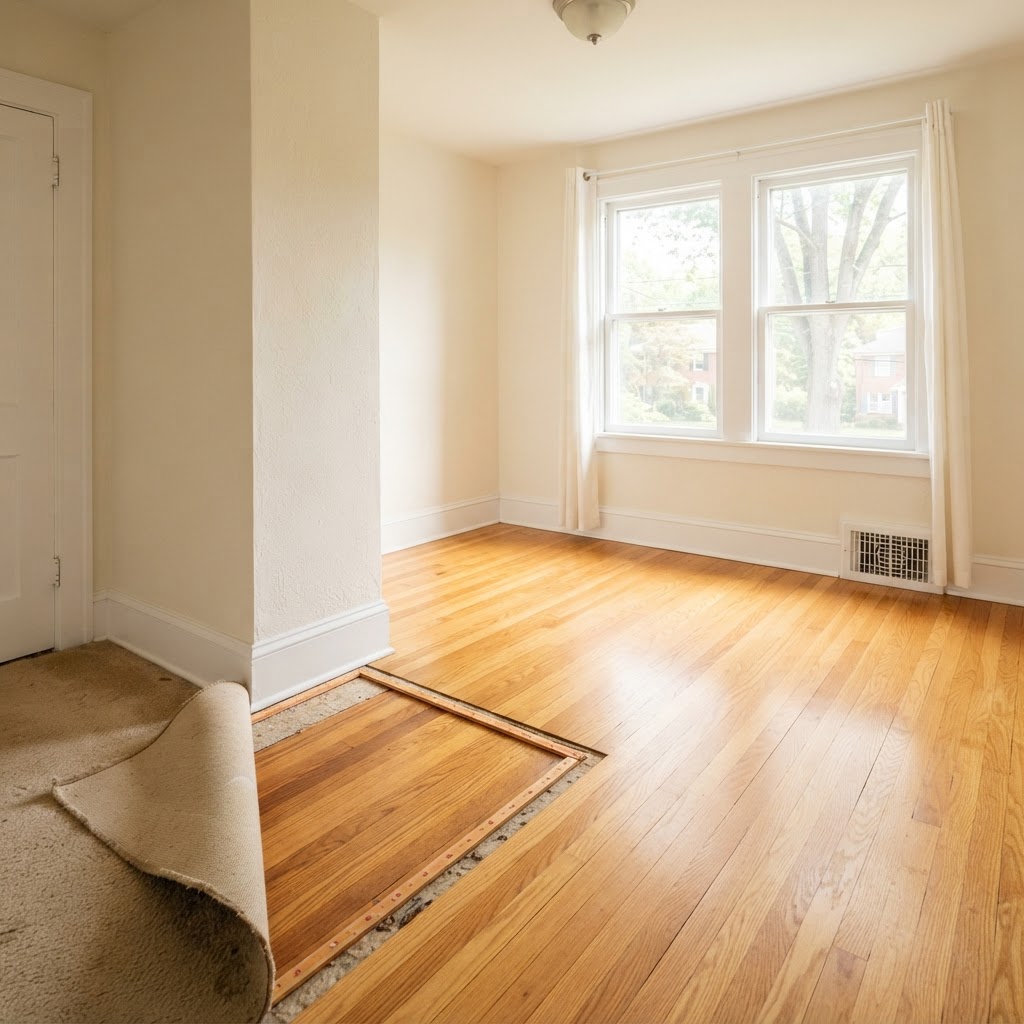
What should you check before removing carpet that may be covering hardwood in an Arlington home?
Before removing carpet that may be covering hardwood in an Arlington home, check whether wood is actually there by lifting a corner in a closet or along a wall, identify whether it is solid hardwood or something else, look at the condition of the boards for stains, water damage, gaps and wear, expect rows of small holes and possibly damage where the carpet tack strips were nailed, watch for discoloration and uneven color left by old pads and adhesives, and decide whether the floor needs light cleaning, a full sanding and refinishing, repair or board replacement. Many older Arlington houses have original hardwood waiting under wall-to-wall carpet, and it is often in better shape than people fear, but the only way to know is to look carefully before committing to a plan. Floors and Beyond VA, a family-owned Northern Virginia flooring and remodeling contractor serving Fairfax, Loudoun, Prince William and Arlington counties since 1987, inspects hardwood under carpet during a free in-home consultation, removes carpet carefully with in-house crews and no subcontractors and recommends a refinish-first path whenever the wood can be saved.
The idea is appealing and common. Arlington's housing stock includes many bungalows, Cape Cods and colonials in Lyon Park, Lyon Village, Cherrydale, Westover, Ashton Heights, Maywood, Waverly Hills and Arlington Ridge, built in an era when hardwood was the standard finished floor. At some point in the following decades, many owners covered those floors with wall-to-wall carpet, which was fashionable, warm and practical. Now new owners peel back a corner in a bedroom closet, see oak, and wonder what they might find if they pull up the whole room. This guide helps you make that discovery wisely. It explains how to check for hardwood, what kinds of damage to expect, how to read what you see and how to decide whether sanding, repair or replacement is needed. For related reading, see our wood flooring page, our carpet page and our article on carpet to hard flooring conversion in Northern Virginia.
Step one: confirm what is under the carpet
Do not assume. The floor beneath carpet could be any of several things.
Solid hardwood. The classic find: narrow strip oak, sometimes maple, pine or fir, nailed down over a subfloor. In older Arlington houses, it is often the original floor.
Engineered wood. Less common in older homes but possible where flooring was replaced at some point.
Plywood or board subfloor only. In some homes, particularly additions, rental conversions or lower-grade construction, carpet sits directly over subfloor, and no finished hardwood exists.
Concrete. Basements and slab-on-grade rooms, and some ground-level condominiums, often have carpet over concrete.
Vinyl, linoleum or tile. Previous owners may have covered an earlier floor, and carpet may sit over a layer of old resilient flooring.
Mixed conditions. A home may have hardwood in some rooms, subfloor in others and patches where changes were made.
Good places to look are closets, the edges beneath a heating register or vent cover, under a doorway threshold, inside a cabinet or beneath trim. In a closet, carefully lift the carpet at a corner along the wall, or peel back a small area near a vent. Avoid cutting through carpet in a visible location. A floor register is often a window into the layers: remove the register cover and look at the cut edge of the floor around the opening. You can see the thickness and species of the wood there.
If you find wood, observe its direction, width and color. If you find something else, stop and decide whether it is safe to proceed. Old vinyl flooring, adhesives and some older materials may contain hazardous substances such as asbestos, and disturbing them without precautions is not advisable. A responsible contractor will recommend testing before removal where there is reason for concern. Responsible handling is directional here: follow guidance from appropriate authorities for your home.
Step two: check the age and construction of the home
The age of the house provides clues.
Early and middle twentieth-century houses. Many were built with hardwood throughout main living areas and bedrooms, especially oak strip floors. Kitchens and baths often had different flooring. Upper floors and attics may have softer woods.
Postwar houses and additions. Floors vary. Some have hardwood, some have plywood and some are built for carpet.
Condominiums and apartments. Carpet over concrete or plywood is typical, and there may be no hardwood.
Renovated homes. Renovations may have replaced original floors.
Look at the home's general character. A bungalow with oak trim and high baseboards probably had hardwood. A house with thin baseboards and hollow doors may not. These are hints, not proof.
Step three: understand what carpet leaves behind
Even if hardwood is present, carpet installation and removal leave marks that you should expect.
Tack strip holes
Carpet is traditionally stretched over strips of wood with sharp tacks, which are nailed around the perimeter of each room. When the strips are removed, they leave rows of small holes along the walls and sometimes damage the surface. This is a normal result of carpet installation. In most cases, holes are small and can be filled during refinishing. The visible border can remain, particularly if there are many nails or if the edges were damaged when the strips were pulled up. Some owners embrace it with a border or area rug, and others choose to replace perimeter boards.
Staples and tacks in the field
The pad is usually stapled or tacked to the floor. Removing it leaves many staples that must be pulled thoroughly. Leftover staples damage sanding equipment and leave marks. Careful removal is crucial.
Adhesive residue
Some carpet and pads are glued to the floor. Residue can be difficult to remove and can interfere with sanding and finishing. Old adhesives may also be hazardous in some cases, which is another reason to inspect before removal.
Pad deterioration
Foam pad can deteriorate, bond to the floor and leave a crumbly or sticky layer. Old rubber pad can stain wood.
Dirt and dust
Years of dirt sift through carpet, so the wood below may be gritty. Cleaning is part of the process.
Subfloor and flooring below
Take note of any discoloration, stains or surface contamination.
Step four: read the condition of the wood
Once you have a view of the boards, examine them for the following.
Discoloration
Uniform tone. If the wood looks consistently pale or golden, that's a good sign. Wood that has been covered from light often looks fresher than exposed floors.
Dark spots or stains. These can be pet stains, water damage or iron stains. Pet urine often leaves dark rings that penetrate deeply. Water leaves gray or black marks. Some can be sanded out, while others go deeper.
Uneven color. Areas that were covered by furniture or by a rug beneath the carpet, or places that received sunlight at the edges, can look different from the rest.
Pad or dye bleed. Colors from pad or carpet backing can stain wood.
Surface damage
Scratches and gouges. Light scratches sand out. Deep gouges may need repair.
Worn areas. Heavy traffic zones may show wear, but wood under carpet is usually protected from foot traffic and may be in better condition than exposed floors.
Paint, drywall compound and spills. Renovations often leave drips.
Structural damage
Cupping, crowning and buckling. Cupping means board edges rise higher than centers, which indicates moisture imbalance. Crowning is the reverse. Buckling is boards lifting from the subfloor. These suggest moisture problems that must be corrected. Carpet traps moisture, and if a leak or damp crawl space has been a problem, the wood may be affected.
Gaps. Wood shrinks and expands, and gaps between boards are common in older floors. Large gaps may require filling.
Cracked or split boards. Replace if severe.
Loose boards and squeaks. May need re-fastening.
Moisture and mold
Musty smell. Lift a corner and smell. A damp, moldy odor suggests a moisture problem.
Visible mold or mildew. On the back of carpet, on pad or on wood.
Water stains on the subfloor or carpet back. Look for signs of past leaks.
Insects and rot. Soft, crumbling wood indicates rot, which is a structural issue that must be addressed.
Missing or altered areas
Patches. Previous owners may have cut holes for plumbing, heating, doors or built-ins, and filled them with plywood or different wood.
Removed walls. If walls were moved, gaps may exist in the flooring where they stood.
Thresholds and transitions. Areas where floor heights change.
These checks tell you whether the floor is a straightforward restoration or a more involved project.
Step five: check whether there is enough wood to sand
Hardwood floors can be sanded and refinished several times, but not forever. The usable wood above the tongue limits sanding.
Solid hardwood floors in older houses are often thick enough for multiple refinishes. Engineered flooring has a thin wear layer that may allow limited sanding or none. Floors that have been sanded many times in the past may have little wood left. A floor register is useful for checking thickness. Professionals also assess whether nail heads are close to the surface.
If the wood is too thin, the floor may still be refinished lightly with a screen-and-recoat approach, but deeper repairs may require replacement. Our article on whether refinishing hardwood floors is worth it explains the thinking behind this decision.
Step six: assess the subfloor and the room
Hardwood is only as sound as what is beneath it.
Subfloor condition. Check for soft spots, movement and squeaks.
Crawl space or basement. Moisture below affects the floor above. Inspect when access exists.
Levelness. Old floors may slope. Note heights near doorways.
Heating and cooling. Registers and radiators affect humidity and wood movement.
Walls and trim. Baseboards may need to be removed and reinstalled, or replaced. Shoe molding is often added or replaced.
Doors and thresholds. Removing carpet and pad changes floor height, which can affect door clearance. Doors may need adjustment.
Closets. Closet floors may have been left unfinished or be made of different wood.
Deciding on the right path
After inspection, the options usually fall into a few categories.
Clean and refinish
If the floor is in good condition, with only minor holes and surface wear, a full sanding and refinishing can restore it beautifully. This is often the case in Arlington's older homes. It's also the most economical way to get a high-quality, historic floor.
Repair and refinish
If the floor has localized damage, such as stains that don't sand out, damaged boards, patches and gaps, repairs come first. Damaged boards are cut out and replaced, gaps are filled, loose boards are re-fastened and the whole floor is then sanded and refinished so that repairs blend. This is an extremely common path. Our article on flooring damage repair for water, scratches and buckling describes repairs.
Replace sections
If damage covers whole areas, such as large water-damaged zones, rotted sections or heavily patched areas, replacement of sections may be best. Matching new boards to old, in species, width and finish, requires care. Sanding and refinishing old and new together brings them into harmony.
Replace the floor
If the floor is too thin, too damaged or incompatible with your plans, new flooring may be the right answer. Options include new hardwood, engineered hardwood, luxury vinyl plank, tile or new carpet. See our vinyl flooring page, our tile and stone page and our article on hardwood versus LVP in Northern Virginia. Our article on flooring replacement and when to choose what offers guidance.
Keep carpet
Sometimes, the answer is to keep carpet, perhaps new. Bedrooms, basements and stairs often make sense with carpet. See our luxury carpet page and our article on choosing carpet in Northern Virginia.
How professionals remove carpet from over hardwood
Removal technique matters, because careless removal damages the floor you hope to save.
Cut carpet into strips. Rather than ripping, carpet is cut and rolled in manageable strips.
Remove the pad. Pad is lifted carefully, and staples are pulled one by one or with specialized tools.
Remove tack strips gently. Strips are pried with care to avoid splitting boards. Nails are removed or set.
Clean the floor. Vacuuming and scraping clear debris.
Treat adhesive. If present, adhesive is removed using appropriate methods, with attention to safety.
Inspect again. With the floor exposed, we reassess condition and confirm the plan.
Protect the home. Dust, odors and debris are controlled.
Carpet and pad removal is included in our estimates, along with disposal and cleanup. We handle removal with in-house crews and no subcontractors. Our flooring installation guide explains our general process.
What a representative situation looks like
Because we do not share customer projects without permission, here is a representative example, not a particular customer's home. Imagine a bungalow in a neighborhood like Lyon Park, where a homeowner peels back carpet in a closet and finds oak strip flooring. During the consultation, a floor register shows solid wood of generous thickness. Carpet is removed carefully. The floor has tack strip holes around the perimeter, a few staple lines, one dark stain from a long-ago pet accident and several loose boards. The stain partly sands out. Two boards are replaced with matching salvage wood from a closet. The whole floor is sanded and finished, and the border holes are filled. The result is a unified, warm floor that looks original. This is an illustration, and your floor will have its own story.
Condominiums and apartments
In Arlington condominiums, carpet over concrete is common, and hardwood may not exist. If you want hardwood, you will need to follow building requirements for installation systems and acoustics. See our condominium remodeling page and our article on condo remodeling rules and permits.
What drives the scope of a carpet-removal and refinishing project
We do not publish prices in articles, but the factors that shape any estimate are clear. The square footage. Carpet, pad and tack strip removal and disposal. The condition of the wood, including stains, gaps and damage. Board repair or replacement and matching. Refinishing including sanding, staining and finishing. Subfloor repairs. Stairs and closets. Baseboard and trim work. Furniture moving. And the company, including its crews, licensing, bonding and insurance.
At Floors and Beyond VA, we provide an honest, all-inclusive estimate, and what we quote is what you pay. Our estimates include old flooring removal, new materials, professional installation, furniture moving, transitions, molding and full cleanup. Our article on flooring cost factors in Northern Virginia explains why estimates differ.
Common mistakes with carpet over hardwood
The first mistake is assuming hardwood is there without checking.
The second is ripping up carpet carelessly.
The third is ignoring tack strip holes and expecting a perfect perimeter.
The fourth is missing staples that damage sanders.
The fifth is skipping moisture checks.
The sixth is disturbing old adhesives without considering hazards.
The seventh is expecting every stain to sand out.
The eighth is forgetting door and threshold clearances.
The ninth is refinishing without repairing loose boards.
The tenth is hiring without an inspection.
Frequently asked questions
How can I tell if there's hardwood under my carpet? Check closets, floor registers, thresholds and corners. Lift carpet gently in a hidden spot.
Will tack strips damage the floor? They leave small holes and sometimes surface damage, usually repairable.
Can you sand out pet stains? Light stains often sand out. Deep stains may remain or require board replacement.
Is hardwood under carpet usually in good shape? Often better than expected, but condition varies.
Can all hardwood be refinished? Most solid hardwood can. Thickness and condition determine how.
What if there is no hardwood? We can discuss new flooring options.
Is Floors and Beyond VA licensed and insured? Yes. We are fully licensed, bonded and insured for every project, and our in-house crews work with no subcontractors.
Do you serve my Arlington neighborhood? Yes, including Clarendon, Courthouse, Ballston, Rosslyn, Shirlington, Lyon Park, Lyon Village, Cherrydale, Westover, Ashton Heights, Maywood, Waverly Hills, Arlington Ridge, Aurora Highlands, Fairlington, Columbia Pike and Nauck, along with Fairfax, Loudoun and Prince William counties.
Ready to see what's under your carpet?
Discovering hardwood is exciting, and doing it right protects it. Floors and Beyond VA brings nearly forty years of Northern Virginia experience, in-house crews with no subcontractors, a refinish-first philosophy and a free in-home consultation with samples and precise laser measurements at no charge.
Request your free Arlington flooring estimate: Contact Floors and Beyond VA
You can also call (703) 906-5698.




