
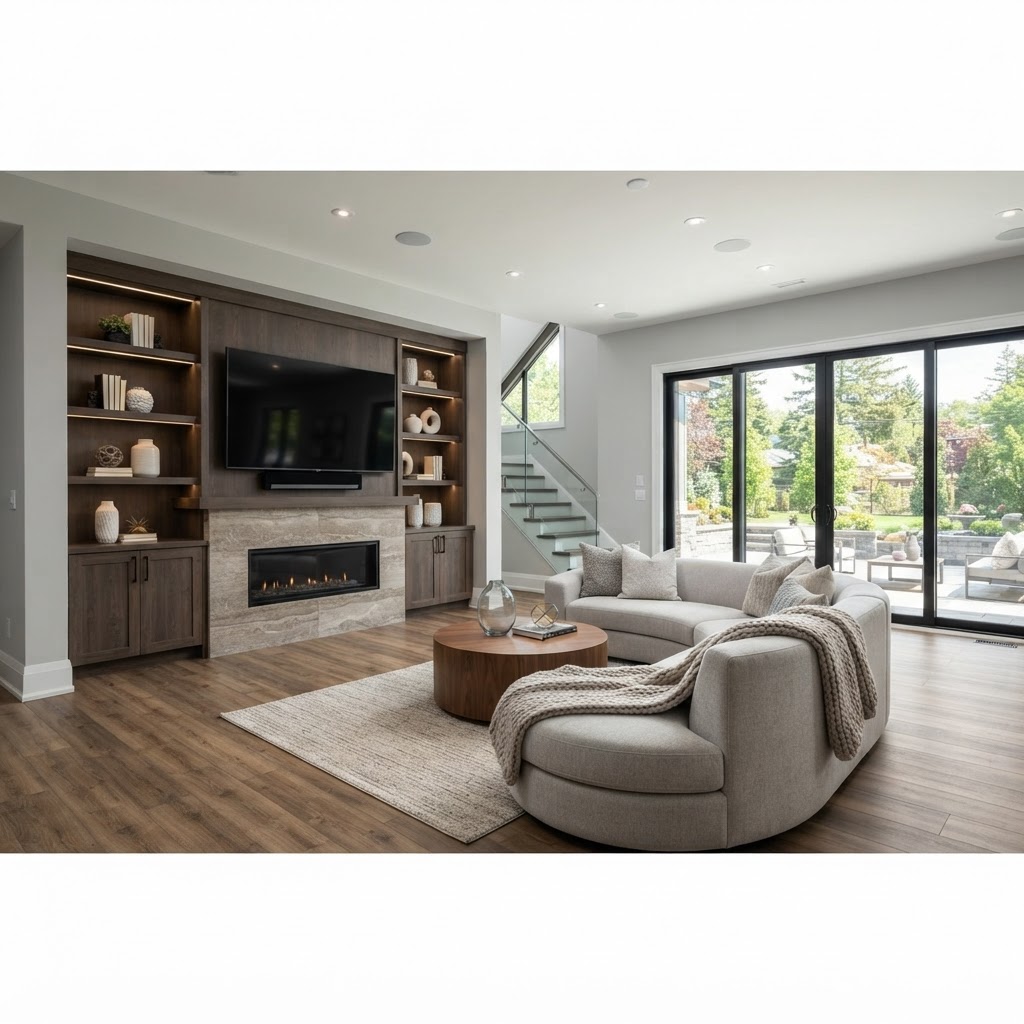
What is the best basement flooring for Aldie, VA homes?
For most Aldie basements, the best flooring is a moisture-tolerant product installed over a properly tested and prepared slab: rigid-core luxury vinyl plank, porcelain tile, correctly specified engineered hardwood, or rubber for gyms and utility spaces. Which one is right depends on how much moisture the slab is actually moving, how the space will be used and how finished you want it to feel. The material matters, but the preparation matters more. Moisture testing, addressing water sources and installing the right barrier or underlayment are what keep a basement floor looking good for years. Floors and Beyond VA, a family-owned Northern Virginia flooring and remodeling contractor serving Fairfax, Loudoun, Prince William and Arlington counties since 1987, installs basement flooring with in-house crews and no subcontractors, and we begin with the slab, not the sample board.
Basements in the Aldie area span a wide range. Many homes in Stone Ridge, South Riding, Willowsford and the surrounding Dulles South communities have full basements, often unfinished at closing or finished by the builder with basic materials, and homeowners commonly finish them later as recreation rooms, media rooms, guest suites, gyms or home offices. Larger properties toward Arcola, Gilbert's Corner and Middleburg often have expansive lower levels, some with walkout exposure. Older homes near the historic village may have partial basements, crawl spaces or older foundations. The common thread is that these spaces sit in contact with the ground, and the ground holds water. Loudoun County's clay-rich soils can hold moisture against foundations, and heavy seasonal rain keeps many slabs damp at some level. This guide explains why basement floors behave differently from floors upstairs, how moisture testing works, which materials suit which conditions and what subfloor preparation really involves. For related reading, see our guides on the best flooring options for basements with moisture issues, the best flooring on concrete basements in Northern Virginia and flooring for the basement.
Why basements are different
Upstairs floors are separated from the ground by air, framing and a ventilated structure. A basement floor is typically a concrete slab poured on soil or gravel, sometimes over a vapor retarder. Concrete is porous. It draws moisture from the ground and can release water vapor upward for years, even when no liquid water is visible.
Moisture arrives in several ways. Vapor transmission is the slow movement of water vapor through the slab, which happens even when the surface looks dry. Hydrostatic pressure occurs when groundwater pushes against the slab and walls, especially after heavy rain. Seepage and leaks come from cracks, wall-floor joints, window wells, plumbing or appliances. Humidity in the air matters too, since basements are often cooler than the rest of the house, which can cause condensation on cool surfaces.
New construction adds one more factor. A slab poured recently may still be releasing the water used to mix and cure it, and the house itself may still be drying out. Flooring installed too early over a young slab can suffer.
Different flooring materials respond to these conditions very differently. Wood, laminate and carpet can swell, warp, mildew or degrade. Adhesives can fail. Vinyl, tile and rubber tolerate moisture better, though they can still be affected by trapped water if moisture is not managed. This is why basement flooring selection should always begin with understanding the slab.
Start with the source: fix water problems first
No flooring substitutes for fixing the cause of a moisture problem. If water enters your basement, find and correct the source before covering the slab.
Look at exterior drainage. Gutters should be clean and downspouts should discharge well away from the foundation. Soil around the house should slope away from the walls. Window wells should drain. Inside, look for efflorescence (white mineral deposits), staining, peeling paint, musty odors, rust at the base of walls or visible cracks.
Interior or exterior drainage systems, sump pumps, crack repair and waterproofing may be needed in homes with active water entry. Those are separate trades, and they come first. A floor installed over an unresolved leak will eventually suffer. A responsible flooring contractor will tell you honestly if your basement needs attention before flooring.
Moisture testing: measuring what you cannot see
Moisture testing is what separates a successful basement floor from a failed one. A slab can look dry and still emit enough vapor to damage a floor.
The calcium chloride test measures the rate at which moisture vapor leaves the surface of the slab over a period of time. In-situ relative humidity testing uses probes placed in holes drilled into the concrete to measure humidity within the slab, which many manufacturers use to set limits. Electronic moisture meters provide quick surface readings, useful for screening but less reliable as the sole measure. Simple plastic-sheet tests, in which a sheet is taped down for a day or two to see whether condensation forms, can hint at moisture but are not a substitute for standardized testing.
Flooring manufacturers publish moisture limits for their products, and exceeding them can void warranties. Testing tells you whether your slab is within range and, if not, what mitigation is required. Results vary with season and weather, so testing under typical conditions, and sometimes more than once, gives the most reliable picture.
If readings are high, options include moisture-mitigating primers or membranes applied to the slab, vapor barriers beneath floating floors, dimpled underlayments that allow air movement and, in severe cases, waterproofing work that addresses the source. The right approach depends on the readings and the flooring choice.
Subfloor conditions and preparation
Preparation is where basement floors succeed or fail.
Cleaning and inspection. The slab should be clean and free of oil, paint, old adhesive and dust. Existing coverings must be removed. In older homes, some historical flooring and adhesive materials may contain hazardous substances, and a careful contractor treats them with appropriate caution before disturbing them.
Crack and joint repair. Non-structural cracks can often be filled. Active or structural cracks need professional evaluation.
Flatness. Floors must be flat within the manufacturer's tolerances. Slabs are often uneven or slope toward a drain. Self-leveling compounds or patching can correct dips and humps. Rigid-core vinyl bridges small variations, but significant ones should be fixed. Tile and wide-plank products demand especially flat surfaces.
Moisture mitigation. As discussed, this may include sealers, membranes or barriers.
Underlayment. Depending on the flooring, an underlayment may provide moisture protection, sound reduction, thermal comfort or leveling.
Temperature and humidity control. Basements should be conditioned before and during installation, with temperature and humidity within manufacturer ranges. Dehumidification helps maintain stable conditions.
Our flooring installation guide describes the general process, and our article on preparing your home for new floors explains what homeowners can do beforehand.
Flooring options for below-grade rooms
Luxury vinyl plank
LVP, especially rigid-core SPC, is among the most popular basement choices. The plank resists water, so spills and minor humidity do not harm it. It can be installed as a floating floor over a properly prepared slab, with an underlayment or attached pad for comfort and sound. It is warm underfoot compared with tile, durable, easy to clean and available in wood-look and stone-look designs suited to finished living spaces. LVP does not tolerate being installed over a wet slab or one with unresolved hydrostatic pressure, because trapped water can cause mold or damage. Our articles on how to choose luxury vinyl plank, what SPC core flooring is, LVP pros and cons and whether vinyl flooring is waterproof explain the product. See our vinyl flooring page.
Porcelain tile
Porcelain is dense and nearly impervious to water, which makes it an excellent basement floor in terms of moisture tolerance. It is durable, easy to clean and works well with radiant heat, which can make a basement far more comfortable. Tile feels cool and hard, so rugs help, and it needs a flat, stable substrate. For basement bathrooms, wet bars, laundry rooms and entry areas, porcelain is a strong choice. See our tile and stone page.
Engineered hardwood
Engineered hardwood can be installed in many basements when moisture is controlled, typically glued or floated over an appropriate barrier. It brings the warmth of real wood downstairs, which many homeowners want for finished lower levels. It is more sensitive to moisture than vinyl or tile, so testing and mitigation are critical. Solid hardwood is generally not appropriate below grade. See our wood flooring page.
Rubber flooring
Rubber is durable, water resistant, comfortable and sound dampening, which makes it popular for home gyms, play areas and utility spaces. It stands up to heavy equipment and impact. See our rubber flooring page.
Carpet and carpet tile
Carpet can be comfortable and warm in a basement media room or bedroom, but it requires careful moisture management. Carpet on a damp slab can trap moisture and encourage mold and mildew. If you choose carpet, use a moisture barrier or appropriate pad, select fibers and backings suited to basements and make sure the slab is dry. Our article on preventing carpet mold in basements through building science explains the issues, and our carpet and home theater carpet pages describe options. Carpet tiles, which can be lifted and replaced individually, suit areas prone to occasional moisture.
Materials to be careful with
Solid hardwood, traditional laminate and unprotected carpet over bare concrete are generally poor choices for basements with any moisture history. Peel-and-stick products and thin vinyl over a damp slab often fail as adhesive loses its bond. Painted or sealed concrete is a legitimate finish for utility rooms but offers little comfort.
Matching materials to basement uses
Family room or media room. LVP or carpet with proper moisture control, or engineered hardwood after testing. Sound and comfort matter.
Guest suite or bedroom. LVP with a rug, or carpet over a suitable pad and barrier.
Home gym. Rubber flooring or specialty gym surfaces.
Bar, wine room or entertaining space. Porcelain tile or LVP. See our bars and wine rooms page.
Laundry room and utility area. Porcelain tile, LVP or sealed concrete. See our laundry room remodeling page.
Home office. LVP or carpet tile. See our home office design page.
Playroom. LVP or rubber, which are durable and easy to clean.
Complete basement finishing. When finishing an entire basement, flooring is one piece of a larger plan including framing, insulation, electrical and more. Our basement finishing services address the whole space.
Comfort: warmth and sound
Basement floors are often cold and can be noisy. Both can be addressed.
For warmth, a pad or underlayment adds insulation. Carpet is warmer than hard surfaces. Radiant heating, particularly under tile or approved engineered products, brings significant comfort. Rugs help on any hard floor.
For sound, underlayments with acoustic properties reduce impact noise to rooms above, which matters in homes where the basement hosts a gym, media room or children's play. Soft surfaces absorb sound within the room. Combining insulating underlayment with a quiet product makes a lower level far more pleasant.
Mold, mildew and air quality
Moisture and organic materials are the ingredients for mold. Non-organic materials such as vinyl, tile and rubber do not feed mold the way wood and paper-backed products might. Proper ventilation and dehumidification help control humidity, and a hygrometer lets you track humidity and spot changes early.
If you see or smell mold, address the source and consult a qualified professional before installing new flooring. Covering a mold problem does not solve it.
Building codes, permits and finished-basement considerations
Finishing a basement involves more than flooring, and the flooring decision interacts with the rest of the project. Egress requirements for bedrooms, ceiling heights, insulation, electrical work and HVAC all affect how the space is built, and some of this work may require permits through the county. If you are finishing a basement from scratch, the order of operations matters: moisture issues are addressed first, framing and mechanical work follow, then drywall and painting, and flooring comes near the end, usually before final trim. Our basement finishing page describes how we handle complete projects, and flooring is planned alongside the other trades so that the floor is protected and the schedule is realistic.
If you have a walkout basement, expect different conditions from a fully below-grade lower level. Walkout spaces often have more natural light, more temperature swing near glass doors and sometimes different moisture patterns. Material choices may reflect those conditions, such as selecting a floor with good temperature tolerance near sliding doors.
Stairs and the transition into the basement
The stairway to the basement deserves thought. It connects two environments with different conditions, and the flooring on the stairs, at the bottom landing and at the doorway into the finished space should all work together. Many homeowners carpet or cover the stairs and use a different material in the basement itself. Others carry the same product from the stairs into the room. The choice affects safety, noise and appearance, and stair work in any material is detailed, so confirm that your estimate states clearly whether stairs are included.
What affects the scope of a basement flooring project
We do not publish prices in articles, but the factors that shape scope are clear. The moisture condition of the slab and any mitigation required. Slab flatness and leveling work. Removal of existing flooring and adhesive. The material you choose and its installation steps. Square footage and layout. Stairs leading to the basement. Transitions, trim and molding, and doors that need trimming. Furniture and storage items that need moving. Underlayment or radiant heat.
Floors and Beyond VA provides an honest, all-inclusive estimate, and what we quote is what you pay. Our estimates include old flooring removal, new materials, professional installation, furniture moving, transitions, molding and full cleanup.
Common mistakes to avoid
The first mistake is skipping moisture testing.
The second is choosing a floor before understanding the moisture condition.
The third is ignoring the source of water. Drainage, gutters and leaks must be addressed first.
The fourth is installing wood or laminate over damp concrete.
The fifth is assuming waterproof flooring eliminates the need for preparation.
The sixth is installing over an uneven slab.
The seventh is skipping a vapor barrier or underlayment when required.
The eighth is laying carpet on a damp slab.
The ninth is flooring a new slab too soon, before it has had time to dry.
The tenth is hiring an installer without basement experience.
Frequently asked questions
What is the best flooring for a basement in Aldie? Rigid-core luxury vinyl plank, porcelain tile and properly installed engineered hardwood are common choices, depending on moisture and use.
Can I put hardwood in my basement? Engineered hardwood can work with moisture testing and mitigation. Solid hardwood is generally not recommended below grade.
How do I know if my slab is too moist? Moisture testing, such as calcium chloride or in-situ relative humidity testing, measures it. Visual inspection alone is not reliable.
Is vinyl plank really waterproof in a basement? The plank resists water, but the floor system still needs a prepared, dry slab.
Can I install carpet in a basement? Yes, with moisture control, appropriate padding and fibers suited to the space.
Do I need a vapor barrier? Often, depending on moisture readings and the flooring product. Manufacturer requirements apply.
How soon can I floor a new basement slab? It depends on the slab and the product. Testing, not the calendar, should decide.
Does Floors and Beyond VA use subcontractors? No. Our in-house crews handle every project, and we are fully licensed, bonded and insured.
Do you serve Aldie? Yes, including Stone Ridge, South Riding, Willowsford, Arcola, Gilbert's Corner, Middleburg and surrounding Loudoun County communities, along with Fairfax, Prince William and Arlington counties.
Ready to floor your Aldie basement the right way?
A successful basement floor starts with the slab. Floors and Beyond VA brings nearly forty years of Northern Virginia experience, in-house crews with no subcontractors and an honest all-inclusive estimate to every lower-level project, so you get a floor chosen and prepared for the conditions it will actually face.
Request your free basement flooring consultation: https://floorsandbeyondva.com/Contact
You can also call (703) 906-5698 or send us a message through our contact page.




