
Wood-Look Tile vs. Real Hardwood: Why More Aldie and Northern Virginia Homeowners Are Reconsidering the Look
Is wood-look tile or real hardwood the better choice for Aldie and Northern Virginia homes?
Real hardwood is generally the better choice for living areas, bedrooms and main-level spaces where warmth, authenticity, comfort underfoot and long-term renewability matter, while wood-look porcelain tile is the better choice for entries, mudrooms, bathrooms, laundry rooms and other wet or heavily abused areas where moisture resistance and durability matter more than the feel of real wood. Recent design commentary has questioned the appeal of imitation wood tile in favor of authentic materials, and more homeowners in Aldie, South Riding, Brambleton, Ashburn, Leesburg, Middleburg and Chantilly are reconsidering large expanses of plank-shaped tile, because a long, narrow tile that imitates wood often reads as a copy, feels hard and cold and lacks the warmth and variation of the real thing. Tile still has an essential role, but it often looks best when it is allowed to look like tile. Floors and Beyond VA, a family-owned Northern Virginia flooring and remodeling contractor serving Fairfax, Loudoun, Prince William and Arlington counties since 1987, installs both hardwood and tile with in-house crews and no subcontractors, so we can recommend each where it truly belongs.
Wood-look tile arrived with a strong promise: the beauty of wood with the toughness and water resistance of porcelain. Improved printing technology produced convincing grain, and plank-shaped formats made it possible to cover entire homes in an easy-care surface. For some situations, it remains an excellent solution. But as tastes evolve, many homeowners and designers have begun to question the idea of a house full of faux wood, preferring authentic materials: real wood where wood belongs and honest tile, stone and other materials where they do. This guide explains the real strengths and limits of each, how they differ in feel, sound, warmth and durability, where each fits in a Northern Virginia home and how to decide. For our services, see our wood flooring and tile and stone pages.
What wood-look tile is
Wood-look tile is typically porcelain, a dense, hard ceramic fired at high temperature, with a printed image of wood grain on its surface. It is made in long, narrow plank shapes, often in lengths and widths that echo hardwood planks. Quality products use high-resolution printing, multiple unique patterns, textured surfaces that follow the grain and rectified edges that allow narrow grout lines.
Its advantages are real. Porcelain is extremely durable, resists scratches and stains, does not absorb water, is easy to clean, does not fade in sunlight and is compatible with radiant heating. It can be installed in places where real wood cannot, such as wet bathrooms, covered porches and below-grade spaces with moisture concerns.
Where wood-look tile falls short
The same qualities that make porcelain practical create design and comfort trade-offs.
It reads as a copy. Real wood has depth: the grain is part of the material, color moves through the board and the surface responds to light. Printed tile, no matter how good, is a two-dimensional image on a uniform body. At close range and in raking light, the difference can be visible, particularly if patterns repeat.
Grout lines betray it. Real wood planks meet in tight seams. Tile requires grout, and even narrow joints are more visible than wood seams. Long runs of grout lines in a wood pattern can look unnatural.
It feels hard and cold. Porcelain has little give, conducts heat away from your feet and can be tiring to stand on for long periods. Without radiant heat or rugs, it feels cold in Northern Virginia winters.
It is loud. Tile reflects sound. Footsteps, dropped objects and moving furniture produce sharper noise than on wood or carpeted floors, which matters especially in upper levels and multi-family buildings.
It is unforgiving. Dropped glasses and dishes break on tile, and items that might bounce on wood shatter.
It is not renewable. Hardwood can be sanded and refinished, and tile cannot. A cracked or chipped tile requires replacement, and matching an old tile from a discontinued production run can be difficult.
It demands a flat, stiff substrate. Large-format tile requires careful preparation, and improper installation leads to lippage, cracking and failed grout. Quality installation is a skilled craft.
It can date quickly. Trend-driven patterns, colors and plank formats can look of their era.
These are not reasons to avoid wood-look tile everywhere, but they explain why a house covered entirely in it often feels less warm and less authentic than one with real wood in the main living areas.
What real hardwood offers
Authenticity and warmth. Real wood has natural variation in color, grain and character. It looks and feels like what it is. Its warmth, visual and physical, is difficult to replicate.
Comfort underfoot. Wood has some resilience and is warmer to the touch than tile, making it more comfortable for living spaces and bedrooms.
Renewability. Solid hardwood can be refinished multiple times, restoring worn surfaces and allowing color changes. Engineered hardwood with a thick wear layer can be refinished as well. This is a unique advantage and the heart of our refinish-first philosophy. Our articles on whether your hardwood floors can be saved, whether refinishing is worth it and our hardwood floor refinishing field guide for Northern Virginia explain this.
Repairability. Individual boards can be replaced and blended.
Long-term value. Hardwood is widely valued by buyers. Our articles on whether houses sell better with carpet or hardwood floors and the best flooring before selling a home discuss resale considerations.
Design flexibility. Species, width, color, finish and pattern offer a vast range of looks.
Hardwood's weaknesses. It scratches and dents, is sensitive to standing water and persistent moisture and moves with humidity. It is generally not recommended below grade or in wet areas. Engineered hardwood improves stability. Our article on engineered wide-plank flooring in Northern Virginia explains how.
Where tile is the right answer
Tile earns its place in demanding environments.
Entryways and mudrooms. Rain, snow, mud, road salt and pets challenge any floor. Porcelain tile shrugs them off. In Aldie and across Loudoun County, where homes often back to fields, woods and gravel drives, muddy entries are a fact of life.
Bathrooms and showers. Tile is the standard for wet environments, with proper waterproofing underneath. See our bathroom remodeling and primary suite remodeling pages.
Laundry rooms and utility spaces. Water, detergent and appliances are no problem. See our laundry room remodeling page.
Kitchens. Porcelain tile handles spills and heavy use, though some homeowners prefer wood's warmth and softness.
Basements and bars. In below-grade spaces with moisture, tile tolerates conditions better than hardwood. See our basement finishing and bars and wine rooms pages.
Outdoor-adjacent spaces. Covered porches and screened rooms benefit from weather-appropriate tile. See our screened-in porches, patios and decks and outdoor flooring pages.
Over radiant heat. Porcelain conducts heat efficiently, making it ideal over radiant systems.
Letting tile look like tile
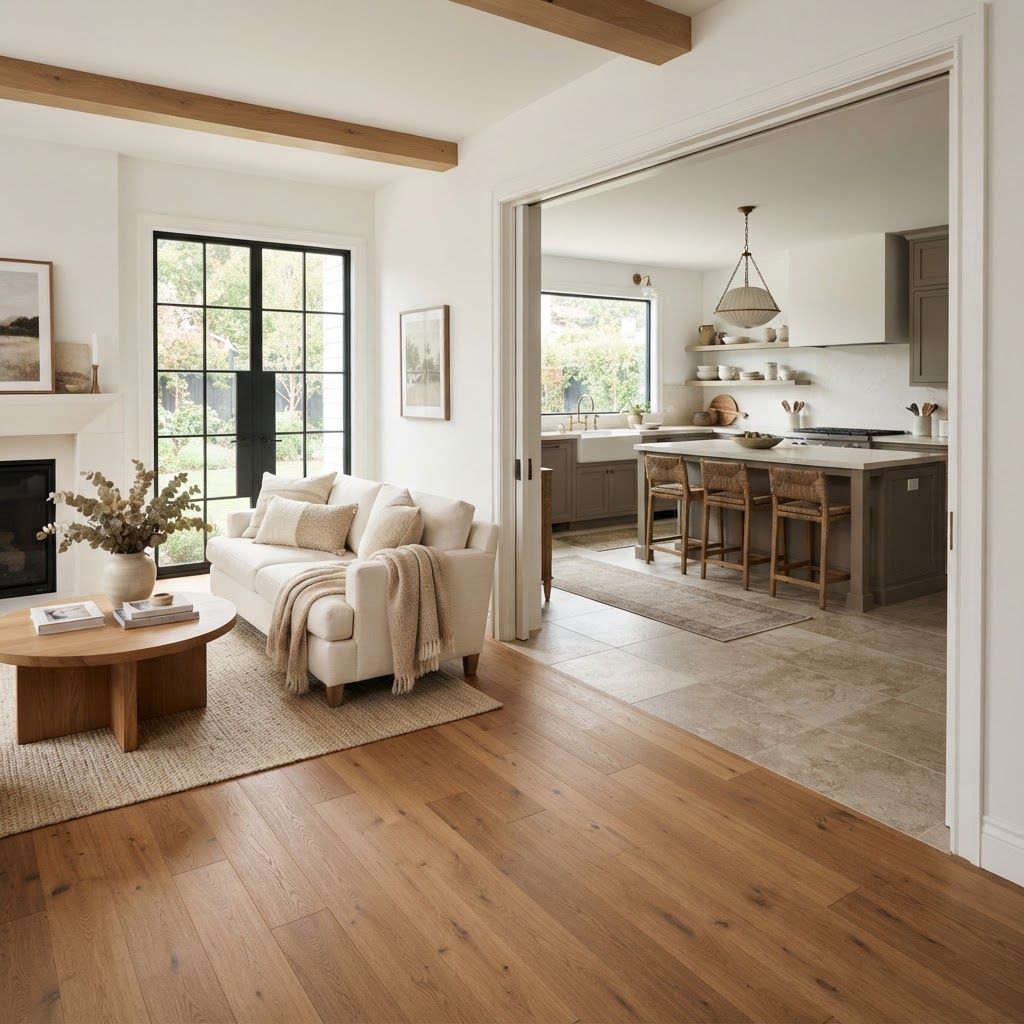
If the case for tile is practical, the best-looking tile installations embrace what tile is. Rather than imitating wood, many designers choose natural stone looks, concrete looks, handmade-style ceramic, terrazzo-inspired patterns, large-format neutrals and classic geometric layouts. These materials look authentic as tile, and they pair beautifully with wood elsewhere in the home. A wood floor in the living areas flowing into a stone-look tile kitchen entry, for example, feels intentional and layered, while a wood-look tile imitating the adjacent wood can look like a mismatch.
Where homeowners still want a wood look in wet areas, quality matters. Choose a product with varied patterns, rectified edges for tight joints, a surface texture that follows the grain, a muted, natural color and a grout color that matches the tile. Select a width and length that look believable and avoid repeating patterns. Samples seen in your own home, in your own light, reveal the difference.
Hybrid and alternative solutions
If you want a wood look in a place where hardwood cannot go, consider alternatives.
Luxury vinyl plank. Waterproof planks with embossed-in-register texture offer a warmer, softer, quieter wood look than tile, with no grout lines. They suit basements, kitchens and bathrooms where moisture is managed. Our vinyl flooring page and articles on how to choose luxury vinyl plank and hardwood versus LVP explain these options.
Engineered hardwood. In many spaces, engineered hardwood with proper moisture control gives real wood in places solid wood cannot go, such as over slabs.
Zoned approach. Real hardwood in living areas, tile in wet zones and carefully designed transitions between them. Our article on kitchen versus living room flooring in Northern Virginia explores material pairings.
Installation: why craftsmanship decides the result
Both materials depend on careful installation.
Hardwood requires a flat, dry subfloor, proper acclimation, correct fastening or gluing, expansion gaps and skillful finishing. Mistakes lead to gaps, cupping and squeaks.
Tile requires a flat, rigid, clean substrate, proper waterproofing in wet areas, correct thin-set coverage, careful layout, consistent grout joints and movement joints where needed. Large-format and plank-shaped tiles are especially demanding. Poor installation leads to lippage, hollow tiles, cracked tiles and failed grout.
Layout is crucial. For plank-shaped tile, offset patterns, usually less than half the plank length, avoid lippage issues due to tile warpage and help the pattern look random. A skilled installer plans layout from the main sightline and balances cuts at the edges.
Our in-house crews, with no subcontractors, handle both trades. Our flooring installation guide describes the process, and our guide to preparing your home for new floors explains how to get ready.
Transitions between wood and tile
In homes that use both, the transitions require thought. Floors may differ in thickness, so heights must be aligned. Expansion gaps and movement joints must be respected. Thresholds and trim should be neat and purposeful. Natural boundaries, such as doorways, are better places for transitions than the middle of an open room. A well-planned transition between hardwood and tile can look elegant, using a flush reducer or a custom-fit threshold. Our estimates include transitions and molding.
What drives the scope of each project
We do not publish costs in articles, but the factors that shape any estimate are clear. The material and its quality tier. Square footage and layout. Substrate preparation, including flattening, waterproofing and moisture testing. Tile size and pattern, which affect layout complexity. Grout and sealing. Removal of existing flooring. Stairs. Trim, molding and transitions. Furniture moving. And the company, including its crews, licensing, bonding and insurance.
At Floors and Beyond VA, we provide an honest, all-inclusive estimate, and what we quote is what you pay. Our estimates include old flooring removal, new materials, professional installation, furniture moving, transitions, molding and full cleanup. Our article on flooring cost factors in Northern Virginia explains why estimates differ.
Wood and tile in Aldie and Loudoun County homes
The balance between wood and tile looks a little different in Aldie than in a dense suburb. Many homes sit on larger lots near fields, woods and gravel drives, so mudrooms, side entries and laundry rooms take mud, water and pet traffic that a hardwood floor should not be asked to handle. Porcelain tile in those spaces is a sensible, honest use of the material. In the living areas of the same home, real hardwood or engineered wood gives the warmth that families want in rooms where they spend evenings.
Newer neighborhoods near South Riding, Brambleton and Ashburn often have builder tile in entries and bathrooms, and builder wood-look tile or luxury vinyl in basements. Owners updating these homes frequently decide to keep tile where it earns its place and replace it with real wood, engineered wood or higher-quality resilient flooring in the main living spaces. Older homes around Middleburg and Leesburg may hide original hardwood under tile, vinyl or carpet, which can sometimes be uncovered and refinished. During our free in-home consultation, we look at what you have, explain what can be saved and show samples of both materials so you can compare them side by side in your own light.
Comfort, sound and daily life
The experience of a floor is more than its appearance. Hardwood has a gentle give and a warmer feel, especially in winter, and it softens footsteps compared with tile. Tile is cooler and harder, and it carries sound and echo more, which can matter in open kitchens with tall ceilings. Radiant heat under tile changes that equation in bathrooms and kitchens, making the floor comfortable year-round. Rugs bring softness and acoustic control to either material. Think about how you use each room, whether you stand for long periods cooking, whether children play on the floor and whether older family members need warm, forgiving surfaces. These practical factors often settle the decision more clearly than appearance does.
Common mistakes when choosing between wood-look tile and hardwood
The first mistake is covering an entire home in wood-look tile because it is easy to maintain.
The second is ignoring comfort and sound, then finding the floor cold and loud.
The third is choosing low-quality printed tile with obvious repetition.
The fourth is using hardwood in constantly wet areas.
The fifth is replacing hardwood that could be refinished.
The sixth is underestimating substrate preparation for large-format tile.
The seventh is choosing grout color that highlights the joints.
The eighth is creating abrupt transitions between materials.
The ninth is ignoring radiant heat opportunities with tile.
The tenth is hiring an installer who does only one of the two trades well.
Frequently asked questions
Is wood-look tile out of style? Many designers are moving away from imitation wood tile in favor of authentic materials, but quality wood-look tile still has practical uses in wet areas.
Is tile or hardwood better for a kitchen? Tile is more forgiving of spills and heavy use, and hardwood is warmer and more comfortable. The best choice depends on your priorities.
Does wood-look tile add value? Buyers tend to value real hardwood in living areas. Tile is valued where it suits the room.
Can I put hardwood in a bathroom? Generally not recommended. Tile or luxury vinyl plank is a better choice for wet areas.
Is tile colder than hardwood? Yes, but radiant heat can make tile warm and comfortable.
Can wood-look tile be refinished? No. Tile cannot be refinished, while solid hardwood can.
Is Floors and Beyond VA licensed and insured? Yes. We are fully licensed, bonded and insured for every project, and our in-house crews work with no subcontractors.
Do you serve my area? Yes. We serve Aldie, South Riding, Brambleton, Ashburn, Leesburg, Middleburg, Chantilly, Gainesville, Haymarket, Fairfax, McLean, Vienna, Reston, Herndon and Arlington, along with Fairfax, Loudoun, Prince William and Arlington counties.
Ready to choose the right material for each room?
The best homes use each material where it belongs. Floors and Beyond VA brings nearly forty years of Northern Virginia experience, in-house crews with no subcontractors, a refinish-first philosophy and a free in-home consultation with samples and precise laser measurements at no charge.
Request your free Aldie flooring estimate: https://floorsandbeyondva.com/Contact
You can also call (703) 906-5698.




