
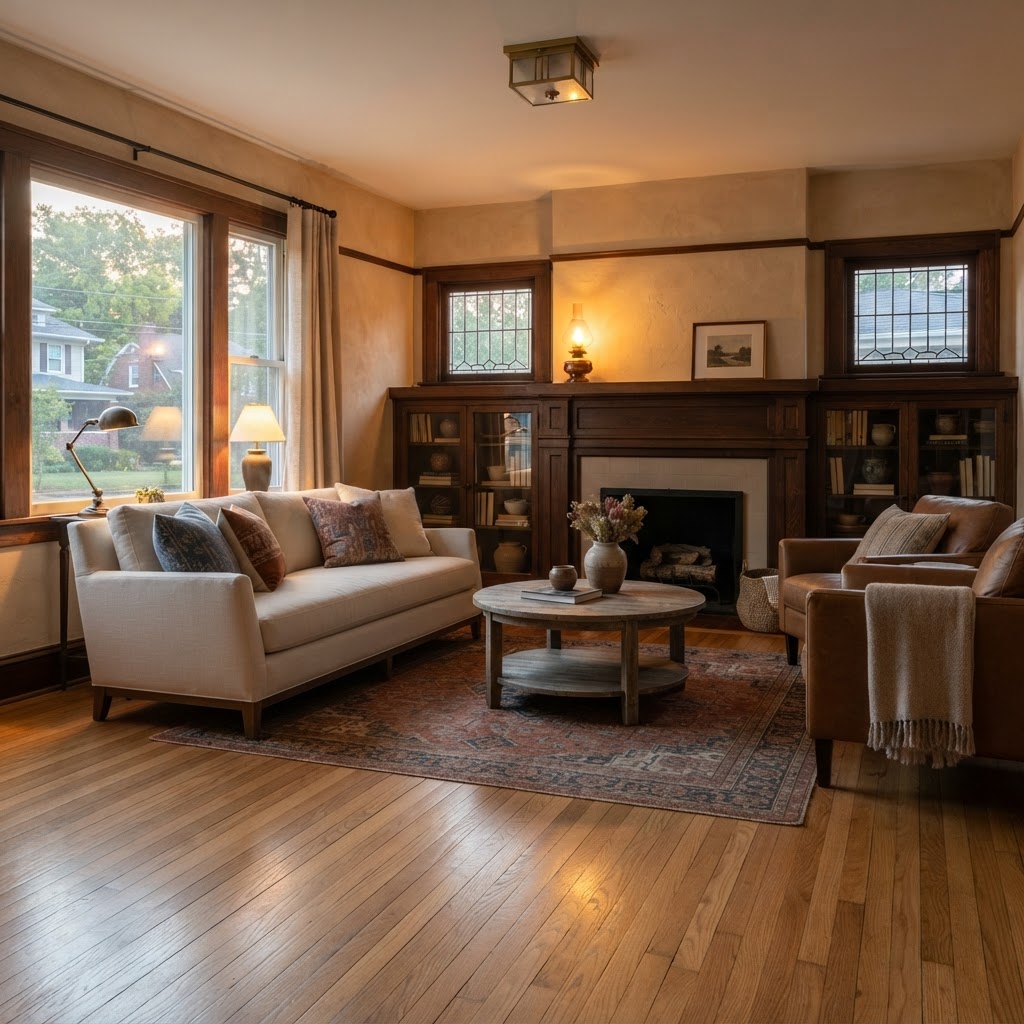
How do you update the flooring in an older Arlington home without losing its character?
You update flooring in an older Arlington home without losing its character by treating the floor as part of the architecture instead of a blank surface: choose stain colors and finishes that suit the house's proportions and light, use layout and plank direction to improve flow between rooms, keep warm natural wood tones and lower sheens that feel current without feeling foreign, and make the modern parts of the home, such as kitchens, baths and additions, relate to the older parts through consistent materials and thoughtful transitions. The goal is not to make an old house look new but to make it look like itself, only fresher and more livable. Floors and Beyond VA is a family-owned Northern Virginia flooring and remodeling contractor serving Fairfax, Loudoun, Prince William and Arlington counties since 1987, and our in-house crews, with no subcontractors, work in older homes regularly and bring samples to your house so you can judge color and finish in your own light. This guide focuses on design choices: stain color, finish and layout. It is not about whether floors can be saved, which is a different question. It is about what to do with floors once you have decided to refresh them. If you are consulting a flooring company in Arlington, VA about an older home, these are the choices that shape how the result feels.
Older Arlington homes have a particular charm. In Cherrydale, Lyon Park, Lyon Village, Westover, Ashton Heights, Maywood and Waverly Hills, bungalows, Cape Cods and colonials have proportions, trim, windows and room sequences that newer houses seldom match. Many also carry the signs of decades of updates: a kitchen opened to the dining room, an addition at the back, bathrooms redone in different eras, and floors that vary from room to room. Updating the flooring is one of the most powerful ways to unify those layers. It also carries a risk. Choose a floor that is too glossy, too gray, too dark or too trendy, and the house can feel as if a stranger's taste has been laid over its bones. This guide helps you avoid that.
Start with what the house is telling you
Before choosing anything, look at the house the way a designer would.
- Proportions and ceilings. Smaller rooms with lower ceilings often feel better with warmer, lighter or medium floors that avoid shrinking the space. Taller rooms can carry deeper tones.
- Light. Mature trees shade many Arlington streets, and rooms may be dim. Floors that are too dark in a shaded room can feel heavy. Rooms with large windows can handle richer tones and show texture beautifully.
- Trim and woodwork. Original baseboards, door casings, built-ins and stair parts are part of the palette. Floors that clash with existing wood trim can look off.
- Architectural style. A craftsman-influenced bungalow, a symmetrical colonial and a compact Cape Cod each carry different cues. Traditional proportions often suit warm, natural wood tones. More open, renovated layouts can take a lighter, simpler treatment.
- What is staying. Cabinets, countertops, tile, fireplace surrounds and furniture you plan to keep all influence what will harmonize.
- How the house flows. Notice the sightlines from the entry through living, dining and kitchen. The floors need to tell one story along those lines.
Walk through the house at different times of day. The color you see in morning sun may differ from evening lamplight. That context is the starting point for every choice that follows.
Stain color: warm, natural and what to be careful with
Color is the decision that most defines the character of a floor.
Natural and lightly toned finishes
Many older Arlington houses have oak floors, and oak responds well to natural or lightly toned finishes. A clear or very lightly tinted finish lets the wood's own character show, with its grain, color variation and warmth. This tends to feel timeless and works in almost every older home. Water-based finishes keep wood lighter and clearer, while oil-based finishes add a deeper amber. If you want a subtle, organic look, test both. Our article on engineered wide plank flooring and our wood flooring page describe related options.
Medium warm tones
A medium honey, golden brown or soft walnut tone feels rooted in tradition and flatters many interiors. It tends to hide dust and scratches better than very light or very dark floors, which is a practical advantage in busy households.
Dark stains
Deep espresso or near-black stains can look dramatic and are popular in some renovated spaces. In older homes, they can overwhelm small rooms, show dust and scratches readily and may sit uneasily with period trim. If you love a dark floor, consider using it in rooms with ample light and ceiling height, and test in the actual space.
Gray and cool tones
Gray-washed floors have been fashionable, but cool tones can feel out of character in older houses with warm woods and plaster. Gray on warm oak also requires care, because mixing a cool pigment with warm wood can look muddy. If you want a cooler, softer look, test carefully and consider whether the style will age well. The principle is simply to test on real wood in your light before committing.
Whitewashed and very pale tones
Pale, limed or whitewashed floors can brighten dim rooms and suit coastal or Scandinavian styles. In older houses, they work best when the rest of the palette supports them. They can also show wear in different ways.
How to choose
Bring photographs of floors you like and tell us what you dislike. We bring samples to your home, because the decision belongs in your light. Compare them next to your trim, cabinetry and furniture, at different times of day, and live with them for a few days if you can. Samples applied to your own sanded wood tell you far more than a catalog.
Finish and sheen: modern without shiny
Sheen has as much influence on character as color.
- Matte and low-sheen finishes. These look natural, contemporary and understated. They hide scratches and dust, and they let wood texture show. They suit older homes beautifully because they avoid a plasticky glare.
- Satin. A soft, gentle glow that adds depth without drawing attention. A sensible middle ground.
- Semi-gloss and gloss. These can look formal and dated in many contexts, and they show every imperfection. They can work in certain traditional or formal settings but are seldom the best choice for modernizing.
- Oil-based versus water-based. Oil-based finishes deepen and warm over time, which can feel period-appropriate. Water-based finishes stay clearer, which suits lighter palettes. Hardwax oils offer a very natural, tactile look with different maintenance needs.
- Consistency. Keep sheen consistent across connected rooms to maintain unity.
Our hardwood floor refinishing field guide for Northern Virginia describes finishing options in more detail.
Layout: the quiet way to modernize
The way boards are laid shapes how a space feels, and layout is often overlooked.
Plank direction
Boards generally run along the longest dimension of a room, or toward the main light source, to make spaces feel longer or more open. In older homes, continuity matters: running boards in the same direction through connected rooms creates flow. Changing direction at a doorway can be a purposeful break.
Plank width
Original strip floors in older Arlington houses are typically narrow. Wider planks feel more contemporary and open, and they can look beautiful in additions and renovated areas. In an original room, a sudden change in width can look inconsistent. If you are adding new floors next to old, matching width or making a deliberate transition is important.
Patterns
Herringbone and chevron patterns add architectural interest and can suit formal rooms, entries and kitchens. They are a significant design statement and need to fit the house. A bungalow may welcome a patterned entry, while an understated Cape Cod might suit a simpler layout. Borders can add traditional detail.
Open plans and removed walls
Many Arlington homeowners open the wall between kitchen and dining room. The floor is where the old and new spaces meet. Continuous flooring across the opening makes the space feel intentional. Where the kitchen was previously a different material, the best result often comes from extending the hardwood and refinishing the entire open area together so the tone matches.
Transitions and thresholds
Where floors change, make the change purposeful. Align transitions with doorways and architectural breaks, and avoid abrupt changes in open spaces. Our accessibility services emphasize smooth, safe transitions.
Stairs
Stairs are focal points. Coordinating treads, risers and railings with the floor creates a polished look. A classic combination is stained treads with painted risers. Our historic home restoration page describes our approach to preserving character in older homes.
Mixing old and new materials
Many updated older homes combine original floors with new materials. The key is relationship.
Kitchens and baths. Tile or vinyl in these rooms can complement hardwood elsewhere. Choose tones that relate, such as warm neutrals with warm wood. Simple, quiet patterns often age better than loud ones. Our kitchen remodeling and bathroom remodeling services coordinate floors with the rest of the room, and our tile and stone page describes options.
Additions. New rooms can use matching hardwood or a complementary engineered product. The goal is flow. See our home additions service.
Basements. Lower levels often use vinyl or tile for moisture tolerance. Choose a tone that relates to the main level. See our basement finishing service.
Vinyl in older homes. Modern luxury vinyl plank can look convincingly like wood in utility areas and basements. Our vinyl flooring page describes our installations.
Rugs. Area rugs add color and pattern while protecting floors. They are one of the easiest ways to modernize a room without altering the floor.
Keeping what makes the house special
Character often lives in details that modern updating can erase.
- Original patterns and borders. If your house has decorative inlays, keep them.
- Imperfections. Slight color variation, a few knots and the patina of age are part of authenticity. Over-sanding or overly uniform staining can flatten character.
- Proportions of boards. Narrow strips are part of the visual rhythm of older houses.
- Stair parts and trim. Preserve original newel posts, balusters and handrails where possible and finish them to relate to the floor.
- Sounds and feel. Some creaks are part of an old house. Not every one can or should be eliminated.
A thoughtful update refreshes what exists. It brings out the wood's best qualities and removes the grime, yellowed finish and mismatches that hide them.
Practical points for older homes
- Plaster walls and trim. Removing and reinstalling baseboards in plaster houses takes care. Shoe molding can cover small gaps.
- Uneven floors. Older floors may not be perfectly level. We plan layouts that look right in out-of-square rooms.
- Old finishes and paints. In very old homes, older paints or finishes may contain hazardous materials. We recommend testing where appropriate and following safe practices.
- Humidity and crawl spaces. Moisture influences wood movement and finishes.
- Heating and cooling. Radiators, registers and humidity swings affect wood.
- Condominiums. For older condominium buildings, rules govern materials and sound control. Our condominium remodeling page and our article on condo remodeling rules and permits describe related requirements.
What drives the scope of an updating project
We do not publish prices in articles, but the factors that shape any estimate are clear. The area and number of rooms involved. Refinishing, repair or new installation. Stain and finish systems and the number of coats. Pattern complexity, such as herringbone or borders. Stairs and railings. Transitions and trim. Subfloor condition. Furniture moving and access. And the company, including its crews, licensing, bonding and insurance.
At Floors and Beyond VA, we provide an honest, all-inclusive estimate, and what we quote is what you pay. Our estimates include old flooring removal, new materials, professional installation, furniture moving, transitions, molding and full cleanup. Our article on flooring cost factors in Northern Virginia explains why estimates differ.
Planning color room by room in an older home
Older Arlington houses are rarely one big space. They are sequences of rooms, each with its own light, and the floor should feel related from room to room without being identical in effect.
Begin at the front door and move through the house the way a visitor would. Notice where the eye lands and where one room opens into the next. In many bungalows and colonials, the entry, living room and dining room are seen together, and they benefit from one continuous tone and sheen. Kitchens that open to these spaces should join the same story, even if the material changes. Bedrooms and upper floors, which are seen separately, have more freedom, though a shared color family keeps the house coherent.
Pay attention to light in each room. A dim north-facing dining room under mature trees can make a medium-dark stain feel heavy, while the same stain in a bright sunroom looks rich. A small room with a low ceiling can feel larger with a lighter, warmer tone. A room with strong afternoon sun may fade or shift wood color over time, so consider how the floor will age near large windows and plan rugs and window treatments accordingly.
Finally, consider the whole palette together: wall colors, trim, cabinets, countertops and the furniture you intend to keep. A floor chosen in isolation can fight these elements. Samples held against them, in your own light, settle the question better than any description. That is why we bring samples to your home and encourage you to look at them over several days.
Why homeowners trust Floors and Beyond VA with older homes
Updating a house with character requires a contractor who respects what is already there. Floors and Beyond VA has worked in Northern Virginia homes since 1987, and our refinish-first philosophy was built on exactly this kind of project: restoring and refreshing floors so an older house looks like itself, only better. We bring stain and finish samples to your home so you can judge them against your trim, cabinets and light, and our free in-home consultation includes precise laser measurements at no charge. Our in-house crews, with no subcontractors, handle the sanding, finishing, transitions and stair work with the care older homes deserve.
Our honest, all-inclusive estimate covers removal, materials, installation, furniture moving, transitions, molding and full cleanup, and what we quote is what you pay. We are a family-owned company, fully licensed, bonded and insured, and we also offer historic home restoration, kitchen and bathroom remodeling, additions and whole-house projects, so your flooring can be coordinated with the rest of your renovation. Learn more at floorsandbeyondva.com.
Common mistakes when updating older homes
- Chasing a trend that does not suit the house.
- Choosing a stain from a photograph instead of a sample in your light.
- Using glossy finishes that fight the house's character.
- Ignoring existing trim and woodwork.
- Changing plank width abruptly between old and new areas.
- Refinishing connected rooms in different tones.
- Making transitions in the middle of open spaces.
- Overlooking stairs.
- Erasing all variation in pursuit of uniformity.
- Treating the floor in isolation from the rest of the renovation.
Frequently asked questions
What stain color is best for an older home? Natural and warm medium tones suit most older Arlington homes. We test samples on your wood in your light.
Are gray floors a good idea in an older house? Cool tones can clash with warm woods and plaster. If you like the look, test carefully.
What sheen should I choose? Matte or satin finishes feel current and avoid glare.
Should new boards be wider than the old ones? Not usually where they meet. Matching width or making a deliberate transition looks best.
Can I open my floor plan and keep the floors consistent? Yes. Extending and refinishing the whole area together is a reliable approach.
Can you work with my original trim and stairs? Yes. We coordinate floors with stairs, treads and trim.
Is Floors and Beyond VA licensed and insured? Yes. We are fully licensed, bonded and insured for every project, and our in-house crews work with no subcontractors.
Do you serve my Arlington neighborhood? Yes, including Clarendon, Courthouse, Ballston, Rosslyn, Shirlington, Lyon Park, Lyon Village, Cherrydale, Westover, Ashton Heights, Maywood, Waverly Hills, Arlington Ridge, Aurora Highlands, Fairlington, Columbia Pike and Nauck, along with Fairfax, Loudoun and Prince William counties.
Keep reading
For related planning, see Flooring Before Selling an Arlington Home: Refinish, Replace or Leave It?, Best Flooring for a Family Home in Arlington, VA: Room by Room and House by House and An Arlington Flooring Renovation Start to Finish.
Ready to update your floors and keep your home's character?
The best updates feel inevitable, as if the house always looked this good. Floors and Beyond VA brings nearly forty years of Northern Virginia experience, in-house crews with no subcontractors, a refinish-first philosophy and a free in-home consultation with samples and precise laser measurements at no charge. Learn more about our work as a flooring company in Arlington, VA.
Request your free Arlington flooring estimate: https://floorsandbeyondva.com/Contact
You can also call (703) 906-5698 or email hello@floorsandbeyondva.com.




