
Kitchen vs Living Room Flooring · Northern Virginia
What Flooring Should I Put in My Kitchen Versus Living Room?
Kitchen and living room flooring decisions are different decisions, even when the rooms are open to each other. The kitchen has spills, water, grease, and dropped cookware. The living room has foot traffic, furniture weight, and resale value expectations. The right answer for one room is often the wrong answer for the other.
For a Northern Virginia kitchen on a wood joist subfloor (pre-war Del Ray, Old Town Alexandria, Clarendon; post-war Burke, Springfield, Fairfax): porcelain tile with DCOF 0.42+ and a Schluter Ditra decoupling membrane, OR solid 3/4" white oak with a matte finish (hardwood is eligible and many NoVA homeowners prefer the visual continuity with the living room). For a NoVA kitchen on a concrete slab (post-2000 Ashburn, Woodbridge, Herndon, Sterling): SPC LVP with a 20-mil wear layer, OR porcelain tile. For the living room on a wood joist subfloor: solid 3/4" white oak with a wire-brushed or matte finish. For the living room on a concrete slab: SPC LVP with a 20-mil wear layer, or engineered hardwood with a 3mm+ wear veneer. In-house crews, no subcontractors, since 1987.
Kitchen and Living Room Have Different Requirements
The kitchen and the living room serve different functions and have different flooring requirements, even in open-concept NoVA homes where the two spaces flow together. The kitchen has spills, water, grease, dropped cookware, and frequent cleaning. The living room has foot traffic, furniture weight, and resale value expectations. The right flooring for a kitchen is not always the right flooring for a living room, and vice versa.
Floors and Beyond VA approaches kitchen and living room flooring decisions separately, even when the rooms are open to each other. The subfloor determines what is eligible. The room determines what is appropriate. The two decisions may produce the same product — for example, solid white oak flowing from the living room into the kitchen — or they may produce different products, with a transition at the room boundary. The discipline is in evaluating each room on its own requirements.
The honest answer to "what flooring should I put in my kitchen versus living room" is subfloor-dependent and use-case-dependent. On a wood joist subfloor, solid white oak can work in both rooms for visual continuity, but porcelain tile is the more practical kitchen choice. On a concrete slab, SPC LVP is the practical choice for both rooms, but engineered hardwood in the living room with SPC LVP in the kitchen is also a reasonable split.
Kitchen Flooring on Wood Joist Subfloors
On a wood joist subfloor — pre-war Del Ray, Old Town Alexandria, Clarendon, or post-war Burke, Springfield, Fairfax — kitchen flooring has two main options. The first is porcelain tile with DCOF 0.42+ and a Schluter Ditra decoupling membrane. Porcelain is the most practical kitchen flooring because it is waterproof, dimensionally stable, and handles spills, grease, and dropped cookware without damage. The DCOF 0.42+ rating ensures slip resistance on wet surfaces, which is essential in a kitchen where water spills are routine.
The decoupling membrane (Schluter Ditra) is essential on a wood joist subfloor because it prevents cracks in the tile from subfloor movement. Wood joist floors flex slightly underfoot, and any tile installed directly on the subfloor will crack within a few years. The decoupling membrane absorbs the movement and prevents the cracks.
The second option is solid 3/4" white oak with a matte or wire-brushed finish. Hardwood is eligible on a wood joist subfloor, and many NoVA homeowners prefer the visual continuity of wood flowing from the living room into the kitchen. The matte or wire-brushed finish is essential in a kitchen because it hides scratches, dents, and the inevitable water spots that come with kitchen use. High-gloss finishes are not appropriate for kitchens — they show every spill and every scratch.
Kitchen Flooring on Concrete Slabs
On a concrete slab — which describes nearly every post-2000 home in Ashburn, Woodbridge, Herndon, and Sterling — kitchen flooring has two main options. The first is SPC LVP with a 20-mil wear layer and 5mm total thickness or greater. SPC LVP is the practical kitchen flooring on a slab because the waterproof core handles spills, water, and grease without permanent damage. The dimensional stability of the rigid SPC core prevents the floor from cupping or telegraphing subfloor imperfections, which is essential in a kitchen where the floor is exposed to frequent moisture.
The second option is porcelain tile with DCOF 0.42+. Porcelain is the most durable kitchen flooring on any subfloor, and on a concrete slab it can be installed directly (after testing the slab for moisture vapor transmission). The cost is higher than SPC LVP, but the lifespan is longer — porcelain tile can last 50+ years with proper installation, while SPC LVP must be replaced every 15 to 25 years.
The decision between SPC LVP and porcelain tile in a slab kitchen depends on budget, expected tenure in the home, and resale value considerations. Porcelain tile contributes more to resale value than LVP, particularly in higher-priced Ashburn and Woodbridge homes. SPC LVP is the more practical choice for homeowners who prioritize lower upfront cost and easier installation.
Living Room Flooring on Wood Joist Subfloors
On a wood joist subfloor, the living room flooring choice is solid 3/4" white oak with a wire-brushed or matte finish. Solid white oak is the highest-value flooring for living rooms on wood joist subfloors because it can be refinished three to four times over a 30+ year lifespan, contributes measurably to resale value, and handles the NoVA humidity swing with proper acclimation and finish selection.
The species matters — white oak has a tighter grain than red oak, which means the floor absorbs less moisture vapor in a Virginia summer, shrinks less in a Virginia winter, and shows fewer visible gaps across the year. The finish matters — wire-brushed or matte finishes hide scratches, dents, and seasonal movement, which extends the visible lifespan of the floor by years. High-gloss finishes are not appropriate for living rooms because they show every scratch, every dust mote, and every seasonal gap.
The living room flooring choice also depends on the existing floor. If the home has original solid 3/4" oak under carpet or sheet vinyl, restoration is almost always the better investment than new installation. Floors and Beyond VA has found original hardwood under carpet in dozens of NoVA homes. Restoration is a fraction of the cost of new hardwood installation and preserves the original material that buyers in pre-war neighborhoods specifically reward.
Living Room Flooring on Concrete Slabs
On a concrete slab, the living room flooring choice is SPC LVP with a 20-mil wear layer (the practical baseline) or engineered hardwood with a thick wear veneer (the value upgrade). Solid hardwood is not an option on a slab without significant floor build-up, which is rarely worth the cost.
SPC LVP is the practical choice for post-2000 slab homes because the waterproof core handles the inevitable spills and the dimensional stability prevents the floor from telegraphing slab imperfections. Engineered hardwood with a 3mm+ wear veneer is the value upgrade — it can be refinished once and contributes more to resale value, but it costs more upfront and requires proper moisture vapor testing before installation.
The decision between SPC LVP and engineered hardwood in a slab living room depends on budget, expected tenure in the home, and resale value considerations. For homeowners planning to sell within 5 years, engineered hardwood is typically the better investment because the resale contribution exceeds the cost difference. For homeowners planning to stay 10+ years, SPC LVP is often the more practical choice because the lower upfront cost and easier maintenance outweigh the resale contribution.
The Visual Continuity Question
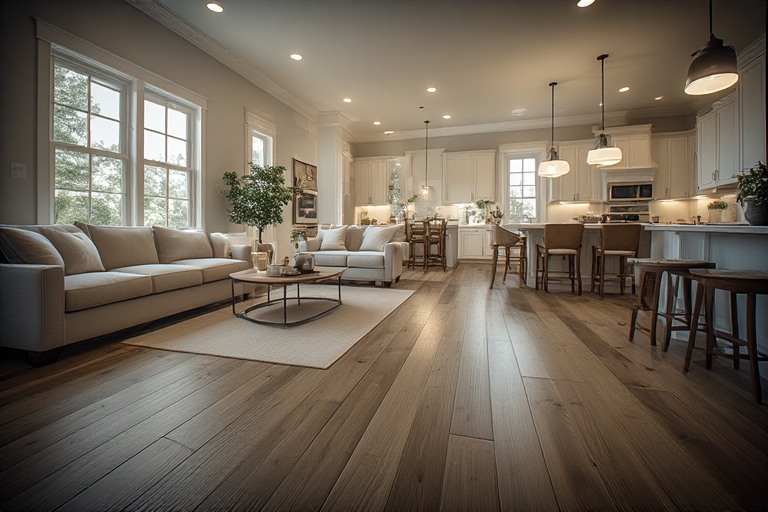
Many NoVA homeowners want visual continuity between the kitchen and the living room, particularly in open-concept homes where the two spaces flow together. The visual continuity question is real, but it should not override the practical requirements of each room. A kitchen floor that fails because it was chosen for visual continuity with the living room is a more expensive problem than a transition strip between two different flooring products.
On a wood joist subfloor, solid white oak can flow from the living room into the kitchen for visual continuity, provided the finish is matte or wire-brushed (not high-gloss) and the homeowner understands that kitchen spills will require more frequent cleaning and may eventually require board replacement. The alternative is porcelain tile in the kitchen with a transition to hardwood in the living room — a common NoVA pattern that balances practicality with aesthetics.
On a concrete slab, SPC LVP can flow from the living room into the kitchen for visual continuity, because the waterproof core handles kitchen spills without damage. This is one of the structural advantages of SPC LVP on a slab — the same product works in both rooms, eliminating the need for a transition. Engineered hardwood can also flow into the kitchen, but the homeowner should be aware that engineered hardwood is more vulnerable to water damage than SPC LVP.
The Resale Value Consideration
The kitchen and living room are the two rooms that contribute most to resale value in a Northern Virginia home. Appraisers in Fairfax, Loudoun, Prince William, and Arlington Counties treat hardwood floors as a quality indicator, and buyers specifically look at the kitchen and living room when evaluating a home. The flooring choices in these rooms matter more than the flooring choices in any other room.
On a wood joist subfloor, solid white oak in both rooms is the highest-value choice. The visual continuity is a selling point, and the hardwood contributes measurably to resale value. On a concrete slab, SPC LVP in both rooms is the baseline, with engineered hardwood in the living room as the value upgrade. The kitchen can remain SPC LVP even when the living room is upgraded to engineered hardwood, because LVP is the practical kitchen flooring on a slab.
The honest answer about resale value is that the kitchen and living room flooring choices should be made with resale in mind, because these rooms have the largest impact on buyer perception and appraised value. The right product on the right subfloor, specified correctly, maximizes both practical performance and resale contribution.
Why In-House Crews
Floors and Beyond VA does not use subcontractors. Every kitchen and living room installation — hardwood, LVP, tile, carpet — is performed by an in-house employee supervised on-site. This structure matters because kitchen and living room installations require precision. A hardwood floor installed without proper acclimation will cup and gap within a year. A tile floor installed without a decoupling membrane on a wood joist subfloor will crack. An LVP floor installed without proper subfloor preparation will telegraph imperfections and fail at the seams.
An in-house crew answers to the company that sold the job. The company answers to the homeowner. There is no third party to blame when something goes wrong. Floors and Beyond, who leads the field assessments, has roughly forty years of experience on Virginia job sites. That experience is what allows the company to walk into any NoVA home and know, within minutes, which product is the right call for the kitchen and the living room.
Frequently Asked Questions
What flooring should I put in my Northern Virginia kitchen?
On a wood joist subfloor — pre-war Del Ray, Old Town Alexandria, Clarendon, or post-war Burke, Springfield, Fairfax — porcelain tile with DCOF 0.42+ and a Schluter Ditra decoupling membrane, or solid 3/4" white oak with a matte finish. On a concrete slab — post-2000 Ashburn, Woodbridge, Herndon, Sterling — SPC LVP with a 20-mil wear layer, or porcelain tile.
What flooring should I put in my NoVA living room?
On a wood joist subfloor, solid 3/4" white oak with a wire-brushed or matte finish. On a concrete slab, SPC LVP with a 20-mil wear layer (the practical baseline) or engineered hardwood with a 3mm+ wear veneer (the value upgrade). Solid hardwood is not an option on a slab without significant floor build-up.
Should the kitchen and living room have the same flooring?
Not necessarily. Visual continuity is a preference, but it should not override the practical requirements of each room. On a wood joist subfloor, solid white oak can flow from the living room into the kitchen, but porcelain tile is the more practical kitchen choice. On a concrete slab, SPC LVP can flow into the kitchen because the waterproof core handles spills without damage.
Is hardwood appropriate for a NoVA kitchen?
Yes, on a wood joist subfloor, with a matte or wire-brushed finish (not high-gloss) and the understanding that kitchen spills will require more frequent cleaning and may eventually require board replacement. Hardwood is not eligible on a concrete slab without significant floor build-up. Many NoVA homeowners prefer hardwood in the kitchen for visual continuity with the living room.
Floors and Beyond VA — Service Area
Floors and Beyond VA installs kitchen and living room flooring across Northern Virginia, including the cities and communities of Ashburn, Woodbridge, Herndon, Sterling, Leesburg, Reston, Springfield, Burke, Fairfax, Alexandria, and Arlington.
Fairfax County · Loudoun County · Prince William County · Arlington County
Schedule a kitchen/living room flooring consultation directly with Floors and Beyond VA — in-house crews, no subcontractors, no pricing on the website.