
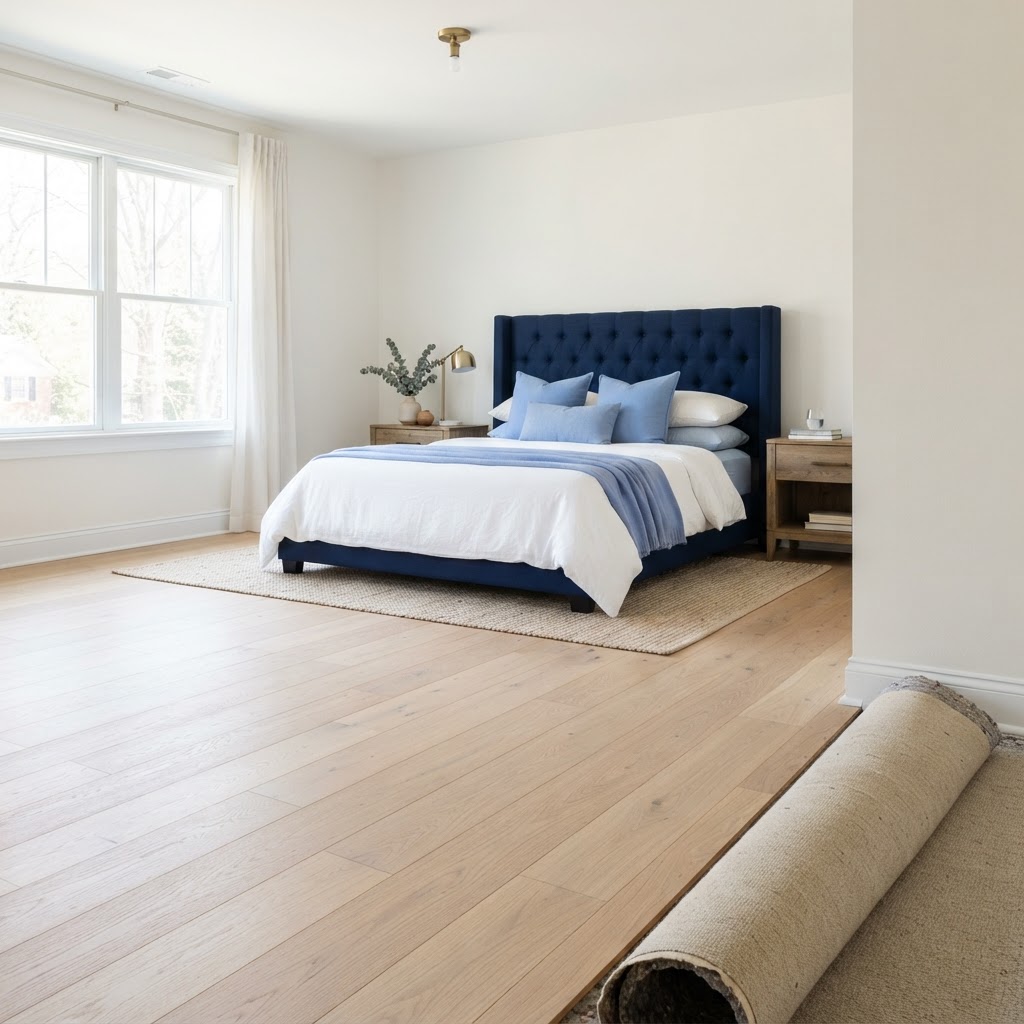
What changes besides appearance when you replace carpet with hardwood or LVP in a McLean home?
When you replace carpet with hardwood or luxury vinyl plank (LVP) in a McLean home, much more changes than the look. Floor height shifts, which affects door clearances, transitions and appliances. Stairs need new treatments. Sound travels differently, because hard surfaces are louder than carpet and padding. The subfloor must be inspected, cleaned and often repaired or leveled. Underlayment choices matter for comfort, moisture and noise. Adjoining rooms influence the layout and may expand the project. Temperature and comfort underfoot change, and maintenance routines change too. Floors and Beyond VA, a family-owned Northern Virginia flooring and remodeling contractor serving Fairfax, Loudoun, Prince William and Arlington counties since 1987, handles carpet-to-hard-surface conversions with in-house crews and no subcontractors, and we look at everything the change affects before we recommend a plan.
Carpet-to-hard-surface conversions are among the most common flooring projects in established McLean homes. Many houses were built or renovated with wall-to-wall carpet in bedrooms, living areas, hallways and stairs, and owners today often prefer the cleaner look, easier maintenance and longer-term value of hardwood or LVP. In some of those homes, original hardwood is waiting beneath the carpet. In others, there is plywood or a plain subfloor that must be prepared. Either way, the work is not simply pulling out one covering and putting down another. This guide walks through what changes, what to check and what surprises to expect, so that you can plan with confidence. For related reading, see our article on carpet to hard flooring conversion in Northern Virginia.
First, see what is under the carpet
Before deciding between hardwood and LVP, find out what lies beneath the carpet. In many older McLean homes, solid oak flooring was installed originally and later covered. If it is intact, it may be a candidate for refinishing, which can give you hardwood floors without installing new material at all. That is the heart of our refinish-first philosophy. Our articles on whether your hardwood floors can be saved and whether refinishing is worth it explain how to evaluate hidden floors.
Hardwood under carpet may bear the marks of its history: tack strip holes along the edges, staining from pet accidents or old moisture, adhesive residue, paint, gaps and areas where boards were cut for vents or other changes. These can often be repaired, but the extent matters. In other homes, the subfloor beneath the carpet is plywood, oriented strand board or a wood plank deck that was never meant to be seen. It can serve as an excellent base for new flooring after preparation, but it is not finish flooring.
A free in-home consultation lets us lift a corner, look at the condition and tell you what you have. That first look often changes the plan.
Hardwood or LVP: choosing the new surface
Both hardwood and LVP can transform a carpeted room, and each has strengths.
Hardwood offers natural beauty, warmth, renewability and long-term value. Solid hardwood suits above-grade wood subfloors and can be refinished many times. Engineered hardwood offers added stability for wide planks, concrete slabs and radiant heat. Hardwood scratches and dents more readily than LVP, is sensitive to standing water and benefits from stable humidity. See our wood flooring page and our article on engineered wide-plank flooring in Northern Virginia.
LVP offers water resistance, scratch resistance and low maintenance, with convincing wood looks. It is a strong choice for basements, kitchens, mudrooms, playrooms and busy family spaces. It cannot be refinished, quality varies widely and a thin wear layer will not hold up in busy zones. See our vinyl flooring page and our articles on how to choose luxury vinyl plank, LVP pros and cons, what SPC core flooring is and whether vinyl flooring is waterproof.
Our hardwood versus LVP comparison for Northern Virginia helps you weigh them directly. Many homeowners choose hardwood for main living areas and bedrooms and LVP for lower levels or wet areas, with thoughtful transitions between them.
Door clearances and floor height
Carpet and pad together have a particular thickness, and when they are removed and replaced with a different material, the finished floor height changes. Hardwood and LVP are generally thinner than carpet with pad, though underlayments and subfloor preparation can add thickness. The result may be a lower floor, which can create gaps under doors, change how doors clear, and expose the edges of baseboards or wall bases that were hidden by carpet.
Conversely, if the new floor is thicker than the old carpet, doors may no longer swing freely, and appliances, cabinets and thresholds can be affected. A careful contractor measures finished floor heights in advance and plans solutions: trimming doors, adjusting thresholds, adding or removing trim and tapering transitions. We take precise laser measurements at no charge, and our estimates include transitions and molding.
Look also at closets, built-ins, fireplaces, heating vents and cabinet toe kicks. Each has a relationship with the floor height, and a change can affect them. Raising or lowering floors requires planning, and surprises are best discovered before materials are ordered.
Transitions between rooms
When one room changes from carpet to hard surface and the next does not, a transition is required. Transitions must handle differences in height, material and expansion, and they should look intentional. Options include flush reducers, T-molding, threshold strips and, in some cases, continuing the new floor into adjoining rooms to eliminate the transition entirely.
Often, the best strategy is to expand the scope slightly to a logical break point, such as a doorway or a change in room function. Converting only half of a hallway or one room in an open layout can create awkward boundaries. Our article on kitchen versus living room flooring in Northern Virginia discusses material pairings across connected spaces. Thoughtful planning of where materials meet is a hallmark of quality work, and it is why we walk the whole home with you at the consultation.
Stairs
Stairs are the most complicated part of many carpet conversions. Carpeted stairs typically have a plywood or softwood base with treads and risers that were never finished for exposure. Converting to hardwood involves new treads and risers, or capping existing treads, and finishing the stringers and edges. Converting to LVP on stairs requires stair nosings and careful fitting. Each approach changes the riser heights, which must remain consistent for safety, and that makes accurate measurement and skilled carpentry essential.
Some homeowners prefer to keep carpet on stairs for traction and quiet, perhaps with a runner on hardwood treads for a classic look. Others choose hardwood throughout. Both can be beautiful. Stair work adds detail, time and scope, and it is one of the main factors that shapes the estimate. Our wood flooring and carpet pages describe stair options, and our luxury carpet page covers premium runners.
Sound and comfort
Carpet and pad absorb sound and soften footsteps. Hard surfaces reflect it. In a two-story McLean home, replacing carpet on the upper level with hard flooring can noticeably increase the noise heard below, as well as echo within the room. Rugs help. So do quality underlayments designed for sound reduction, which are available for floating installations and some other systems. In condominiums and townhomes, association rules may require specific sound performance, which our condominium remodeling page and article on condo remodeling rules and permits discuss.
Comfort underfoot changes as well. Carpet feels warm and soft. Hardwood and LVP feel firmer and, depending on the subfloor and underlayment, cooler. LVP with an attached pad can be more forgiving. If warmth matters, area rugs, quality underlayment and, in some cases, radiant heat systems can help. In bedrooms, many homeowners keep carpet precisely for comfort and quiet while converting living areas to hard surfaces.
Subfloor preparation: the part you do not see
The subfloor determines how well the new floor performs. After carpet and pad are removed, we inspect the subfloor for damage, moisture, squeaks, loose panels, uneven areas, staples, tack strip remnants, adhesives and old patches. Hardwood requires a sound, flat, clean, dry subfloor and proper fastening. LVP is thin and unforgiving of imperfections, since bumps and dips can telegraph through the surface and cause joint stress or gaps. Flatness requirements are specific, and leveling compounds or panel repairs may be needed.
Moisture matters, especially over concrete slabs and in basements. Carpet tolerates minor dampness better than hard surfaces, which can fail if moisture is not addressed. Testing and mitigation are essential. In older homes, certain historic adhesives and flooring materials under carpet may contain hazardous substances such as asbestos, and a responsible contractor advises on testing and safe handling before disturbing them. Our flooring installation guide explains our preparation process, and our guides to flooring for the basement and the best flooring on concrete basements address lower-level conditions.
Because subfloor issues are often hidden until carpet is removed, they are a common source of unexpected scope. A good contractor explains this possibility in advance and communicates promptly if something is found. At Floors and Beyond VA, we tell you what we find and what it means.
Underlayment choices
Underlayment sits between the subfloor and the finished floor and serves several purposes: cushioning, sound reduction, moisture protection, thermal insulation and leveling of minor imperfections. The right underlayment depends on the flooring type, the subfloor and your priorities. Floating hardwood and LVP products have manufacturer requirements for underlayment, and some have attached pads. Nailed or glued hardwood systems use different materials, such as felt or specialized membranes. Concrete slabs often call for moisture barriers.
Using the wrong underlayment can void warranties and cause failures. We select underlayments based on the manufacturer's instructions and the conditions of your home, and we explain why.
How adjoining rooms affect the scope
Conversions rarely stop at a single room. A carpeted bedroom opens into a carpeted hallway, which leads to carpeted stairs and to the other bedrooms. A carpeted living room flows into a hardwood dining room and a tiled kitchen. Where you stop and start affects how finished the home looks and how much work is involved.
Consider sightlines, doorways and room function. Continuing hard flooring through a connected area often looks better and eliminates transitions, but it increases the square footage. Stopping at a doorway may be more economical and logical. Some homeowners convert in phases, completing one level now and another later. If you plan to phase the work, choose materials and layouts that will allow later phases to match.
Our estimates itemize these choices so that you can compare scopes, and our whole house remodels and home additions services help when conversions are part of a larger project.
Daily life after the conversion
Maintenance changes when you move from carpet to hard surfaces. Hardwood and LVP are generally easier to clean and do not trap dust, allergens or pet dander as carpet does. They also need different care: entry mats, felt pads under furniture, appropriate cleaners, humidity control for wood and prompt cleanup of spills. Rugs bring back softness and sound absorption where wanted. Our floor care page gives practical guidance, and our article on removing pet odors from carpet in Northern Virginia may be relevant if odor is part of your reason for converting.
Think also about the rooms where carpet still makes sense. Bedrooms, playrooms, media rooms and stairs often benefit from carpet's comfort. Our home theater carpet page describes carpet designed for media spaces. A mixed approach is common and often best.
Preparing for the project
A conversion involves demolition, so preparation is important. Clear rooms, protect valuables, plan for pets and household members and decide how you will live in the home during the work. Our estimates include furniture moving and full cleanup. Our guide to preparing your home for new floors provides a complete checklist. We also recommend asking your contractor to explain, before work begins, what could change the plan, such as hidden damage, moisture or height conflicts.
What drives the scope of a carpet conversion
We do not publish prices in articles, but the factors that shape any estimate are clear. The new material and its quality tier. Square footage and the number of rooms. Carpet and pad removal and disposal. Subfloor condition and preparation, including leveling, repairs and moisture mitigation. Underlayment. Stairs, which add detailed work. Door adjustments, transitions, trim and molding. Furniture moving. Adjoining rooms that expand the scope. And the company, including its crews, licensing, bonding and insurance.
At Floors and Beyond VA, we provide an honest, all-inclusive estimate, and what we quote is what you pay. Our estimates include old flooring removal, new materials, professional installation, furniture moving, transitions, molding and full cleanup. Our article on flooring cost factors in Northern Virginia explains why estimates differ.
Common mistakes when converting from carpet
The first mistake is replacing hardwood that was hiding under the carpet without checking whether it could be refinished.
The second is ignoring floor-height changes, leading to door and appliance conflicts.
The third is skipping subfloor inspection and preparation.
The fourth is underestimating stairs.
The fifth is forgetting about sound, especially over living spaces and in multi-family buildings.
The sixth is choosing an underlayment without regard to the manufacturer's requirements.
The seventh is ignoring moisture over concrete and in basements.
The eighth is creating awkward transitions by stopping flooring in the wrong place.
The ninth is comparing estimates with different scopes.
The tenth is hiring a contractor who does not discuss what could go wrong.
Frequently asked questions
Can I put hardwood where I have carpet? Often, yes. You may even have hardwood underneath already. Subfloor type, level and moisture determine the best approach.
Is LVP or hardwood better for replacing carpet? Both work. Hardwood offers warmth and renewability, and LVP offers water and scratch resistance. The best choice depends on the room and subfloor.
Will my doors still open after the conversion? Usually, with planning. Floor heights are measured in advance, and doors may need trimming or adjustment.
What about my stairs? Stairs can be converted to hardwood or LVP with new treads, risers and nosings, or kept in carpet or runners. Stair work adds detail.
Will it be noisier? Hard surfaces are louder than carpet. Rugs and sound-rated underlayments help.
What surprises might come up? Hidden subfloor damage, moisture, adhesive residue, height conflicts and historic materials that need testing.
Is Floors and Beyond VA licensed and insured? Yes. We are fully licensed, bonded and insured for every project, and our in-house crews work with no subcontractors.
Do you serve my McLean neighborhood? Yes, including Langley, Chesterbrook, Franklin Park, Salona Village, Hamilton, Dunn Loring, Vienna, Great Falls and Tysons, as well as Fairfax, Loudoun, Prince William and Arlington counties.
Ready to replace your carpet?
A good carpet conversion begins with looking closely at what is under your feet. Floors and Beyond VA brings nearly forty years of Northern Virginia experience, in-house crews with no subcontractors, a refinish-first philosophy and a free in-home consultation with samples and precise laser measurements at no charge.
Request your free McLean flooring estimate: https://floorsandbeyondva.com/Contact
You can also call (703) 906-5698 or email hello@floorsandbeyondva.com.




