
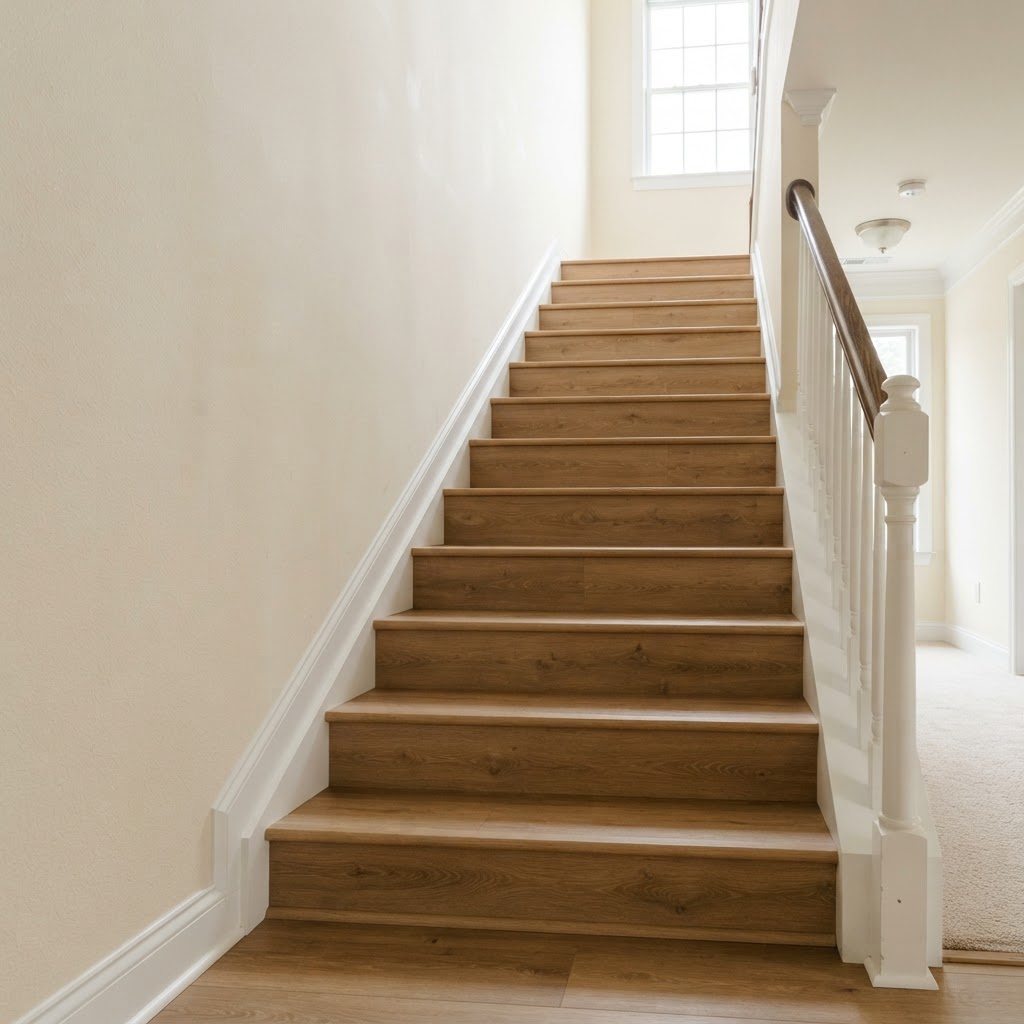
Yes, with the right product, parts and method. Vinyl plank on stairs is glued or fastened, not floated, and it needs a secure stair nose and uniform steps. Traction matters, and the planks must be approved for stairs. Floors and Beyond VA checks each staircase in person before quoting.
For local project notes, service details and answers to common questions, see our Flooring Company in Fairfax, VA page.
Stairs are the most demanding part of any flooring project. Every tread gets concentrated traffic on its front edge, every step has to match the next, and nothing can flex or lift. That is why the same plank that works beautifully across a large floor often fails on a staircase when it is installed the same way.
Why stairs are not just a small floor
A flat floor sits on one continuous surface, and most vinyl planks are designed to float over it, held in place by their own weight and the walls. A stair tread is a small platform with a free edge, a vertical face and a nose that takes the impact of every footstep. It is surrounded by cut edges instead of overlapping seams, and it moves with the temperature of the house.
That combination means floating is not an option. Planks are glued down or fastened, the nose is a separate piece, and the installation is judged by how uniform and solid each step feels underfoot.
How it is done
- Measure each tread and riser individually. Old stairs are rarely identical, and the small differences decide the cut list.
- Prepare the surface. Carpet, padding, staples and tack strip are removed, loose treads fastened, squeaks fixed and gaps filled.
- Install the risers first. The vertical faces go in before the horizontal surfaces so the joints are hidden by the treads.
- Install the treads. Planks are cut to fit, glued or fastened with the manufacturer's specified adhesive and fasteners, and any seams set in a consistent direction.
- Fit the stair nose along the front edge. This piece caps the exposed edge and protects it from impact. Some products have pre-formed treads with an attached nose.
- Trim and finish the openings. Balusters, stringers and any open side are addressed so the stair looks complete.
- Let it cure. The stairs must cure before use, per the adhesive's instructions. Walking on fresh adhesive is the most common way a stair installation fails.
Preparation
Carpet, padding, staples and tack strip come out, loose treads are fastened, squeaks are fixed and gaps are filled. Surfaces must be clean, dry and smooth so the adhesive bonds. On older stairs this is the stage that takes the longest. A tread that flexes will eventually break the bond above it, no matter how good the adhesive is.
What a sound staircase looks like before planks go down
- Every tread solid underfoot, with no movement or give.
- Risers tight to the treads, with no gaps at either end.
- Consistent tread depth and riser height across the run.
- No protruding nails, staples or old adhesive left behind.
- Dry wood, with no signs of damp or past water damage.
Plank choice and parts
Check that your plank is approved for stairs and whether matching stair nose pieces exist in the same color. A stronger wear layer helps because stairs take concentrated wear, and thickness adds to the height of each step.
| What to check | Why it matters on stairs |
|---|---|
| Stair approval from the manufacturer | Not every plank is rated for glue-down or vertical work |
| Matching stair nose in the same color | An off-color edge is the first thing anyone sees |
| Wear layer thickness | The front edge takes the most wear in the house |
| Overall thickness | It adds height to every step, which affects the whole run |
| Texture and finish | Determines traction, especially in socks |
Safety and code
Vinyl can be slippery in socks, so choose a textured surface and consider a runner with a vinyl-safe backing. Steps must stay uniform, because a step that differs from the others is a trip hazard and can raise code issues. Ask how the installer will keep the dimensions consistent and whether a permit or inspection applies.
Adding a layer over an existing tread changes the height of the step, even if only slightly, and that change repeats up the entire staircase. A good installer plans the whole run before cutting the first piece rather than discovering a mismatch at the top landing.
Northern Virginia specifics
Townhomes across Fairfax, Loudoun and Prince William counties often have carpeted stairs along a wall, sometimes with an open side and balusters. Sound can travel through shared walls, so a runner or the right adhesive and plank help. Older homes in Arlington and Alexandria may have stairs that settled unevenly, which shows up as a tread that rocks or a riser that is taller than its neighbors.
How Floors and Beyond VA approaches stairs
Floors and Beyond VA looks at the staircase in person, confirms the treads and risers are sound and uniform and discusses product, nose and traction with you. We use the parts and adhesives the manufacturer specifies and tell you honestly if a different material suits the stairs better. At Floors and Beyond VA, our crews are our own employees.
For the longer walkthrough, read LVP flooring for stairs. If you are in Fairfax, see our LVP flooring in Fairfax, VA page.
Frequently asked questions
Can click-lock planks float on stairs?
Generally no. Stairs need glued or fastened installation.
Do I need a stair nose?
Yes, for a safe, durable, finished edge.
Can I install over carpet?
No. The carpet and padding must be removed first.
When to call a professional
If you are thinking about vinyl on your stairs, have them evaluated first, because stairs are the most demanding part of a flooring project. Floors and Beyond VA is family-owned and has served Northern Virginia since 1987. Schedule an in-home estimate at floorsandbeyondva.com/Contact or call (703) 906-5698.
Have your staircase looked at first
Tread condition, uniformity and the right stair nose decide whether vinyl works on your stairs. We check all three before quoting.
LVP Flooring in Fairfax, VARead the full guide: LVP flooring for stairs




