
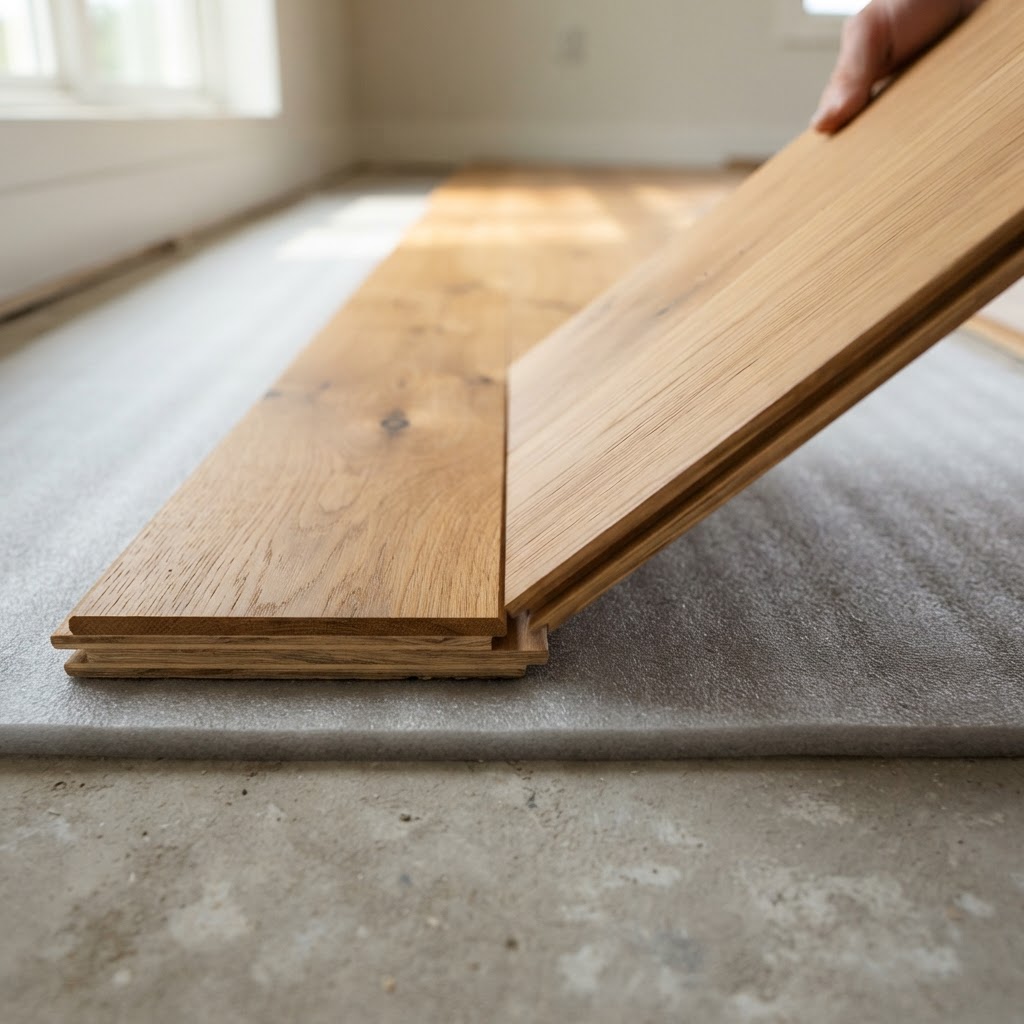
A floating floor is not attached to the subfloor. The planks connect to each other, by click-lock edges or glued tongue-and-groove joints, and the whole floor rests on an underlayment. Floating engineered hardwood is popular in Northern Virginia because it installs quickly, works over wood or concrete and suits condos and townhomes. It is not right for every room, and the details decide whether it feels solid or hollow. This guide explains how a floating engineered hardwood floor works, its advantages and limits and how to get a good result. Floors and Beyond VA is a family-owned flooring company that has served Northern Virginia since 1987, and our own crews handle the work from the first visit to the final cleanup.
How a Floating Floor Works
The planks form a single sheet that rests on the underlayment. Because it is not nailed or glued to the subfloor, the floor can expand and contract slightly with humidity as a unit. That is why a gap, usually covered by baseboard or trim, is left around the edges. The locking system or glue joints keep the planks together.
Advantages
Installation is quicker than glue-down or nail-down, with less preparation of adhesive. It works over concrete slabs and most wood subfloors. It can be installed over some existing floors when they are flat and sound. It allows an underlayment that adds cushioning, sound control or a moisture barrier. If a plank is damaged, it can often be replaced by releasing the joints from the nearest wall. These features make it a frequent choice for condos, basements and rooms where a quick install matters.
Limits to Know
A floating floor can feel slightly less solid than a glued floor, particularly with thin planks or soft underlayment. It may sound hollow under footsteps if the underlayment is poor or the subfloor is uneven. Large open areas need expansion breaks, and long runs may need a transition. It is not meant for heavy loads such as a kitchen island without special instruction, since the island should not pin the floor. Floating floors also need a flat subfloor, because dips let the joints flex and eventually separate.
Underlayment Matters
The pad under a floating floor affects feel, sound and moisture protection. Over a slab, it needs a vapor barrier. In a condo, it must meet the building's sound rating. Too thick or too soft a pad lets the joints move. Choose one the manufacturer allows, and see our underlayment guide for the types.
Subfloor Flatness
Most manufacturers specify a flatness tolerance. Wood subfloors may need sanding or leveling, and concrete may need grinding or a leveling compound. This preparation is what keeps a floating floor quiet and tight. It is also what separates a careful installation from a rushed one.
Radiant Heat and Humidity
Many floating engineered products are approved over radiant heat, but follow the temperature limits and the heating system's instructions. In humid or dry seasons, a stable indoor climate keeps joints tight and prevents gapping or peaking.
FLOATING OR GLUED?
Choose floating when you want a faster install, an underlayment for sound or moisture or a floor that can be replaced in sections. Choose glue-down when you want the most solid feel and the least hollow sound, especially on concrete. See our guide to glue-down engineered hardwood to compare.
In Northern Virginia Homes
In Northern Virginia, floating engineered hardwood is especially common in condos in Arlington, Alexandria, Tysons and Reston, where buildings often require a sound-rated assembly and a quick, clean installation. It is also used in finished basements across Fairfax, Loudoun and Prince William counties, where a vapor barrier under the planks protects the wood from the slab. Whichever room it goes in, ask for the product data sheet, the underlayment's rating and the flatness tolerance, and make sure your installer checks the subfloor against them before the first row goes down.
Frequently Asked Questions
Is floating engineered hardwood good?
Yes, when the subfloor is flat, the underlayment is right and the product is suited to the room.
Does floating engineered hardwood sound hollow?
It can, with a poor pad or uneven subfloor. A good underlayment and a flat base reduce it.
Can it go over concrete?
Yes, with a vapor barrier and a dry, flat slab.
Can it be refinished?
Sometimes, depending on the thickness of the top layer.
Can it go in a kitchen?
Often, but check the product's instructions around cabinets and islands.
Ready When You are
If you are deciding between floating and glue-down engineered hardwood, we can look at your subfloor and tell you which suits it. Floors and Beyond VA serves Fairfax, Loudoun, Prince William and Arlington counties, Alexandria and the Washington, DC area. Schedule an in-home estimate at floorsandbeyondva.com/Contact or call (703) 906-5698.

