
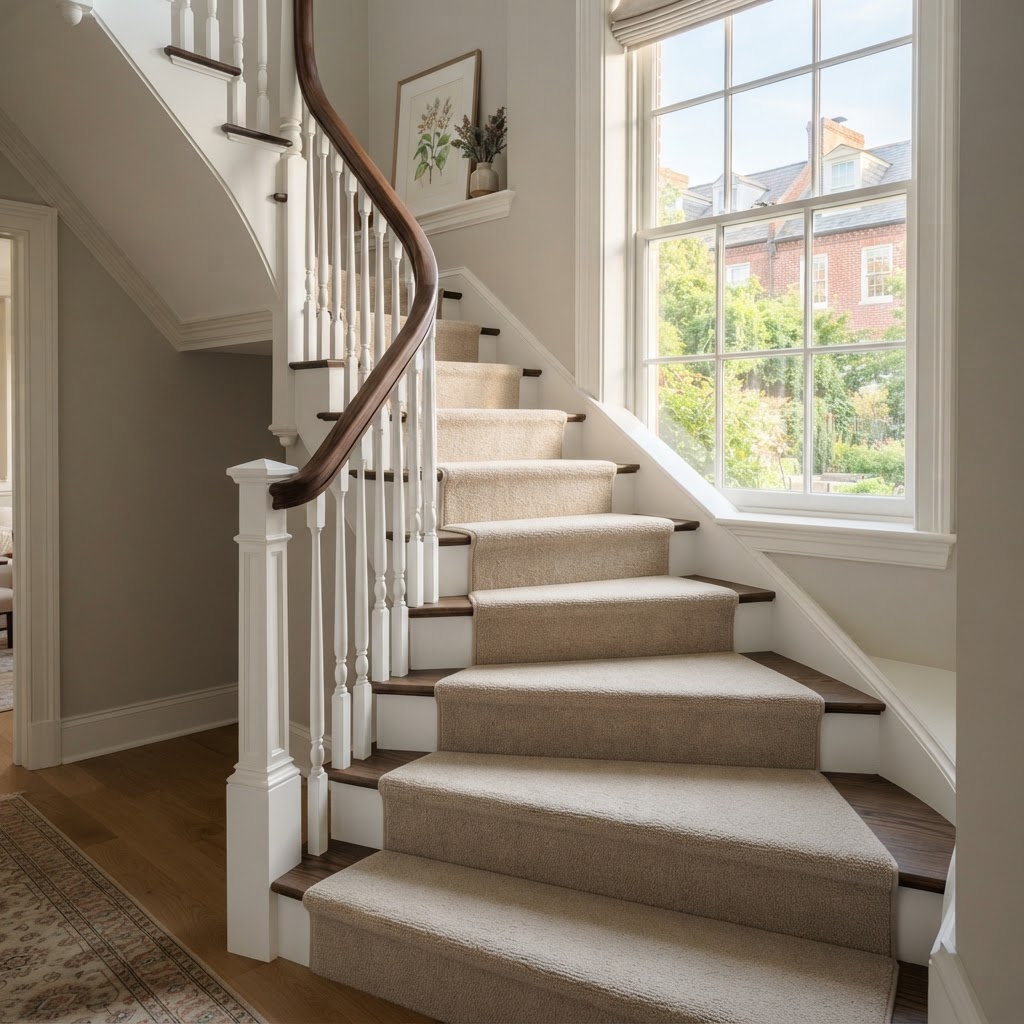
The townhouse is the signature home of the Alexandria area. Drive through Kingstowne, Cameron Station, Potomac Yard, Franconia or the communities along Telegraph Road and Van Dorn Street and you see the same shape over and over: three or four levels stacked on a narrow footprint, a garage or finished basement on the ground floor, a main living level, and bedrooms above. These homes were designed around carpet. Most were delivered with wall-to-wall carpet in the bedrooms, on the stairs and often in the lower level, and twenty or thirty years later a lot of that original builder-grade carpet is flattened, stained and ready to go.
Floors and Beyond VA installs carpet in townhomes across the City of Alexandria and the Alexandria neighborhoods of Fairfax County, and townhouse carpet has its own set of challenges that a big single-level house does not. Stairs make up a large part of the job. Basements bring moisture into the picture. Narrow rooms create seam decisions. And because so much of a townhouse is vertical, getting rolls of carpet and furniture up and down the stairs is part of the planning. This guide walks through what Alexandria and Fairfax County homeowners should know before replacing townhouse carpet.
Alexandria, Fairfax County and Where Townhouses Fit
It helps to understand how the Alexandria area is put together, because it affects everything from permits to how people search for contractors. The City of Alexandria is an independent city with its own government, covering Old Town, Del Ray, Rosemont, Cameron Station, Potomac Yard, Carlyle and the West End. But many homes with an Alexandria mailing address are actually in Fairfax County, including Kingstowne, Franconia, Rose Hill, Hayfield, Huntington, Groveton, Hybla Valley, Belle Haven, Fort Hunt and Mount Vernon.
Townhouses are common on both sides of that line. In the city, Cameron Station and Potomac Yard are dominated by newer townhomes, and the West End has many communities built in the 1970s through the 1990s. In Fairfax County, Kingstowne is one of the largest concentrations of townhouses in Northern Virginia, and the corridors around Franconia, Springfield and Lorton add thousands more. Floors and Beyond VA works throughout all of these areas, so whether your home is in the city or the county, the advice here applies the same way.
Bedrooms: Comfort, Quiet and Durability
Carpet remains the most popular choice for townhouse bedrooms, and the reasons are practical. It is warm underfoot on winter mornings, it softens sound between floors in a home where bedrooms sit directly above the living area, and it is comfortable for children who play on the floor.
The main decision in bedrooms is carpet style. Cut pile carpets, where the yarn loops are cut so the fibers stand upright, include plush and Saxony styles with a smooth, formal surface and textured or trackless styles with twisted fibers that hide footprints and vacuum marks. Textured cut pile is the most forgiving choice for busy households because it does not show every step. Loop pile carpets, often called Berber, keep the loops intact for a flatter, more durable surface, which works well in offices and lower levels but is less soft underfoot and can snag with pets that have sharp claws. Cut-and-loop carpets combine the two to create patterns and texture.
Fiber matters as much as style. Nylon is the most resilient fiber in common use and holds its shape well in traffic areas. Polyester and its variants are soft and stain-resistant and can be good value in low-traffic bedrooms. Wool is the premium natural option, beautiful and long-lasting, though it requires more careful cleaning. We bring samples to your home so you can see and feel them in your own lighting rather than under showroom lights.
Carpet Pad: The Part Nobody Sees
Pad is the most overlooked part of a carpet installation and one of the most important. A good pad makes carpet feel better, helps it resist crushing, and extends its life. A poor pad lets the carpet flex too much with every step, which breaks down the backing and causes the carpet to wear and wrinkle early.
The key specification for pad is density, usually expressed in pounds per cubic foot, along with thickness. For most residential carpet, a dense pad of moderate thickness performs better than a very thick, soft pad. Thick, soft pads feel luxurious in the store, but they can allow too much movement, especially on stairs, and some carpet manufacturers specify maximum thickness and minimum density in their warranties. We match the pad to the carpet you choose and the room it goes in, so the carpet performs the way it was designed to and its warranty stays valid.
In homes with pets or young children, a pad with a moisture barrier can keep spills and accidents from soaking down to the subfloor, where they create odors that are hard to remove. This is a small upgrade that makes a big difference in daily life.
Stairs: Where Townhouse Carpet Jobs Are Won or Lost
A typical Alexandria or Fairfax County townhouse has two or three flights of stairs, which means dozens of individual treads and risers. Stairs take more skill and more time than any other part of a carpet installation, and they are where you see the difference between an experienced installer and an average one.
There are two main ways to install carpet on stairs. The waterfall method lets the carpet flow over the nosing and drop straight down to the next tread, leaving a small gap behind the riser. It is quicker but can look loose. The upholstered or cap-and-band method, sometimes called the Hollywood method, wraps the carpet tightly around the nosing and fastens it under the nose of each step, so the carpet follows the shape of the stair exactly. It takes more time but gives a tailored look that holds up better over time.
Pattern and direction matter on stairs too. Patterned carpets and carpets with a visible pile direction need careful planning so the pattern lines up from one step to the next and the pile runs the same way on every tread. Loop pile carpet on stairs can show grin-through, where the backing becomes visible at the bend of the nosing, so some styles that work well in bedrooms are a poor choice for stairs. We will tell you during the estimate whether the carpet you love is suited to your stairs.
Many townhouse owners also consider a stair runner over hardwood stairs instead of wall-to-wall carpet. If your stairs have hardwood treads under the carpet, a runner can give you the look of finished wood at the edges with the comfort and safety of carpet in the center. If the stairs are built from construction-grade lumber meant to be covered, wall-to-wall carpet is usually the better answer, or the treads can be replaced with finished hardwood as a separate project.
Basements: Carpet Over Concrete
Many Alexandria and Fairfax County townhouses have finished lower levels that serve as family rooms, guest rooms or home offices, and many of those lower levels sit on concrete slabs, sometimes partly below grade. Carpet can work well in these spaces, but the slab changes the plan.
Concrete is cold and can release moisture vapor, especially in below-grade spaces during humid Northern Virginia summers. Before installing carpet in a basement, we check the slab for signs of moisture and look at the condition of the space. In a dry basement, carpet over a pad with a moisture barrier creates a comfortable, warm room. In a basement with a history of water intrusion, carpet is a risky choice because it holds water and can grow mold after even a minor leak. In those cases, we may recommend luxury vinyl plank instead, which handles moisture far better and can be combined with area rugs for warmth.
If you want carpet in a lower level that has had moisture problems in the past, address the cause first. Grading, gutters, sump pumps and dehumidification often make a bigger difference than any flooring choice.
Measuring and Seams in Narrow Rooms
Broadloom carpet is manufactured in rolls of a fixed width, most commonly twelve feet. Rooms wider than that require seams, and townhouse floor plans, with their long, narrow rooms and open lofts, often require careful seam planning.
A good installer places seams where they will be least visible and least stressed, away from doorways and main traffic paths and running in the direction of the light from windows when possible. Seams are joined with seaming tape and heat, then stretched tight so they lie flat. Power-stretching the carpet during installation, rather than relying only on a knee kicker, is what keeps carpet from developing ripples and wrinkles after a year or two of use. If your current carpet has waves in it, poor stretching during installation is usually the reason.
We measure every room in person before ordering material. Accurate measurement keeps waste down and makes sure the seam layout is planned before the carpet ever arrives.
Installation Day in a Townhouse
Installation day in a townhouse follows a predictable rhythm. The crew moves furniture out of the rooms being carpeted, removes the old carpet and pad, and hauls them away. With the subfloor exposed, we check for squeaks, loose panels and damaged areas and fix them before the new pad goes down. Squeaks in particular are much easier to fix with the carpet up than at any other time.
New tack strip is installed where the old strip is damaged or loose. Pad goes down next, followed by the carpet, which is seamed, power-stretched and trimmed. Stairs usually come last. When the carpet is in, the crew moves furniture back, vacuums, and walks through the work with you.
Most townhouse carpet projects are completed in a day or two depending on the number of rooms and flights of stairs. Doors sometimes need to be trimmed if the new carpet and pad are thicker than what was there before, and we check door clearances as part of the job.
Pets, Kids and Carpet
A lot of the carpet in Alexandria townhomes is being replaced because of pets. If you have dogs or cats, a few choices make a big difference in how long your new carpet lasts. Choose a textured cut pile over loop pile, since claws can catch loops. Choose a fiber with strong stain resistance. And invest in a pad with a moisture barrier, because the pad is often where pet odors take hold.
For families with young children, carpet in bedrooms and playrooms is still one of the safest and most comfortable choices. Darker or multi-tone colors hide everyday wear better than solid light colors, and modern stain treatments make cleanup far easier than with older carpet.
Mixing Carpet With Hard Flooring
Many Alexandria and Fairfax County townhouse owners are moving to a mix of materials: luxury vinyl plank or hardwood on the main level where the kitchen and living area are, carpet on the bedroom level and stairs, and either carpet or LVP in the basement. That combination gives you durable, easy-to-clean floors where you cook and eat and soft, quiet floors where you sleep.
The key to a mixed plan is clean transitions. Where carpet meets hard flooring at a doorway or the top of the stairs, the heights and transition pieces need to be planned so there is no trip edge. Floors and Beyond VA installs carpet, LVP and hardwood with our own crews, so a mixed project is planned as one job rather than coordinated between different contractors.
Caring for New Carpet So It Lasts
A quality carpet installed over the right pad can look good for many years, but how long it lasts depends heavily on what happens after the installers leave. A few simple habits make the biggest difference in townhouses, where the same stairs and hallways take nearly all of the household's foot traffic.
Vacuuming is the most important one. Grit and dirt that work down into the pile act like sandpaper on the fibers every time someone walks across them. Vacuuming high-traffic areas such as stairs, the top landing and bedroom doorways several times a week, and the rest of the house at least weekly, removes that grit before it does damage. Use a vacuum with adjustable height and a brush roll that suits your carpet style, since some loop pile and wool carpets can fuzz under an aggressive beater bar.
Entry mats help more than most people expect. In many Alexandria and Fairfax County townhouses, the garage door leads straight into a lower level or up a flight of carpeted stairs. A good mat at that door and at the front entry catches much of the dirt before it reaches the carpet.
Spills should be blotted, not rubbed. Rubbing spreads the stain and untwists the fibers, which leaves a fuzzy patch even after the color is gone. Blot with a clean white cloth, work from the outside of the spill inward, and use only cleaners approved for your carpet's fiber.
Professional hot water extraction cleaning every year or two removes the deeper soil that vacuums leave behind, and many carpet manufacturers require periodic professional cleaning to keep the warranty valid. Keep your receipts in case you ever need to make a claim.
Sunlight is the last factor. Strong afternoon sun through a south- or west-facing window can fade carpet over time. Blinds, curtains or UV-filtering window film protect both the carpet and your furniture. Moving furniture slightly every so often also prevents permanent dents and uneven wear patterns.
Floors and Beyond VA leaves every carpet customer with care guidance for the specific carpet and pad installed, so you know exactly what your warranty expects and how to keep the new floor looking its best.
Why Townhouse Owners in Alexandria and Fairfax County Choose Floors and Beyond VA
Floors and Beyond VA is a family-owned Northern Virginia flooring company that has served homeowners since 1987. Every carpet installation is done by our own in-house crews, never subcontractors, which means the people stretching your carpet and wrapping your stairs are trained and accountable to us. We have installed carpet in townhouses across Kingstowne, Franconia, Rose Hill, Huntington and Mount Vernon in Fairfax County and across Cameron Station, Potomac Yard and the West End in the City of Alexandria.
Book Your Free In-Home Estimate
If your townhouse carpet is worn, stained or simply dated, the next step is an in-home visit. We will measure every room and flight of stairs, bring samples you can see in your own light, recommend the right pad, and plan the seams before anything is ordered.

