
Homeowners in Alexandria have no shortage of places to buy flooring. There are big-box stores along Richmond Highway and Little River Turnpike, large flooring retailers on Eisenhower Avenue, long-standing carpet shops, and dozens of independent installers working out of trucks across the City of Alexandria and Fairfax County. What is harder to find is a clear way to tell them apart. Two estimates for the same rooms can look completely different, and the cheapest number on paper is not always the cheapest floor over the next fifteen years.
Floors and Beyond VA has been installing and refinishing floors in Northern Virginia since 1987, and we have been called in to fix a lot of jobs that someone else started. This guide explains what to look for when choosing a flooring installer in Alexandria and the Fairfax County communities around it, what questions to ask, and which warning signs to take seriously. We think it is useful even if you never call us.
Know Where Your Home Is: City of Alexandria or Fairfax County
Before you start calling contractors, it helps to know which jurisdiction your home is in, because the Alexandria area is split. The City of Alexandria is an independent city covering Old Town, Del Ray, Rosemont, Parker-Gray, Seminary Hill, Cameron Station, Potomac Yard, Carlyle and the West End. Many other Alexandria addresses, including Kingstowne, Franconia, Rose Hill, Huntington, Belle Haven, Groveton, Hybla Valley, Fort Hunt and Mount Vernon, are in Fairfax County.
For most flooring projects, jurisdiction does not change much, because straightforward floor replacement rarely requires a building permit. It starts to matter when flooring is part of a larger job, such as a kitchen remodel, a basement finish or a structural repair, which may require permits from the city or the county. It also matters for homes in the City of Alexandria's historic districts, where exterior changes are reviewed but interior flooring generally is not. A good contractor will know which rules apply to your address and will tell you when a project crosses into permit territory.
Check the License, Then Check It Yourself
In Virginia, contractors who perform work above certain dollar thresholds must hold a contractor license issued by the Department of Professional and Occupational Regulation. Licenses come in classes that limit the size of projects a contractor can take on, and they carry specialty designations for the types of work the contractor is qualified to perform.
Ask every installer for their Virginia contractor license number, and then look it up on the DPOR website yourself. The lookup shows whether the license is active, what class it is, and what specialties it covers. It takes a couple of minutes and is the single easiest way to filter out contractors who should not be working in your home. If an installer is vague about licensing or tells you it is not needed for your project, ask why and get the answer in writing.
Ask Who Will Actually Be in Your Home
This is the most important question most homeowners never ask: who will actually install my floor?
Many flooring sellers, including most big-box stores and many retail showrooms, do not employ installers. They sell the material and then subcontract the installation to independent crews, sometimes through a third-party installation company. The quality of those crews varies widely, and you often do not know who is coming until they knock on the door. When something goes wrong, the store points to the installer and the installer points to the store.
Other companies employ their own installers or work with the same small group of crews consistently. In-house crews are trained to one standard, they answer to the company whose name is on your contract, and the person who measured your home can talk directly with the person who installs it. That is the model Floors and Beyond VA uses: every job is done by our own in-house crews, never subcontractors. Whoever you hire, ask the question directly and get a direct answer.
Insurance and Lead-Safe Certification
Any contractor working in your home should carry general liability insurance, and contractors with employees should carry workers' compensation coverage as required by Virginia law. Ask for a certificate of insurance. If you live in a condo, your association will likely require the certificate to name the association before work can begin.
If your home was built before 1978, which describes a large share of homes in Old Town, Del Ray, Rosemont, Belle Haven, Huntington and Hollin Hills, ask whether the contractor follows the EPA's lead-safe work practices for renovation that disturbs painted surfaces. Removing baseboards, sanding near painted trim and pulling up old flooring can all disturb lead paint in older homes. A professional contractor will have a clear answer.
Insist on an In-Home Measurement
An accurate flooring estimate starts with someone visiting your home. Online calculators and estimates based on square footage from a listing miss the things that actually drive the cost and quality of a job: the condition of the subfloor, how level the floor is, how many transitions and doorways there are, whether stairs are involved, what is under the existing flooring, and how furniture and appliances will be handled.
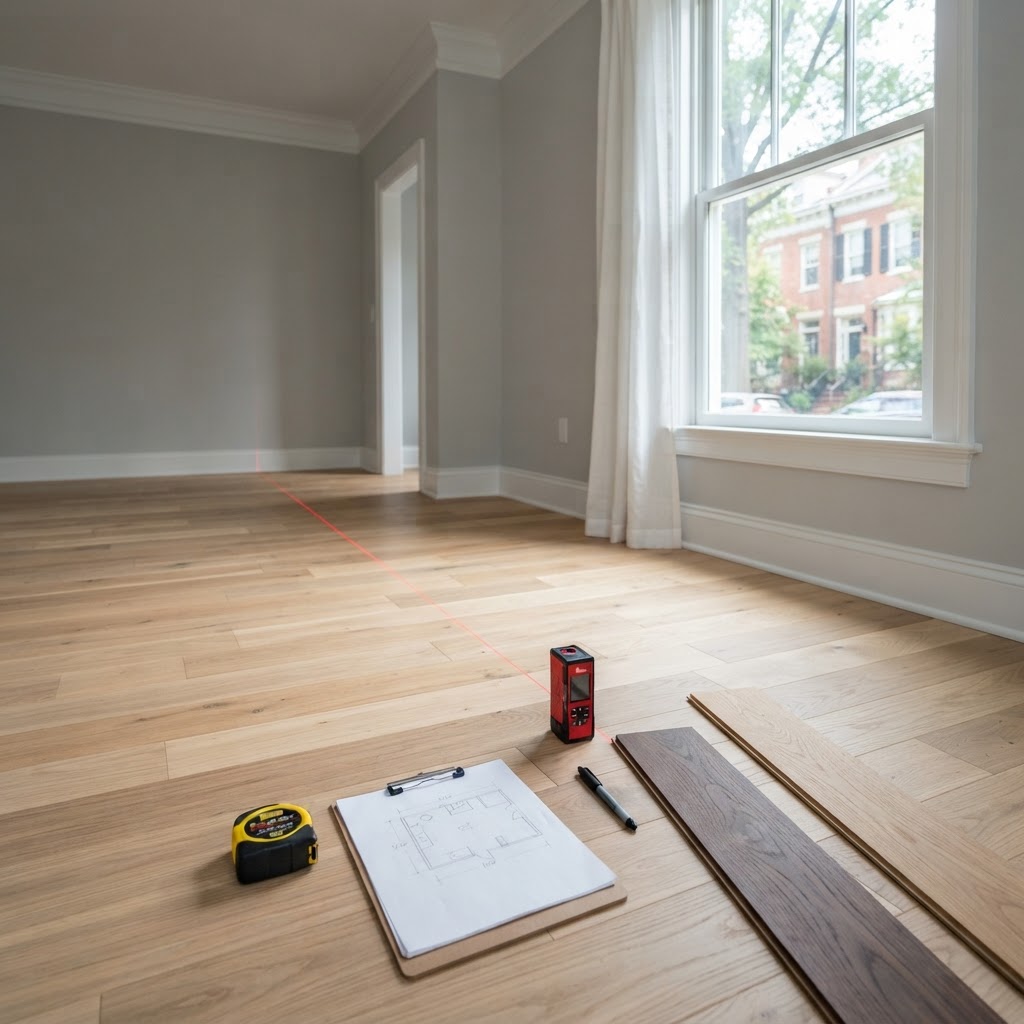
During the visit, a good estimator will measure every room, look at the subfloor wherever possible, check for moisture in basements and over slabs, note door clearances, and ask how you use each space. If an installer is willing to quote your job without seeing it, the price will likely change once they arrive, or corners will be cut to stay within the original number.
Read the Estimate Line by Line
When comparing estimates, the total matters less than what is included. A complete flooring estimate should spell out the flooring material, including the specific product; the underlayment or pad; removal and disposal of the old flooring; subfloor preparation, such as leveling, repairs and squeak fixes; moving furniture and appliances; transitions, thresholds and stair nosings; baseboard or shoe molding work; and cleanup.
The most common way low estimates become expensive is through items left off the page. Subfloor leveling is the big one. Rigid LVP and many engineered floors require a flat substrate, and older Alexandria homes and concrete slabs rarely start perfectly flat. If one estimate includes leveling and another does not, they are not quoting the same job. Ask each contractor to explain what happens if they find problems under the old floor, and how those changes will be priced and approved.
Understand Two Kinds of Warranty
Flooring comes with two separate warranties, and homeowners often confuse them.
The manufacturer's warranty covers defects in the product itself, such as a wear layer that fails early or a carpet that loses its texture prematurely. Manufacturer warranties usually require that the product be installed according to the manufacturer's instructions, including subfloor flatness, moisture limits, acclimation and the correct underlayment or pad. A poor installation can void the product warranty.
The workmanship warranty is the installer's promise about their own work, covering problems like seams separating, planks lifting or carpet rippling because of installation errors. Ask how long the workmanship warranty lasts, what it covers, and how service calls are handled. A company that has been in business for decades is in a better position to honor that promise than one that may not be around next year.
Look for Experience With Homes Like Yours
Alexandria's housing is varied, and experience with one kind of home does not always transfer. Refinishing heart pine in an Old Town rowhouse calls for different skills than installing rigid LVP in a Kingstowne townhouse basement or engineered hardwood in a West End high-rise condo. Ask a prospective installer about recent projects similar to yours, and listen for specifics: how they handled an uneven subfloor in an older home, how they met a condo association's sound rules, how they dealt with moisture in a basement slab.
Reviews help here, but read them for detail rather than star counts. Reviews that describe the crew's care with the home, how problems were handled and how the floor looked months later are more useful than short ratings.
Warning Signs Worth Taking Seriously
A few patterns should make you slow down. Be cautious about any installer who asks for most or all of the payment before work begins. A reasonable deposit to order material is normal, but paying in full up front removes your leverage if something goes wrong. Be cautious about pressure to sign the same day, especially when paired with a price that expires immediately. Be cautious about contractors who cannot provide a license number, proof of insurance or a written contract. And be cautious about anyone who suggests skipping acclimation, moisture testing or subfloor preparation to save time, because those are exactly the steps that keep a floor from failing.
Questions to Ask During the Estimate Visit
The in-home estimate is your best chance to judge a contractor, so use it. Beyond the price, a few questions reveal a lot about how the job will go.
Ask what they found when they looked at your subfloor. A careful estimator will tell you whether the floor is level, whether there are soft spots or squeaks, and what is under the current flooring. If they did not look, that tells you something too.
Ask how long the material needs to acclimate and where it will be stored. Hardwood in particular needs time to adjust to the humidity in your home before installation, and some LVP products have acclimation requirements as well. A contractor who skips this step is gambling with your floor.
Ask who your point of contact will be during the job, and how changes are handled. When a crew pulls up old flooring and finds rot, an old leak or an unexpected layer of tile, you want to know who will call you, how quickly, and how the decision will be documented.
Ask what the day-to-day schedule looks like. How many days will the job take? What time will the crew arrive? Will rooms be closed off? Where will the crew cut material? In condos and townhouses especially, these details affect your daily life and your neighbors.
Ask how they protect the rest of your home. Floor protection in walkways, plastic over doorways, care around walls and stair railings, and daily cleanup are signs of a crew that respects the house it is working in.
Should You Buy the Material Yourself?
Some homeowners buy flooring from a big-box store or an online retailer and then hire a separate installer, hoping to save money. It can work, but it shifts risk onto you. If you buy the wrong amount, the installer has to wait while you reorder, and a second batch may not match the first in color. If you buy a product that is not suited to your subfloor, your basement or your condo's sound rules, the installer may refuse to install it or install it and void its warranty. And if a problem appears later, the seller blames the installation while the installer blames the product.
When the same company supplies the material and installs it, as Floors and Beyond VA does, one party is responsible for the whole floor. The company measuring your home orders the right amount, chooses the right underlayment or pad, and stands behind both the product choice and the workmanship. For most Alexandria and Fairfax County homeowners, that single point of responsibility is worth more than any small savings on the material itself.
What Happens After You Sign
Once you sign with a reputable installer, the process should feel organized. Material is ordered and scheduled for delivery, and you should know the expected dates. If acclimation is required, the material arrives at your home ahead of installation and sits in the rooms where it will be installed.
Before installation day, you should receive clear instructions about what to move, what the crew will move, and whether appliances need to be disconnected. On installation day, the crew should arrive when promised, walk through the plan with you, and start with protection and removal.
When the job is finished, the crew should walk through the work with you, point out any transitions or details you should know about, and leave care instructions for the specific floor installed. That final walkthrough is your chance to point out anything that does not look right while the crew is still there. Floors and Beyond VA treats that walkthrough as part of every job, not an afterthought, and our customers receive care guidance written for the floor they chose.
Finally, keep your paperwork. The contract, the product information, the warranty documents and the care instructions will matter if you ever need warranty service or sell the house.
How Floors and Beyond VA Works in Alexandria
Floors and Beyond VA is a family-owned, licensed Virginia flooring contractor that has worked in Northern Virginia since 1987. Our owner has roughly four decades in the flooring trade, and our installations are performed by our own in-house crews, never subcontractors. We install carpet, luxury vinyl plank, hardwood and engineered hardwood, and we sand and refinish existing hardwood, which means we can plan a whole-home project with multiple materials as one job.
Every project starts with a free in-home visit where we measure, check the subfloor and moisture, review any condo association rules, and talk through how you use each room. Our estimates spell out what is included, and when we find a problem under an old floor, we show it to you and explain the options before doing anything that changes the scope.
We work throughout the City of Alexandria, including Old Town, Del Ray, Rosemont, Parker-Gray, Seminary Hill, Cameron Station, Potomac Yard, Carlyle and the West End, and throughout Fairfax County, including Kingstowne, Franconia, Rose Hill, Huntington, Belle Haven, Hybla Valley, Fort Hunt and Mount Vernon.
A Simple Checklist Before You Sign
Before signing with any flooring installer in Alexandria or Fairfax County, make sure you can answer yes to a handful of questions. Have you verified their Virginia contractor license on the DPOR site? Do you know whether their own employees or subcontractors will install your floor? Have you seen a certificate of insurance? Did someone measure your home in person and look at the subfloor? Does the written estimate list removal, preparation, materials, transitions and cleanup? Do you understand both the product warranty and the workmanship warranty? If any answer is no, ask more questions before you commit.
Book Your Free In-Home Estimate
If you are comparing flooring installers in Alexandria or Fairfax County, we would welcome the chance to be one of them. Floors and Beyond VA will measure your home, check what is under your current floors, and give you a clear, written plan you can compare line by line with anyone else's.

