
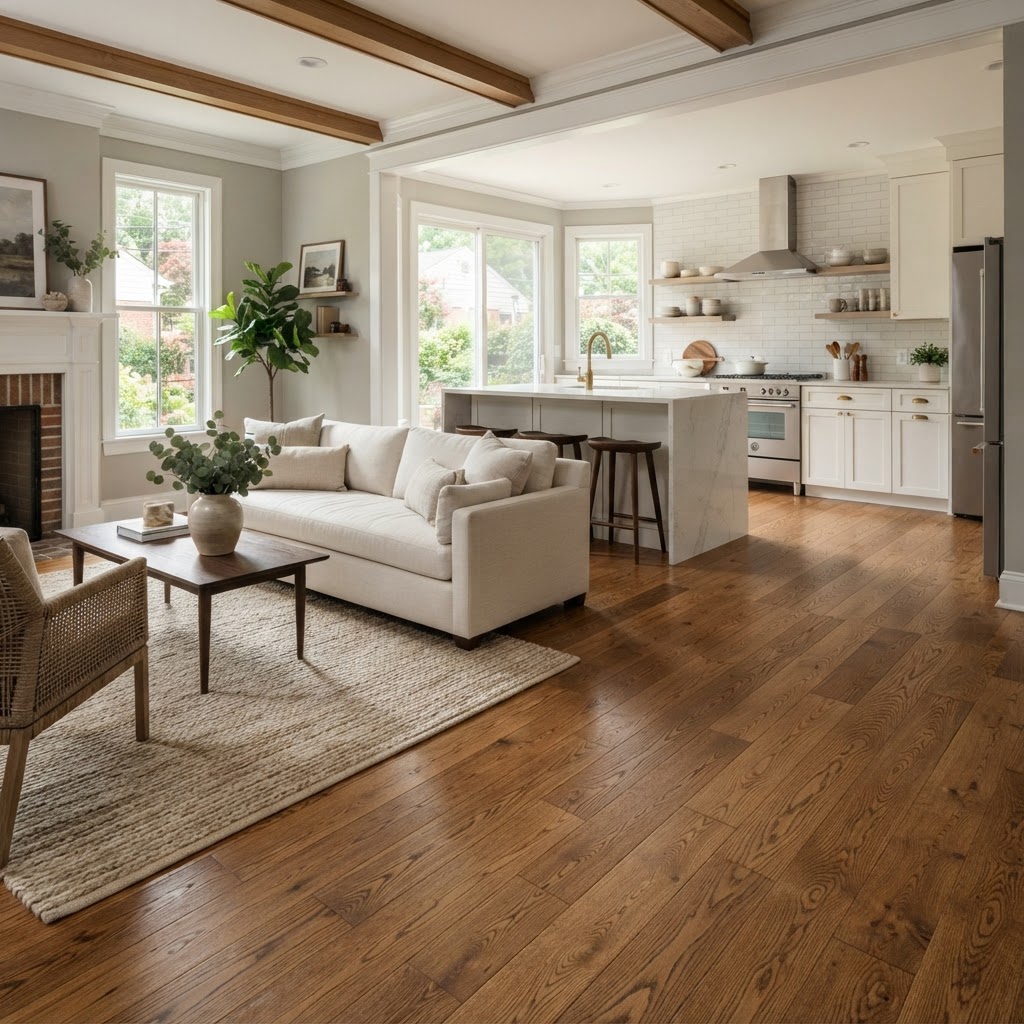
If you live in Alexandria or the Fairfax County neighborhoods that share its mailing address, the choice between luxury vinyl plank and hardwood is probably the flooring question you hear most from friends and neighbors. Both look like wood. Both are popular in renovated kitchens and open living areas. Both are installed every week in homes from Old Town to Mount Vernon. But they behave very differently, and the right choice depends a lot on where your home sits, how it was built, and how you live in it.
Floors and Beyond VA installs both luxury vinyl plank and hardwood throughout the City of Alexandria and Fairfax County, and we do not have a stake in steering you toward one over the other. This guide lays out how each material performs in the specific conditions Alexandria-area homes face, including humidity, basements, flood-prone areas, condos, pets and resale, so you can choose with confidence.
What Each Floor Actually Is
Solid hardwood is exactly what it sounds like: each board is a single piece of wood, typically three-quarters of an inch thick, milled with a tongue and groove and nailed to a wood subfloor. Oak is the most common species in the Alexandria area, though older homes in Old Town and Parker-Gray often have heart pine. Because it is solid wood all the way through, hardwood can be sanded and refinished several times over its life.
Engineered hardwood has a real hardwood surface layer bonded to a core of plywood or other layered material. The layered core makes it more dimensionally stable than solid wood, so it handles changes in humidity better and can be installed over concrete. Depending on the thickness of the wear layer, engineered hardwood can be refinished once or more.
Luxury vinyl plank, or LVP, is a synthetic floor with a printed wood-look image layer protected by a clear wear layer, bonded to a vinyl or composite core. Rigid core products, including SPC, which uses a stone-plastic composite core, are stiff and click together as a floating floor. Flexible LVP is often glued down. The core resists water, which is the biggest single reason homeowners choose it.
The Potomac Factor: Humidity and Water
Alexandria's location on the Potomac shapes its climate. Summers are long, hot and humid. Winters are cool, and once the furnace runs, indoor air gets dry. That swing matters for wood floors.
Solid hardwood absorbs and releases moisture with the seasons. In humid summers the boards swell slightly and the gaps between them close. In dry winters they shrink and small gaps appear. That movement is normal and does not hurt a properly installed floor, but extreme humidity, especially from a wet crawlspace or an unconditioned basement, can cause cupping, where the edges of boards rise above the centers. Keeping indoor humidity in a moderate range year-round is the best protection.
LVP is largely unaffected by humidity. It does expand and contract slightly with temperature, which is why floating LVP needs expansion gaps at the walls, but it does not cup or gap the way wood does. In homes where humidity is hard to control, that stability is a real advantage.
Then there is liquid water. Parts of Alexandria have well-known flood histories. The Old Town waterfront along Union Street and the lower blocks of King Street sees tidal and storm flooding. In Fairfax County, the Huntington neighborhood along Cameron Run has a long history of flooding that led to a flood-protection levee. Homes in lower-lying areas near Four Mile Run, Hunting Creek and other streams can also see water in basements during heavy storms. If water ever reaches your floor, hardwood is likely to be damaged and may need replacement, while LVP planks themselves usually survive, although the subfloor underneath still needs to dry properly. For lower levels and ground floors in flood-prone areas, LVP is usually the smarter choice.
Basements: An Easy Call
Many Alexandria and Fairfax County homes have finished basements on concrete slabs, whether they are 1950s ramblers in Rose Hill, split-levels in Belle Haven or newer townhouses in Kingstowne. Solid hardwood is not recommended directly on below-grade concrete, because the slab can release moisture and the wood has nothing to nail into. Engineered hardwood can work over a dry slab with the right moisture barrier, but it is still wood and still vulnerable if the basement takes on water.
LVP is the most common basement floor we install for this reason. It goes over concrete with the right underlayment, it tolerates the moisture conditions of a below-grade space, and if a water heater leaks or a storm overwhelms the sump pump, it gives you the best chance of saving the floor. For basements, we recommend LVP to most homeowners, and the exceptions are dry, well-conditioned basements where an owner specifically wants real wood.
Kitchens and Open Plans
Kitchens are where the choice gets closest. Hardwood has been used in kitchens for generations, and in many Alexandria homes a continuous hardwood floor flowing from the living room through the kitchen is part of the house's character. Hardwood in a kitchen needs reasonable care: wipe up spills promptly, use mats at the sink, and fix leaks quickly. Minor wear can be sanded out at the next refinishing.
LVP in a kitchen is more forgiving of spills, dropped water bowls and the occasional dishwasher leak, and it is easier on families who do not want to think about their floor. Its weak point is sharp impact. A dropped knife or heavy pot can dent or gouge LVP, and while individual planks can be replaced, the floor cannot be sanded and refinished.
In open floor plans, the decision usually needs to cover the whole space, because a material change in the middle of an open room rarely looks good. If your kitchen opens to a living room and dining room with original hardwood, extending matching hardwood into the kitchen often looks better than adding LVP. If the whole main level is being redone, either material can work throughout.
Older Homes in Old Town, Del Ray and Rosemont
In the historic neighborhoods of the City of Alexandria, many homes still have original hardwood or heart pine floors. Our strong advice in those homes is to refinish rather than cover or replace original floors whenever possible. Original wood is often higher-quality material than anything available today, it is part of what buyers pay for in those neighborhoods, and LVP laid over or in place of it tends to lower the perceived quality of the home.
Where new flooring is needed in an older home, for example in a kitchen addition or a converted porch, hardwood that matches the original species and width usually blends best. LVP still has a place in older homes, particularly in basements, bathrooms and rental units, but in the main living areas of a historic Alexandria home, real wood is usually the right call.
Condos in Alexandria and Fairfax County
Condo buildings add sound rules to the decision. Many associations in Alexandria's high-rise and mid-rise buildings, from the West End to Carlyle and Eisenhower East, and in Fairfax County communities around Kingstowne and Huntington, require a minimum sound rating before hard flooring can replace carpet. Both LVP and engineered hardwood can meet these requirements when paired with the right acoustic underlayment.
LVP is more common in condos because it is thinner, easier to install over concrete, and resistant to the leaks that can affect neighbors below. Engineered hardwood is the choice for condo owners who want real wood, and it can be floated or glued over sound-rated underlayment. Solid hardwood is rarely practical over concrete. Whichever you choose, get your building's written flooring rules before ordering anything.
Pets, Kids and Daily Wear
Households with large dogs often lean toward LVP, and the reasoning is sound. A good LVP with a thick wear layer resists scratching from claws better than most hardwood finishes, and it is not harmed by accidents that would stain or damage wood. It is also quieter underfoot than some people expect when installed over a quality underlayment.
Hardwood shows scratches from pets more readily, especially with darker stains and glossy finishes. On the other hand, hardwood can be screened and recoated or fully refinished to remove years of wear, while worn LVP cannot be renewed. Families who plan to stay in a home for decades sometimes prefer hardwood for that reason, accepting some visible wear in exchange for the ability to make the floor look new again later.
For active families, a matte finish and a medium tone hide wear best on either material. High gloss and very dark or very light colors show the most.
Resale and Buyer Expectations
In much of Alexandria, especially in single-family neighborhoods in the city and in established parts of Fairfax County like Belle Haven and Hollin Hills, buyers expect hardwood in the main living areas. Real wood floors are frequently mentioned in listings and contribute to the sense of quality in a home.
That said, buyer expectations have shifted. High-quality LVP is now widely accepted, especially in basements, condos, townhouses and rental properties, and many buyers specifically look for waterproof flooring in lower levels. The safest approach for resale is to match the material to the space and the neighborhood: hardwood where buyers expect it, LVP where its strengths are obvious.
Comfort and Sound
Hardwood feels solid and warm underfoot, and nailed-down wood over a wood subfloor has a reassuring, quiet feel. LVP can feel slightly harder and cooler, especially rigid core products floated over concrete, and cheaper products can sound hollow when walked on. Choosing a quality LVP with an attached or separate underlayment, and installing it over a flat, properly prepared subfloor, makes a large difference in how it feels and sounds.
Lifespan and Long-Term Value
A well-maintained solid hardwood floor can last the life of the house, with refinishing every decade or so in high-traffic homes. That longevity is why so many century-old floors survive in Alexandria today. Engineered hardwood lasts a long time as well, depending on its wear layer.
LVP has a shorter expected life than solid hardwood, and its lifespan depends heavily on the thickness of the wear layer and the amount of traffic. When it wears out, it is replaced rather than refinished. For many homeowners, the trade-off is worth it in exchange for water resistance and low maintenance.
Questions Alexandria Homeowners Ask Us
Can LVP be installed over my existing hardwood? Technically, a floating LVP floor can go over a flat, sound hardwood floor. In most cases we advise against it. If the hardwood underneath is worth covering, it is usually worth refinishing, and covering it hides one of the most valuable features of the home. When the hardwood is badly damaged, removing it and installing the new floor on a properly prepared subfloor generally gives a better result than layering over it.
Can I put hardwood in my basement? Solid hardwood is not a good fit for below-grade concrete. Engineered hardwood can work in a dry, well-conditioned basement with the correct moisture barrier, and some Alexandria and Fairfax County homeowners choose it for finished lower levels that serve as family rooms or guest suites. If the basement has ever taken on water, LVP is the safer choice.
Will LVP look fake? Quality varies widely. Lower-end products often repeat the same few plank images, so the pattern becomes obvious across a large room. Better products use many unique plank images, realistic textures that follow the printed grain, and varied plank lengths. When Floors and Beyond VA brings samples to your home, we bring full-size planks so you can judge the realism in your own light rather than from a small chip.
Is engineered hardwood real wood? Yes. The surface you walk on is real hardwood, and the floor looks and feels like wood because it is. The difference is underneath, where the layered core makes it more stable than solid wood. Engineered hardwood is often the best compromise for homeowners who want real wood in a condo or over concrete.
Can I mix LVP and hardwood in one house? Absolutely, and many of our Alexandria customers do exactly that. The trick is placing the change where it makes sense, such as at a stairway, a doorway or the transition between the main level and the basement, and choosing colors that work together. A well-planned transition looks intentional. A random one in the middle of an open room looks like a repair.
What about laminate? Laminate is a third option some Alexandria homeowners consider. It uses a photographic wood-look layer over a fiberboard core, and modern laminate is scratch-resistant and realistic. Its weakness is water. Many laminate products are now marketed as water-resistant, but the fiberboard core can still swell if water sits on it or gets into the seams. For dry upper floors, quality laminate can work well. For kitchens, basements and flood-prone lower levels anywhere in Alexandria or Fairfax County, LVP is usually the more forgiving choice.
Does the choice affect my homeowners insurance or a future sale? Flooring itself rarely changes an insurance premium, but the way it handles water can change what a claim looks like after a leak. For resale, the general rule from the section above holds: buyers expect hardwood in main living areas of single-family homes and accept quality LVP in lower levels, condos and townhouses.
How long does each one take to install? Both are typically installed in a few days for an average-sized area, though hardwood needs time to acclimate before installation and site-finished hardwood needs drying and curing time between finish coats. Prefinished hardwood and LVP are usually ready to walk on as soon as the installation is complete. Floors and Beyond VA gives you a realistic schedule for your specific project during the estimate.
Our Straight Recommendation
For most Alexandria and Fairfax County homes, the right answer is not one material everywhere. It is LVP in basements, lower levels in flood-prone areas, many condos, laundry rooms and rental properties, and hardwood in main living areas and bedrooms of single-family homes, especially where original wood already exists. Kitchens can go either way depending on what the rest of the level has and how your household lives.
Floors and Beyond VA is a family-owned flooring company that has worked in Northern Virginia since 1987, with all installations handled by our own in-house crews rather than subcontractors. Because we install both LVP and hardwood ourselves, we can plan a home with both materials and make the transitions between them clean.
Book Your Free In-Home Estimate
The fastest way to settle the LVP versus hardwood question is to have someone look at your actual home: the subfloor, the slab, the humidity, the existing floors and how the rooms connect. Floors and Beyond VA will walk through each space with you and recommend the right material room by room.

