
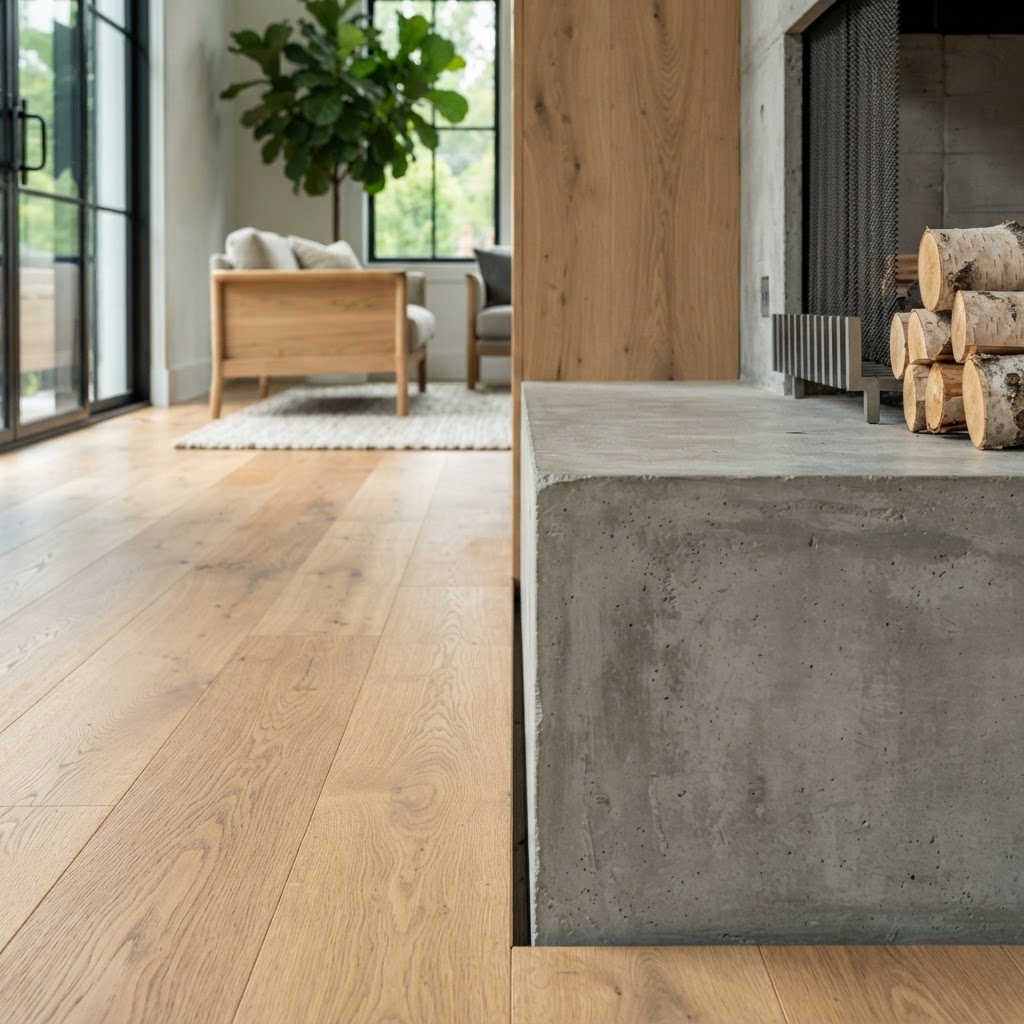
Which holds up better in Tysons, McLean and Vienna: solid or engineered hardwood?
Neither wins everywhere. Solid hardwood holds up better over many years in a wood-framed house where it can be sanded and refinished repeatedly, while engineered hardwood holds up better against humidity swings, concrete slabs, basements and wide planks, which is why it is often the stronger performer in Tysons high-rises, finished lower levels and open-plan McLean renovations. Floors and Beyond VA installs both with in-house crews and no subcontractors, and we choose between them room by room rather than by slogan, because the answer depends on what is under the floor, how much the air in your home changes between August and January and how long you plan to stay.
"Which is better" is the wrong question, and homeowners who ask it usually get a sales answer. The useful question is what each construction does under stress, and which stresses your home actually produces. Northern Virginia is a place of strong seasons. Summers are humid, winters with forced-air heat are dry, and the swing between them is exactly what tests a wood floor. A high-rise near Tysons Corner has concrete underfoot. A Vienna cottage near Maple Avenue has a crawl space. A McLean house off Chain Bridge Road may have an addition on a slab beside an original wood-framed core. Each of those conditions favors a different construction.
What the two constructions actually are
Solid hardwood is a single piece of wood from top to bottom, milled with a tongue and groove. Because it is one species all the way through, it can be sanded many times over its life, limited mainly by how much wood remains above the tongue. It is nailed or stapled to a wood subfloor in most installations.
Engineered hardwood is built in layers. A top layer of real hardwood, called the wear layer, sits over a core made of cross-laminated plywood or similar material, sometimes with a backing layer. Because the layers run in opposing directions, the board resists the expansion and contraction that wood naturally undergoes. The wear layer is real wood of the same species you would see in solid, and its thickness decides how many times it can be refinished.
Both are real hardwood on the surface. The difference is structural, and structure decides behavior.
How each reacts to Northern Virginia's humidity
Wood absorbs moisture in humid air and releases it in dry air, changing dimension across the grain more than along it. In a solid board, all of that movement happens in one direction of grain, so a wide solid board can open visible gaps in winter and push at its edges in summer. Narrow solid boards move less in absolute terms per board, which is one reason older homes with narrow strip floors tend to hold their appearance well.
Engineered construction counters that movement with its cross-layered core. The wear layer still wants to move, but it is restrained, so seasonal gapping is usually less pronounced. That is why engineered products are often the practical choice for wide planks, a point we expand on in Engineered Wood Wide Plank Flooring: A Northern Virginia Guide.
Neither construction is immune. Both respond to a house that is allowed to become extremely dry in winter or damp in summer. A hygrometer and, where appropriate, a humidifier or dehumidifier help both. But if your home swings widely and you want a wide board, engineered usually behaves better.
How each reacts to the subfloor
Subfloor is the second great determinant.
Wood subfloor over joists. This is the classic setting for solid hardwood. A nailed solid floor over a sound plywood or board subfloor is the traditional assembly in the colonials, Cape Cods and ranches around Vienna, Falls Church and Pimmit Hills. Engineered also works here and can be stapled, nailed or glued.
Concrete slab. Solid hardwood is generally a poor match for direct installation on concrete because moisture in the slab can affect it and nailing is not possible without building a wood subfloor system. Engineered, installed with appropriate moisture mitigation and adhesive or as a floating floor, is the usual answer. Condominium rules add further constraints, covered in Renovating a Tysons High-Rise Apartment: Which Floors Work on Concrete Subfloors.
Radiant heat. Systems under the floor demand stable products. Engineered, with suitable construction and manufacturer approval, is generally favored over solid. Always verify with the manufacturer.
Below grade. Basements and lower levels carry more moisture risk. Solid hardwood is not usually recommended in below-grade spaces, while engineered may be considered with proper moisture control, and many homeowners choose other materials there.
Refinishing: where solid has the edge
Solid hardwood's great advantage is longevity through sanding. A solid floor with ample wood above the tongue can be sanded and refinished several times across its life, which is how some floors in older Northern Virginia homes remain beautiful long after they were first laid. This is central to our refinish-first philosophy: we would rather restore a good floor than remove it.
Engineered hardwood can be refinished too, but only as many times as its wear layer allows. A thick wear layer can handle a number of sandings comparable to a modest solid floor. A thin wear layer may allow only a light screen-and-recoat or a single careful sanding. When comparing engineered products, wear-layer thickness matters more than the headline thickness of the whole board. Ask to see it in a cross-section.
If you expect to stay in your home for many years and want the option to change color or erase heavy wear, a solid floor over wood framing or an engineered floor with a thick wear layer both serve. If you expect to sell within a few years, refinishability matters less than appearance and stability.
Width, length and style
Boards wider than the usual strip are popular in McLean renovations and new construction around Tysons. Wide boards look calm, but they magnify movement and any unevenness in the subfloor. Engineered construction makes wide and long boards more practical. Solid wide boards exist and can be beautiful, but they demand tight humidity control and a flat subfloor and may show seasonal gaps.
Narrow solid strips, by contrast, are the traditional look of older homes. If you are extending a floor in a Falls Church bungalow or repairing a section, matching the width and species of the original often means installing solid. Our guide to premium hardwood flooring in McLean: plank width, finish and installation choices walks through how those choices come together.
Noise, feel and underfoot comfort
Solid nailed floors over a wood subfloor feel substantial and tend to sound solid. Floating engineered floors can sound hollow if underlayment or flatness is poor. Glued engineered floors over concrete tend to feel firm. In multifamily buildings, sound control rules often decide the construction and underlayment, since impact noise transmits to neighbors below. We do not state building requirements in articles; each association sets its own, and you should verify yours before choosing.
Appearance over time
Both constructions show scratches and dents according to species hardness and finish, not construction. Both can be stained or left natural. Both can have wire-brushed, smooth, hand-scraped or sawn textures. A prefinished engineered board comes with a factory finish that is often very hard, while a solid board can be finished on site for a seamless surface. That decision is separate from solid versus engineered, and we discuss it in Warm Oak vs. Gray Flooring in 2026 in terms of color and tone, and in our oak guides in terms of grain and species character.
Matching existing floors
Many projects add to an existing floor. If your house has original solid oak, adding a new room in solid oak of the same width allows blending after sanding and finishing together. Matching engineered to existing solid can work when species, width and finish are chosen carefully, but a transition or a deliberate contrast is sometimes the better design. We assess this at the consultation by looking at your boards.
Local scenarios
These are representative scenarios, not accounts of particular customers.
A high-rise condominium near Tysons Corner. Concrete slab, building sound rules, elevator logistics. Engineered is almost always the construction considered, with an approved underlayment system.
A townhome in Merrifield. Wood-framed floors above a slab-level entry or garage. Main level often suits either, with engineered favored for open plans and solid for traditional layouts. Stairs may call for solid treads for strength and matching.
A large house in McLean with an addition. Original wood-framed core, new addition on a slab or crawlspace. A mix is common: solid in the original portion, engineered in the addition, finished so the tones relate.
An older home in Vienna or Falls Church. Original narrow solid strip floors, sometimes under carpet. The refinish-first answer is to restore them. Where new areas are needed, solid is usually matched.
A finished lower level in Great Falls. Engineered with moisture control, or a different material altogether.
A closer look at how each construction fails, and how to prevent it
Understanding failure modes is the most practical way to compare constructions, because it tells you what to watch for after installation.
A solid board fails mainly by moving. In a dry winter it shrinks across its width, opening gaps; in a wet summer it swells, and if there is not enough expansion space at the walls the floor can crowd, lift or buckle. Solid boards can also cup if moisture arrives from below, as it might from a damp crawl space beneath an older house in Falls Church. The prevention is a dry, ventilated crawl space with a ground vapor barrier, a properly acclimated product, correct expansion space and steady indoor humidity.
An engineered board fails differently. Because it is a layered product, the usual problems are delamination, where layers separate, and wear-layer problems, where a thin top layer is sanded through or chips. Cheaper constructions use thin veneers and low-quality adhesives that can fail under repeated moisture cycles. Prevention lies in choosing a reputable construction with a meaningful wear layer, installing it according to the manufacturer's requirements and not subjecting it to standing water. A well-built engineered floor of good quality performs for a very long time, and the difference between a good and a poor one is not visible on a sample table. This is why we ask to see cross-sections and manufacturer documentation rather than relying on thickness alone.
Both constructions share enemies: leaks, spills left standing, steam cleaners, excessive heat from direct sun or equipment, and extreme humidity. A refrigerator ice-maker line that weeps for months will damage either one. A dishwasher that leaks at the door seal will ruin boards along the kitchen edge. Good habits protect both.
How the choice shows up in different rooms
Rather than choosing one construction for an entire house, many Northern Virginia homeowners match construction to room.
In a kitchen, moisture exposure from sinks, dishwashers and refrigerators favors engineered construction with a durable finish, though solid is common in older kitchens where it has served for generations. In a living room or dining room with wood framing below, either performs well, and the decision turns on appearance, width and refinishing expectations. In a primary suite, comfort and appearance dominate, and solid or engineered both serve. In an entry, where mud, salt and moisture arrive, a tougher surface or a durable finish matters more than construction. In a finished lower level, engineered with moisture control or an entirely different material is usually wiser than solid wood. On a stair, solid treads are common because of structural demand, with engineered or capped systems used where practical.
Houses with additions are a special case. A McLean home that added a family room over a slab in an earlier renovation has two different substrates under one continuous view. Using solid in the original section and engineered in the addition can work well when the species, width and finish are matched so the eye sees a single floor. We plan the junction carefully, often placing it at a natural break such as a doorway or a change in room function, and we finish old and new together where possible.
Questions to ask any installer about the choice
A short list of questions will reveal how well an installer understands the decision. Ask what the subfloor is and how it will be prepared. Ask how moisture will be measured. Ask what the wear-layer thickness of an engineered product is and how many times it can be refinished. Ask how the installer will handle expansion space and transitions. Ask what happens if the floor develops gaps or cupping. Ask who will be doing the work. A contractor who answers these questions in detail, rather than simply praising one product, is thinking about your house.
We also encourage you to be skeptical of absolute claims. "Engineered is always better" and "solid is always better" are both sales lines. The right answer lives in the details of your subfloor, your climate habits and your plans for the house.
What drives the scope of the choice
Without quoting figures, the factors that shape the project include the species and grade, board width and length, wear-layer thickness for engineered, subfloor type and condition, moisture mitigation needs, underlayment or adhesive systems, stair work, transitions, pattern, removal and access. The right question is not which line item is cheaper, but which assembly will perform where it is installed.
Why homeowners choose Floors and Beyond VA for this decision
Choosing between solid and engineered is easier with an installer who is not selling only one. Floors and Beyond VA, a family-owned Northern Virginia company serving Fairfax, Loudoun, Prince William and Arlington counties since 1987, installs both and will tell you honestly which suits each room. Our in-house crews, with no subcontractors, take care of subfloor assessment, installation, finishing and cleanup. We are fully licensed, bonded and insured. We bring samples and precise laser measurement to your home at no charge, and our estimate is honest and all-inclusive, so what we quote is what you pay. The same standards extend to our wood flooring work across the region. You can read more at floorsandbeyondva.com.
Common mistakes in choosing between solid and engineered
The first mistake is installing solid hardwood directly on a slab. The second is choosing engineered based on total thickness while ignoring wear-layer thickness. The third is choosing a wide solid board without controlling humidity. The fourth is assuming engineered cannot be refinished. The fifth is assuming solid is always better. The sixth is overlooking condominium rules. The seventh is mismatching new and existing floors without a plan. The eighth is selecting a floor before checking the subfloor.
Frequently asked questions
Is engineered hardwood real wood? Yes. The top layer is real hardwood.
Can engineered hardwood be refinished? Yes, within the limits of its wear layer.
Which is better for a basement? Neither is ideal in every basement. Moisture control decides, and other materials may be wiser.
Which is better for a Tysons condo? Engineered is typically the construction considered, subject to your association's rules.
Do you install both? Yes, with in-house crews and no subcontractors.
Do you serve my neighborhood? Yes, including Tysons, McLean, Vienna, Falls Church, Merrifield, Dunn Loring, Great Falls and Oakton, along with Fairfax, Loudoun, Prince William and Arlington counties.
See how we serve neighbors across the river as a flooring company in Arlington, VA.
Ready to choose the right construction for your home?
Floors and Beyond VA will bring samples to your door, measure with a laser at no charge and explain which construction fits each room. The request form below goes straight to our team, and we follow up with scheduling options for your free consultation.
Request your free estimate: https://floorsandbeyondva.com/Contact
You can also call (703) 906-5698 or email hello@floorsandbeyondva.com.




