
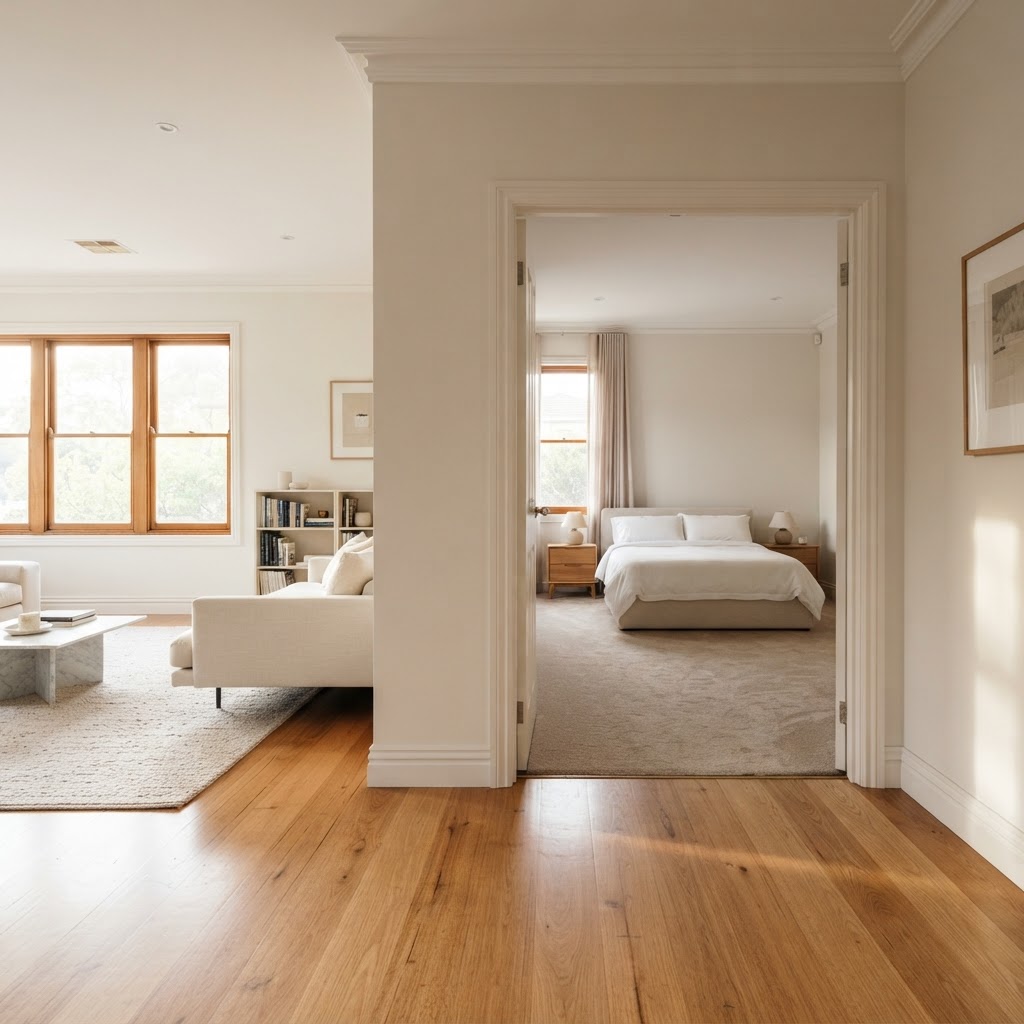
Is carpet or hardwood better for Aldie homes?
Neither is better in every room. Hardwood is better for main living areas, dining rooms, hallways and home offices where durability, easy cleaning and long-term value matter most. Carpet is better for bedrooms, playrooms, media rooms and stairs where comfort, warmth, quiet and softness underfoot matter most. Many Aldie homes use both: hardwood or engineered hardwood on the main level, carpet in the bedrooms upstairs, and a water-resistant material in the kitchen and basement. The best choice depends on your household, your priorities for comfort and maintenance, and the condition of the subfloor beneath. Floors and Beyond VA, a family-owned Northern Virginia flooring and remodeling contractor serving Fairfax, Loudoun, Prince William and Arlington counties since 1987, installs carpet, hardwood and everything in between with in-house crews and no subcontractors, so our advice is not tilted toward any one product.
The question comes up constantly in Aldie. Homes in Stone Ridge, South Riding, Willowsford and the surrounding Loudoun County communities often arrive from the builder with carpet in most rooms, and owners wonder whether to replace it with hardwood. Others have hardwood downstairs and wonder whether bedrooms should stay carpeted. Still others are thinking ahead to selling. This guide compares carpet and hardwood on comfort, maintenance, noise reduction, durability and long-term value, and gives practical recommendations for bedrooms, living areas and stairs. For service details, see our carpet and wood flooring pages.
Comfort and feel
Carpet is soft, warm and forgiving. It cushions steps, feels pleasant on bare feet, stays warmer on cold mornings and provides a comfortable surface for children playing on the floor and for anyone standing or sitting on it. A quality pad beneath adds resilience. Carpet is also gentler on falls, which matters for toddlers and older adults.
Hardwood is firm, smooth and cooler. It feels solid underfoot and has a refined look and feel that many people prefer. Warmth and softness come from area rugs, and radiant heat can address the cold in some installations. Engineered and solid hardwood feel similar once installed.
If comfort is your top priority in a specific room, as in a bedroom, nursery or media room, carpet leads. If you want a refined, easy-to-live-with surface for shared spaces, hardwood leads.
Maintenance and cleaning
Hardwood is easy to keep clean. Sweeping or vacuuming removes dust, and occasional damp mopping with a cleaner made for wood keeps the finish fresh. Spills sit on the surface and wipe up if handled promptly. Hard surfaces do not trap dust, pollen and dander the way carpet fibers can, which many allergy-sensitive households appreciate. Over the years, a hardwood floor may need periodic screening and recoating, and eventually refinishing. Our floor care page offers practical guidance.
Carpet requires more regular attention. Frequent vacuuming is essential, since carpet holds soil, and traffic paths show wear sooner. Spills need prompt treatment to prevent staining. Periodic professional cleaning removes embedded dirt and refreshes fibers. Modern stain-resistant fibers and treatments have improved dramatically, and our article on stain-resistant carpet for families explains how to choose them. For pet households, our article on removing pet odors from carpet in Northern Virginia addresses a common concern.
Overall, hardwood is simpler day to day, and carpet needs a more deliberate routine.
Noise reduction
Sound is one of carpet's greatest strengths. Carpet and pad absorb sound within the room, softening footsteps, voices and echoes, and they reduce impact noise transmitted to the room below. In two-story homes, which are common in Aldie's newer communities, carpeted bedrooms and stairs keep the upstairs quiet and keep the downstairs from hearing every step.
Hardwood reflects sound. In open plans with high ceilings, hard surfaces can make a room feel lively and echoey. Area rugs, soft furnishings and quality underlayment beneath the hardwood help considerably. In townhomes and condominiums, associations sometimes require sound-rated underlayment for hard floors above other units. Our articles on condo remodeling rules and permits and flooring in condo remodels cover this.
If quiet is a priority for a particular room, such as a nursery, bedroom above a living space or a media room, carpet is hard to beat. Our home theater carpet page covers dedicated media spaces.
Durability and lifespan
Hardwood can last for generations. Its great advantage is renewability. When the finish wears or scratches accumulate, a hardwood floor can often be sanded and refinished, or recolored, to look new. Solid hardwood can be refinished many times, and a quality engineered floor with a thick wear layer can be refinished several times. Hardwood is, however, vulnerable to water, and it can scratch and dent. This is why Floors and Beyond VA follows a refinish-first philosophy. Our articles on whether your hardwood floors can be saved and whether refinishing is worth it explain how to decide.
Carpet has a shorter lifespan, and it cannot be refinished. Its durability depends heavily on fiber, density, twist and padding. Nylon is known for resilience, polyester for softness and color, triexta for stain resistance, and wool for natural performance with more care. Higher density and quality pads extend life. Traffic paths, stairs and entries wear first. When carpet becomes matted, stained or worn, it is replaced. Our articles on the most durable carpet types and on choosing carpet in Northern Virginia help you choose well.
Over decades, hardwood generally outlasts carpet by a wide margin. Over the next several years, a good carpet in a lightly used bedroom performs perfectly well.
Cost drivers
We do not publish prices in articles, because the numbers that matter come from your own rooms and choices. We can explain what drives the difference between the two.
For carpet, the main drivers are the fiber and quality tier, the density and face weight, the quality of the pad, the square yardage including seams and waste, the removal and disposal of existing carpet, stairs and furniture moving. Carpet installation is generally faster than hardwood installation, because there is no sanding or finishing. Our article on what affects professional carpet installation costs explains more.
For hardwood, the main drivers are the species and grade, solid versus engineered construction, plank width, finish type, the square footage, the subfloor condition, the installation method, the removal of existing flooring, stairs, trim and any on-site sanding and finishing. Hardwood installation involves more steps and generally takes longer.
Beyond upfront considerations, think about lifetime value. Carpet is replaced periodically. Hardwood, with care, may only need refinishing. A floor that lasts for decades may offer better long-term value even if the initial investment is higher. Floors and Beyond VA provides an honest, all-inclusive estimate, and what we quote is what you pay, including old flooring removal, new materials, professional installation, furniture moving, transitions, molding and full cleanup. Our article on flooring cost factors in Northern Virginia explains why estimates differ.
Health, allergens and air quality
Hard surfaces are easier to keep free of dust, pollen, dander and mites, and many allergy-sensitive households prefer hardwood for this reason. Carpet can hold allergens in its fibers, though regular vacuuming with a good filter and periodic professional cleaning keep them manageable, and some households find that carpet traps particles that would otherwise stir into the air.
Both materials depend on keeping moisture in check. Carpet in damp environments, particularly basements, can support mold and mildew. Our article on basement carpet mold prevention explains the building science.
The best choice for bedrooms
Bedrooms are where carpet makes its best case. Warmth, softness and quiet are what most people want in a place to sleep, and carpet delivers all three. Upstairs bedrooms in two-story homes benefit from the noise reduction, and children's rooms benefit from a forgiving surface for play.
That said, many homeowners prefer hardwood or engineered hardwood in bedrooms, especially for allergy reasons or aesthetic continuity, and use area rugs for warmth. A hardwood bedroom with a large rug beside the bed offers both a clean surface and a soft landing.
A practical approach is to choose carpet for bedrooms where comfort matters most, and hardwood for the hallway and common areas, so the home reads as a coherent whole.
The best choice for living areas
Main living areas are where hardwood usually wins. Living rooms, dining rooms, family rooms and hallways see the most traffic, benefit from easy cleaning, and are the rooms buyers and guests see first. Hardwood and wide-plank engineered hardwood suit open layouts and add lasting value. Our article on engineered wide-plank flooring in Northern Virginia explains why that style is popular in newer homes.
Some households still prefer carpet in a family room or finished basement living space because of its comfort and sound absorption. That is a legitimate choice, particularly with kids and pets who spend time on the floor, provided the carpet is chosen for durability and the moisture conditions are controlled.
If you are considering converting a carpeted main level to hardwood, our article on carpet-to-hard-flooring conversion in Northern Virginia walks through what is involved.
Stairs
Stairs are a special case. Carpeted stairs are quiet, safer for many households because of their traction and softer landing, and forgiving of small imperfections in the stair structure. Hardwood stairs are striking and durable but can be slippery, louder and less forgiving. A runner on hardwood stairs offers a middle path: the beauty of wood with the traction and noise reduction of carpet. Stair work is detailed and demands experience, regardless of material.
Resale considerations
Buyers' preferences vary, but there are patterns. Hardwood in main living areas is widely appreciated, and a well-maintained hardwood floor is a selling point. Worn, stained or dated carpet can hurt a home's appeal, and fresh neutral carpet in bedrooms is often perfectly acceptable. Our articles on whether houses sell better with carpet or hardwood floors and on the best flooring before selling a home go deeper. If you plan to sell within a few years, targeted refreshes, such as refinishing existing hardwood or replacing worn carpet, are often more sensible than a complete overhaul.
Matching the decision to your household
Rather than asking which material is better in the abstract, think about who lives in your home and how they use it.
Households with infants and toddlers spend a lot of time on the floor, and many parents appreciate carpet's cushioning in play areas and bedrooms. Households with school-age children and teenagers often prefer the easier cleaning and more durable feel of hardwood or luxury vinyl plank in shared spaces. Pet owners weigh scratches and odors, and many choose hardwood or LVP in main areas with washable rugs. People who work from home and take calls throughout the day may want sound control in the office. Empty-nesters and older adults often value traction, comfort and ease of maintenance, which can point toward carpet on stairs and bedrooms and firm, non-slip surfaces elsewhere. Entertaining households care about the look under evening light and about floors that handle crowds.
Your own habits matter as much as your demographics. If you vacuum frequently and like a plush surface, carpet will serve you well. If you prefer to sweep quickly and move on, hardwood fits better. If you dislike the sound of footsteps or the cool feel of hard floors in winter, carpet or rugs will improve your day.
A simple room-by-room starting point
As a starting point for a typical Aldie home: choose hardwood or engineered hardwood for the foyer, living room, dining room and hallway; choose a durable water-resistant surface such as porcelain tile or luxury vinyl plank for the kitchen, laundry and mudroom; choose carpet for bedrooms, and consider it for stairs and the media room; and choose a moisture-tolerant product for the basement. From there, adjust to your priorities. Samples in your own home, evaluated in your own light, will quickly show what feels right.
What drives the scope of carpet or hardwood installation
Whatever you choose, the scope of the project depends on material and quality, square footage, layout and number of rooms, subfloor condition, removal and disposal of existing flooring, stairs, trim, molding and transitions, furniture moving and, for hardwood, finishing steps and cure time. Understanding these drivers helps you compare estimates on scope, not just totals. Our flooring installation guide and our guide to preparing your home for new floors explain the process.
Combining carpet and hardwood well
Because most Aldie homes end up with both materials, how they meet matters. Plan transitions at natural breaks such as doorways, the top of the stairs or the edge of a room, not in the middle of an open space. Carpet and hardwood differ in thickness, so a properly chosen transition strip or a tucked edge keeps the junction safe and tidy. Keep the tones of the two materials in the same family, so that a warm hardwood does not sit beside a cool gray carpet without a reason. Use the same hardwood in hallways and landings that you use downstairs, so the upper level feels connected to the main level. And remember that carpet pad thickness affects the finished height, which is worth discussing with your installer before ordering materials.
Common mistakes to avoid
The first mistake is choosing one material for the whole house out of habit. Rooms have different needs.
The second is picking carpet by color and softness alone. Fiber, density and padding determine performance.
The third is skimping on carpet pad. A good pad extends the life and comfort of carpet.
The fourth is choosing hardwood for rooms with frequent water exposure.
The fifth is ignoring sound transmission in multi-level homes and townhomes.
The sixth is replacing hardwood that could be refinished.
The seventh is overlooking the subfloor. Either floor depends on a flat, sound, dry base.
The eighth is using the wrong cleaning methods. Carpet and hardwood each have specific care needs.
The ninth is hiring an installer without experience in the material.
Frequently asked questions
Is carpet or hardwood better for bedrooms? Carpet is often better for comfort, warmth and quiet, though hardwood with area rugs works for many households.
Is hardwood better for living areas? Usually yes, for durability, easy cleaning and long-term value.
Which is better for pets? Hardwood is easier to clean after accidents, but pets can scratch it. Carpet can hold odors and stains. Durable carpet and durable hardwood finishes both work with sensible care.
Which is quieter? Carpet, by a wide margin.
Which lasts longer? Hardwood, which can be refinished many times.
Which is better for allergies? Hard surfaces are generally easier to keep free of allergens, though well-maintained carpet can be manageable.
Can I put hardwood over my existing carpet? Carpet and pad are removed first, and the subfloor is evaluated before hardwood is installed.
Does Floors and Beyond VA use subcontractors? No. Our in-house crews handle every project, and we are fully licensed, bonded and insured.
Do you serve Aldie? Yes, including Stone Ridge, South Riding, Willowsford, Arcola, Gilbert's Corner, Middleburg and surrounding Loudoun County communities, along with Fairfax, Prince William and Arlington counties.
Ready to decide between carpet and hardwood?
The right answer depends on the room, and often it is both. Floors and Beyond VA brings nearly forty years of Northern Virginia experience, in-house crews with no subcontractors, a refinish-first philosophy and an honest all-inclusive estimate to every Aldie project.
Request your free Aldie flooring consultation: https://floorsandbeyondva.com/Contact
You can also call (703) 906-5698 or send us a message through our contact page.




