
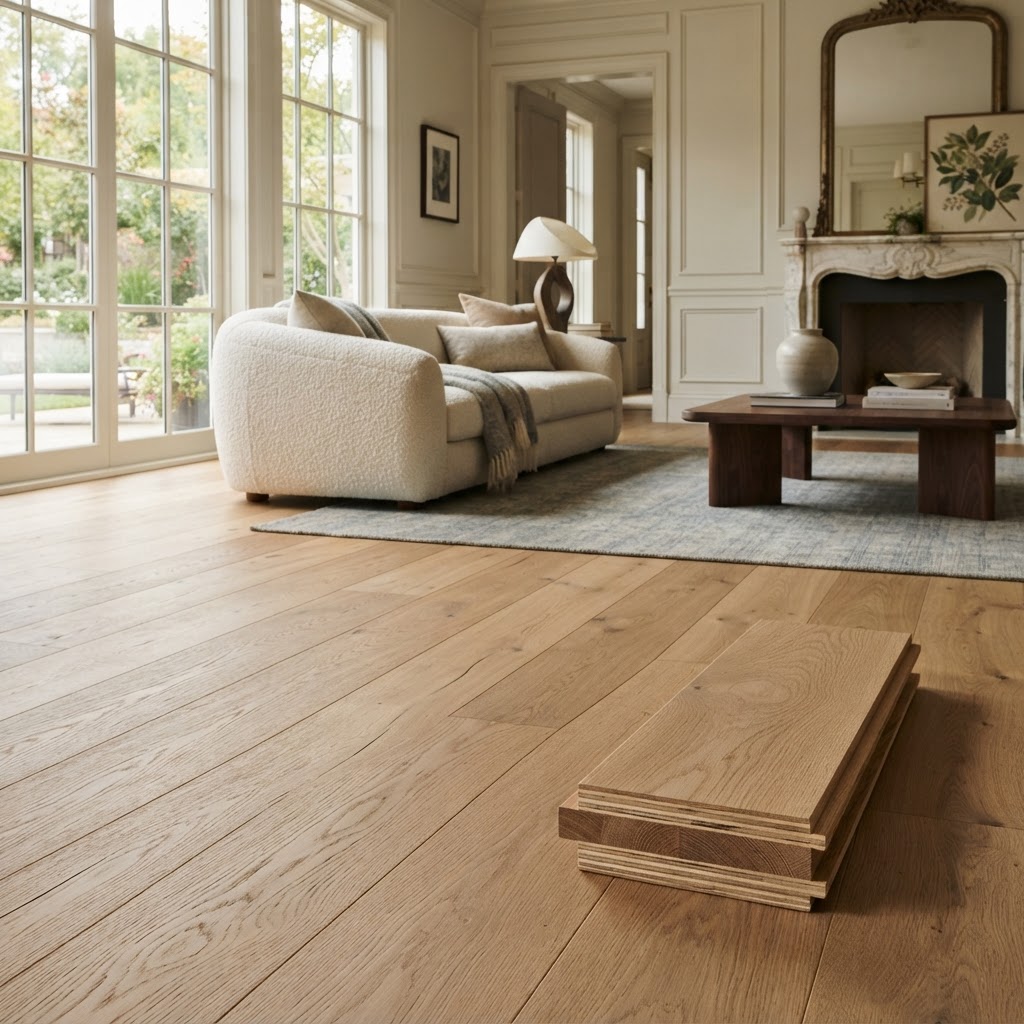
Neither is universally better. Solid hardwood is best for above-grade rooms with stable subfloors where you want the longest possible lifespan and the most refinishing opportunities. Engineered hardwood is best where moisture, humidity swings, concrete slabs, radiant heat or wide planks make a more dimensionally stable floor the smarter choice. In McLean, many homes contain both: solid hardwood on the main level of older homes, and engineered hardwood in basements, additions and newer wide-plank installations. The right answer depends on the room, the subfloor, the moisture conditions and how you plan to use and maintain the floor. Floors and Beyond VA, a family-owned Northern Virginia flooring and remodeling contractor serving Fairfax, Loudoun, Prince William and Arlington counties since 1987, installs, refinishes and repairs both types with in-house crews and no subcontractors, so our recommendation comes from what suits your home, not from what we happen to be selling.
This guide looks at the question from the construction side. We cover how each type is built, how each handles moisture, how each is installed, what refinishing potential each offers, and how they compare in long-term value. Our wood flooring page describes the hardwood services we provide, including installation, refinishing and repair. The aim here is to help you understand why the two products behave differently, so you can choose with confidence.
Construction: what each type is made of
Solid hardwood
Solid hardwood is exactly what it sounds like: each plank is a single piece of wood from top to bottom. Common thicknesses allow for substantial wear layers, because the entire thickness above the tongue can be sanded. Species such as red oak, white oak, hickory, maple and walnut are common in the region. Planks are milled with a tongue and groove so that they interlock, and they are usually fastened to a wood subfloor with nails or staples.
Because solid wood is a single, continuous piece, it responds to humidity in a particular way. Wood is hygroscopic, meaning it absorbs and releases moisture from the air. As it does, it expands and contracts, mostly across the width of the plank rather than along its length. In a stable indoor climate this movement is small and manageable. In an environment with large humidity swings, or when planks are very wide, movement can become visible as gaps between boards in dry months or cupping in humid ones.
Engineered hardwood
Engineered hardwood is built in layers. The top layer, called the wear layer or veneer, is genuine hardwood of the species you choose. Beneath it are additional layers of wood or wood-based material, typically arranged with their grain running in alternating directions. This cross-layered construction is the key to engineered wood's stability. Because each layer restrains the movement of the layers adjacent to it, the plank as a whole expands and contracts far less than a solid board of the same width.
Engineered planks vary widely in quality. The thickness of the wear layer determines how many times the floor can be sanded and refinished. The core construction, whether plywood, high-density fiberboard or another structure, affects stability, strength and sound. Higher-quality products have thick, premium wear layers and multi-ply cores, while lower-quality ones have thin veneers that can only be refinished once, if at all. This is why two engineered products that look similar can have very different lifespans. Our article on engineered wide-plank flooring in Northern Virginia goes deeper into how construction affects performance.
Importantly, the surface of a quality engineered floor is real wood. It can look, feel and age like solid hardwood, because the visible and walkable surface is the same material.
Moisture and stability: the deciding factor in many rooms
Moisture is the single most important factor separating the two types, and it is the reason this decision matters so much in Northern Virginia, where summers are humid and winters are dry.
Solid hardwood performs best in above-grade living spaces with a wood subfloor and a stable indoor climate. It should not be installed directly on concrete, and it is generally not recommended for below-grade basements, where moisture can migrate through slabs and walls. In bathrooms and other spaces with frequent water exposure, solid hardwood is a risk.
Engineered hardwood is more tolerant of humidity changes and can be installed in a wider range of locations, including over concrete slabs, in many basements with proper moisture control, and over radiant heating when the manufacturer approves. The stability that comes from its layered construction makes it the better choice for wide planks, which are more prone to movement, and for homes with large seasonal humidity swings.
Neither type is waterproof. Standing water, leaks and persistent high humidity can damage both. The difference is how much movement and how much tolerance each has before problems appear. When moisture is a real concern, the answer is not simply to select an engineered product, but also to test the subfloor, correct moisture sources and use appropriate barriers. Our article on the best flooring options for basements with moisture issues and our guide to the best flooring on concrete basements in Northern Virginia explain what proper moisture assessment involves.
Acclimation and moisture testing
Both types should be acclimated and tested. Wood delivered to a home should be allowed to adjust to the indoor environment, and the moisture content of both the wood and the subfloor should be measured and recorded. For wood subfloors, a moisture meter can show whether the subfloor is within acceptable range and whether it matches the flooring. For concrete, moisture testing methods such as calcium chloride tests or in-situ relative humidity probes help determine whether the slab is dry enough for installation. These steps take time, but skipping them is the most common cause of cupping, gapping and buckling.
Installation methods: nail, glue or float
How a hardwood floor is installed affects its performance, its sound and its suitability for a given subfloor.
Nail-down or staple-down. This is the traditional method for solid hardwood over a wood subfloor, and it works for many engineered products as well. Planks are fastened through the tongue into the subfloor. The result is a solid, quiet floor with a firm feel. It requires a wood subfloor, typically plywood or boards, that can hold fasteners.
Glue-down. Planks are bonded to the subfloor with a specialized adhesive. This is common for engineered hardwood over concrete and is sometimes used for solid wood in certain conditions. Glue-down installation requires a clean, flat, properly prepared subfloor and careful troweling. It yields a solid feel and can reduce sound, but it makes removal later more labor-intensive.
Floating. Planks are connected to each other, by click-lock systems or glued tongues and grooves, and rest on an underlayment rather than being attached to the subfloor. This method is available for many engineered products and is often used over concrete or over existing flooring when conditions allow. Floating floors can feel slightly hollower underfoot if not installed with a suitable underlayment, and they require perimeter expansion gaps.
Solid hardwood is almost always nailed or stapled. Engineered hardwood offers more options, which is part of its flexibility. The best method depends on the subfloor, the product, the room and the manufacturer's requirements.
Subfloor and radiant heat
Subfloor type influences the choice. Wood subfloors allow nailing, which suits both solid and many engineered products. Concrete subfloors favor engineered products installed by glue or floating. Radiant heat systems add another layer of complexity, because wood is sensitive to temperature as well as moisture. Many manufacturers approve specific engineered products for use over radiant heat with defined temperature limits, whereas solid hardwood is generally more restricted. Always confirm with the product manufacturer and your installer.
Refinishing potential: the real long-term difference
Refinishing is where solid hardwood has its biggest advantage, and it is also where our refinish-first philosophy comes in.
Solid hardwood typically allows many sandings over its life, because the wood above the tongue is thick. A well-maintained solid floor can be sanded and refinished multiple times across decades, and each time it can be restored to like-new condition or changed to a different color. This is why many century-old floors in the region still look beautiful. In many McLean homes, original oak floors from the mid-century era still have plenty of life left.
Engineered hardwood can also be refinished, but the number of times depends on the thickness of the wear layer. A thick wear layer may permit several refinishings, while a thin veneer may permit one or none. If you plan to refinish engineered flooring in the future, ask about wear layer thickness before you buy.
Before replacing any hardwood, it is worth asking whether it can be refinished. Many floors that look worn or dated are excellent candidates for restoration, which preserves the material you already own and avoids the cost and disruption of replacement. Our articles on whether your hardwood floors can be saved, whether refinishing is worth it and our hardwood floor refinishing field guide help homeowners make that decision. For ongoing upkeep, our floor care page offers practical advice.
Plank width, appearance and design
Design preferences often drive the choice as much as performance does. Wide planks, which have become popular in contemporary McLean homes, are more prone to movement in solid form. That is a major reason engineered hardwood dominates the wide-plank market: its stability makes planks of seven, eight or more inches practical. Solid hardwood is well suited to narrower and medium widths, though wider solid planks are available with careful installation and controlled indoor conditions.
Long lengths are also easier to produce and install reliably in engineered form. Patterns such as herringbone and chevron are available in both types, though the construction and installation method influence the result. Species selection is wide in both categories, with oak, hickory, maple, walnut and others available in solid and engineered forms.
In terms of appearance, a quality engineered floor and a solid floor are indistinguishable once installed, because the surface is real wood in either case. Differences emerge at the edges, such as where a floor meets a vent or at a stair nose, and in how the floor ages over decades.
Sound, feel and comfort
Floors feel different depending on construction and installation. Nailed solid hardwood over a wood subfloor feels firm and substantial. Glued engineered hardwood over concrete also feels solid. Floating engineered floors can sound or feel slightly hollow if the underlayment is not appropriate, though quality underlayment and careful installation greatly reduce this.
In multi-level homes, townhomes and condominiums, sound transmission matters. Many associations require an underlayment with specified sound ratings, and the installation method influences how much noise passes to the unit below. If you live in a managed community near Tysons, check the rules before selecting a product and installation method. Our guide to condo remodeling rules and permits can help.
Long-term value
Value is more than an upfront decision, so consider the whole life of the floor.
Solid hardwood has an exceptional lifespan when maintained and the capacity for repeated renewal. Buyers in many McLean neighborhoods recognize and value genuine solid hardwood, especially in homes with traditional or historic character. For homes with original floors, preserving them can be a selling point. Our historic home restoration services address the unique needs of older homes.
Engineered hardwood offers durability and stability with the flexibility to install in more locations. Thick-wear-layer products can last for decades and be refinished more than once, delivering strong long-term value, particularly when installed over concrete or in wide-plank designs where solid wood would be risky. Lower-quality engineered products with thin veneers offer less long-term value, which is why product quality matters more than the category label.
Resale. Buyers care most about condition, color and style. A beautifully finished engineered floor with a quality wear layer is generally just as appealing as solid hardwood. The more important factor is that the floor is well installed and well maintained. Our article on what flooring sells best before selling a home touches on how buyers respond to different surfaces.
A practical room-by-room guide for McLean homes
Main level living and dining rooms, above grade, wood subfloor. Either type works. Solid is a classic choice, and engineered is excellent for wide planks.
Kitchens. Both can work with proper care, though water exposure is a risk. Engineered offers more stability. Many homeowners choose a moisture-tolerant product in kitchens. Our article on kitchen versus living room flooring in Northern Virginia discusses the differences.
Basements. Engineered hardwood, installed with proper moisture testing and mitigation, is a viable option. Solid hardwood is generally not recommended below grade.
Over concrete slabs. Engineered, glued or floated, is the standard choice.
Over radiant heat. Engineered products approved for radiant systems are typically the best option.
Bathrooms. Hardwood of either type is generally not ideal due to moisture.
Stairs. Both types can be used, with solid or specially milled engineered stair parts. Stair work demands precision.
Additions and sunrooms. Engineered often performs better where temperature and humidity vary more.
Bedrooms and upper levels. Either type works, depending on preference and subfloor.
What affects the scope of a hardwood project
We do not publish prices in articles, but the factors that shape scope are straightforward. The type and species you choose matter. Wear layer thickness and plank width shape the product category. Square footage and layout complexity affect quantity and labor. Subfloor condition determines how much preparation or leveling is required. Installation method influences labor and materials. Removal of existing flooring adds work. Stairs require precision. Stain and finish choices affect the process and the number of coats. Furniture moving, trim and molding and transitions all contribute.
Floors and Beyond VA provides an honest, all-inclusive estimate, and what we quote is what you pay. Our estimates include old flooring removal, new materials, installation, furniture moving, transitions, molding and cleanup. Our flooring installation guide explains the process.
Common mistakes when choosing between solid and engineered hardwood
The first mistake is assuming engineered is a lower-quality product by definition. Quality varies. A premium engineered floor with a thick wear layer is excellent.
The second is assuming solid is always better. Solid is wonderful in the right setting, but in the wrong one, such as a slab or a damp basement, it can fail.
The third is ignoring wear layer thickness. It determines refinishing potential.
The fourth is skipping moisture testing. Both types need it.
The fifth is installing without acclimation. Wood needs time to adjust.
The sixth is choosing wide planks without considering stability. Wide solid planks need controlled conditions.
The seventh is ignoring radiant heat requirements. Always confirm compatibility.
The eighth is replacing a floor that could be refinished. Restoration can be the wiser path.
The ninth is hiring a crew without hardwood experience. Nailing, gluing and finishing are specialized skills.
Frequently asked questions
Is solid or engineered hardwood better?
It depends on the room, subfloor and moisture conditions. Solid excels above grade; engineered excels where stability matters.
Can engineered hardwood be refinished?
Yes, depending on the thickness of its wear layer. Thicker layers allow more refinishing.
Can solid hardwood be installed in a basement?
Generally not recommended. Engineered hardwood with proper moisture control is usually a better choice below grade.
Which is better over concrete?
Engineered hardwood, installed by glue or floating methods after moisture testing.
Which is better over radiant heat?
Engineered hardwood approved for radiant heat is typically preferred. Always check manufacturer guidance.
Do they look different?
Once installed, the surface of each is real wood and can look identical.
Which lasts longer?
Solid hardwood can be refinished more times, but a thick-wear-layer engineered floor can also last for decades.
Which is better for wide planks?
Engineered, because of its stability.
Can I refinish my existing hardwood instead of replacing it?
Often yes. We take a refinish-first approach and will tell you honestly if your floors can be saved.
Does Floors and Beyond VA use subcontractors?
No. Our in-house crews handle every project, and we are fully licensed, bonded and insured.
Do you serve McLean?
Yes, including Langley, Chesterbrook, Franklin Park, Salona Village, Hamilton, Dunn Loring, Vienna, Great Falls and Tysons, along with Fairfax, Loudoun, Prince William and Arlington counties.
Ready to choose between solid and engineered hardwood?
The best hardwood floor is the one that suits your subfloor, your rooms and your household, and that is installed by people who understand the material. Floors and Beyond VA brings nearly forty years of Northern Virginia experience, in-house crews with no subcontractors and a refinish-first philosophy to every McLean home.
Request your free hardwood flooring consultation: https://floorsandbeyondva.com/Contact
You can also call (703) 906-5698, or send us a message through our contact page.




