
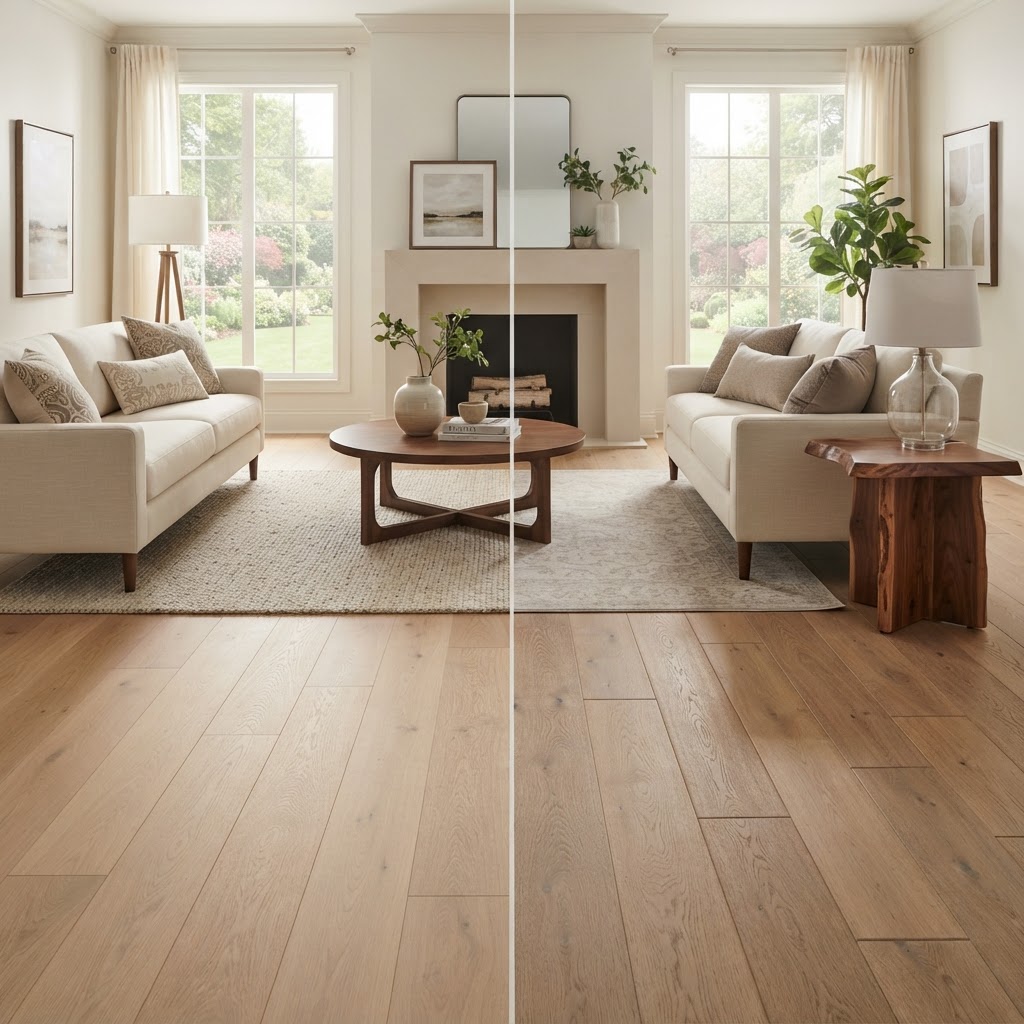
What is the difference between site-finished and prefinished hardwood, and which should Northern Virginia homeowners choose?
Prefinished hardwood arrives with its stain and protective coating already applied in a factory, so it installs quickly with little dust or odor, while site-finished hardwood is installed raw and then sanded, stained and coated inside your home, which allows a seamless surface, custom color and a finish tailored to the room. Most homeowners should choose prefinished when speed, minimal disruption and a very hard factory coating matter most, and site-finished when a flat, continuous floor, an exact color match or a restored historic look matter most. Floors and Beyond VA does both with in-house crews and no subcontractors, and the honest answer for your house depends on its age, its layout and how you live.
The difference between these two is bigger than a sales pitch usually makes it sound. It changes how the floor looks at the joints, how it handles humidity, what the project demands of your household, what repairs will look like in the future and how closely you can match the floor to the rest of your house. This article takes each point in turn, with attention to the particular houses of Northern Virginia, from original oak in Falls Church bungalows to new construction around the Mosaic District in Merrifield.
How each is made
Prefinished. Boards are milled, sanded, stained and coated in a controlled factory environment. Finishes are cured with equipment that is not practical in a living room, which allows very hard coatings, often with mineral or aluminum oxide additives for scratch resistance. Edges of each board are typically beveled or slightly eased, so a visible groove appears at each joint.
Site-finished. Boards are installed raw. After installation, the whole floor is sanded flat in stages with progressively finer abrasives, any stain is applied, and several coats of finish are put on with drying time between them. The result is one continuous surface.
Both can be solid or engineered. The finish decision is separate from the construction decision, which we cover in Solid vs Engineered Hardwood in Tysons, McLean and Vienna: Which Holds Up Better.
Appearance: seamless versus beveled
The most visible difference is at the edges. A site-finished floor is sanded so that adjoining boards sit at the same height, and the finish flows across the joints. The floor reads as a single plane. This suits traditional homes, historic interiors and any design where an unbroken look is part of the charm.
A prefinished floor has micro-bevels or small grooves along board edges. Some people love the definition this gives to each plank, especially in wide-plank, rustic or contemporary styles. Others dislike that the grooves can collect dust and debris. Neither is wrong; it is a style choice.
Color is the other visible difference. With a site-finished floor, color is mixed and applied in your home, so you can adjust it, test it on the actual boards, and match it to existing floors nearby. With prefinished, you choose from the manufacturer's range. The range is wide, but if you need to match an existing floor exactly, such as when you extend original oak into a new room in a Vienna colonial, prefinished options may not match, whereas site finishing can.
Durability and protection
Factory finishes are hard. The curing methods used in factories allow coatings with exceptional scratch resistance. For busy families and households with dogs, this is a real advantage.
Site finishes can also be tough, especially modern water-based urethanes and well-applied oil-modified systems, and they have the advantage of sealing the joints between boards, which helps resist spills from seeping between planks. However, they generally cannot match the hardest factory coatings in raw scratch resistance.
Repair is where the two diverge. A site-finished floor can be spot repaired and blended, or sanded and refinished across a whole area, so a damaged section can be addressed and the floor made uniform again. A prefinished floor can be refinished too if the wear layer permits, but a localized repair may be harder to blend because the factory finish and the new finish differ. Replacing individual damaged boards is practical in both, but the new prefinished boards must match the old ones in color and sheen.
Disruption, dust and odor
This is where prefinished is usually the clear winner.
A prefinished floor goes down and can often be walked on soon afterward. There is no sanding dust and little odor. For homeowners who work from home, who have infants or pets, or who cannot easily leave, or who live in a condominium with neighbors close by, that matters.
A site-finished floor produces sanding dust, even with dust containment systems, and finish odors during and after coating. Rooms are off limits for stretches, and a cure period follows. For a historic home near Broad Street in Falls Church or a spacious house in McLean, many owners accept that for the result. Our team plans the order of rooms to preserve as much usable space as possible and provides ventilation guidance.
In a Tysons high-rise, building rules about noise, fumes and dust can make on-site finishing difficult or impossible. Many associations favor prefinished products for that reason, and sound-control requirements add other constraints. Always verify your association's rules.
Timeline
Because on-site finishing adds sanding, coating and cure steps, a site-finished project takes longer than a prefinished one of the same size. Our guide How Long Does Hardwood Floor Installation Take? A Timeline for Tysons-Area Homes walks through the phases. If you are racing a deadline, prefinished usually wins.
Humidity and seasonal movement
Finish type does not change wood's fundamental response to moisture, but it does influence how visible movement is. On a prefinished floor, a seasonal gap opens at a groove and may be visually masked by the bevel. On a site-finished floor, the finish can sometimes bridge the tiny gap between boards, so seasonal movement may be seen as hairline cracks in the finish at joints in very dry conditions. Neither is a defect in normal seasonal behavior; both respond to controlling indoor humidity through Northern Virginia's heating season.
Color depth and character
Site finishing allows layered color: a stain, a toner and a topcoat that together create depth. It also allows special techniques such as custom blends, bleaching, whitewashing, ebonizing and combination finishes. Historic restorations often depend on these techniques.
Prefinished offers consistency. Every board is finished the same way, so color is uniform across the floor and across multiple boxes. For modern interiors where uniformity is the goal, that is an advantage.
Cost drivers
We do not publish prices, but we can explain how the choice shapes an estimate. Prefinished shifts cost into the material and away from labor on site. Site-finished shifts cost into labor, finishing materials and time. The total depends on the species, grade and size of the job. Comparing proposals requires checking what each includes, since on-site finishing involves sanding, stain, multiple coats and cure time that must be accounted for. Our all-inclusive estimate includes removal, materials, installation, furniture moving, transitions, molding and cleanup.
Choosing for specific houses
These are representative scenarios, not accounts of particular customers.
Older home in Vienna or Falls Church with original narrow oak. If you are extending the floor into a new room or repairing a section, site-finished is usually the better way to blend. For the original floor itself, refinishing in place is often the first answer.
Townhome in Merrifield or Dunn Loring. Compact, finished quickly, often occupied by working households. Prefinished is frequently the practical choice, with stairs matched carefully.
Large home in McLean with an open plan. A continuous surface across a large area is attractive. Site-finished gives a seamless look and precise color control; prefinished wide planks give a crisp, contemporary look with a quicker schedule.
High-rise near Tysons Corner. Prefinished engineered products are commonly considered due to building constraints.
A home with a young family or large dogs. A very hard prefinished surface may be attractive, along with a plan for traction and nail care.
A home where the floor is the star. A hand-selected species with custom color on site gives the most control.
The finish systems
If you choose site finishing, there are several systems to understand.
Water-based polyurethane. Clear, low odor, quick drying, and resistant to yellowing. Often favored for light and natural looks.
Oil-modified polyurethane. Warm amber tone that deepens with age, durable, slower drying and stronger odor.
Hardwax oil. Penetrates the wood and leaves a natural, low-sheen surface. Maintenance is different, and spot repair is often easier.
Sheen. Matte, satin and semi-gloss each change how the floor looks and how it hides wear. Lower sheens hide scratches better.
Our wood flooring page outlines the options we install and finish. We also test stain on your actual boards because color on a sample is never exactly the color on your floor.
Species matter to the decision
Some species finish beautifully on site but are less common prefinished; others thrive with factory finishes. The grain pattern, hardness and tannin content of the wood all affect stain behavior.
What happens at the joints: a closer look
The place where prefinished and site-finished floors differ most is at the seams between boards, and it is worth understanding what is happening there.
On a site-finished floor, the boards are installed tightly, then the whole surface is sanded flat. The sander takes off the thin high edges where one board meets another, so adjacent boards sit at the same level. The finish is then applied over the entire surface, flowing into the tiny gaps between boards and partially bridging them. The practical effect is a floor that is smooth underfoot, easy to sweep and visually continuous. It also means that dust and spills have a harder time entering the joints.
On a prefinished floor, each board arrives with its own finish and with factory-milled edges that are slightly beveled or eased. When the boards are installed, a tiny valley forms at every joint. This is sometimes described as a micro-bevel or pillowed edge. It does a useful job: it hides small variations in height between neighboring boards, which is helpful when a subfloor is not perfectly flat. It also gives the floor a more defined, plank-by-plank look. The trade-off is that those valleys can collect fine dust and require attention when cleaning.
Which you prefer is partly aesthetic and partly practical. In a house with a very flat subfloor and a traditional style, a seamless site-finished surface often looks best. In a house where the subfloor has small imperfections or in a contemporary interior where the plank-by-plank look is intended, prefinished bevels can be an advantage.
Warranties and finish performance
Prefinished floors typically come with a manufacturer's finish warranty, and manufacturers often emphasize the hardness of their factory coating. It is worth reading what a warranty actually covers, including what maintenance it requires, which cleaners are acceptable and what conditions void it. Site-finished floors are warranted by the installer or finisher and by the finish manufacturer's guidelines, which means the quality of the application matters as much as the product.
Because we apply site finishes with our own in-house crews, we are accountable for them directly. Because we install prefinished products to the manufacturer's requirements, we protect the warranty that comes with them. In both cases, the best protection is correct subfloor preparation, correct acclimation and correct installation, which is why we treat those steps as non-negotiable.
Maintaining each type over time
Day-to-day care is similar for both: sweep or vacuum with a soft attachment, clean with a product recommended for your finish, avoid wet mopping and steam cleaners, use mats at entries, put pads under furniture and keep pet nails trimmed. The longer-term differences are in renewal.
A site-finished floor can be maintained with periodic screen-and-recoat treatments, which lightly abrade and recoat the surface to renew the protective layer before wear reaches the wood. This is a lighter, faster process than a full sanding and can extend the life of a floor considerably. When a site-finished floor eventually needs full restoration, it can be sanded and refinished, subject to the wood available above the tongue.
A prefinished floor can often be screened and recoated too, depending on the finish and manufacturer guidance, though the factory coating's hardness can make adhesion more particular and we test before proceeding. When a prefinished floor wears through, it can be refinished within the limits of its wear layer, at which point it becomes essentially a site-finished surface.
The condominium and townhome question
Many Tysons-area buyers live in buildings and communities with rules that influence the finish decision. Condominium associations may limit on-site sanding and finishing because of dust, odors and noise, and they may prefer or require products with documented sound-control performance. Townhome communities in Merrifield and along Gallows Road may restrict contractor hours or require notice to neighbors. In these settings, prefinished products often reduce friction with the building. Always verify your association's rules before ordering. If you are unsure, ask management in writing and share the answer with us so we can plan accordingly.
Environmental and health considerations
Finishing on site releases vapors during application and drying. Modern water-based finishes are lower in odor and dry quickly, but they still require ventilation, and oil-based finishes carry stronger odors. If anyone in your household is sensitive to odors, pregnant, very young or elderly, or if you have pets that spend all day indoors, tell us at the consultation. We can recommend low-odor systems, plan ventilation and sequence the work so that the most odor-intensive steps happen when the house can be quiet. Prefinished products reduce on-site emissions, though the products themselves and adhesives may have their own characteristics, and we are glad to discuss manufacturer information.
What drives the scope
Without quoting figures, the factors include the area, species, construction, finish system, number of coats, stain complexity, subfloor condition, removal, stairs, transitions, access and furniture volume. The finish decision touches several at once.
Why homeowners choose Floors and Beyond VA for finishing decisions
An installer who only does one kind of finish will recommend that kind. Floors and Beyond VA, a family-owned Northern Virginia company serving Fairfax, Loudoun, Prince William and Arlington counties since 1987, installs and finishes both, and our refinish-first philosophy means we respect what is already in your home. Our in-house crews, with no subcontractors, handle installation, sanding and finishing under one roof. We are fully licensed, bonded and insured. We bring samples to your door, test stains on your own boards when appropriate, and give you an honest, all-inclusive estimate in which what we quote is what you pay. Learn more about the same standards at our flooring company in Arlington, VA page or at floorsandbeyondva.com.
Common mistakes
The first mistake is choosing prefinished when you need to match an existing floor exactly. The second is choosing site-finished without planning for dust, odor and cure time. The third is ignoring building rules in condominiums. The fourth is selecting sheen from a small sample. The fifth is walking on or placing rugs on a curing floor. The sixth is assuming a factory finish cannot be repaired. The seventh is forgetting that finish choice affects schedule. The eighth is picking a stain by photograph.
Frequently asked questions
Which is more durable? Factory finishes can be the hardest, while well-applied site finishes seal joints and can be repaired in place.
Which is faster? Prefinished.
Can I match my existing floor? Site-finished usually matches better.
Does site finishing make a mess? There is dust, though containment reduces it, and there are odors during finishing.
Do you install both? Yes.
Do you serve my neighborhood? Yes, including Tysons, McLean, Vienna, Falls Church, Merrifield, Dunn Loring, Great Falls and Oakton, along with Fairfax, Loudoun, Prince William and Arlington counties.
Ready to choose your finish?
Floors and Beyond VA will bring finish samples to your home, test stain on your actual boards where it helps and explain what each path means for your schedule. The request form below goes straight to our team, and we follow up with scheduling options for your free consultation.
Request your free estimate: https://floorsandbeyondva.com/Contact
You can also call (703) 906-5698 or email hello@floorsandbeyondva.com.




