
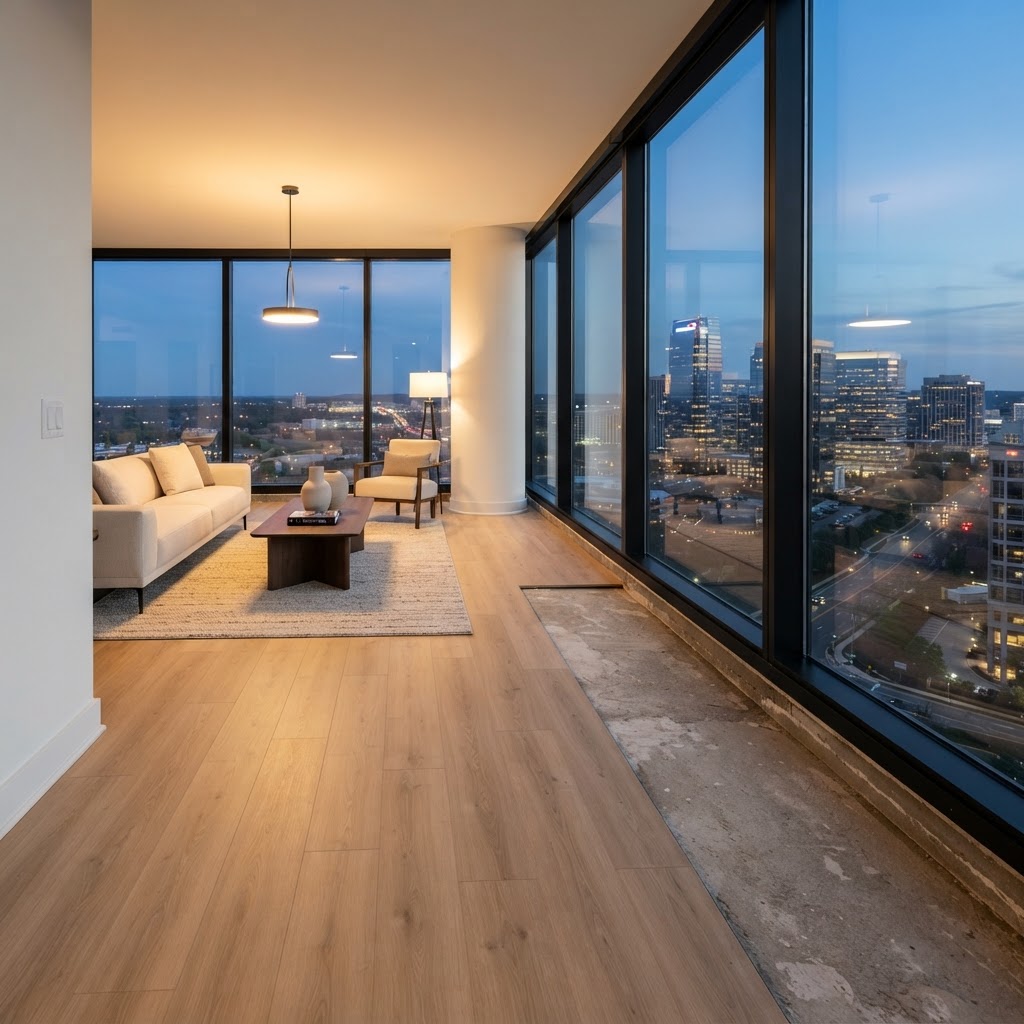
Which floors work best on concrete subfloors in a Tysons high-rise apartment?
On the concrete subfloors found in most Tysons high-rise apartments and condominiums, luxury vinyl plank (LVP), engineered hardwood installed as a floating or glued system, porcelain tile and carpet all work well when the slab is properly prepared, while solid hardwood is generally a poor fit. The right choice depends on the slab's moisture and flatness, the building's sound-control and approval rules, the height you can add before doors and thresholds are affected, whether you own and live in the unit or manage it as a rental, and how you value durability, look and repairability. LVP tends to win on water resistance, speed and ease of replacement, while engineered hardwood wins on authentic wood appearance and the ability to be refinished a limited number of times, so the real comparison is between those two. Floors and Beyond VA, a family-owned Northern Virginia flooring and remodeling contractor serving Fairfax, Loudoun, Prince William and Arlington counties since 1987, installs both with in-house crews and no subcontractors, and we help owners, landlords and property managers choose honestly between them. This guide compares LVP and hardwood on concrete in a Tysons high-rise and explains what any floor needs from the slab beneath it.
Tysons is a vertical community. Towers around Tysons Corner, along the Silver Line and near Greensboro and Spring Hill contain thousands of units, and they are renovated constantly, by owners updating a home, investors preparing a rental and property managers refreshing units between tenants. Nearly all of them sit on concrete. A concrete floor changes the flooring conversation in ways that single-family homeowners with wood subfloors never face. Nails cannot be driven into it, moisture can rise through it, flatness varies, sound transmits through it and building rules govern what you can put on it. This article answers the question many Tysons owners and landlords ask: LVP or hardwood on concrete? It also pulls in the practical concerns of managing multiple units.
What concrete means for flooring
A concrete slab is rigid, durable and permanent, but it brings specific considerations.
You cannot nail into it. Traditional nail-down hardwood does not apply. Floors must be glued, floated or installed over a built-up subfloor system.
It holds and transmits moisture. Concrete is porous. Even in upper floors of a high-rise, residual construction moisture, plumbing leaks, humidity and water from adjacent units can affect a slab. Ground-level and below-grade units face moisture from the soil as well. Testing before installation is standard practice.
It is rarely perfectly flat. Slabs have humps, dips, ridges and patches. Thin and rigid flooring is sensitive to this, so grinding or leveling is often needed.
It is hard and cold. Hard surfaces amplify sound and feel cooler underfoot than wood-framed floors.
It transmits sound. Impact noise, such as footsteps and dropped items, can pass to the unit below. Buildings usually regulate flooring for this reason.
It limits height. Doors, thresholds, balcony sliders, appliances and adjoining floors constrain how much thickness you can add.
It may have embedded systems. Some slabs contain post-tension cables, conduits or radiant heating. Drilling, cutting and fastening into a slab without knowing what is inside is dangerous. Ask the building for slab information before any work that penetrates it.
It may carry old materials. Existing glue-down flooring, adhesives and patching compounds on older slabs may contain hazardous substances. Testing and safe handling are advisable when there is reason for concern. Follow guidance from appropriate authorities.
These facts shape every option below. Our article on the best flooring on concrete basements in Northern Virginia explains many principles that apply to slabs generally.
Slab preparation: the foundation of every option
Whichever floor you choose, the slab must be ready.
Moisture testing. Standardized tests measure the moisture condition of the slab so that flooring, adhesives and any mitigation can be matched to reality. Manufacturers specify tests and limits for their products, and we follow them. We do not state numeric thresholds here, because they vary by product.
Flatness. Manufacturers specify how flat the slab must be. High spots are ground, and low spots are filled with patching or self-leveling compound.
Cleanliness and soundness. Dust, oil, paint, old adhesive and weak surface layers interfere with bonding and must be removed.
Cracks and joints. Hairline cracks are common. Moving cracks and expansion joints require special handling, especially under tile.
Existing flooring removal. Old glue-down floors, tile and carpet adhesives must be removed or properly prepared.
Moisture mitigation. If testing shows elevated moisture, systems such as penetrating sealers or membranes may be used, or a more tolerant product may be selected.
Building requirements. Sound-control layers, vapor barriers and other assemblies may be required.
Our flooring installation guide describes our preparation process, and it is where durability is built.
Luxury vinyl plank on concrete
LVP is the most common choice in Tysons apartments, for good reasons.
Strengths
Water resistance. Planks resist spills and humidity, which suits kitchens, baths and entries and gives a margin of safety in an apartment where a neighbor's leak is a possibility. Note that the plank resists water; moisture from the slab must still be managed, as the system matters. Our article on whether vinyl flooring is waterproof explains the distinction.
Speed and simplicity. Floating click-lock or glue-down installations on a prepared slab are relatively quick. That matters when work hours are limited or a rental needs to turn quickly.
Thin profile. Many LVP products are slim, which helps with door clearances and transitions.
Realistic looks. Modern textures and printing replicate wood and stone convincingly.
Comfort and sound. Thicker products and attached underlayments soften footfall and reduce noise somewhat, though a building's standard must still be met.
Repairability. Individual planks can often be replaced if damaged, which suits rentals.
Consistency. The same product across multiple units simplifies maintenance and replacement.
Limitations
Not refinishable. When the surface wears out, planks are replaced.
Slab sensitivity. Floating LVP bridges small dips, but significant flatness problems cause gaps and stress on locking joints. Thin glue-down products telegraph imperfections.
Quality varies widely. Wear layer thickness, core construction and finish quality differ. Choosing wisely matters. Our article on how to choose luxury vinyl plank and our article on what SPC core flooring is explain what to look for, and our article on LVP pros and cons offers a balanced view.
Perceived value. Some buyers and tenants prefer real wood.
Our vinyl flooring page describes our installations.
Hardwood on concrete: what actually works
Solid hardwood is generally not recommended on a concrete slab. The slab cannot be nailed, moisture is a risk and solid wood is dimensionally sensitive. That leaves engineered hardwood and specialized systems.
Engineered hardwood
Construction. A real wood wear layer bonded to a stable, layered core. The construction resists expansion and contraction better than solid wood, which makes it suitable for concrete when moisture is controlled.
Installation. Floating over an underlayment or glued directly to the slab with appropriate adhesive. Glue-down offers a solid feel and good sound performance with the right adhesive and moisture control. Floating is simpler and can accommodate an acoustic underlayment.
Strengths. Authentic wood appearance and feel. Wear layers can often be refinished a limited number of times, depending on thickness. Wide planks are available. It carries a premium look that many buyers appreciate. Our wood flooring page and our article on engineered wide plank flooring describe the category.
Limitations. More sensitive to moisture and humidity than LVP. Water leaks are a bigger concern. Quality varies by wear layer and construction. Typically more demanding on the slab's flatness and moisture condition. May be subject to building restrictions.
Sleeper and built-up subfloor systems for solid wood
In some situations, a wood subfloor system is built over the slab, allowing nail-down hardwood. These systems add height and cost and may not be allowed or practical in many buildings.
LVP versus engineered hardwood on concrete: the practical comparison
The choice depends on priorities. Here is how the two compare in the areas that matter most for a Tysons high-rise.
Moisture tolerance. LVP is more forgiving of spills and humidity. Engineered hardwood needs more careful moisture control.
Appearance and feel. Hardwood offers real wood character. LVP offers convincing imitation with the practicality of vinyl.
Sound. Both depend heavily on the underlayment and assembly. Neither is inherently compliant with a building's standard. Check the requirement and documentation.
Height. Both can be relatively slim, depending on product and underlayment.
Durability. Good LVP resists scratches and dents well. Hardwood can dent and scratch but can be refinished within limits.
Repair. LVP planks can be replaced individually. Engineered wood planks can also be replaced, but matching can be harder, and refinishing is limited.
Installation time. LVP is usually quicker.
Resale and tenant appeal. Owner-occupants and buyers often prefer real wood. Tenants and landlords often prefer durability and low maintenance.
Building approval. Some buildings treat them differently. Always check.
Long-term value. Hardwood may add perceived value. LVP offers lower risk and simpler maintenance.
Our article on hardwood versus LVP in Northern Virginia goes deeper. The honest answer is that neither is universally better. We help you decide for your unit.
Tile and carpet on concrete
Porcelain tile. Very durable and water-impervious, tile suits kitchens, baths and entries. It is heavy, rigid and noisy without sound control, and needs a flat slab and often crack-isolation or sound-control membranes. Thickness affects transitions. See our tile and stone page.
Carpet. Absorbs sound, warms the floor and is easiest to get approved. It suits bedrooms. Moisture control and quality pad are important. See our carpet and luxury carpet pages.
Hybrid layouts. Many units use LVP or tile in living areas and kitchens, with carpet in bedrooms.
Sound control and building rules
In a high-rise, the building's rules often matter as much as your taste. Many buildings require written approval, product documentation and specified sound performance for hard flooring, and some limit it by location. We do not state any specific requirement as universal, and you must verify yours with the association or management. Our article on Tysons condo flooring rules, sound ratings, underlayment and HOA approval explains what to ask and how assemblies are documented, and our condominium remodeling page describes our work in these buildings.
Considerations for landlords and property managers
Investors and managers in Tysons have priorities that differ from owner-occupants.
Durability and repairability. Rental units take hard use. Surfaces that resist wear and can be repaired quickly reduce downtime.
Consistency. Using the same product across units simplifies repairs and tenant turnover.
Turnaround speed. Quick installation between tenants matters. Our in-house crews can plan around turnover windows.
Water risk. In multi-unit buildings, leaks happen. Water-resistant floors reduce damage risk.
Building approvals. Each unit's work requires compliance. Keep records.
Documentation. Maintain approvals, product data and warranties per unit.
Tenant communication. Coordinate access and schedules.
Lifecycle thinking. Consider the cost of replacement and repair over the holding period, not just the initial installation. We do not publish prices, but we discuss lifecycle tradeoffs during the consultation.
Owner-occupied versus rental. Owner-occupants may weigh feel and appearance more, while landlords weigh durability and ease. Both deserve honest advice.
Height, doors and transitions
Concrete floors leave little room to add thickness.
Door clearances. Entry doors, closet doors and bathroom doors may need trimming if flooring thickness increases.
Thresholds. Balcony doors and entry thresholds require care. Floors that rise too high create trip hazards or interfere with sliding doors.
Appliances. Dishwashers and other built-ins may be sensitive to floor height.
Transitions. Where flooring meets tile, carpet or another floor, transitions must manage height differences.
Cabinets. Floating floors may need to stop short of fixed cabinetry.
We plan heights during the consultation, and our estimates include transitions and molding. Our accessibility services emphasize smooth, safe thresholds.
What drives the scope of a high-rise flooring project
We do not publish prices in articles, but the factors that shape any estimate are clear. The material and quality tier. The area and layout. Slab preparation, including moisture testing, grinding, leveling and mitigation. Required assemblies for sound control. Removal of existing flooring and adhesives. Transitions, trim and thresholds. Building requirements, such as work hours, elevators and common-area protection. Number of units in a managed project. Furniture moving. And the company, including its crews, licensing, bonding and insurance.
At Floors and Beyond VA, we provide an honest, all-inclusive estimate, and what we quote is what you pay. Our estimates include old flooring removal, new materials, professional installation, furniture moving, transitions, molding and full cleanup. Our article on flooring cost factors in Northern Virginia explains why estimates differ.
Why Tysons owners and managers choose Floors and Beyond VA
Whether you own the unit or manage dozens, you need a contractor who is honest about options and dependable on schedule. Floors and Beyond VA has served Northern Virginia since 1987 as a family-owned company. Our in-house crews, with no subcontractors, handle slab preparation, installation and finishing, so there is one team accountable for the result. We are fully licensed, bonded and insured and can provide the certificates your building requires. The free in-home consultation brings samples to your door, includes precise laser measurements at no charge and gives you a straightforward comparison of LVP, engineered hardwood, tile and carpet for your unit. Our honest, all-inclusive estimate covers removal, materials, installation, furniture moving, transitions, molding and full cleanup, and what we quote is what you pay. Learn more at floorsandbeyondva.com.
Common mistakes with high-rise flooring
The first mistake is choosing a floor before learning the building's rules.
The second is skipping moisture testing because the unit is on an upper floor.
The third is ignoring slab flatness.
The fourth is choosing solid hardwood for a concrete slab.
The fifth is underestimating the height added by underlayment.
The sixth is drilling or fastening into a slab without knowing what is inside.
The seventh is buying the cheapest LVP without considering wear layer and core.
The eighth is assuming a product's rating applies to your assembly.
The ninth is overlooking old adhesives on older slabs.
The tenth is forgetting turnover timelines in rentals.
Frequently asked questions
Can I put hardwood on concrete in my Tysons apartment? Solid hardwood is generally not recommended. Engineered hardwood can work with moisture control and a proper system.
Is LVP better than hardwood on concrete? It is more forgiving of moisture and quicker to install. Hardwood offers real wood character. We compare them for your unit.
Do I need to test the slab? Yes. Moisture testing is a standard step.
What about sound? Check your building's requirement. The assembly matters more than the surface alone.
Can you handle multiple units? Yes. We plan around turnover and building procedures.
Is Floors and Beyond VA licensed and insured? Yes. We are fully licensed, bonded and insured for every project, and our in-house crews work with no subcontractors.
Do you serve my building? Yes, throughout Tysons, McLean, Vienna, Falls Church, Merrifield and the rest of Fairfax, Loudoun, Prince William and Arlington counties.
Keep reading
For related planning, see Tysons Condo Flooring Rules: Sound Ratings, Underlayment and HOA Approval Before You Install, Best Flooring for Dogs and Muddy Fall Weather in the Tysons Area and Water Damage and Flooring Replacement in Tysons-Area Homes: What to Do in the First 48 Hours.
Ready to choose the right floor for your high-rise apartment?
The right floor starts with an honest look at the slab and the building. Floors and Beyond VA brings nearly forty years of Northern Virginia experience, in-house crews with no subcontractors and a free in-home consultation with samples and precise laser measurements at no charge.
Request your free flooring estimate today: https://floorsandbeyondva.com/Contact
You can also call (703) 906-5698 or email hello@floorsandbeyondva.com.




