
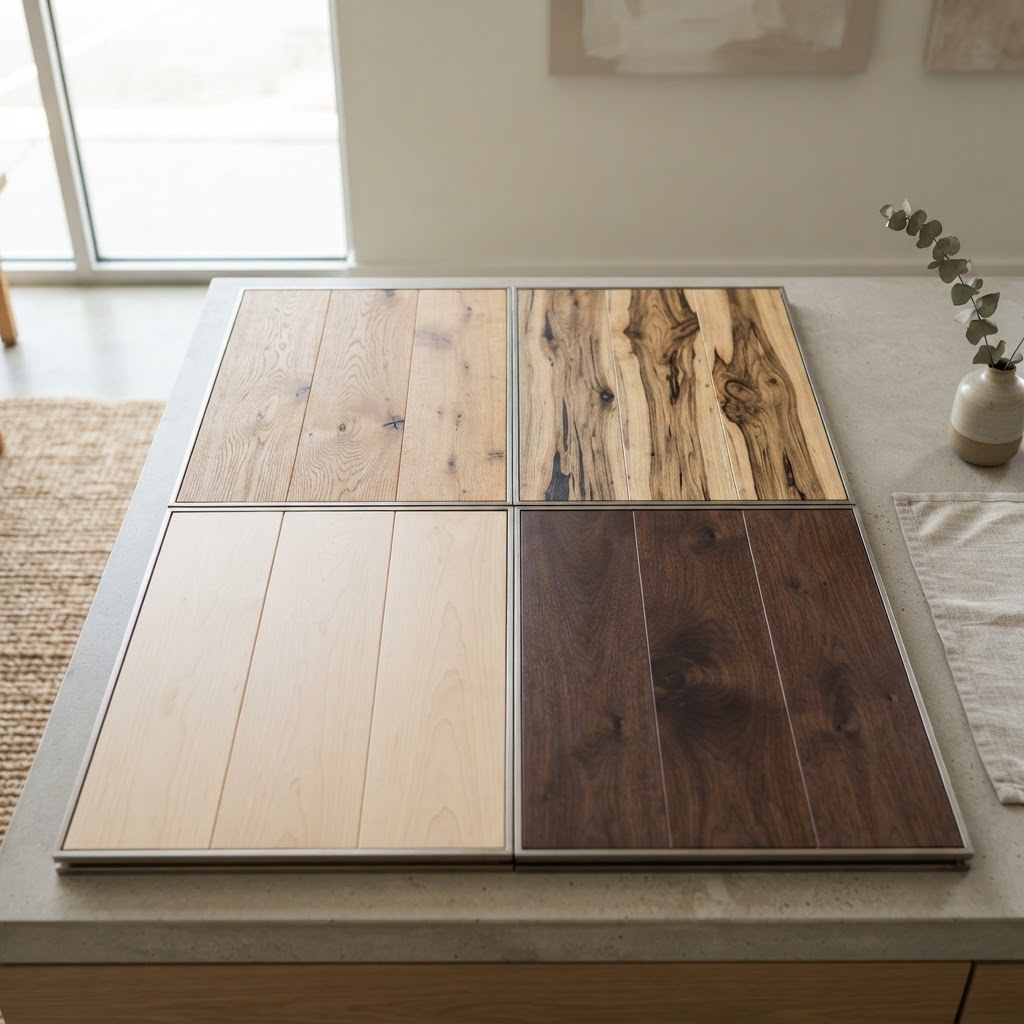
What is the best hardwood species for Northern Virginia homes: oak, hickory, maple or walnut?
For most Northern Virginia homes, oak is the best all-around species because it balances hardness, availability, stain flexibility and a proven record in local houses, while hickory is the better pick for hard-wearing family homes with dogs, maple suits clean, contemporary interiors, and walnut is the choice for rooms where rich color matters more than scratch resistance. Floors and Beyond VA installs and refinishes all four with in-house crews and no subcontractors, and we choose a species by looking at your light, your household and your existing floors rather than defaulting to what is in stock.
The species you pick sets the floor's color, grain, hardness, response to stain and personality for decades. It is also one of the least reversible choices in a flooring project. A finish can be changed by refinishing, but a species cannot. This article compares the four most requested species in the region on the dimensions that matter: hardness, grain, color, stability, how they take stain and where they fit best in houses from Falls Church to Great Falls.
Why species matters more than most people think
Species determines four things you will live with.
Hardness. How well the surface resists dents and scratches. Measured by an industry scale, harder species resist denting but may show different wear patterns.
Grain and figure. Whether the floor looks busy or calm, and whether it hides or highlights scratches and dust.
Color and aging. The natural color of the wood and how it changes with light exposure over years.
Stain behavior. Some species take stain evenly; others blotch, resist color or look their best unstained.
Hardness numbers alone mislead. A harder floor resists dents but can show scratches more starkly, and a softer floor may dent but hide wear in its grain. Choose with the whole picture.
Oak: the Northern Virginia default
Oak is the species most closely associated with floors in this region, and for good reasons. Two main families are sold: red oak and white oak.
Red oak. Warm, with pinkish or reddish undertones, and a pronounced open grain. It is widely available and the species of many original floors in older Northern Virginia houses. It takes stain readily and responds well to refinishing. Its warm tone can be toned down with the right stain or finish.
White oak. Slightly harder and more stable than red, with a more neutral, sometimes olive or tan undertone. It is very popular in contemporary homes for its ability to hold natural, light and gray-brown tones. It is often chosen for wide planks and for rift-and-quartered cuts, which have a straight, calm grain.
Strengths. Excellent availability in many grades and widths. Reliable stain absorption. A familiar, timeless look. Suited to both solid and engineered construction. A long track record in local houses.
Limitations. Not the hardest species. Open grain can collect dust, particularly in lighter stains. Red oak's warmth may clash with certain cool palettes unless adjusted.
Where it fits. Nearly everywhere: colonials in Vienna, split-levels in McLean, townhomes in Merrifield. If you're extending an original oak floor, matching to the existing species is the starting point.
Hickory: the tough one
Hickory is among the hardest domestic species commonly used for flooring, and it displays dramatic character.
Appearance. Strong contrast between pale sapwood and darker heartwood, producing a lively, varied floor with plenty of grain movement. Stains bring out the variation or can mute it, depending on color.
Strengths. Exceptional hardness and dent resistance, which suits busy households and dogs. The character hides scratches and dust well.
Limitations. The pronounced color variation is not for everyone and can feel busy in formal or minimalist rooms. Hard wood is more demanding to cut and install, and it can be more reactive to humidity changes, so acclimation and humidity control are important. Staining can be uneven because of the density and contrast.
Where it fits. Family rooms, kitchens and mudroom-adjacent spaces in larger homes near Great Falls and Oakton, and in households where durability matters most. Less common in formal living rooms.
Maple: clean and contemporary
Maple is a dense, fine-grained wood with a pale, creamy appearance.
Appearance. Smooth, subtle grain and a light, uniform color. It reads as clean and modern, and it can look elegant in bright, airy rooms.
Strengths. High hardness, fine texture, and a refined, uncluttered look. Good for natural finishes that preserve its pale color.
Limitations. Stain can blotch on maple because of its tight, uneven absorption, so conditioners or specialized techniques are used, and some homeowners choose to leave it natural or lightly toned. Its pale color can show dirt and can yellow or darken with light exposure and oil-based finishes. Its smooth surface can show scratches and dents more visibly in some lights.
Where it fits. Contemporary renovations in Tysons-area townhomes and condominiums, and bright open-plan rooms. Often considered for wide-plank engineered applications.
Walnut: rich and luxurious
Walnut is a premium species prized for its deep chocolate color.
Appearance. Naturally rich brown, from warm chocolate to violet-gray tones, with fine, flowing grain. It rarely needs stain.
Strengths. Striking natural color, elegant grain, and good dimensional stability. It makes a statement and pairs well with light walls and contemporary or mid-century furnishings.
Limitations. Softer than oak, hickory and maple, so it dents more easily. Dark floors show dust, lint and pet hair, and scratches can be visible. Natural color lightens with light exposure over time. It is generally a premium material, though we do not publish prices.
Where it fits. Libraries, primary suites, formal living and dining rooms, and entries in McLean and Great Falls houses where appearance is the priority and the household can accept more visible wear. Often used in engineered wide-plank forms.
Side-by-side: how the four behave
Rather than a table, consider these comparisons in prose.
Dent resistance. Hickory and maple lead, oak sits in the middle, walnut is softest. That doesn't mean walnut is fragile; it means it will show impact marks sooner.
Hiding wear. Hickory's grain and color variation hide scratches best. Red oak's open grain also camouflages wear. Smooth maple and dark walnut show scratches and dust more.
Color range. Oak has the widest stain range. Maple is best light or natural. Walnut is best natural or deep. Hickory takes stain but is dramatic regardless.
Stability. White oak and walnut are generally stable. Hickory can be more reactive. Maple is moderately stable. Construction type and humidity control matter more than species alone, a point discussed in Solid vs Engineered Hardwood in Tysons, McLean and Vienna: Which Holds Up Better.
Availability. Oak is the easiest to source in many forms. Hickory and maple are common. Walnut is typically more limited and often special order.
Light and color in Northern Virginia houses
Natural light changes how species look. A home with large south-facing windows in a Vienna addition will make pale maple glow and may deepen walnut with time. A north-light McLean kitchen can make a warm red oak look redder or a gray-toned white oak look cooler. Tysons-area high-rise units with floor-to-ceiling glass see strong light that can cause rapid color change in some species, so we test and advise.
Because of this, we bring samples to your home and look at them in the room at different times of day. A sample on a showroom shelf tells you very little about what it will do on your floor.
Species and finish interactions
Finish changes how a species looks as much as stain does.
Water-based finishes keep wood pale and clear, ideal for maple and white oak when you want a light look.
Oil-based finishes add amber warmth, which can enrich oak and walnut but may make maple yellow.
Hardwax oils give a natural, low-sheen look and let the species speak for itself. Walnut and white oak are especially attractive.
Sheen affects how scratches show. Lower sheens hide wear. For the decision between factory and on-site finishing, see Site-Finished vs Prefinished Hardwood: What Northern Virginia Homeowners Should Know.
Matching existing floors
Species decisions are often constrained by what already exists. If you are adding to an original floor in a Falls Church bungalow or Vienna colonial, matching the species and width is the first step. Different species side by side rarely look intentional unless separated by a clear transition. In those homes, we may recommend staying with oak and finishing old and new together.
If the existing species is unusual, we identify it by inspecting the grain and end details. Where an exact species is no longer available, careful substitution and finishing can approximate it.
Other species worth knowing
Though the four above dominate, other species appear in local projects. Ash offers a light, open grain similar to oak. Cherry gives a warm, reddish color that deepens with age. Pecan is a hickory relative with a similar look. Birch and beech occasionally appear. Exotic species such as Brazilian cherry or teak appear in some imported products, and we discuss their sourcing and performance case by case. If you are drawn to something outside the four, ask us.
How species age in Northern Virginia light
Floors change over time, and species change differently. Understanding this helps you choose a floor you will still love years from now.
Most woods darken or shift in color as they are exposed to light and air. Cherry and walnut are well known for color change; cherry deepens toward a richer red-brown, while walnut tends to lighten slightly from its freshly finished depth. Maple can warm and yellow, particularly under oil-based finishes. Oak shifts gently, with red oak taking on an amber depth and white oak holding a calmer, more neutral cast. Hickory evolves less dramatically, but its sapwood and heartwood contrast can narrow over time as exposure evens out.
Light is the main driver. In a Tysons high-rise with floor-to-ceiling glass facing south or west, a floor can change noticeably within the first year, and areas under rugs or furniture stay the original color, which creates visible differences if a rug is moved. In a McLean house with mature trees filtering the light, change is slower and more even. The practical advice is to rotate rugs and furniture occasionally in sunny rooms, use window treatments where it makes sense and expect color to settle over the first year or two.
Species and the sound and feel underfoot
Species also affect how a floor feels. Harder woods are less forgiving underfoot but wear well. Softer woods feel a little warmer and quieter but dent more easily. The construction and installation method influence feel as much as species does, since a floor glued to a slab feels different from a floating floor and different again from a nailed floor over joists. For comfort, many homeowners prefer a nailed floor over a wood subfloor, which has a slight, pleasant give. In a condominium, the assembly and underlayment, not the species, determine sound.
Sourcing, grades and the look of the board
Within each species, grade affects the look. Cleaner grades have more uniform color and fewer knots, giving a refined appearance. Rustic or character grades include knots, color variation and mineral streaks, giving a more informal, textured look. Neither grade is better; they are different styles. A clean-grade white oak in a contemporary McLean great room has a quiet elegance, while a character-grade hickory in a Great Falls mudroom has personality and hides wear. Mixing grades in the same floor is unusual and usually looks accidental.
Cut also changes appearance. Plain-sawn boards show the familiar cathedral pattern in the grain. Quarter-sawn and rift-sawn boards show straighter, more linear grain and are more dimensionally stable, which is why they are often chosen for wide planks and modern interiors. Ask which cuts are available in the species you like.
Reading a sample honestly
A sample is a useful starting point but an incomplete picture. A small piece cannot show the range of color and grain across a full room. Ask to see several boards, not one. Look at samples in the actual room at different times of day, and against your cabinets, walls and furniture. Check how the stain looks on the specific species, since stain on oak differs from the same stain on maple. We bring multiple samples to your home and, where it matters, test stain on your existing boards or on scraps of the actual species so that the color you approve is the color you get.
What drives the scope
Without quoting figures, species is one of several factors that shape an estimate, along with grade, board width and length, construction, finish, subfloor condition, removal, stairs, pattern, transitions and access. We explain which of these your species choice affects.
Why homeowners choose Floors and Beyond VA for species selection
A species recommendation should come from someone who will install and refinish it. Floors and Beyond VA is a family-owned Northern Virginia company serving Fairfax, Loudoun, Prince William and Arlington counties since 1987. Our in-house crews, with no subcontractors, have worked with these species in homes across the region, and our refinish-first philosophy means we are as comfortable restoring original oak as installing new walnut. We are fully licensed, bonded and insured. We bring samples to your door, measure with a laser at no charge and give an honest, all-inclusive estimate in which what we quote is what you pay. See our wood flooring page for the options, or visit floorsandbeyondva.com.
Common mistakes in choosing a species
The first mistake is choosing from a small sample under store lighting. The second is ignoring hardness in a household with dogs. The third is choosing maple and expecting stain to behave like oak. The fourth is choosing walnut without accepting visible dust and wear. The fifth is ignoring sun exposure. The sixth is mismatching existing floors. The seventh is selecting a species without considering construction and humidity. The eighth is assuming color on a sample equals color on the floor.
Frequently asked questions
Which species is hardest? Hickory and maple are among the hardest commonly installed.
Which is best for dogs? Hickory and oak, with textured or low-sheen finishes, are common choices.
Which species is best for light, modern floors? White oak and maple.
Does walnut fade? Its color lightens with light exposure over time.
Can you match my existing oak? Often yes. We inspect your boards.
Do you serve my neighborhood? Yes, including Tysons, McLean, Vienna, Falls Church, Merrifield, Dunn Loring, Great Falls and Oakton, along with Fairfax, Loudoun, Prince William and Arlington counties.
Ready to choose your species?
Floors and Beyond VA will bring species samples to your home, show them in your light and recommend what suits your household. For a look at how the same approach serves neighbors elsewhere, see our flooring company in Arlington, VA page. The request form below goes straight to our team, and we follow up with scheduling options for your free consultation.
Request your free estimate: https://floorsandbeyondva.com/Contact
You can also call (703) 906-5698 or email hello@floorsandbeyondva.com.




