
What is the best flooring for kitchens and bathrooms in Aldie, VA?
For most Aldie kitchens and bathrooms, the best flooring is porcelain tile or a quality rigid-core luxury vinyl plank. Porcelain is dense, extremely low in water absorption, hard-wearing and available in an enormous range of looks, which makes it the most dependable choice for wet, high-use rooms. Luxury vinyl plank offers water-resistant planks, a warmer and softer feel underfoot and a simpler installation, which suits busy family kitchens and secondary baths. Ceramic tile is a good option for walls and lighter-duty floors, and natural stone can be stunning where the homeowner accepts the sealing and care it needs. The right choice depends on slip resistance, cleaning, grout, comfort and how the room is used. Floors and Beyond VA, a family-owned Northern Virginia flooring and remodeling contractor serving Fairfax, Loudoun, Prince William and Arlington counties since 1987, installs tile and vinyl with in-house crews and no subcontractors, and we treat layout and preparation as seriously as the material itself.
Kitchens and bathrooms are the hardest-working rooms in the house, and they are where flooring mistakes hurt most. A kitchen floor takes spills, dropped pans, constant foot traffic and hours of standing. A bathroom floor takes steam, splashes and bare, wet feet. In Aldie, where households in Stone Ridge, South Riding, Willowsford and the surrounding Loudoun County communities juggle children, pets and active schedules, these rooms rarely get a rest. This guide compares porcelain tile, ceramic tile and waterproof flooring options on slip resistance, cleaning and long-term durability, and explains the installation details that decide whether a floor lasts. Our tile and stone and vinyl flooring pages describe the services we offer.
Porcelain versus ceramic tile
The terms are used loosely, but the difference is meaningful.
Ceramic tile is made from clay, shaped and fired, and usually glazed on the surface. It is relatively easy to cut and install, comes in many styles and is well suited to walls, backsplashes and lighter-duty floors. It is generally a little softer and more porous than porcelain, so if the glaze chips, the body beneath may show a different color, and in demanding conditions it can be less forgiving.
Porcelain tile is made from finer clay fired at higher temperatures, producing a denser, harder and less porous tile. It absorbs very little water, which makes it a leading choice for bathrooms, kitchens, entryways and basements. Many porcelain tiles are through-body, meaning the color runs the full thickness, so chips are far less noticeable. It resists stains and scratches and handles heavy traffic exceptionally well. The tradeoff is that porcelain is harder to cut and drill, which requires proper tools and experience.
For floors in kitchens and bathrooms, porcelain is usually the stronger choice. Ceramic is perfectly reasonable on walls and in lower-traffic powder rooms.
Natural stone, such as marble, travertine, slate and granite, offers unmistakable beauty but behaves differently. Most stone is more porous and needs sealing. Some stones etch when exposed to acids, including citrus, wine or certain cleaners, and some vary in hardness. Stone can be superb in the right setting, but it asks more of the homeowner.
Waterproof flooring options beyond tile
Luxury vinyl plank (LVP). The plank itself resists water, so spills and humidity do not harm it. Rigid-core SPC products are dimensionally stable and dent resistant. LVP is warmer and softer underfoot than tile, quieter and comfortable for long periods of standing, and it replicates wood and stone convincingly. It is a strong choice for family kitchens, secondary baths, laundry rooms and mudrooms. Remember that "waterproof" describes the plank, not the entire floor system, so a dry, flat, properly prepared subfloor still matters. Our articles on whether vinyl flooring is waterproof, LVP pros and cons and what SPC core flooring is explain more.
Sheet vinyl and vinyl tile. These are options for utilitarian spaces, though quality and appearance vary widely.
Rubber flooring. Durable, water resistant and comfortable, rubber suits utility areas and some laundry rooms. See our rubber flooring page.
Hardwood in kitchens. Many homeowners want hardwood to run continuously from the family room into the kitchen. It can work, particularly with a durable finish and prompt spill cleanup, but it is more vulnerable to water than tile or vinyl. In bathrooms, hardwood is generally not recommended. Our article on kitchen versus living room flooring in Northern Virginia weighs these tradeoffs.
Slip resistance
Slip resistance is one of the most important and most overlooked qualities of a floor in wet rooms.
Surfaces range from highly polished to textured. A glossy, polished tile can be elegant yet slippery when wet. A matte, honed or textured surface provides more traction. Manufacturers often publish a coefficient of friction rating that indicates grip, and appropriate ratings differ for dry interiors, wet interiors and exteriors. Rather than relying on a single number, think about how the room is used.
Bathrooms need the most traction, especially in showers and around tubs. Smaller tiles have more grout lines, which add grip, so mosaics are common on shower floors. Larger tiles with a textured finish can work on bathroom floors. Bare wet feet and children make traction a safety issue.
Kitchens are more forgiving, but a softly matte or lightly textured surface handles spills better than high gloss.
Entries from garages and mudrooms benefit from textured surfaces that grip wet shoes.
Aging in place. If you plan to remain in your home for decades, choose surfaces with reliable traction and consider grab bars and curbless showers. Our accessibility services address these design choices.
LVP generally has a textured wear layer that offers reasonable traction, though products vary.
Cleaning and maintenance
Tile. Sweep or vacuum to remove grit, and mop with a pH-neutral cleaner suited to the tile. Avoid harsh acids and abrasives on natural stone and polished surfaces. Seal natural stone and cement grout as recommended, and reseal over time. Epoxy grout resists stains and does not need sealing. Clean grout periodically to prevent buildup and mildew.
LVP. Sweep or vacuum with a soft attachment, and damp mop with a cleaner approved for vinyl. Avoid abrasives, wax and excessive steam. Use felt pads under furniture.
Grout color matters. Light grout shows dirt readily in high-traffic kitchens. Mid-tone or darker grout hides wear. In bathrooms, a color that resists visible mildew staining reduces upkeep.
Our floor care page offers further guidance. Both tile and LVP are among the lowest-maintenance floors available, which is why they dominate wet rooms.
Grout: the small detail with a big effect
Grout affects appearance, cleanliness and longevity more than most homeowners expect.
Cement-based grout is traditional, comes in sanded and unsanded forms and in many colors. It is porous and typically needs sealing.
Epoxy grout is highly stain resistant and water resistant, does not require sealing and is an excellent option for showers, kitchens and busy entries. It is more demanding to install because it sets quickly.
Joint width matters. Narrow joints look sleek but demand precisely consistent, rectified tile and exact installation. Wider joints are more forgiving and suit rustic or handmade-style tile.
Movement joints are an often-overlooked detail. Large tiled areas need flexible sealant joints at perimeters and at intervals to accommodate expansion and contraction. Skipping them is a common cause of cracked tile and grout.
Size, shape and layout
Large-format tile creates a clean, contemporary look with fewer grout lines, and it makes rooms feel larger. It demands a very flat subfloor, because unevenness causes lippage, where one tile edge sits higher than its neighbor.
Standard-format tile is versatile and forgiving and remains the workhorse of residential tile.
Small-format tile and mosaics add pattern, texture and traction, and they conform to slopes, which is why they are used on shower floors.
Plank-style tile mimics hardwood in porcelain form and is popular in kitchens, baths and mudrooms where homeowners want the look of wood with the durability of tile.
Patterns such as herringbone, chevron, offset and diagonal each create a different effect. Diagonal layouts can make a small room feel larger but involve more cutting and waste.
Good layout begins with deciding where the pattern starts so that cuts at doorways, walls and focal points look balanced. A skilled installer plans the pattern so that thin slivers do not end up at visible edges.
Subfloor preparation and waterproofing
What lies beneath a kitchen or bathroom floor decides whether it succeeds.
Flatness and stiffness. Tile does not bend. Dips, humps and flexing joists lead to lippage, hollow spots and cracks. Floors must be flat within tight tolerances, and the structure must be stiff enough. In some homes, reinforcement or an appropriate underlayment such as cement backer board or an uncoupling membrane is needed.
Waterproofing. In showers and wet areas, a waterproofing membrane protects the structure. Tile and grout are not waterproof by themselves, because water can pass through grout lines.
Moisture. For vinyl and other moisture-sensitive materials, the subfloor must be dry. Concrete should be tested.
Underlayment. The right product depends on the subfloor and the flooring.
Thinset and setting technique. Full coverage with the correct trowel and mortar is essential, especially for large tiles.
Cure time. Mortar, grout and sealers need time before heavy use.
Radiant heat. Heated floors pair beautifully with tile in bathrooms and kitchens and bring welcome warmth to a hard surface.
Our flooring installation guide describes the process, and our article on whether flooring can be put over tile addresses a question that often arises when updating an older room.
Choosing by room
Kitchens
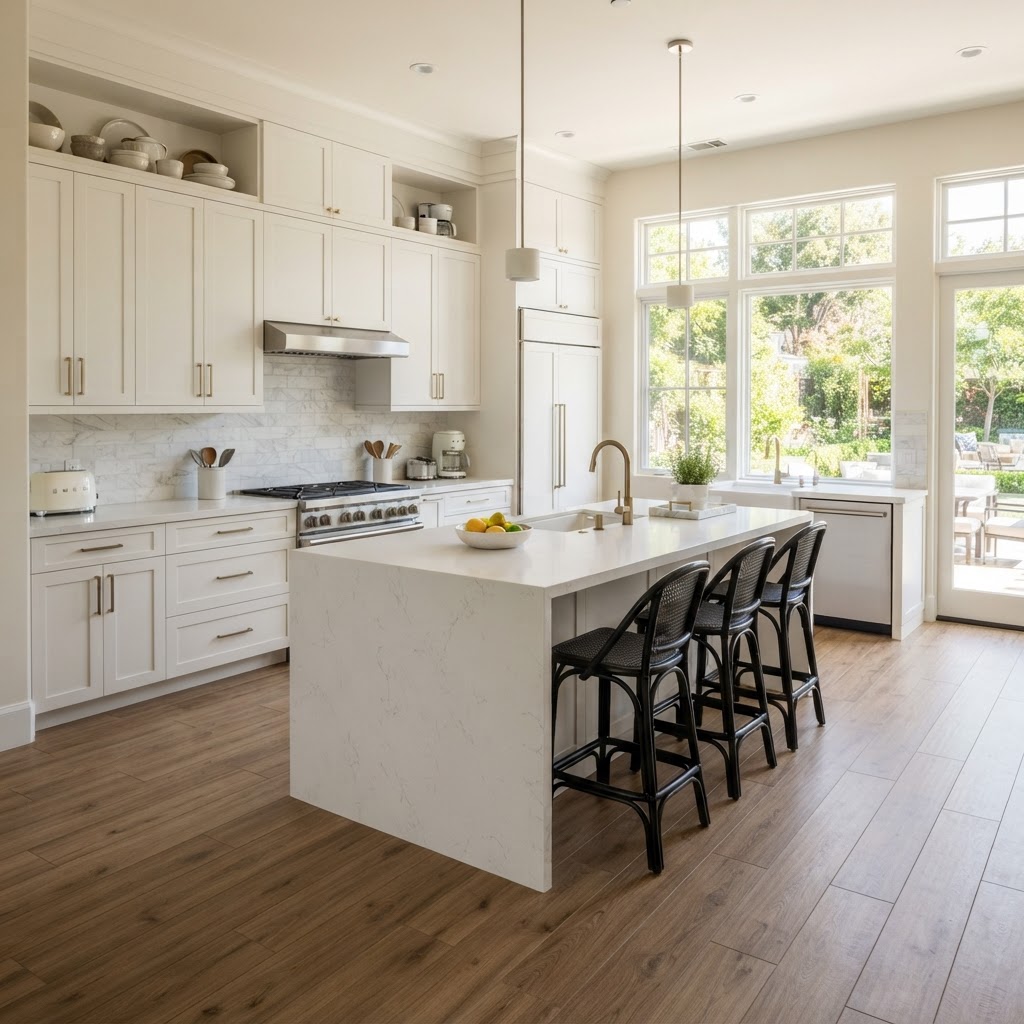
A kitchen floor must handle spills, drops, constant traffic and standing. Porcelain is the most common choice for durability and stain resistance. Wood-look porcelain brings warmth with tile performance. LVP offers comfort and quieter, softer footing. If the kitchen opens to a hardwood living area, matching tones help the transition. Anti-fatigue mats add comfort in work zones. When the kitchen is part of a larger renovation, our kitchen remodeling services coordinate flooring with cabinets and counters.
Primary and secondary bathrooms
Porcelain with a matte or textured finish offers safe traction. Mosaics suit shower floors. Radiant heat under bathroom tile is a comfortable upgrade. LVP can work in secondary baths with careful sealing at edges. For primary baths, see our primary suite remodeling services, and for ideas, our guide to bathroom remodeling in Northern Virginia. Our bathroom remodeling page covers complete projects.
Powder rooms
A small space is a chance for bold, decorative tile or a distinctive pattern.
Laundry rooms and mudrooms
Porcelain or LVP. Water, detergent and dirt demand toughness. See our laundry room remodeling page.
Basement baths and kitchenettes
Porcelain or rigid-core LVP, installed on a tested, prepared slab. Our basement finishing services address complete lower-level projects.
Comfort and ergonomics in kitchens and bathrooms
Wet rooms are also rooms where you stand, work and walk barefoot, so comfort deserves a place in the decision alongside durability. Kitchens in particular involve long periods of standing. Porcelain tile is hard and unforgiving, which some people find tiring over time, while luxury vinyl plank with an attached pad is noticeably softer. Anti-fatigue mats in work zones, radiant heat and well-chosen area rugs can make tile far more comfortable. In bathrooms, warmth matters most. Heated floors under tile turn a cold morning routine into something pleasant, and they also help bathrooms dry faster, which helps with mildew.
Think also about noise. Hard surfaces in a kitchen can make a busy household louder, with dishes, chairs and footsteps reverberating through an open floor plan. Rugs, upholstered seating, window treatments and soft materials elsewhere in the room offset this. In a two-story home, a hard-surface kitchen below a bedroom is worth thinking about, and underlayment choices can help.
Open floor plans and transitions
Many Aldie homes have kitchens that open directly into family rooms and breakfast areas, so the kitchen floor is not an isolated decision. If you choose tile in the kitchen and hardwood in the adjoining room, the point where they meet is highly visible. Plan that transition deliberately, with the two surfaces at compatible heights and a threshold or clean joint that suits the style of the home. Some homeowners avoid the issue by running one material, such as a wood-look porcelain or luxury vinyl plank, through the entire open area. Others choose a natural break, such as a change at an archway, to separate materials.
Bathrooms have their own transitions. The step from a tiled bathroom floor to a hallway or bedroom floor requires attention to height, especially if radiant heat or a thick mortar bed raises the tile. A skilled installer plans this at the outset so that thresholds are low, safe and attractive.
Long-term durability
Porcelain tile can last for decades when installed on a prepared substrate. It resists wear, stains and moisture. Its limits are impact and hardness: dropped items can chip or break, and the surface is cold without radiant heat.
Luxury vinyl plank resists water, scratches and stains for many years when a quality product is installed well. It cannot be refinished, so when the wear layer eventually wears through, the floor is replaced.
Ceramic tile is durable in lighter-duty areas but less forgiving under heavy impact.
Natural stone can last indefinitely with proper care but requires sealing and attention.
Durability depends on installation as much as material. Poor preparation, missing movement joints or inadequate waterproofing shortens the life of any floor.
What drives the scope of a kitchen or bathroom flooring project
We do not publish prices in articles, but several factors shape scope. The material and its size and pattern. Square footage and the number of cuts around cabinets, tubs and fixtures. Subfloor condition, including flatness, structure and moisture. Waterproofing requirements in wet areas. Demolition of existing flooring, from vinyl to old tile in mortar. Grout type, trim, transitions and thresholds. Radiant heat, if installed. Fixture handling, such as removing and resetting toilets and vanities, and appliance moving in kitchens. Cure times that affect scheduling.
Floors and Beyond VA provides an honest, all-inclusive estimate, and what we quote is what you pay. Our estimates include old flooring removal, new materials, professional installation, furniture moving, transitions, molding and full cleanup.
Common mistakes to avoid
The first mistake is choosing tile for looks without checking slip resistance.
The second is ignoring subfloor flatness and stiffness.
The third is skipping waterproofing in wet areas.
The fourth is treating "waterproof" vinyl as a reason to skip preparation.
The fifth is choosing narrow grout joints with non-rectified tile.
The sixth is omitting movement joints.
The seventh is using light cement grout in a busy kitchen without sealing.
The eighth is forgetting transitions to adjacent flooring.
The ninth is using the floor before it cures.
The tenth is hiring an installer without tile or vinyl experience.
Frequently asked questions
What is the best flooring for a kitchen? Porcelain tile and quality luxury vinyl plank are the most common choices for durability and easy cleaning.
What is the best flooring for a bathroom? Porcelain with a matte or textured finish. Mosaics are popular on shower floors.
Is porcelain better than ceramic? For floors in demanding rooms, usually yes. Porcelain is denser and more water resistant.
Is vinyl plank really waterproof? The plank resists water, but the floor system still needs a prepared, dry subfloor.
Is tile slippery? It can be, especially polished tile when wet. Choose slip-resistant finishes in wet areas.
Do I need to seal tile? Porcelain generally does not need sealing. Natural stone and cement grout usually do.
What is epoxy grout? A stain- and water-resistant grout that does not require sealing, ideal for showers and busy areas.
Can I put hardwood in my kitchen? It can work with a durable finish and careful care, but it is more vulnerable to water than tile or vinyl.
Does Floors and Beyond VA use subcontractors? No. Our in-house crews handle every project, and we are fully licensed, bonded and insured.
Do you serve Aldie? Yes, including Stone Ridge, South Riding, Willowsford, Arcola, Gilbert's Corner, Middleburg and surrounding Loudoun County communities, along with Fairfax, Prince William and Arlington counties.
Ready to choose flooring for your kitchen and bathrooms?
The best floors for wet rooms combine the right material, thoughtful layout and careful preparation. Floors and Beyond VA brings nearly forty years of Northern Virginia experience, in-house crews with no subcontractors and an honest all-inclusive estimate to every kitchen and bathroom flooring project.
Request your free Aldie flooring consultation: https://floorsandbeyondva.com/Contact
You can also call (703) 906-5698 or send us a message through our contact page.




