
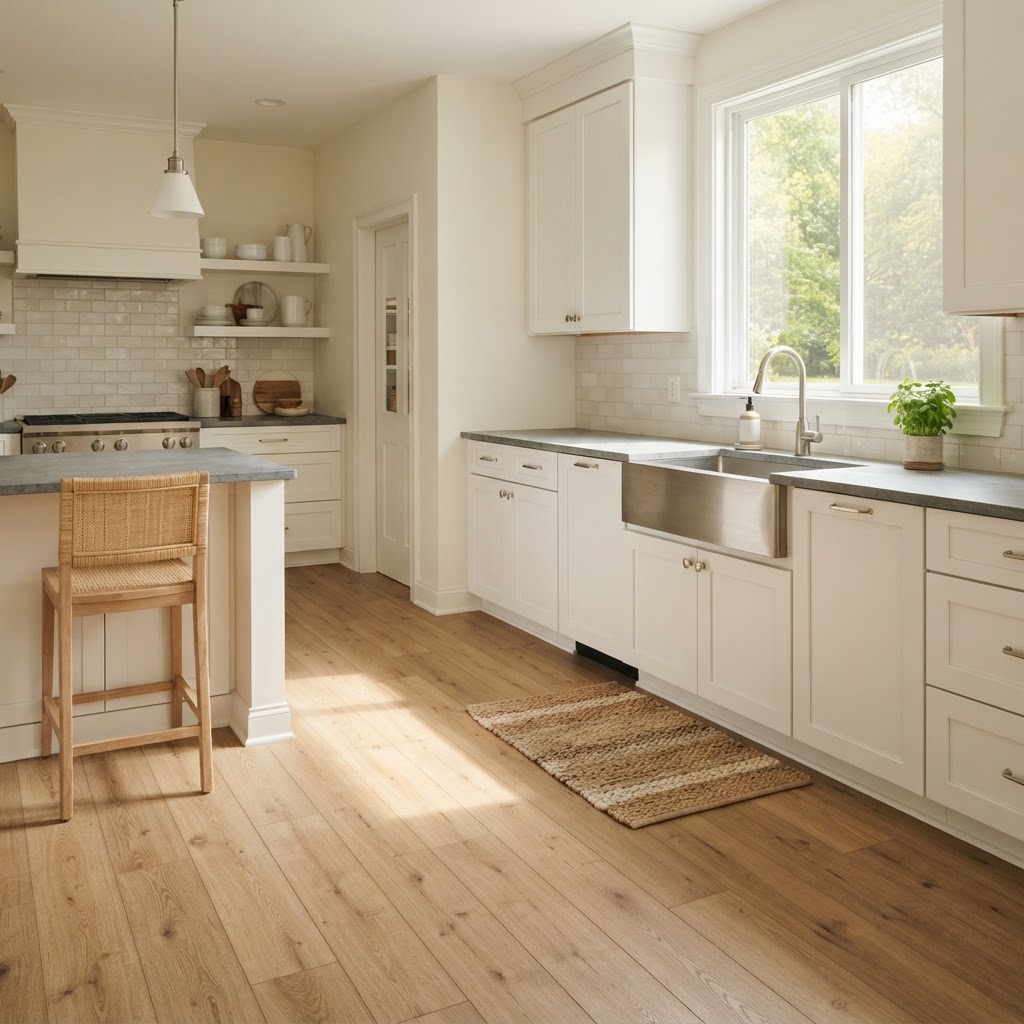
The kitchen is the busiest room in the house, and its floor has the hardest job. It handles spilled water, dropped pans, wet shoes, pet bowls, chairs dragged back from the table and hours of standing at the counter. It also has to look good, because in most Northern Virginia homes the kitchen is open to the living and dining areas and the floor is part of the whole picture.
This guide compares the main kitchen flooring choices, hardwood flooring, luxury vinyl plank flooring and tile, explains how each handles water, wear and comfort, shows how to choose between them for your household, and describes how the floor fits into a kitchen remodel. Floors and Beyond VA is a family-owned flooring and remodeling company that has served Northern Virginia since 1987, and our own crews handle the flooring and the remodeling work.
What a kitchen floor has to do
Before comparing materials, list what your kitchen floor needs to handle. Spills and moisture come first, from sink splashes to dishwasher leaks. Heavy items, such as cast iron pans and appliances, can dent and scratch softer floors. Traffic is heavy and constant. Pets and children add wear. Standing comfort matters for people who cook often. Cleaning needs to be quick and effective. And the floor has to coordinate with cabinets, counters and the adjoining rooms.
No floor is perfect at all of these. The best choice depends on which of them matters most in your household.
Luxury vinyl plank in kitchens
Luxury vinyl plank has become one of the most popular kitchen floors in Northern Virginia, and the reasons are straightforward. Its core is waterproof, so spills and leaks do not penetrate the plank. The wear layer resists scratches, scuffs and stains. It is dimensionally stable, so it handles seasonal humidity changes. It is softer and warmer underfoot than tile and quieter than hard floors. It comes in realistic wood looks and in stone and tile looks, and it can be installed as a floating floor over many surfaces once they are properly prepared.
The trade-offs are practical. Quality varies, so thickness, wear layer and core construction matter. A heavy appliance can leave an indentation in some products, so ask about point-load resistance. Luxury vinyl plank generally cannot be refinished, though individual planks can be replaced in many installations. Installation quality matters, since a floating plank over an uneven subfloor will flex at the joints.
Luxury vinyl plank suits households with children and pets, busy kitchens and homes where a waterproof surface is a priority.
Hardwood in kitchens
Hardwood in a kitchen is beautiful and often the choice when the floor runs continuously from the living and dining areas. It is warm, natural and can be refinished over its life, which means scratches and wear can be renewed. Many Northern Virginia homes have oak floors that run through the kitchen, and keeping them there gives a consistent look.
The trade-off is water. Wood absorbs moisture, and standing water, leaks under the dishwasher or refrigerator and repeated spills can cause cupping, staining and finish damage. A good finish protects the surface, and prompt cleanup of spills makes a large difference. A kitchen with hardwood needs a bit more attention than one with a waterproof product. Mats at the sink and in front of the stove protect the finish, and a leak detector near the dishwasher or refrigerator is a small, smart precaution.
Engineered hardwood has a real wood surface over a layered core that handles humidity changes better than solid wood, and it suits kitchens on slabs. Solid hardwood is nailed to a wood subfloor and suits kitchens above grade.
Tile in kitchens
Tile is the most water-resistant and durable option. Porcelain tile in particular resists water, stains and scratches and lasts for decades. It comes in many sizes, colors and patterns, including wood looks. It handles heat and heavy items well and suits kitchens that see a lot of wet use.
The trade-offs are comfort and fragility. Tile is hard and cold underfoot, and dropped dishes tend to break. Grout lines collect dirt and need sealing and cleaning. Installation requires a very flat, stiff subfloor, because movement can crack tile and grout. Tile is also harder to change later than a floating floor.
Tile suits households that put durability and water resistance above all, and kitchens with a style that calls for it.
Other options
Sheet vinyl, laminate and natural stone also appear in kitchens. Sheet vinyl is waterproof and flexible but may not match the look many owners want. Laminate has a hard surface and a range of looks, but standard laminate is vulnerable to water at the seams, and water-resistant versions vary in performance. Natural stone is beautiful and durable but requires sealing and care, and it can be slippery and cold. For most Northern Virginia kitchens, luxury vinyl plank, hardwood and tile are the three finalists.
Comparing the three
On water, tile and luxury vinyl plank lead, and hardwood needs care. On warmth and comfort, hardwood and luxury vinyl plank beat tile. On scratch and dent resistance, tile leads, luxury vinyl plank is strong and hardwood can be renewed by refinishing. On cleaning, luxury vinyl plank is easiest, tile is easy except for grout and hardwood needs prompt attention to liquids. On style, hardwood offers the most natural warmth, tile the widest range of patterns and luxury vinyl plank the broadest range of looks. On the ability to renew a worn surface, hardwood can be refinished, while tile and luxury vinyl plank are generally replaced in sections.
The right choice depends on your priorities. Many households choose luxury vinyl plank for the combination of water resistance and warmth, hardwood when the kitchen is part of a continuous wood floor and tile in kitchens where water resistance is a priority.
Continuous floors in open layouts
Many Northern Virginia homes have open layouts where the kitchen flows into the family room and dining area. A continuous floor through those spaces makes the whole level look larger and avoids awkward transitions. If you are choosing a floor for an open kitchen, think about the adjoining rooms. Luxury vinyl plank and hardwood both run well through open spaces. Tile usually ends at a threshold, and the transition needs careful handling.
Subfloors and preparation
Kitchen floors depend on what is underneath. Check flatness, repair loose or damaged areas, address any moisture source and remove old adhesive or flooring. If you are replacing an old floor, find out what is under it. Some older kitchens have multiple layers of vinyl, and very old materials need special handling. If the kitchen sits on a slab, test the concrete for moisture. If it is above a crawl space or a basement, check for humidity below. These steps are invisible once the floor is down, and they are the reason a floor lasts.
Cabinets, appliances and order of work
How the floor interacts with the cabinets matters in a remodel. In some designs the floor goes in first and the cabinets sit on top, and in others the cabinets go in first and the floor is installed up to them. Floating floors should not be pinned under heavy cabinets, because they need room to expand, so a plan that lets the floor move is important. Appliances need clearance, and a new floor that is thicker than the old one can make it hard to slide a dishwasher or refrigerator back in. Plan these details early with your contractor.
Kitchen remodels and flooring
If you are remodeling the kitchen, the floor is a key decision. Flooring is usually installed after demolition, rough plumbing and electrical, drywall and sometimes cabinets, and before final fixtures and appliances. Floors are installed late because they are easily damaged, and they are protected afterward until the work is done. Floors and Beyond VA offers both flooring and remodeling, so the order of work can be planned in one place.
Coordinating color and style
Floors, cabinets, counters and backsplashes need to agree. Look at floor samples next to cabinet doors and counter samples in the kitchen's own light. If cabinets are warm in tone, a floor with a warm undertone will look natural, and a cool floor can look like a mismatch. If the cabinets are painted white or gray, a mid-tone floor often provides a pleasing contrast. Avoid choosing a floor that is nearly the same tone as the cabinets, since the two can blend together. Mixed tones look intentional when they are clearly different.
Kitchens in older Northern Virginia houses
In Alexandria, Arlington and older parts of Fairfax, kitchens are often small, with floors that have been replaced several times. Layers of old vinyl or tile may hide original wood, and subfloors can be uneven. When a kitchen floor is replaced in an older house, take the opportunity to find out what is under the existing surface. If original oak or pine runs under the kitchen, it may be possible to refinish it and have the floor match the adjoining rooms. If the subfloor needs repair, do it before anything new goes down. Where the kitchen was added later, the floor may sit at a different height from the rest of the house, and transitions need to be planned.
Condo and townhome kitchens
In condos and townhomes, kitchen floors come with building rules. Sound ratings, approved underlayments and work hours apply, and the slab beneath needs moisture and flatness checks. Luxury vinyl plank over an approved acoustic underlayment is common, and tile may require an uncoupling membrane and approval. Because these kitchens are often smaller, a continuous floor from the entry through the living area makes the space feel larger. Ask your management office for the flooring policy before you choose, and share it with your contractor.
Comfort underfoot and standing
If you cook often, comfort matters. Hardwood and luxury vinyl plank with a cushioned underlayment are gentler on feet and joints than tile over concrete. Anti-fatigue mats in front of the sink and stove add comfort on any floor. Radiant heat under tile or suitable flooring can warm cold kitchen mornings, but it needs a product approved for that use and gradual temperature changes. Tell your contractor if you plan to add heated flooring, because it affects the choice of floor and the sequence of work.
Pets and children in the kitchen
Kitchens attract pets and children, and both test a floor. Dog bowls leave water rings, claws scratch finishes and toys and chairs are dragged across the surface. Luxury vinyl plank and tile handle this well. Hardwood can too, with a durable low-sheen finish, mats under bowls and felt pads on chairs. Texture matters for traction. A smooth glossy floor can be slippery for dogs and for children in socks, so a matte or lightly textured surface is safer.
Light, glare and sheen
Kitchens are often brightly lit, with large windows and strong overhead lights. Glossy floors reflect that light and show every footprint and crumb. Matte and satin finishes look calmer and hide marks. If your kitchen has a lot of natural light, look at samples in that light, since a floor that looks even in the showroom can look streaky or uneven when sunlight rakes across it.
Small upgrades that help
If a full replacement is not planned, there are smaller ways to improve a kitchen floor. A hardwood floor that looks dull can be refreshed with a screen and recoat. A worn section of luxury vinyl plank can be replaced. Loose or damaged tile can be repaired. A good mat or runner can protect high-traffic paths. Ask your flooring company what is worth doing and what can wait.
How to choose a flooring company for your kitchen
Ask a few practical questions. Will someone visit and look at the kitchen before giving a plan? Do they offer more than one type of floor, so the advice is balanced? How will they prepare the subfloor and handle moisture? How will they plan around cabinets and appliances? Do their own crews do the work? Can they coordinate with other trades if you are remodeling?
We start every project with an in-home estimate and a written plan, and our own crews measure, prepare and install. See local kitchen work on our Flooring Company in Fairfax, VA and Flooring Company in Ashburn, VA pages.
Timing a kitchen floor around life
A kitchen without a floor is a kitchen you cannot fully use, so plan the timing. If the floor is being replaced on its own, the work usually takes a few days, during which the room is unavailable and appliances may need to be moved. Plan meals accordingly, set up a temporary cooking space and arrange for the refrigerator to stay running. If the floor is part of a remodel, it fits into the larger schedule, and your contractor should map out when you will have a working kitchen again. Ask for the plan in writing.
Caring for your kitchen floor
Wipe spills promptly, use mats at the sink and stove, put felt pads under chairs and use the cleaner the manufacturer recommends. Avoid steam mops on hardwood and on some vinyl products. Sweep or vacuum regularly, since grit scratches any floor. For hardwood, a maintenance coat every few years refreshes the finish. For tile, reseal grout as recommended.
If you choose luxury vinyl plank, our guides to what is LVP flooring and how to clean LVP flooring go into more detail.
Common mistakes to avoid
Choosing a floor for looks alone and ignoring water is the most common mistake. Others include skipping subfloor preparation, pinning a floating floor under cabinets, choosing a color that clashes with cabinets and forgetting about appliance clearance. Ordering material before the layout is settled can lead to waste or delays. Planning the floor with the rest of the kitchen prevents most of these.
Frequently asked questions
What is the best flooring for a kitchen?
It depends on your priorities. Luxury vinyl plank offers waterproof protection with warmth, hardwood offers natural beauty and can be refinished and tile offers the most water resistance.
Can hardwood go in a kitchen?
Yes, with care. Prompt cleanup of spills, mats and a good finish protect it. Engineered hardwood handles humidity better than solid wood.
Is luxury vinyl plank good for kitchens?
Often yes. It is waterproof, scratch resistant and comfortable underfoot.
Should the kitchen floor match the rest of the house?
In open layouts a continuous floor often looks best. Where rooms are separate, the floors should coordinate.
Do I install the floor before or after cabinets?
It depends on the design. Plan it with your contractor early.
Can one company handle flooring and a kitchen remodel?
Yes. Floors and Beyond VA offers both.
Ready to pick your kitchen floor?
If you are planning a kitchen floor or a full remodel in Northern Virginia, the best first step is a visit from someone who will look at your kitchen and explain the options. Floors and Beyond VA is a family-owned flooring and remodeling company serving Fairfax, Loudoun, Prince William and Arlington counties, Alexandria and the Washington, DC area since 1987. Schedule an in-home estimate or call (703) 906-5698.




