
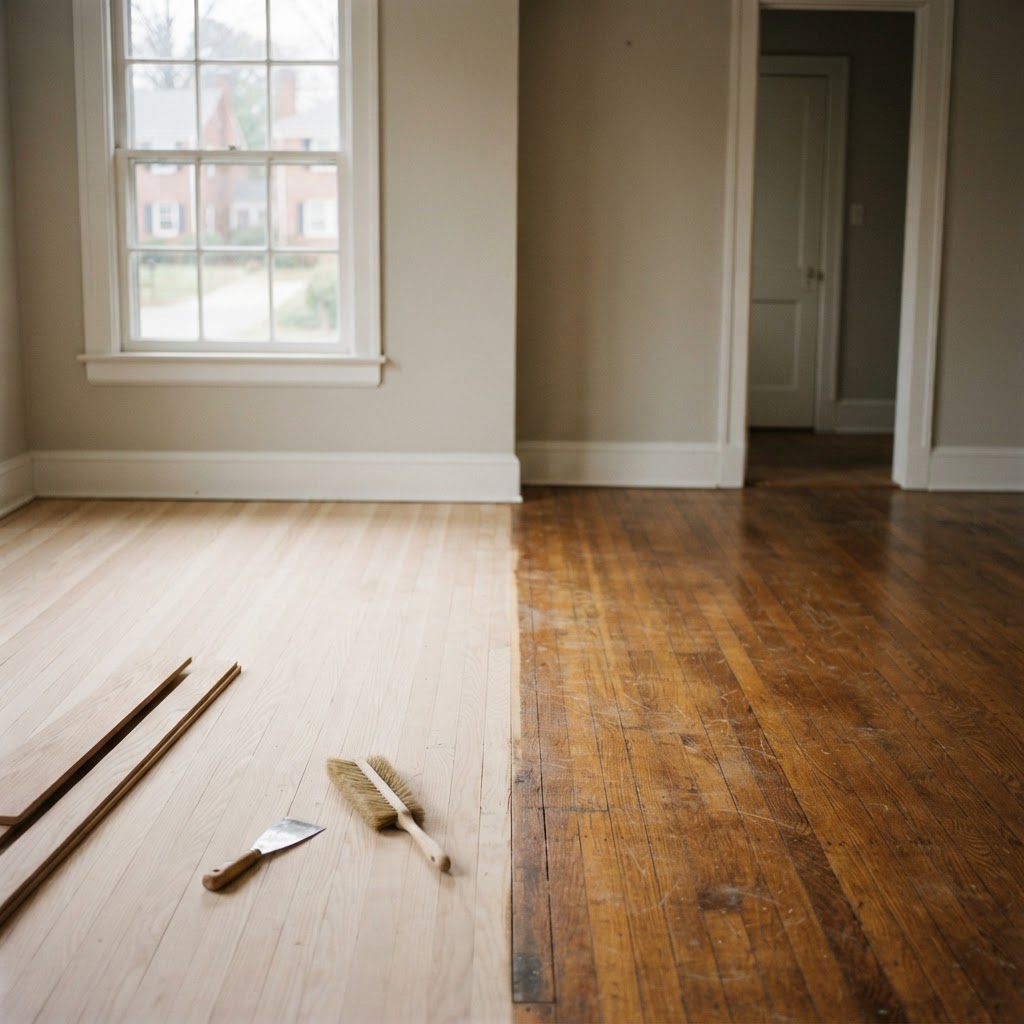
Floor restoration includes assessment, repairs, sanding, color and finish, and sometimes stairs and areas uncovered under carpet. It is broader than refinishing: refinishing renews the surface finish, while restoration brings a damaged or neglected floor back to good condition first and then finishes it.
Restoration in one paragraph
A contractor identifies the wood and how much thickness is left, corrects what is loose or broken, replaces boards that cannot be saved, fills and blends the repair areas, sands to bare wood, applies color if wanted, and finishes with two or three coats. Then the floor cures before furniture or rugs go back.
The steps, in order
1. Assessment. Species, board thickness, remaining wear layer, finish condition and damage are all recorded. This decides whether the job is a light renewal or a full restoration.
2. Protection. Furniture out, rugs up, adjoining rooms and fixtures masked, dust control connected. Baseboards may be removed and reinstalled so sanding reaches the wall.
3. Repairs. Loose boards fastened, high nails set, cracked or stained boards cut out and replaced, gaps and holes filled, thresholds rebuilt. Repairs come before sanding so the sanding pass blends them in.
4. Sanding. Coarse abrasives first, finer passes after, with hand tools at edges, corners and stairs. The aim is to remove only what must come off.
5. Color. Natural, or a stain to deepen the tone or match another floor. Different species take stain differently, so a sample is tested first.
6. Finish. Water-based or oil-based polyurethane, usually two or three coats with light abrasion between. Sheen from matte to semi-gloss.
7. Cure and care. Dry to the touch is not cured. Furniture and rugs wait longer than foot traffic, and a maintenance coat later extends the life of the finish.
Refinishing versus restoration
| Refinishing | Restoration | |
|---|---|---|
| Scope | Renews the finish | Repairs, then renews |
| Repairs included | Usually not | Yes |
| Typical use | Worn finish, sound wood | Damage, gaps, stains, neglect |
| Can skip sanding | Sometimes (screen and recoat) | Rarely |
A floor that only needs a fresh coat is a refinishing job. A floor with damage or a long history is a restoration job.
What restoration cannot fix
- A floor already sanded to its limit cannot be sanded again safely.
- Deep stains from water or pet accidents may still be visible.
- Old and new boards will not always match exactly, only blend closely.
- Subfloor movement and moisture sources have to be corrected at the cause.
When those limits are reached, partial replacement of the worst sections, or a new floor, is the honest answer.
Why older Arlington homes change the plan
Much of Arlington, Alexandria and Falls Church was built between the 1920s and the 1960s, and the original narrow strip oak in those houses has often been refinished several times already. That leaves less thickness for another full sanding, so an assessment of what remains above the nails or tongue matters more than the homeowner's wish list.
Older floors also bring surprises: patched areas, mismatched boards from earlier repairs, nails of several eras, wax build-up that changes how a new finish bonds, and gaps that open and close with the seasons. Condominiums and newer townhomes are a different case, sometimes engineered hardwood and often subject to association rules on work hours and noise.
How Floors and Beyond VA handles restoration
Family-owned since 1987, with its own employee crews, Floors and Beyond VA takes a refinish-first approach. Every project starts with an in-person evaluation of the wood, a plain-language explanation of what was found and a recommendation for the lightest process that will give a good result. The scope is written down, so it is clear whether stairs are included and what happens if a board cannot be saved.
If you are in Arlington and wondering about the floors in your home, see our floor restoration services in Arlington, VA.
Keep reading
The full walkthrough, including what to expect in older Northern Virginia homes, common myths and how to prepare for an assessment, is in What Does Floor Restoration Include? A Northern Virginia Homeowner's Guide.
Frequently asked questions
Does restoration always mean sanding?
No. If the wood is sound and only the finish has worn, a screen and recoat or a deep clean may be enough.
Is restoration cheaper than replacement?
Usually, when the existing wood still has thickness to give. Widespread water damage or rot can change that math.
Can stairs be included?
Yes, and they usually need more handwork. Confirm in writing that they are in scope.
How long does it take?
A single room may take a few days; a whole house with repairs and stairs takes longer, and drying time between coats cannot be rushed.
Schedule an in-home estimate at floorsandbeyondva.com/Contact or call (703) 906-5698.




