
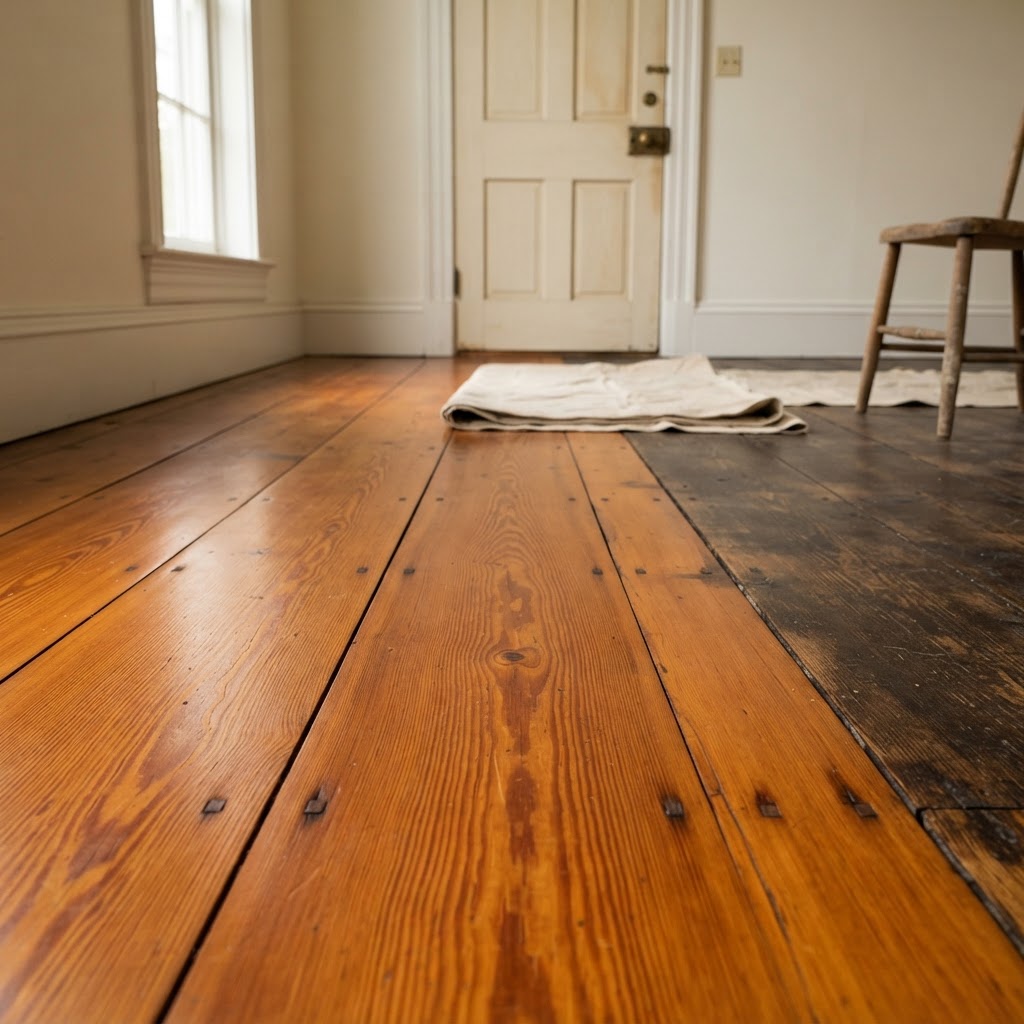
Some of the best floors in Northern Virginia are already in the house. Under worn varnish, old carpet and a century of footsteps, the boards in older homes in Alexandria, Arlington, Falls Church and Vienna are often old-growth heart pine, quartersawn oak or wide-plank hardwood that cannot be bought new at any reasonable scale today.
Antique floor restoration is the work of bringing those boards back without erasing what makes them special. It is different from ordinary refinishing because the boards are thinner from years of wear, the nails and gaps tell a story, and the finish under the surface may be shellac, wax or an early varnish. This guide explains what counts as an antique floor, how to judge whether yours can be saved, how a careful restoration works from first inspection to last coat, and what to ask before anyone sands a board.
At Floors and Beyond VA, our refinish-first approach comes from decades of working on exactly these floors. You can see the areas we serve on our floor restoration in Alexandria page.
What counts as an antique floor
There is no formal rule, but most people mean floors that are at least several decades old and often much older. In Northern Virginia that usually means homes built before the middle of the twentieth century. You may have narrow strip oak from the 1920s, heart pine from a rowhouse or farmhouse, or wide boards cut from timber that grew slowly for generations.
Old-growth wood is denser and more stable than much modern lumber because it grew with tight rings over many years. That density is why these floors have survived so long and why they respond so well to careful restoration. It also means they deserve a gentler plan than a quick sand and spray.
Why restoring beats replacing
When a floor is tired, replacement seems simple. In an older home, though, it often removes the best material in the house and replaces it with something thinner and newer. Restoring keeps the original boards, the character of the grain and the history in the wood. A restored floor in an older house adds a feel that new flooring struggles to copy. It also tends to be less disruptive, because the boards are already in place and the work is finished in the room.
Restoration is not always the right answer, but it should be the first option considered. Our guide to wood floor restoration in Northern Virginia explains how that decision is made.
First, know what you have
Every restoration starts with identification. The species matters because heart pine, oak, maple and others sand and take stain differently. The board width matters because wide boards move more with the seasons. The thickness of the wood above the tongue is critical, because a floor can be sanded only so many times before the nail heads or tongue are exposed. The age and type of the existing finish matters because it affects how the surface is prepared.
A good crew spends time on this inspection before they touch a sander, and they should be able to explain what they see in plain language.
Checking the wear layer of solid boards
Solid hardwood has a usable thickness above the tongue-and-groove joint. In an old floor that thickness may already be reduced by earlier sanding. A crew can check it at a floor vent opening, at a threshold or by looking at a removed board edge.
If there is plenty of wood left, a full sanding is possible. If the floor is thin, a lighter approach may be needed, such as a screen and recoat or a careful partial sanding. This is the main reason antique floors are not suited to a one-size-fits-all process. The answer depends on how much wood is left to work with.
Lead paint and older homes
Homes built before 1978 may contain lead-based paint, and older floors sometimes have paint on the boards or on adjacent trim. Federal rules require lead-safe work practices for many renovation activities in pre-1978 housing, and a reputable crew follows them. That can include containment, controlled cleanup and avoiding methods that spread dust.
If your home is older, ask any contractor how they handle lead safety. It is a sign of professionalism, and it protects your family, especially children and pregnant women. If paint is on the floor itself, the plan may need to change.
Contained sanding
Sanding an old floor creates fine dust, and in an older home that dust can travel into every room. Contained, dust-controlled sanding uses machines connected to vacuum systems that capture most of the dust at the source. Sealing off doorways and vents further limits what spreads.
For antique floors, containment is not only about cleanliness. It protects old plaster, woodwork and furniture, and it matters when lead may be present. Floors and Beyond VA uses a contained approach on restoration work, and it is one of the questions homeowners should ask any crew.
Repairing before refinishing
Antique floors usually need repairs before the finish. Boards may be loose, squeaky or cracked. There may be gaps where the wood has shrunk. Old patches may be uneven, or a section may have been replaced with different material.
A crew can re-secure loose boards, fill small cracks and replace damaged pieces with reclaimed boards from the same species when possible. Matching old wood is both craft and sourcing. The goal is repairs that blend in after refinishing, not ones that stand out as new. Our guide to creaky hardwood floor repair methods covers the techniques for securing boards.
Dealing with gaps
Gaps in old floors are normal. They open as boards dry over many decades. Some people want them filled, and others like the look as part of the floor's character. Narrow gaps can be filled with flexible filler or thin wood slivers, called dutchmen or splines. Wide gaps may be better left alone or filled with slivers cut to fit.
Filler can crack as the wood moves, so the choice depends on the width and the look you want. A good crew will show you options before filling anything.
Nail heads, face nails and old fasteners
Many antique floors were face-nailed with cut nails, and the heads are visible on the surface. In some homes that is part of the charm and the crew will leave them. In other cases heads need to be set below the surface so they do not tear sandpaper.
Old nails can be hard and brittle, and a crew should know how to set them without splitting boards. Rusted or protruding fasteners may need to be replaced. These details take time, and they are part of why antique floors benefit from experienced hands.
Deep stains, pet marks and water marks
Old floors carry history, and some of it shows as dark stains. Black marks from pet urine, rings from plant pots and water stains from old leaks may penetrate deeply. Sanding removes surface staining. Deeper stains may need bleaching, spot treatment or board replacement.
A restoration specialist can tell you which stains will come out and which may remain faintly after finishing. Setting realistic expectations is part of the job, and some marks are accepted as part of the character of an old floor. Our guide to repairing water-damaged hardwood explains when water marks can be removed.
Heart pine and other species
Heart pine is a favorite in older Northern Virginia homes because of its deep amber color and rich grain. It is also a softer species than oak, which means it dents more easily and can show sanding marks if it is rushed. It takes finish in a particular way and tends to darken with age and light. Our guide on restoring heart pine floors in pre-war Alexandria homes goes into the details.
Oak floors respond differently and generally take stain more evenly. Maple can blotch with some stains. The species is a major reason to hire a crew that has worked on antique floors before.
Sanding steps and grit choices
A careful sanding sequence removes old finish and levels the surface without cutting too deep. The crew starts with a coarser grit as needed to remove old coatings and flatten the floor, then moves through finer grits to smooth the wood. Skipping grits leaves scratches that show after finishing. Edges and corners are sanded with edgers and hand tools so they match the field.
In antique floors, restraint is important, because every pass takes wood. Experienced operators keep the machine moving and avoid dwelling in one place. If you want to see how that sequence plays out on a typical job, our guide to hardwood floor refinishing in Northern Virginia walks through it.
Choosing a color
Old floors often look best in natural tones that let the age of the wood show. Many homeowners choose a clear finish or a light tint that brings out the grain. Others want a darker stain for a traditional feel.
Samples on your own boards, in your own light, are essential, because old wood takes stain differently than new wood. Species, age and previous finishes all affect the result. Tell your crew whether you want a floor that looks new, aged or somewhere between. A good crew will test samples before committing.
Choosing a finish
Finish options include oil-modified polyurethane, water-based polyurethane and hardwax oils. Oil-modified finishes give an amber glow that suits old wood and heart pine. Water-based finishes dry clear and stay lighter. Hardwax oils create a natural, low-sheen look and are easy to spot repair.
Each has trade-offs in dry time, odor, durability and appearance. The right finish depends on the species, the look you want and how the room is used. Ask your crew to show finishes on a sample board and explain the maintenance of each.
Screen and recoat as a gentler option
If the existing finish is worn but the wood is in good shape, a screen and recoat may be enough. This process lightly abrades the surface and adds a fresh coat of finish without sanding to bare wood. It preserves the thickness of the boards and takes less time.
It is not a fix for deep scratches, stains or failed finish, but it can refresh a floor and extend the time before a full sanding is needed. For antique floors with limited wood left, it is a useful tool.
Patina and what to keep
Patina is the soft change in color and surface that wood develops over many years. It is part of what makes antique floors beautiful. Full sanding removes some of that surface layer and resets the look.
Some homeowners prefer to keep as much patina as possible and choose a gentler approach. Others want a clean slate. There is no wrong answer, but you should decide before work begins. Tell your crew what you love most about the floor, and they can adjust the plan.
Board replacement and reclaimed wood
When boards are too damaged to save, they can be replaced. Reclaimed boards from the same species and age blend best, because they have similar color and grain. Sources include salvage from other jobs, architectural salvage yards and recycled lumber suppliers. New boards of the same species can also be used and stained to blend.
Replacement is done carefully so the repair is hard to see. Our guide on parquet floor restoration covers a related set of repair skills for patterned floors.
Transitions and patterns
Old homes often have borders, inlays and parquet patterns that need special handling. Borders frame rooms and may use different species or grain direction. Inlays and medallions require careful sanding to avoid cutting through thin pieces. Transitions between rooms may have thresholds that have worn over time.
A restoration plan should include these details. A crew that has worked on patterned floors will know how to level them without damaging the design.
How long restoration takes
Most antique floor restorations take longer than a standard refinish because of repairs, careful sanding and extra drying time between coats. The schedule depends on the size of the area, the condition of the boards and the finish chosen.
Your crew should give you a clear timeline and explain when rooms can be walked on and when furniture can return. Planning around holidays or events helps. Rushing the finish is a common cause of problems, so allow the floor the time it needs.
Caring for a restored antique floor
After restoration, simple habits protect the floor. Use felt pads on furniture. Place mats at entrances. Clean with a product made for hardwood and avoid soaking the floor. Keep indoor humidity in a moderate range, which helps old boards stay stable through Northern Virginia's seasons. Trim pet nails and avoid dragging heavy items.
Over the years, a maintenance coat can renew the surface before it wears through. Our guide to the hardwood floor refinishing process in McLean explains how finishing steps work and how to plan future coats.
Talk to a specialist before anyone sands
An antique floor is not something to experiment on. Before you hire anyone, ask to see examples of similar work and ask how they decide between sanding and gentler options. Schedule an in-home estimate with Floors and Beyond VA and we will look at your boards in person, check how much wood remains and explain the plan in plain terms. We can also talk through lead safety, finish choices and how to keep the character of the floor.
Questions to ask any restoration craftsperson
How do you check how much wood is left above the tongue? How do you handle lead safety in an older home? What dust control do you use? How do you repair gaps and loose boards? Can you match replacement boards to the species and age of my floor? What finish do you recommend for this wood and why? Will you test color on my floor first? Who does the work, your own crew or subcontractors? The answers tell you how much experience and care to expect.
How Floors and Beyond VA approaches antique floors
Floors and Beyond VA is a family-owned flooring company, and our own crews do the work on every floor. We have been serving Northern Virginia homeowners since 1987, and our refinish-first philosophy means we try to save boards before we recommend replacing them. For antique floors, that means inspection, honest advice and contained sanding. We will tell you if a floor cannot be saved, and we will tell you when it can.
Common mistakes to avoid
Common mistakes include over-sanding a thin floor, using the wrong finish for the species, skipping repairs before finishing, hiring a crew without antique experience and rushing the drying time. Another mistake is covering an old floor with new flooring before checking what is underneath.
Many homeowners discover beautiful wood under old carpet or vinyl. Ask for an inspection before making a decision.
Frequently asked questions
Can antique hardwood floors be refinished? Often yes, if enough wood remains above the tongue and the boards are structurally sound. An inspection confirms this.
How do I know if my floor is old-growth wood? Tight, narrow growth rings, a deep color and wide boards are clues. A restoration specialist can identify the species and age.
Is restoration safe for homes built before 1978? It can be, with lead-safe practices. Ask any contractor how they manage dust and containment.
Can gaps between old boards be filled? Yes, with flexible filler or wood slivers, though many homeowners leave narrow gaps as part of the floor's character.
Is a screen and recoat enough for an old floor? It can refresh a floor with a worn finish and sound wood. It will not remove deep scratches or stains.
How long does antique floor restoration take? It usually takes longer than a standard refinish because of repairs and drying time. Your crew should give a schedule.
The short answer is also in our NoVA Guide: Can antique hardwood floors be restored?.
Ready to bring your old floors back?
If you have older floors in a Northern Virginia home and are wondering whether they can be saved, the best next step is an in-person look. Floors and Beyond VA is a family-owned flooring company serving Fairfax, Loudoun, Prince William and Arlington counties since 1987. Schedule an in-home estimate at floorsandbeyondva.com/Contact or call (703) 906-5698.




