
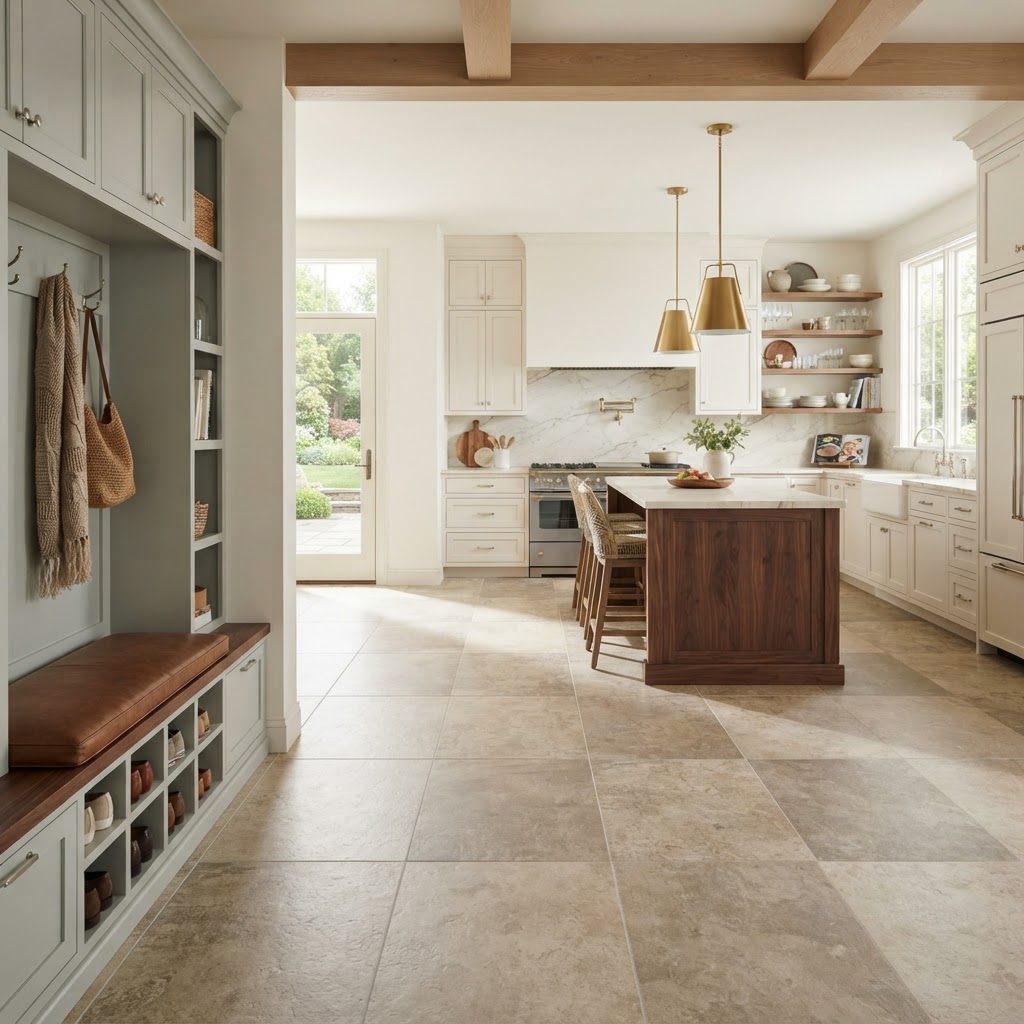
For most McLean kitchens, bathrooms and entryways, porcelain tile is the best all-around choice. It is dense, very low in water absorption, hard-wearing and available in an enormous range of looks, from natural stone and wood to concrete and handmade-style patterns. Ceramic tile is a good option for walls and lighter-duty floors, and natural stone can be stunning where the homeowner is willing to seal and maintain it. The best tile for any particular room depends on slip resistance, size and layout, grout choice, subfloor preparation and the way the space is used. Floors and Beyond VA, a family-owned Northern Virginia flooring and remodeling contractor serving Fairfax, Loudoun, Prince William and Arlington counties since 1987, installs tile with in-house crews and no subcontractors, and we treat preparation and layout as seriously as the tile itself.
McLean homeowners often choose tile for the rooms where moisture, mess and heavy use meet. A kitchen floor takes spills and dropped pans. A bathroom floor takes steam and standing water. An entryway takes rain, snow melt, road salt and dirt carried in from the driveway. In a region with humid summers and winters that bring wet boots and de-icing salt, tile is a practical and long-lasting answer. This guide explains the differences between porcelain, ceramic and natural stone, how to think about slip resistance, how grout affects both appearance and maintenance, and what makes a tile installation last. Our tile and stone page describes the services we offer, and our guides to kitchen remodeling and bathroom remodeling cover the larger projects tile often belongs to.
Porcelain versus ceramic: what is the real difference?
The terms are often used loosely, but the distinction is meaningful.
Ceramic tile is made from clay, shaped and fired at high temperatures, and usually glazed on the surface. It is relatively easy to cut and install, available in many styles and well suited to walls, backsplashes and moderate-traffic floors. Ceramic is generally a little softer and more porous than porcelain, which means that if the glaze is chipped, the body beneath may show a different color, and in wet or freezing conditions it can be less forgiving.
Porcelain tile is made from finer clay and fired at higher temperatures, which produces a denser, harder and less porous tile. Porcelain absorbs very little water, which makes it a leading choice for bathrooms, kitchens, entryways, basements and even covered outdoor spaces. Many porcelain tiles are "through-body," meaning the color runs through the entire tile, so chips are far less noticeable. Porcelain is also highly resistant to staining and scratching, and it handles heavy traffic exceptionally well.
The tradeoff is that porcelain is harder to cut and drill, which requires proper tools and experience, and it is often heavier. For floors that must perform in demanding conditions, those tradeoffs are usually worth it.
Natural stone such as marble, travertine, slate, limestone and granite offers unmistakable beauty and variation, but it behaves differently from manufactured tile. Most stone is more porous and needs sealing. Some stones etch when exposed to acids such as those in citrus, wine or certain cleaners. Others vary in hardness. Stone can be a superb choice in the right setting, and our tile and stone services include it, but it asks more of the homeowner in maintenance.
Understanding slip resistance
Slip resistance is one of the most important and most overlooked tile qualities, especially in bathrooms and entryways where water is present.
Tile surfaces vary from highly polished to textured. A glossy, polished tile can be elegant but slippery when wet. A matte, honed or textured surface provides more traction. Manufacturers often provide a coefficient of friction rating that indicates how much grip a tile offers, and appropriate ratings differ between dry interiors, wet interiors and exterior locations. Rather than relying on a single number, think about how the space is used.
Entryways benefit from textured, matte surfaces that grip wet shoes. Rain, snow and slush make entry floors among the most slip-prone in the house, so a slightly textured porcelain is a smart choice.
Bathrooms call for more traction, especially in showers and around tubs. Smaller tiles have more grout lines, which add grip, and mosaics are commonly used on shower floors for this reason. Larger-format tiles with a textured finish can also work on bathroom floors.
Kitchens can use a wide range of finishes, but a softly matte or lightly textured surface is more forgiving of spills.
Slip resistance also matters for aging in place. Homeowners planning for long-term comfort and safety should consider surfaces with reliable traction. Our accessibility services address design choices that support safe, comfortable living.
Size, shape and layout
Tile size and layout shape both the look and the performance of the floor.
Large-format tile, with sides of twenty-four inches or more, creates a clean, contemporary look with fewer grout lines. It makes rooms feel larger and is easier to keep clean because there is less grout. However, large tiles demand a very flat subfloor, because any unevenness can cause lippage, where one tile edge sits higher than its neighbor. They also require careful setting techniques to ensure full support and adhesion.
Standard-format tile, around twelve by twenty-four inches or twelve by twelve inches, is versatile and forgiving, and it remains the workhorse of residential tile.
Small-format tile and mosaics add pattern, texture and traction. They conform to slopes, which is why they are used on shower floors, but they involve more grout and more labor.
Plank-style tile mimics hardwood in porcelain form, long and narrow, and is popular in kitchens, baths and mudrooms where homeowners want the look of wood with the durability of tile. Its long length makes substrate flatness especially important, and the layout must avoid unattractive repetition.
Patterns such as herringbone, chevron, basketweave, offset and diagonal each create a different effect. Diagonal layouts, for example, can make a small room feel bigger and hide irregular walls, but they involve more cutting and waste.
Good layout planning begins with deciding where the tile pattern starts, so that cuts at doorways, walls and focal points look balanced. A skilled installer will dry-lay or carefully plan the pattern, centering it on the room or on a key feature, and avoiding slivers of tile at visible edges.
Grout: the small detail that makes a big difference
Grout fills the joints between tiles, and it affects appearance, cleanliness and longevity more than most homeowners expect.
Cement-based grout is the traditional choice. It comes in sanded and unsanded varieties, with sanded grout used for wider joints and unsanded for narrow ones. Cement grout is porous and typically needs to be sealed to resist staining. It is available in a wide range of colors.
Epoxy grout is highly stain resistant, water resistant and durable. It does not require sealing and is a strong option for showers, kitchens and busy entryways. It can be more demanding to install, because it sets quickly and requires skill.
Grout color matters. A grout that matches the tile creates a seamless, continuous look. A contrasting grout emphasizes the pattern and shape. Lighter grout shows dirt more readily in high-traffic areas. Darker or mid-tone grout hides wear in kitchens and entryways. In bathrooms, a color that resists visible mildew staining can reduce upkeep.
Joint width also matters. Narrow joints look sleek but demand perfectly consistent tile and precise installation. Wider joints are more forgiving and suit rustic or handmade-style tile. Rectified tile, which is cut to precise dimensions, allows very narrow joints.
Movement joints are another often-overlooked detail. Large tiled areas need flexible joints filled with sealant, not grout, at perimeters and at intervals, to accommodate expansion and contraction. Skipping them is a common cause of cracked tile and grout.
Durability and hardness
Tile is among the most durable flooring options, but durability varies.
Porcelain rates very high for wear resistance, scratch resistance and stain resistance, which makes it appropriate for the busiest rooms in the house. Glazed ceramic suits lighter-traffic areas. Natural stone ranges widely: granite is hard, while marble and limestone are softer and show wear.
Tile does have limits. It is hard, so dropped dishes will probably break, and it feels cold and firm underfoot. Radiant floor heating pairs well with tile and removes the cold, and tile is a good conductor of that warmth. Area rugs and anti-fatigue mats in the kitchen add comfort where you stand for long periods.
Impact can chip or crack tile, and heavy point loads can crack a tile if the substrate is not solid. A well-installed tile floor with a properly prepared substrate resists these problems.
Subfloor preparation: the foundation of a tile floor
If there is one factor that determines whether a tile floor succeeds, it is what lies beneath it.
Flatness. Tile does not bend. Dips and humps in the subfloor lead to lippage, hollow spots and cracks. Floors must be flat within tight tolerances, particularly for large-format tile. Leveling compounds and corrective work are common.
Stiffness. Tile requires a rigid substrate. Floor framing that flexes too much can crack tile and grout. In older McLean homes with original joists and thin subfloors, installers may need to add reinforcement or an appropriate underlayment such as cement backer board or an uncoupling membrane.
Moisture and waterproofing. In wet areas, a waterproofing membrane protects the structure beneath the tile. Showers and tub surrounds require careful waterproofing. Tile and grout are not waterproof by themselves, and water can pass through grout lines.
Underlayment. Cement backer board, uncoupling membranes and similar products provide a stable, bondable surface and help prevent cracking. The right choice depends on the subfloor and the room.
Adhesive (thinset). Proper thinset, spread with the correct trowel to achieve full coverage, bonds the tile to the substrate. Large tiles typically require more attention to coverage and technique.
Cure time. Thinset, grout and sealers need time to cure before heavy use. Rushing leads to problems.
Our flooring installation guide describes the installation process, and our article on whether flooring can be put over tile covers a question that often arises when updating an older tiled room.
Choosing tile room by room
Kitchens
A kitchen floor must handle spills, dropped items, foot traffic and, often, years of standing. Porcelain is the most common choice because of its durability and stain resistance. Choose a finish with some texture for traction, and consider grout that resists staining, such as epoxy or well-sealed cement grout. Large-format tile creates an open, uninterrupted look, while wood-look porcelain brings warmth. If the kitchen opens to a hardwood living area, matching tones can ease the transition. Our article on kitchen versus living room flooring in Northern Virginia explores this question. When the kitchen is part of a bigger renovation, our kitchen remodeling services coordinate flooring with cabinets and counters.
Bathrooms
Bathrooms combine moisture, steam and bare feet. Porcelain with a matte or textured finish offers safe traction. Small mosaics on shower floors improve grip and conform to slopes. Waterproofing is essential. Radiant heat under bathroom tile is a comfortable upgrade. Consider the slip resistance of tile in showers, and think about grout color to manage mildew. For powder rooms, decorative tile makes a bold statement in a small space. Our bathroom remodeling page and our guide to bathroom remodeling ideas in Northern Virginia provide additional ideas, and for primary baths, see our primary suite remodeling services.
Entryways and mudrooms
Entryways take the worst of the weather. Porcelain with a textured, slip-resistant finish handles water, salt and dirt. Darker or patterned tile hides footprints and grime. A recessed boot tray or integrated walk-off area helps contain mess. Mudrooms, which often adjoin garages and laundry rooms, benefit from the same approach. In larger McLean homes with grand foyers, tile can also set an elegant tone, and natural stone or large-format porcelain can create a striking first impression. Our laundry room remodeling page covers related spaces.
Other spaces
Tile also suits sunrooms, covered porches, outdoor kitchens and patios when the material is rated for the conditions. Our outdoor flooring and patios and decks pages describe options for exterior and transitional spaces. Garages can use tile or other durable surfaces, covered on our garage flooring page.
Maintenance: keeping tile looking its best
Tile is easy to maintain with a few good habits. Sweep or vacuum regularly to remove grit. Mop with a pH-neutral cleaner suited to the tile. Avoid harsh acids or abrasive pads on natural stone and polished surfaces. Seal natural stone and cement grout as recommended, and reseal as needed. Wipe spills promptly, especially on stone and unsealed grout. Use mats at entries to cut down on dirt and moisture. Clean grout periodically with appropriate products to prevent buildup and mildew.
Epoxy grout and well-sealed porcelain reduce maintenance significantly. Our floor care page offers further guidance.
Tile in older McLean homes
Many McLean homes were built decades ago, and their floors and framing reflect the standards of their time. Replacing old tile or adding new tile in an older home often reveals surprises. Original mortar beds can be thick and heavy. Subfloors may be uneven or thin. Old tile, adhesive or underlayment materials in some older homes may contain materials that require careful testing and handling before removal, and a responsible contractor will raise this before disturbing them. Floors may need leveling or reinforcement to carry tile properly.
These issues are manageable with the right preparation and experience. A thorough in-home evaluation before the project begins helps identify what will be needed, so the plan and estimate reflect reality.
What affects the scope of a tile project
We do not publish prices in articles, but several factors shape the scope of a tile installation. The tile type and size matter, along with pattern complexity. Square footage and room shape affect quantities and cuts. Subfloor condition determines how much leveling, reinforcement or underlayment is needed. Waterproofing requirements in wet areas add steps. Demolition of existing flooring is often a significant part of the work. Grout type, trim pieces, transitions and thresholds add detail. Radiant heat adds installation steps. Furniture and fixture handling, such as removing toilets and vanities, affects logistics. And cure time influences scheduling.
Floors and Beyond VA provides an honest, all-inclusive estimate, and what we quote is what you pay. Our estimates include old flooring removal, new materials, professional installation, furniture moving, transitions, molding and full cleanup.
Common mistakes to avoid with tile
The first mistake is choosing tile for looks without checking slip resistance. A beautiful glossy floor can be dangerous when wet.
The second is ignoring subfloor flatness and stiffness. Tile fails when the foundation moves.
The third is skipping waterproofing in wet areas. Grout is not a waterproof barrier.
The fourth is choosing very narrow grout joints with tile that is not rectified. The result looks uneven.
The fifth is omitting movement joints. Large floors need room to expand and contract.
The sixth is using the wrong grout for the room. Light cement grout in a busy entry may stain quickly.
The seventh is forgetting about transitions to adjacent flooring. Height differences should be planned.
The eighth is walking on or using the floor before it cures. Patience protects the installation.
The ninth is hiring an installer without tile experience. Tile work is a specialized craft.
Frequently asked questions
What is the best tile for a kitchen floor?
Porcelain is the most common choice because it is durable, dense and stain resistant. Choose a finish with some texture for traction.
What is the best tile for a bathroom floor?
Porcelain with a matte or textured finish. Mosaics are popular for shower floors because of grip and slope conformity.
What is the best tile for an entryway?
Slip-resistant, textured porcelain that handles water, salt and dirt.
Is porcelain better than ceramic?
For floors in demanding rooms, usually yes. Porcelain is denser and more water resistant.
Is tile slippery?
It can be, especially polished tile when wet. Choose slip-resistant finishes in wet areas.
Do I need to seal tile?
Porcelain generally does not. Natural stone and cement grout usually do.
What is epoxy grout?
A highly stain- and water-resistant grout that does not need sealing, ideal for showers and busy areas.
Can tile go over radiant heat?
Yes. Tile conducts heat well and is a popular pairing.
Can new flooring go over existing tile?
Sometimes, depending on its condition and the new product.
Does Floors and Beyond VA use subcontractors?
No. Our in-house crews handle every project, and we are fully licensed, bonded and insured.
Do you serve McLean?
Yes, including Langley, Chesterbrook, Franklin Park, Salona Village, Hamilton, Dunn Loring, Vienna, Great Falls and Tysons, along with Fairfax, Loudoun, Prince William and Arlington counties.
Ready to choose tile for your McLean home?
A great tile floor is the result of good material, thoughtful layout and careful preparation. Floors and Beyond VA brings nearly forty years of Northern Virginia experience, in-house crews with no subcontractors and an honest all-inclusive estimate to every tile project.
Request your free tile flooring consultation: https://floorsandbeyondva.com/Contact
You can also call (703) 906-5698, or send us a message through our contact page.




