
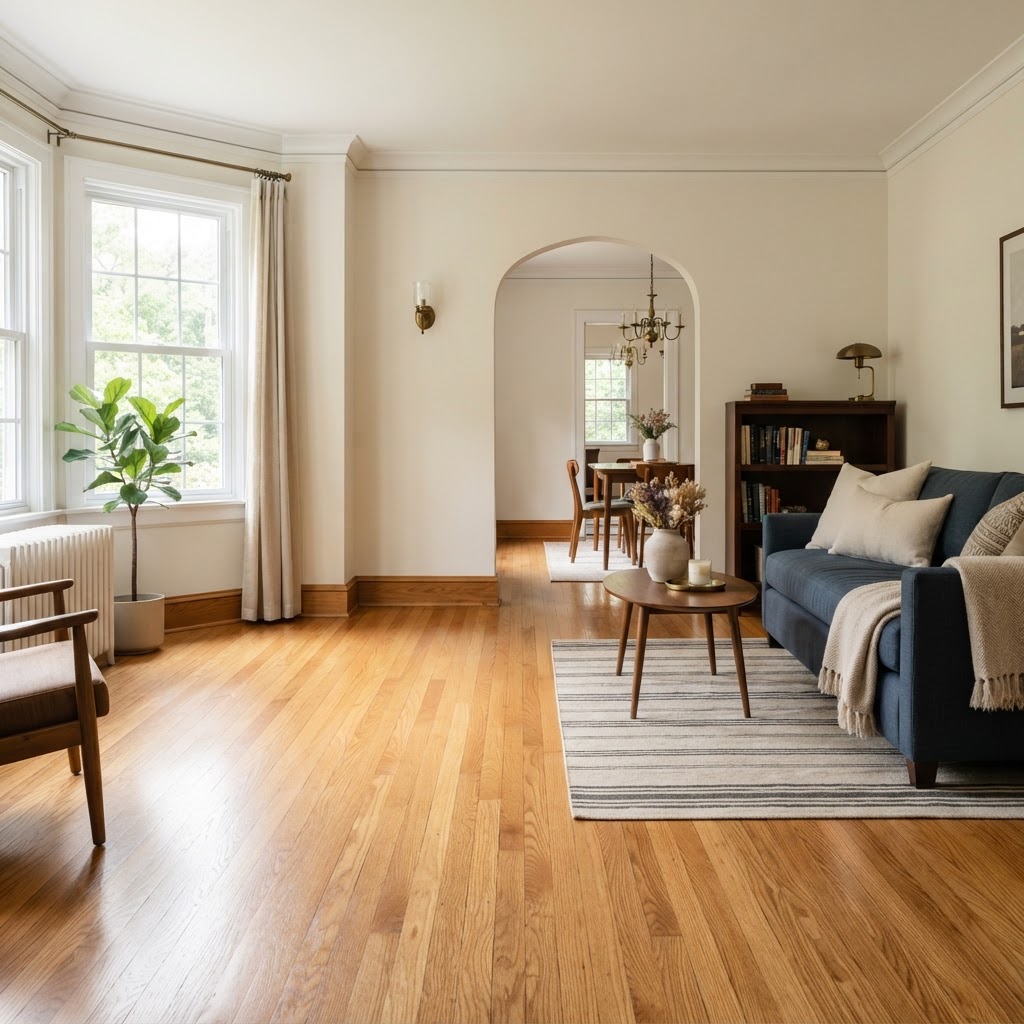
Can original hardwood floors be saved in older Arlington, VA homes?
In most older Arlington homes, yes: original hardwood floors can usually be saved, restored and refinished, provided the boards are structurally sound, enough wood remains above the tongue and groove to be sanded, and any damage from water, pests, fasteners or past repairs is limited and repairable. The floors in Arlington's early-to-mid twentieth-century bungalows, Cape Cods, colonials and garden-style apartments and condominiums were typically built from thick, tight-grained oak that is often in better condition than newer flooring. Restoration is a process of identifying what you have, evaluating wear and damage, repairing or replacing individual boards with matched wood, sanding and refinishing, and deciding honestly whether the floor is a candidate or whether replacement is the better path. Floors and Beyond VA, a family-owned Northern Virginia flooring and remodeling contractor serving Fairfax, Loudoun, Prince William and Arlington counties since 1987, follows a refinish-first philosophy, which means we begin every Arlington consultation by asking whether the floors you already have can be saved.
Arlington is one of the oldest and most architecturally varied communities in Northern Virginia. Neighborhoods such as Lyon Park, Lyon Village, Cherrydale, Westover, Ashton Heights, Maywood, Waverly Hills, Arlington Ridge, Aurora Highlands and Nauck contain houses built across several decades of the early and middle twentieth century, many with original hardwood still beneath carpet, paint, worn finish or decades of accumulated layers. The Fairlington area and many older garden-style buildings along the Columbia Pike corridor, in Clarendon, Courthouse, Ballston and Shirlington also contain original wood flooring in units that have changed hands many times. For owners of these homes, the question "can my floors be saved?" matters, because original flooring is thick, dense and irreplaceable in character. This guide is distinct from a general refinishing overview. It focuses on original floors: how to identify them, how to read their condition, how matching works when boards must be replaced and how to decide between restoration and replacement. For related reading, see our articles on whether your hardwood floors can be saved, whether refinishing is worth it and our hardwood floor refinishing field guide.
Why original floors are worth the effort
Original hardwood has qualities that are difficult and expensive to replicate. Much of the oak used in older Arlington homes came from mature, slow-grown trees, producing dense wood with tight growth rings. The boards are often thick, with a generous wear layer above the tongue and groove that can be sanded multiple times. They were typically laid by hand, nailed to substantial subfloors and have had decades to stabilize. Many are strip flooring in narrow widths, which gives rooms their characteristic fine, linear look.
Original floors also contribute to a home's character and, for many buyers, its value. Hardwood in an older house signals authenticity and care, and a restored floor can be the centerpiece of a renovation. Beyond aesthetics, restoring rather than replacing keeps good material in service and avoids the waste and disruption of demolition, which is the heart of our refinish-first philosophy.
That said, not every old floor can be saved, and an honest evaluation matters. The point of a careful assessment is to identify which category your floors fall into before money is spent.
Step one: identify what you have
Confirming that the floor is original hardwood
In older Arlington homes, hardwood is frequently hidden. It may be under wall-to-wall carpet, vinyl, linoleum, painted finishes, layers of underlayment or newer laminate. Signs that original hardwood lies beneath include tack-strip holes along the edges, floor vents that reveal boards at the cut, thresholds and closets where the hardwood stops or continues and areas near radiators or baseboards where old flooring is exposed. Lifting a corner of carpet at a closet or doorway often reveals the boards.
Identifying the species
Most original floors in Arlington homes are oak, often red oak, with some white oak. Other species appear in some homes: maple, pine, fir, heart pine, beech or ash. Species matters for hardness, grain, stain behavior and how well new boards will match. Identification relies on examining grain pattern, the visible pores, color and end grain. Red oak has a warm, pinkish undertone with open, porous grain. White oak is more neutral with a tighter grain and distinctive ray flecks in quarter-sawn boards. Pine and fir are softer, with a different grain pattern and a tendency to dent. Professionals often take a close look at a hidden spot, such as the inside of a closet, where the wood is less altered by age and finish.
Understanding board dimensions and installation
Original strip flooring is typically narrow, with tongue-and-groove edges, laid over a plank or plywood subfloor and nailed through the tongue. Some floors are parquet or have decorative borders. Knowing the width and thickness helps determine how much wood is left to sand and how to match replacement boards. Many original floors are three-quarters of an inch thick, though older flooring varies. Thickness above the tongue and groove, not the nominal thickness, determines how many times it can be refinished.
Step two: check wear and damage
A thorough evaluation looks at several kinds of condition.
Surface wear
Worn finish, dull paths, gray traffic lanes and shallow scratches are the classic reasons to refinish, and they are usually fixable. If the finish is worn through to bare wood, sanding is likely needed. Finish buildup, such as wax, multiple coats of varnish or paint, may require thorough stripping.
Stains and discoloration
Dark stains, especially black rings around the stain, often indicate water or pet damage that has penetrated the wood and reacted with tannins. Some lighten with sanding, while deeper stains may remain and require board replacement. Sun fading and uneven coloration from rugs and furniture can usually be evened out through sanding and staining.
Gaps
Gaps between boards occur with seasonal humidity swings and as wood ages. Narrow gaps are normal. Wide, persistent gaps may reflect dryness, shrinkage or movement. Gaps can sometimes be filled, but filling must be done carefully so that seasonal movement does not crack the filler.
Cupping, crowning and buckling
Cupped boards, with raised edges, and crowned boards, with raised centers, signal moisture imbalance. If the source of moisture, such as a damp crawl space, a leak or high humidity, has been corrected and the wood has stabilized, mild cupping may be sanded flat. Severe cupping or buckling may require replacement of affected boards. Arlington's older homes often have crawl spaces whose moisture conditions affect floors above, so inspection of the crawl space is part of a thorough assessment.
Loose, squeaky or soft areas
Loose boards and squeaks often come from nails that have loosened over time or from subfloor movement. Soft or spongy areas can indicate rot or deterioration in the subfloor. These matter because refinishing does not fix structural problems.
Pet stains and odors
Old pet accidents can penetrate wood and subfloor. Odor may persist even after refinishing if the source is not removed. Professionals check for odor and stain depth and may recommend replacing affected boards.
Previous repairs and patches
Patches of different wood, filled holes where plumbing or wiring once passed and mismatched sections from earlier renovations are common in older homes. They can often be blended but may require thoughtful matching.
Nail holes and tack-strip damage
Floors that were carpeted for decades often have rows of tack-strip nail holes along the edges and staple holes across the field. These can be filled and sanded, and they are usually cosmetic.
Remaining wood thickness
A floor that has been sanded repeatedly may have little wood left above the nails. Sanding such a floor risks exposing nail heads and weakening the tongue. A professional can estimate remaining thickness by examining an edge at a floor vent or threshold, or at a cut made for a repair.
Hazardous materials
In very old homes, finishes and adhesives may contain lead or other hazardous substances, and some historic mastics beneath later flooring may contain asbestos. A responsible contractor raises testing and safe-handling questions before sanding or disturbing old materials, particularly in homes built before modern regulations. Homeowners should follow current guidance from appropriate authorities.
Step three: matching replacement boards
When boards are too damaged to restore, they must be replaced, and the quality of the match determines how invisible the repair will be.
Species and grade. Replacement boards should be the same species and, as far as possible, a similar grade and cut. Red oak and white oak differ in color and grain, and they stain differently.
Width and thickness. Narrow strip widths are less common in modern flooring catalogs, but they can be sourced or milled. Thickness must align to avoid steps. Thin or thick replacements may require shimming or subfloor adjustments.
Reclaimed boards. Salvaged boards taken from inconspicuous areas, such as a closet, or from other sources can provide an excellent match because they share the age and history of the original wood. Boards from a closet can be swapped for damaged boards in the main room, with new boards placed in the closet where they are less visible.
Weaving and blending. Skilled repair involves cutting out damaged boards and weaving in replacements so that end joints stagger naturally, just as in the original installation. Poorly executed repairs show as rectangular patches.
Aging and color. Old wood has darkened and developed patina. New wood will look lighter and different until sanded and finished together. The best matching strategy is to sand the repaired area and the surrounding floor together, then apply a uniform stain and finish, so that old and new boards share one surface.
Our wood flooring page describes our repair and refinishing services.
Step four: deciding between restoration and replacement
After the evaluation, the decision becomes clearer. Consider the following in narrative form.
Restore when the floor is structurally sound, mostly intact and has enough wood to be sanded, even if it looks tired, scratched, faded or stained on the surface. Restoration is also the answer when damage is localized and can be repaired by replacing individual boards.
Repair and restore when parts of the floor are damaged by water, pets or past renovations, but surrounding areas are good. Replace the damaged sections with matched wood and refinish the entire floor together.
Replace when the floor has been sanded too many times to be sanded again, when widespread moisture damage has caused cupping, buckling, rot or mold, when the subfloor is compromised or when the wood is extensively damaged by pests. Replacement may also be the right choice when you want a different board width, species or look that restoration cannot deliver.
Cover or alternative approaches are options in limited situations. If a floor is badly damaged but you wish to keep some character, a different approach, such as installing new flooring over a prepared surface, may be possible, though it adds height and changes transitions.
An honest contractor will not push you toward replacement because it is a larger job. Our articles on flooring damage repair for water, scratches and buckling in Northern Virginia and flooring replacement: when and what to choose explain these paths in more detail.
Illustrative restoration scenarios
The following scenarios are representative examples of the kinds of situations we see in older Arlington homes. They are illustrations to help you recognize your own situation, and they are not accounts of particular customers.
The carpeted bungalow. A home in a neighborhood such as Lyon Park or Cherrydale has wall-to-wall carpet throughout the living areas and bedrooms. Lifting a corner in a closet reveals narrow oak strip flooring with tack-strip holes along the edges and light staining near a window where a plant leaked. The wood is thick and tight, and the damage is limited. The plan is to remove carpet and pad, remove tack strips and staples, replace a few stained boards with matched oak taken from a closet, then sand the entire floor and apply a natural-looking finish. The result is a unified oak floor that looks as though it has always been there.
The tired colonial. A house in Maywood or Waverly Hills has original oak floors with a dark, worn, amber finish and gray traffic paths. The boards are structurally sound, with minimal gaps. The plan is a full sanding and refinishing with a lighter, more natural stain and a satin finish. The home feels brighter and more current, and the floors are preserved.
The water-damaged kitchen edge. A kitchen in an older Arlington home has dark, cupped boards near the dishwasher where a slow leak occurred years ago. The leak has been repaired and the area is dry. The plan is to cut out the damaged section, inspect and repair the subfloor, weave in matched boards and refinish the entire kitchen floor so that the repair blends. In a related scenario, if the damage is extensive, replacement of the whole kitchen floor may be advised.
The over-sanded floor. A home has been refinished several times over the decades, and nail heads are close to the surface. Further aggressive sanding risks exposing nails and weakening the floor. The honest advice is a light screen and recoat if the finish allows it, or replacement if the floor is too thin to sand safely.
Your floor may fall into one of these categories, or into a different one entirely. The only way to know is to look.
Arlington condos and apartments with original wood
Many older Arlington condominiums and garden-style buildings, including those in Fairlington, along Columbia Pike and in the Clarendon, Courthouse, Ballston and Shirlington corridors, have original hardwood in individual units. Restoration in these buildings follows the same principles, with additional considerations: association approval, work hours, delivery and elevator rules, dust and odor control in shared buildings and neighbors' sensitivity to noise. Finish choices may also be influenced by odor and cure time. Our condominium remodeling page describes how we work within building requirements, and our articles on condo remodeling rules and permits and flooring in condo remodels discuss the topic further.
Preserving historic character
For homes with historic significance or particular architectural integrity, restoration should respect the original design. That may include maintaining narrow board widths, original borders and inlays, historically appropriate finishes and traditional repair techniques. Our historic home restoration services are designed for these properties, and our team approaches such work with respect for what has lasted.
Coordinating restoration with renovation
Restoration is often part of a larger renovation. If you are opening walls, updating a kitchen or bathroom or adding space, plan the sequence so that the floor is protected and refinished at the right time. Heavy work that could damage a finished floor should be completed before final sanding and finish. When walls are removed, floors may need to be extended or blended, and old and new boards should be refinished together. Our kitchen remodeling, bathroom remodeling, home additions and whole house remodels services allow us to coordinate flooring with the rest of the project.
What drives the scope of a restoration project
We do not publish prices in articles, but the factors that shape any estimate are clear. The condition of the floor, including surface wear, stains and damage. Square footage and the number of rooms. Removal of carpet, pad, tack strips and staples. Repairs and the number of boards to be replaced. Matching requirements. Number of finish coats and the finish system. Stain color changes. Stairs. Furniture moving. Dust control. And the company, including its crews, licensing, bonding and insurance.
At Floors and Beyond VA, we provide an honest, all-inclusive estimate, and what we quote is what you pay. Our estimates include old flooring removal, new materials, professional installation, furniture moving, transitions, molding and full cleanup. Our article on flooring cost factors in Northern Virginia explains why estimates differ.
Common mistakes when restoring original floors
The first mistake is assuming old floors must be replaced without a professional evaluation.
The second is sanding aggressively without checking remaining wood thickness.
The third is covering structural problems with finish instead of fixing them.
The fourth is ignoring moisture sources, such as a damp crawl space, before refinishing.
The fifth is patching with mismatched boards and then wondering why repairs show.
The sixth is staining a floor without testing on your actual wood.
The seventh is skipping testing for hazardous materials in very old homes where it is appropriate.
The eighth is underestimating cure time and returning furniture too soon.
The ninth is choosing a contractor who treats every floor the same.
The tenth is overlooking transitions and adjoining rooms that affect the final appearance.
Frequently asked questions
How do I know if my Arlington home has original hardwood under the carpet? Check closets, thresholds and floor vents, or lift a corner of carpet. Tack-strip holes along the edges are another clue.
Can very old hardwood still be refinished? Often, yes. Thick, dense original floors can be sanded multiple times unless they have already been heavily sanded.
Can you match missing or damaged boards? Usually, with careful species and width matching, salvaged boards from closets and a refinish of the whole area.
Will refinishing remove deep stains? Many stains sand out. Deep stains may remain and require board replacement.
What if my floor has gaps? Normal seasonal gaps are common. Large, persistent gaps are evaluated individually.
Is restoration better than replacement? Often, when the floor is sound. Replacement is the better path when damage or thinness makes restoration unsafe or unsatisfactory.
Is Floors and Beyond VA licensed and insured? Yes. We are fully licensed, bonded and insured for every project, and our in-house crews work with no subcontractors.
Do you serve my Arlington neighborhood? Yes, including Clarendon, Courthouse, Ballston, Rosslyn, Shirlington, Lyon Park, Lyon Village, Cherrydale, Westover, Ashton Heights, Maywood, Waverly Hills, Arlington Ridge, Aurora Highlands, Fairlington, Columbia Pike and Nauck, along with Fairfax, Loudoun and Prince William counties.
Ready to find out whether your original floors can be saved?
The answer is found by looking closely at the wood. Floors and Beyond VA brings nearly forty years of Northern Virginia experience, in-house crews with no subcontractors, a refinish-first philosophy and a free in-home consultation with samples and precise laser measurements at no charge.
Request your free Arlington flooring estimate: Contact Floors and Beyond VA
You can also call (703) 906-5698.
If your home's original floors are in question, our flooring company in Arlington, VA can assess whether restoration will save them.




