
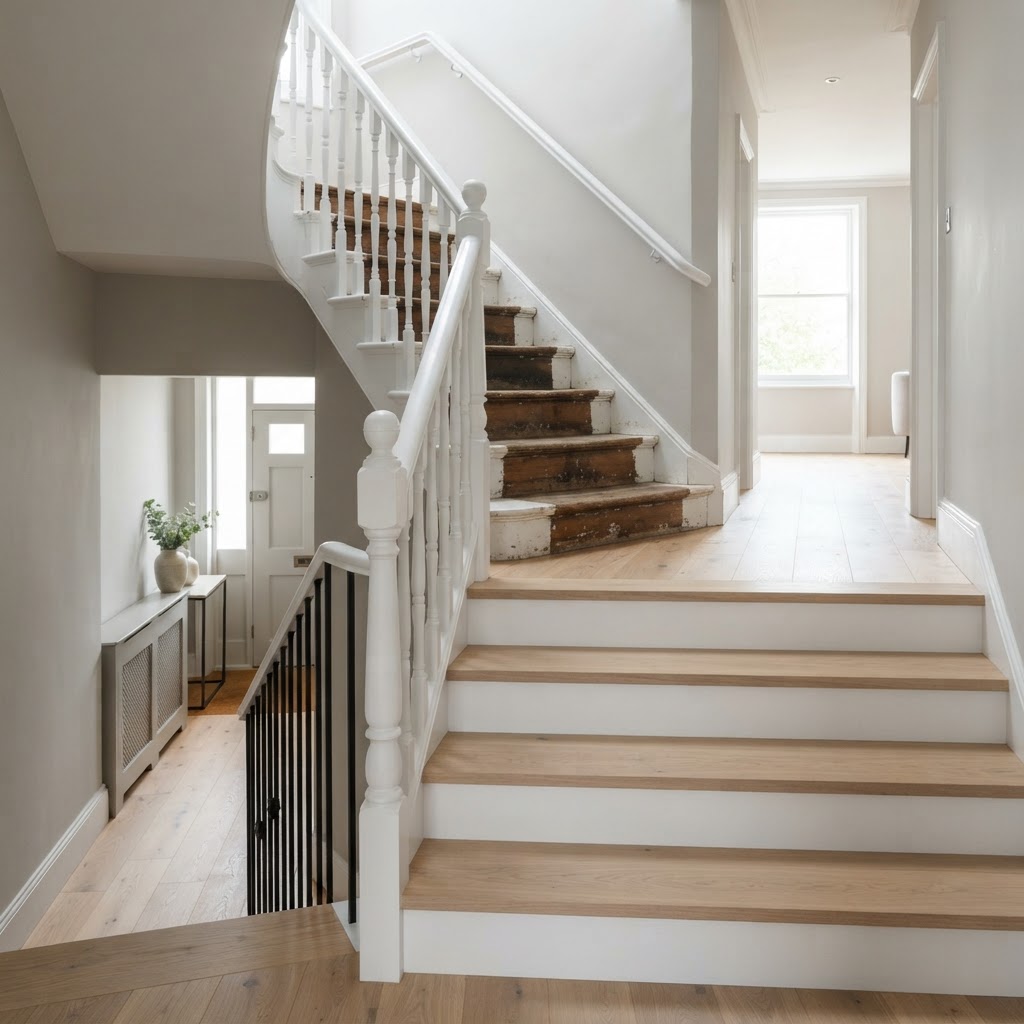
How are hardwood stairs and landings installed in Vienna townhomes, and how do you match your floors?
Hardwood stairs in a Vienna townhome are installed either by replacing the treads, risers and nosings with new hardwood parts, by covering existing treads with caps and risers made to fit, or by refinishing the existing hardwood treads, and matching your floors means choosing the same species, color and sheen as the adjoining landing and hall, then finishing them together so the staircase and floor read as one surface. Floors and Beyond VA handles stairs with in-house crews and no subcontractors, because the staircase is where mismatches show most and where a carpenter's care and a finisher's care need to be the same person's care.
Stairs are the hardest part of a flooring project and the most visible. A floor that is perfect everywhere but ends in a mismatched stair looks unfinished. Townhomes make this more acute. In a typical townhouse the staircase is a central feature of the narrow plan, seen from the front door, from the kitchen and from the upper hall. This article explains how stairs are built, the options for covering or replacing them, how matching actually works and what to expect in the townhomes around Vienna, Oakton, Merrifield and Dunn Loring.
Why townhome stairs are different
Townhomes are narrow, multi-level and often built in rows with shared walls. That shapes stair work in several ways.
Tight dimensions. The staircase may be the only vertical connection, so there is little room to maneuver materials, and the stair may be enclosed between walls.
Visible from many angles. A stair in a narrow plan is often the first thing you see upon entering and part of the view from the main living area.
Multiple floors to coordinate. The entry level, main level and upper level may all have different floor materials, with the stair linking them.
Landings and turns. Many townhomes have a landing with a turn or winders that require careful cutting.
Carpet history. Many townhome stairs were originally carpeted over builder-grade materials, which affects what is underneath.
Shared-wall noise. Stair work is loud, and neighbors share the walls. Courtesy and community rules matter.
Understanding stair anatomy
A few terms help.
Tread. The horizontal surface you step on.
Riser. The vertical piece between treads.
Nosing. The rounded front edge of the tread that overhangs the riser.
Stringer. The structural side member that supports treads and risers.
Landing. A flat platform at the top, bottom or turn of a staircase.
Balusters and newel posts. The vertical parts of the railing system and the heavy posts at the ends and turns.
Skirt board. The trim along the wall side of the stair.
Which of these are replaced, covered or refinished defines the project.
Option one: refinish existing hardwood treads
If your townhome has original hardwood treads, perhaps hidden under carpet, refinishing may be the best path, consistent with our refinish-first philosophy. Many staircases in Northern Virginia homes were built with oak treads that remain in good condition under old carpet. Removing the carpet and pad, pulling the tack strips and staples, and sanding and finishing the treads can restore them.
What to know: treads can be sanded in place, though sanding stairs is detailed hand and edge work. Painted risers are common and can remain painted, giving the classic white riser and stained tread look. Gaps, nail holes and wear need repair. Some builder-grade staircases use softwood or finger-jointed material that is intended to be covered, and these are not good candidates for staining. We inspect before recommending.
Option two: replace treads, risers and nosings
For stairs that cannot be saved or that you want to change, new hardwood treads and risers can be cut to fit. This is the most thorough approach. The old parts are removed, the stringers are inspected and corrected, and new treads and risers are fitted and fastened. Treads usually come with a nosing profile. New parts can be made to match the species and finish of the adjoining floor.
What to know: every stair is slightly different, so parts are cut individually. Out-of-level stringers and walls that aren't parallel make the fit more demanding. The work takes more time than a cap system but delivers a solid, authentic result.
Option three: stair caps and risers over existing treads
A cap system covers existing treads with new hardwood caps that wrap the tread and nosing, and risers are fitted over the old ones. It avoids tearing out the stair structure and is often a practical solution for townhomes with builder-grade treads.
What to know: the cap adds a small amount of height, so rise and run must remain consistent across the staircase. A good installer ensures the first and last steps work with the floors at the top and bottom. Caps depend on a sound base. Quality varies, so the thickness and construction of caps matter.
Landings: the transition between stair and floor
The landing is where stair meets floor, and it is where mismatches show.
Flush landings. The landing floor continues the adjoining hardwood. The stair nosing at the top often has a special piece, called a landing tread or a square nose, that sits flush with the floor and finishes the edge.
Intermediate landings. Mid-staircase platforms, common at turns, are treated like treads or like floors depending on size.
Winders. Pie-shaped treads at turns need careful cutting and fastening, and matching grain direction takes planning.
For a townhome with a landing at the top, board direction on the landing and hall is chosen so that the pattern flows from the stair to the hallway.
Matching your floors: what it really takes
"Matching" can mean different things, and it helps to know which you want.
Exact match. Same species, same cut, same width, same stain and same sheen, finished together. This is achievable when you are installing or refinishing everything at the same time, or when you extend an existing floor and can sand and finish old and new together.
Close match. Same species with a stain chosen to coordinate. Achievable in most situations.
Deliberate contrast. Treads in one tone and floors in another, or stained treads with painted risers. This is a design choice and, done well, can look intentional.
Factors that determine success: species, because different species age and take stain differently; cut, since plain-sawn, quarter-sawn and rift-sawn boards show different grain; width, which affects the visual rhythm; stain, which should be tested on your actual boards; sheen, which must be consistent across surfaces; and aging, since an old floor has darkened or lightened with light exposure and a new piece will not match until sanded and finished alongside it.
The best way to guarantee a match is to sand and finish the old and new surfaces together, so one finish unifies them. This is a core capability of site finishing. It is also why the choice discussed in Replacing Hardwood Floors in a McLean Home: Removal, Subfloor Checks and Installation Steps matters when stairs are part of a larger replacement.
Handling multiple levels
Townhomes often have floors that differ between levels: tile or vinyl at the entry, hardwood on the main level, carpet upstairs. The stair is the connector, so decisions are made about where one material ends and the next begins.
Common arrangements include hardwood stairs from main to upper level, with carpet in bedrooms; hardwood continuing up the stair and across the upper hall; or a runner down the center of hardwood stairs for traction and sound absorption. A runner can also hide a mismatch if you cannot achieve an exact match, though we would rather you see the stair you've paid for.
Safety and code considerations
Stairs are safety features, and several points deserve attention. Treads should be uniform in depth and risers uniform in height. Nosings should be firmly fastened and not slippery. Handrails and balusters should be secure. Finishes should provide adequate traction; glossy finishes on stairs can be slippery, particularly in socks. Local building requirements apply to stairs, and we do not state specific code values here; ask your local building office or your installer how requirements apply to your project.
Noise and neighbors
In a townhome community, stair work generates noise that travels through shared walls, and some communities limit contractor hours or require notice. We ask about this in advance. Prefinished treads and caps generate less dust and odor than on-site sanding and finishing, which can matter in close quarters. Where we do finish on site, we manage ventilation and dust.
Representative scenarios
These are representative situations, not accounts of particular customers.
A Vienna townhome with carpeted stairs. The owner suspects oak under the carpet. We lift a corner on the first visit and find clean oak treads with painted risers. The plan is to refinish the treads, repaint risers and extend a matching oak floor across the landing and upper hall, finishing everything together.
A Merrifield townhome with builder-grade treads. The treads are made of material intended to be covered. The best answer is a cap-and-riser system in oak that matches the new main-level floor.
A Dunn Loring townhome that needs a full change. The owner wants to switch from carpet to hardwood on stairs and the upper hall. We replace treads and risers, install matching hardwood on the landing and hall, and finish everything for a consistent look.
Working with the existing staircase structure
Whatever option you choose, the existing staircase determines what is possible. Before proposing a plan, we look closely at the structure.
We check whether treads are level and firmly attached, since squeaks and movement often come from loose treads or worn glue blocks beneath. We examine the stringers for cracks or damage. We look at the relationship between the stair and the walls on either side, which in many townhomes are not perfectly parallel, requiring custom-scribed fitting. We measure the rise of each step to find out whether the existing riser heights are consistent, because adding caps or changing the floor height at the top and bottom can alter the rise of the first and last steps. We examine the balusters and newel posts to see whether they are solid and whether the new treads will interact with them.
Squeaks deserve special mention. A squeaky stair is a signal that something is moving. Fixing it before new treads or caps go on is far better than trying to quiet it afterward. Techniques include adding screws through treads into stringers, installing wedges or blocks beneath treads, and applying adhesive to eliminate movement. Done properly, a renovated staircase should be both beautiful and silent.
Balusters, railings and newel posts
Stairs are not only treads and risers. The railing system frames the staircase and, in a townhome, is part of the room's character. When floors change, the railing often needs attention. Newel posts can be reset or replaced. Balusters can be refinished, replaced with a different style or changed from painted to stained. Handrails may need refinishing to match new treads.
We coordinate the finish on stair parts with the treads and floors so that the whole assembly looks intentional. If you want to change the railing style, for example from a dated spindle design to a cleaner modern profile, we discuss it during the consultation and, where needed, coordinate with the appropriate trades. Our estimate states what is included.
Traction, comfort and quiet
Hardwood stairs are beautiful, but they can be slippery and noisy. Several measures improve the experience.
A runner down the center of the stairs adds traction, absorbs sound and protects the treads. Runners can be chosen to complement the floors and are secured with hardware that is installed carefully to avoid damaging the wood. Satin or matte finishes provide better traction than glossy ones. Non-slip treatments can be added to the finish where needed. Rubber or felt pads beneath area rugs on landings help prevent slips. And for households with pets or young children, we discuss the balance between appearance and safety.
Sound is another consideration. In townhomes with shared walls, the stair can act like a drum. Underlayments between treads and substrate, tight fastening and soft-soled footwear all help. A runner is often the most effective acoustic measure.
Planning around the whole home
A stair project affects access between levels. While treads are being replaced or finished, you cannot use the stair normally. In a three-level townhome, that can split the household. We plan the sequence so that the stair is unavailable for the shortest time possible, often by working on the stair in stages or timing finish coats so that drying overlaps with times you are away. We tell you in advance when you will not be able to use the stairs, so you can arrange sleeping spaces, pets and daily routines. If you have mobility concerns, tell us at the start so we can plan carefully.
What drives the scope
Without quoting figures, the factors include the number of steps, the stair's configuration (straight, turned, winders), the option chosen (refinish, replace, caps), the species, the condition of stringers and walls, the removal of existing coverings, the landing and hall area, railing work, the finish type, access and furniture volume.
Why homeowners choose Floors and Beyond VA for stairs
Stairs expose weak workmanship, which is why they are a good test of a contractor. Floors and Beyond VA is a family-owned Northern Virginia company serving Fairfax, Loudoun, Prince William and Arlington counties since 1987. Our in-house crews, with no subcontractors, carry stair projects from inspection through finishing so that the person fitting your treads is invested in how they look finished. We are fully licensed, bonded and insured. We bring samples to your home, measure with a laser at no charge and give an honest, all-inclusive estimate in which what we quote is what you pay. See our wood flooring page for more on what we install, or visit floorsandbeyondva.com.
Common mistakes with stairs
The first mistake is refinishing treads that were never meant to be exposed. The second is installing caps without checking rise consistency. The third is ignoring the landing's relation to the hall floor. The fourth is choosing a glossy finish that is slippery. The fifth is mismatching stain between stairs and floors. The sixth is leaving stair work to a separate company from the floor. The seventh is forgetting railings. The eighth is not planning for noise in shared-wall communities.
Frequently asked questions
Can I refinish my stairs? If they are real hardwood, often yes.
Do you cover carpeted stairs with hardwood? Yes, with caps and risers or full replacement.
Will new stairs match my floor? We aim for an exact or close match and finish them together where possible.
Can I keep painted risers? Yes. It is a classic look.
Do you serve my neighborhood? Yes, including Vienna, Oakton, Tysons, McLean, Falls Church, Merrifield, Dunn Loring and Great Falls, along with Fairfax, Loudoun, Prince William and Arlington counties.
Ready to finish your stairs the right way?
Floors and Beyond VA will inspect your stairs, bring samples to your home and measure with a laser at no charge. For a look at how we serve townhome owners elsewhere, see our flooring company in Arlington, VA page. The request form below goes straight to our team, and we follow up with scheduling options for your free consultation.
Request your free estimate: https://floorsandbeyondva.com/Contact
You can also call (703) 906-5698 or email hello@floorsandbeyondva.com.




