
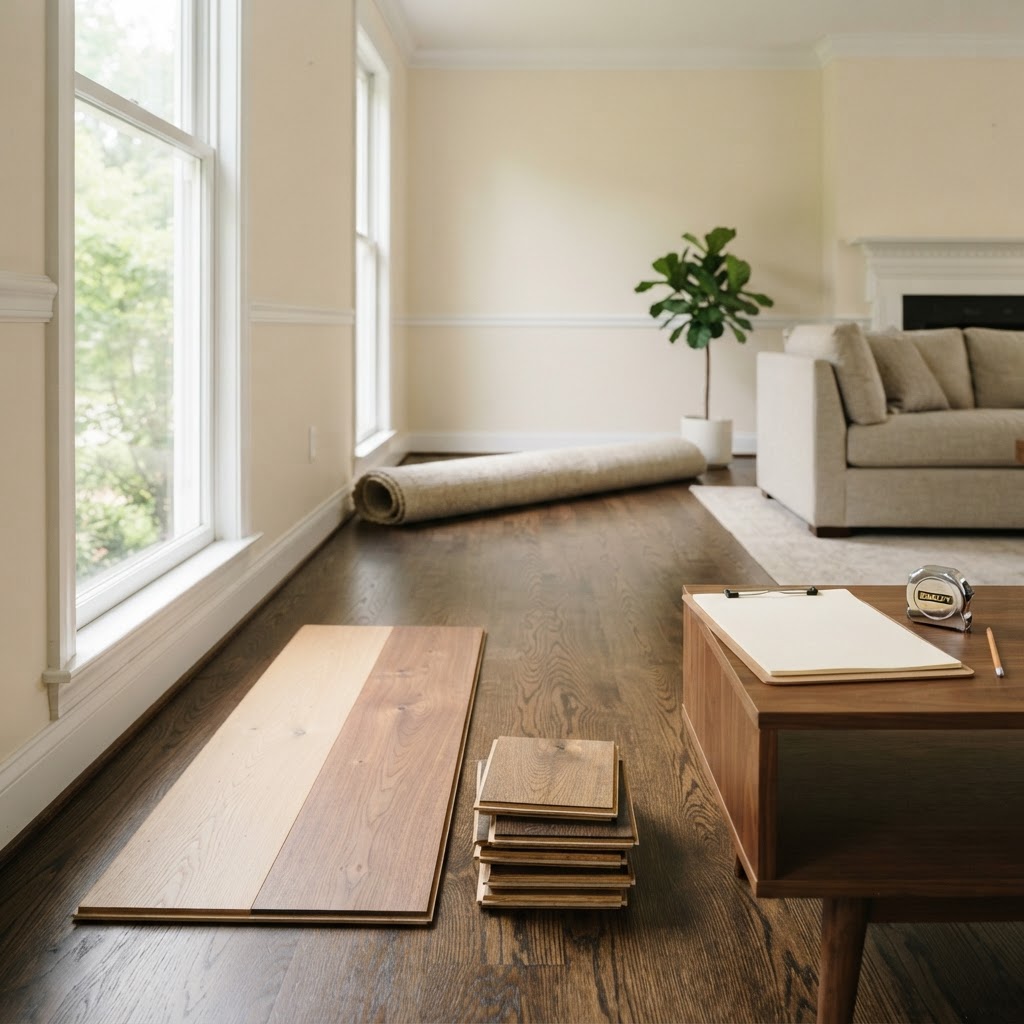
If you have never had a flooring company come to your home, the idea can feel like a commitment before you are ready. It is not. An in-home estimate is how a careful company learns what your floors need and how you can learn whether the company is right for you. The visit should leave you better informed, whether you hire the company or not.
This guide explains why an in-home estimate matters, what happens during the visit step by step, how to prepare, which questions to ask, what a good written plan looks like and what to do afterward. Floors and Beyond VA is a family-owned flooring company that has served Northern Virginia since 1987, and every project we do begins with an in-home visit and a written plan. You can see the range of flooring we install before the visit.
Why an in-home estimate matters
Floors hide their problems. A subfloor can be uneven, damp or loose and look fine from above. A hardwood floor under carpet may be in excellent condition or beyond saving, and no photo can tell you which. A concrete slab can look dry and still release moisture. A condo building can have rules that decide which floors are allowed. None of these things can be known from a phone call or an online form.
A visit lets the company measure accurately, check conditions, see your light, ask about how you live and show you samples in your own rooms. That reduces surprises on installation day, and it helps you make a better choice. A company that is willing to come to your home and look carefully is telling you something about how it works.
What happens during the visit
Every company has its own routine, but a thorough visit usually includes the following steps.
The conversation
The estimator starts by asking what you want, what bothers you about the current floors, how you use each room and whether there are pets, children or other considerations. You describe the look and the timeline you have in mind.
The walkthrough
The estimator goes through each room involved, looking at the floors, the walls and trim, the transitions between rooms and the stairs. They note the condition of what is there.
Measurements
Rooms are measured accurately, including closets, alcoves and stair landings. Accurate measurement affects how much material is ordered and how much is wasted.
The subfloor check
Where possible, the estimator looks at the subfloor, checking flatness, looking for soft spots and noting whether it is wood or concrete. On concrete, they may talk about moisture testing. In a basement, they ask about any past water.
Existing floor inspection
For hardwood, the estimator checks the species, the thickness of the wood above the tongue, the condition of the finish and any damage. At Floors and Beyond VA, we sometimes sand a small test patch in a closet or a hidden corner so you can see the wood before deciding anything.
Samples
The estimator shows you samples in your own light, next to your cabinets, trim and furniture. Seeing a sample in the actual room is the best way to choose.
Building rules
If you live in a condo or a townhome community, the estimator asks about your association's flooring rules, including sound ratings, approved products, insurance requirements and work hours.
The plan
The estimator explains what they recommend and why, describes the work, answers your questions and tells you what happens next.
How long the visit takes
A visit for a single room can take half an hour. A whole level or a house can take an hour or more, particularly if you want to look at several samples or if a test patch is involved. Set aside enough time so you are not rushed, and have the people who will make the decision present if possible.
How to prepare
A little preparation makes the visit much more useful.
- Walk through your home and write down what you want to change in each room. Note any problems, such as squeaks, gaps, stains, soft spots or damage.
- Gather any association or building rules, including the flooring policy, sound rating requirements, insurance language and approved work hours.
- Take photos of existing floors, especially trouble spots.
- If you have carpet over an older floor, lift a corner in a closet or an out-of-the-way spot so the estimator can see what is underneath. Do not force it, and stop if it is tacked down.
- Clear access to the rooms involved and secure pets.
- Collect inspiration, such as photos, paint chips and fabric swatches. Knowing your colors helps with choosing a floor.
- Know your timeline, including dates you cannot move, such as a move-in, a holiday gathering or a sale.
Questions to ask during the visit
The visit is your chance to learn how the company works. Good questions include the following.
- Are you licensed and insured in Virginia? Can I see proof?
- Do your own employees do the work, or do you use subcontractors?
- What condition is my existing floor in, and can it be saved?
- How will you prepare the subfloor and test for moisture?
- Which product do you recommend for this room, and why?
- How will stairs, transitions and trim be handled?
- What will the written plan include?
- What is the schedule, and how will you protect my home?
- What happens if you find something unexpected?
- How do you handle problems after the job is finished?
- Can I see examples of similar work or speak with references?
Pay attention not only to the answers but to how they are given. Clear, patient answers are a good sign.
What a good written plan includes
A good plan arrives in writing after the visit and removes guesswork. It should list the rooms and the work in each, name the product, including brand, line, color and thickness, and describe the preparation, such as leveling, moisture testing and removal of old flooring. It should state how stairs, transitions, baseboards and doors will be handled, and what the schedule is. It should describe how your home will be protected and cleaned, how changes are handled and what warranty applies. If any of this is missing or vague, ask for it before you agree to anything.
Compare plans on the same points. A plan that is more detailed is usually more reliable, because it shows the company has looked at your house.
How to compare estimates
If you are getting more than one estimate, compare them on substance, not just on the headline. Check whether each plan covers the same rooms and the same preparation. Check whether the products are comparable in thickness, wear layer and warranty. Check whether stairs, trim and transitions are included. Check who does the work. A plan that omits subfloor preparation or leaves out transitions may look simpler, but it also leaves the real work for later. Two or three visit-based estimates are enough to compare approach and communication.
Red flags
Some warning signs show up around the estimate. A company that will not visit and insists on quoting from a phone call or photos is guessing. One that pressures you to sign on the spot is not giving you time to think. One that cannot explain what they are recommending, or why, is unlikely to explain problems later. One that will not provide a license number, proof of insurance or references is not being transparent. Trust the company that listened to you, looked carefully and explained honestly.
Estimates for different types of homes
What the visit focuses on depends on the home. In an older house, the estimator spends time on the existing floors, looking at the wood, checking for water damage and discussing what can be saved. In a newer townhome or single-family home, the focus is on subfloor flatness, the basement slab and the layout of the main level. In a condo, the building's rules come first, along with sound ratings and the concrete slab. In a house with stairs, the estimator looks at treads, risers and landings and talks about how they should match the floors. A good company adjusts its visit to your home.
The test patch, explained
For hardwood, one of the most useful parts of a visit is the test patch. The estimator sands a small area, usually in a closet or a hidden corner, down to bare wood. You see the true color of the wood, the condition of the grain and how much damage is superficial and how much is deep. A finish can be applied so you see the result in your own light. The patch answers the question that matters most to many homeowners, which is whether the floor can be saved, and it does so with evidence instead of opinion. If you are considering refinishing, ask whether your estimator can do a test patch. At Floors and Beyond VA, we do it where the wood allows. Our floor restoration service exists for exactly these floors.
Condos and townhome communities: the paperwork
If you live in a building with an association, the visit includes a conversation about paperwork. Associations commonly want a product data sheet showing the sound rating, a certificate of insurance naming the building, a proposed schedule and sometimes a signed work agreement. A good company brings or prepares these documents and explains the approval steps. Approvals can take a week or two, and work cannot begin without them, so start early. Ask your management office who handles requests and how long review usually takes.
Why accurate measurement matters
Measurement sounds simple, but it affects almost everything. Ordering too little material causes delays and mismatched lots, and ordering too much leaves waste. Odd shapes, closets, angled walls and stair landings add complexity. A careful estimator measures each room, notes the layout and allows for cuts and waste appropriate to the product and pattern. Straight layouts need less waste than diagonal or herringbone patterns. Ask your estimator how much extra material they plan to order and why. Keeping a small amount of extra material after the job is useful for future repairs.
What an estimate is not
An estimate is not a decision. It is information. You are not obligated to hire the company that visits, and a good company will not make you feel that you are. It is also not a guarantee that nothing unexpected will arise. Floors sometimes reveal hidden problems when old materials are removed, such as water damage or an uneven subfloor. A good plan explains how these are handled and how you will be informed. Honest communication about the possibility of surprises is a sign of a reliable company.
What happens after the visit
After the visit, you receive a written plan. Take your time reading it, and ask questions about anything unclear. If you are comparing companies, schedule the other visits within a week or two. When you choose a company, confirm the start date, the schedule, the product order and any approvals needed. If you are in a condo or a townhome community, begin the association approval process right away, because it can take a week or two.
Once the product is ordered, ask about delivery and acclimation. Many flooring products need to sit in your home for a period before installation. Your company should tell you how long and where the material will be stored.
Keeping the project on track after you say yes
The estimate is the first step in a longer relationship, and the way a company handles the steps after it tells you a lot. Expect a confirmation of the schedule, a clear contact for questions and notice before installation day about when the crew will arrive and how long they expect to stay. Expect the crew to protect your home, work cleanly and walk you through the finished floor at the end. If something changes, expect to hear about it promptly. If you do not hear back after a visit, or the plan arrives late and vague, take that as information.
What if I am not ready to decide
That is fine. A good company does not pressure you. Many homeowners schedule a visit to learn what is possible, and make decisions over weeks. The plan stays on file, and you can come back when you are ready. If you are still deciding between refinishing and replacing, or between hardwood flooring and luxury vinyl plank flooring, the visit often makes the choice clearer by showing you the options in your own home.
How Floors and Beyond VA handles the visit
We start with an in-home estimate for every project. Our own crews measure, prepare and install, and the person who visits is connected to the people who do the work. We bring samples to your home so you can see them in your own light. We tell you honestly whether your floor can be saved, and we sand a small test patch where it helps. We confirm your association's rules and prepare the documents your building needs. We give you a written plan so you know what to expect. If you are ready to begin, contact Floors and Beyond VA and tell us a little about your floors.
Things people often forget to mention
Some details are easy to forget and can change the plan. Mention any past leaks or flooding. Mention pets, especially large dogs. Mention whether anyone in the household is sensitive to odors or dust, since finishes and adhesives have smells and sanding makes dust. Mention whether you work from home. Mention any plans for renovations, such as a new kitchen or an addition, because floors often follow construction. Mention whether the house has radiant heat in the floor. The more your estimator knows, the better the plan.
If you would like to see how the whole process continues after the estimate, our guide to flooring installation near me covers what happens from the order to the final walkthrough.
Frequently asked questions
Do I have to be home for the estimate?
Yes, or have someone present who can let the estimator in and answer questions. The visit works best when you can talk through what you want.
How long does an in-home estimate take?
Half an hour to an hour or more, depending on the number of rooms and samples.
Will you look at my floors even if I am not sure what I want?
Yes. Many people start with only a general idea. The visit helps you decide.
Can you tell whether my hardwood can be refinished?
Often yes, after an inspection. We can sand a small test patch so you see the wood.
Do I need association approval before the estimate?
No, but gather your rules first. We will use them to recommend an approved assembly.
What do I get after the visit?
A written plan that describes the work, the products, the schedule and how your home will be protected.
Ready to book your in-home estimate?
If you are thinking about new floors, refinishing or a change to your stairs, the best first step is a visit from someone who will look at your home and explain what they see. Floors and Beyond VA is a family-owned flooring company serving Fairfax, Loudoun, Prince William and Arlington counties, Alexandria and the Washington, DC area since 1987. Schedule an in-home estimate or call (703) 906-5698.




