
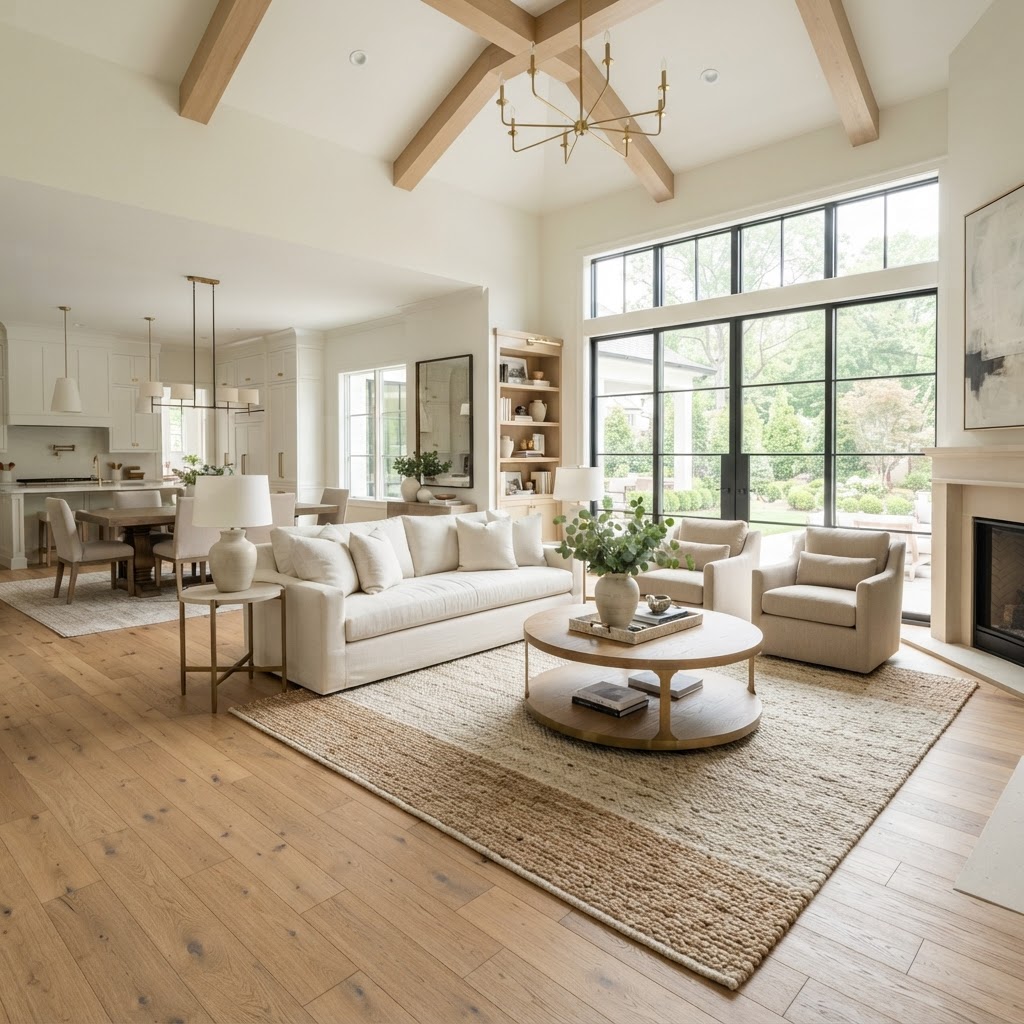
The best flooring for a McLean, VA home is usually a combination: hardwood or engineered wood in the main living areas, luxury vinyl plank in kitchens, basements and busy family spaces, tile in bathrooms, entries and laundry rooms, and carpet in bedrooms, on stairs and in media rooms. McLean's homes are larger and more varied than most, from mid-century ramblers and split-levels to custom colonials and newly rebuilt estates, so the right choice depends on the room, the construction of the house, your design style and how your household lives. The goal is a floor plan that looks cohesive, performs where it must and can be maintained or refinished over decades. Floors and Beyond VA, a family-owned Northern Virginia flooring and remodeling contractor serving Fairfax, Loudoun, Prince William and Arlington counties since 1987, installs every one of these materials with in-house crews and no subcontractors, and we help McLean homeowners choose by looking at the house before recommending the floor.
Searching for flooring in McLean, VA turns up an overwhelming list of materials and opinions. This guide organizes the decision. It compares hardwood, engineered wood, luxury vinyl plank, tile and carpet for different rooms, budgets and design styles, and it explains how McLean's housing stock and lifestyle shape the answer. Budget is discussed as a matter of priorities, without prices. To explore products, visit our wood flooring, vinyl flooring, tile and stone and carpet pages.
What makes flooring decisions in McLean different
McLean sits at the center of one of the most active real estate and remodeling markets in Northern Virginia. Neighborhoods such as Salona Village, Langley, Chesterbrook, Franklin Park, Hamilton, Kirby and the streets near Old Dominion Drive and Chain Bridge Road include homes from many eras. Mid-century ranchers and split-levels often have original oak floors and plaster or early drywall. Colonials from the 1980s and 1990s frequently combine builder-grade hardwood on the main level with carpet upstairs and a large finished basement. Many lots have been redeveloped with large new homes that feature wide-plank floors, open floor plans and expansive lower levels. Townhomes and condominiums near Tysons add another layer, with association rules that affect flooring.
These differences matter because floors respond to the structure beneath them. A 1960s slab-on-grade rambler behaves differently from a 2020s home with an engineered floor system and radiant heat. Large open plans demand flooring that flows across long distances without awkward transitions, and homes with multiple levels need materials that suit each level. Many McLean owners also entertain frequently, have home offices, and care about how a house presents to guests and, eventually, buyers. A careful flooring plan balances beauty, durability and practicality.
Hardwood: the natural centerpiece
Hardwood remains the signature floor of McLean's main living spaces. It suits formal and casual interiors, and it carries a sense of quality that buyers and guests notice.
Solid hardwood is milled from a single piece of wood and can be sanded and refinished multiple times over its life. It is ideal for above-grade rooms and for matching original floors in older houses. Red and white oak are the most common species locally, with hickory, maple and walnut as other options.
Engineered hardwood is built in layers with a real wood surface on a stable core. It handles humidity changes better, can be used over concrete slabs and radiant heat when the product allows, and is available in wide planks that suit contemporary McLean interiors. Our guide to engineered wide-plank flooring in Northern Virginia explores this popular option.
What to watch. Hardwood scratches and dents, dislikes standing water, and responds to seasonal humidity swings. Northern Virginia summers are humid and winters are dry, so moisture and acclimation matter. If you own an older McLean home with original hardwood, evaluate refinishing before replacing. Our guides on whether your hardwood can be saved and whether refinishing is worth it explain how to judge.
Best McLean uses. Foyers, living and dining rooms, family rooms, studies, hallways and primary bedrooms.
Luxury vinyl plank: practical performance
Luxury vinyl plank, or LVP, has become a staple of McLean renovations for good reasons.
Why it works. LVP is highly water-resistant, durable, comfortable underfoot and available in convincing wood and stone looks. It suits kitchens, mudrooms, laundry rooms, finished basements, playrooms and any space where spills, pets and children are part of life. Rigid-core products add stability and help hide minor subfloor imperfections.
What to watch. Products vary widely in wear layer, thickness and core. LVP cannot be refinished, and it can fade or expand under intense direct sun if the product is not designed for it. A quality installation over a flat, dry subfloor is essential. For deeper reading, see our guides on choosing luxury vinyl plank, SPC core flooring and LVP pros and cons.
Best McLean uses. Basements, kitchens in busy households, rental or guest suites, home offices and play areas.
Tile: the answer for wet and high-wear spaces
Tile, particularly porcelain, is the workhorse for areas that see water and heavy use.
Why it works. Porcelain is dense, water-resistant, durable and available in finishes ranging from marble-look to wood-look to concrete. It is the standard for showers and bathroom floors, pairs beautifully with radiant heat and handles entry foyers that see rain, snow and ice melt.
What to watch. Tile is hard and cold unless heated, and the substrate must be flat and stiff. Slip resistance matters in wet areas, and grout needs maintenance. Quality installation determines how long tile lasts. See our tile and stone page and our bathroom remodeling service.
Best McLean uses. Primary and secondary bathrooms, mudrooms, entryways, laundry rooms and kitchens where durability is the priority.
Carpet: comfort and quiet
Carpet remains valuable where softness and sound control matter.
Why it works. Carpet is warm, quiet and forgiving underfoot. It absorbs sound, which helps in multi-level homes where bedrooms sit above living areas, and it provides traction on stairs. In a basement media room or home theater, carpet and quality padding improve acoustics.
What to watch. Carpet shows wear and soil more than hard surfaces, requires regular care and depends heavily on fiber, density and padding. In basements, moisture control is crucial. Our carpet page and our guide to choosing carpet explain the options.
Best McLean uses. Bedrooms, stairs, media rooms, nurseries and finished lower levels with proper moisture management.
Choosing by room
Foyers and entries. First impressions matter in McLean homes, where guests arrive often. Tile or hardwood with a durable finish both work. Tile handles weather, while hardwood continues the flow into the house.
Living and dining rooms. Hardwood or engineered wood, with a plank width and stain that suits the architecture.
Kitchens. Hardwood is common in open plans, but LVP and tile are practical for heavy-use kitchens. Think about how the floor meets adjoining rooms. See our kitchen remodeling page.
Family rooms. Hardwood, engineered wood or LVP, depending on traffic and pets.
Bedrooms. Carpet for softness or hardwood for a clean look. Primary suites often combine both.
Bathrooms. Porcelain tile, with attention to slip resistance, waterproofing and heated floors.
Laundry rooms and mudrooms. Tile or LVP.
Basements. LVP, tile or carefully chosen engineered options after moisture testing. See our basement finishing page.
Home offices. Hardwood, carpet or LVP, depending on acoustics and comfort.
Stairs. Hardwood treads with a runner, full carpet, or a custom detail that matches the main-level floor.
Design styles and how flooring supports them
McLean interiors span traditional, transitional, contemporary and modern farmhouse. Flooring is one of the strongest style signals in a room.
Traditional. Rich oak or walnut tones in narrower planks, perhaps with a border or herringbone pattern in a formal space. Warm stains complement classic millwork.
Transitional. Mid-tone oak with a natural or satin finish and wider planks. This is the most popular direction, blending classic warmth with a lighter, cleaner feel.
Contemporary and modern. Wide planks, lighter or cooler tones and matte finishes. Large-format porcelain tile with minimal grout lines suits modern kitchens and baths.
Farmhouse and casual. Textured, wire-brushed or distressed finishes that hide wear, with natural or gray-washed tones.
Whatever the style, consistency across the main level makes a home feel larger and more deliberate. We often recommend carrying one primary floor through the principal living spaces and changing materials only where function demands it, such as tile in wet rooms.
Budget as priorities, not a number
We do not publish prices in articles, but budget decisions can be framed clearly. Think about where the floor does the most work and where failures would cost the most. Put your investment where you see and touch the floor every day, such as the main level, and in the preparation and installation that determine durability. Choose economical but durable materials in secondary spaces. Consider phasing: complete the most visible areas first and plan transitions so later phases blend in.
Also consider the long view. A floor that can be refinished or repaired has a lower long-term burden than one that must be replaced. Households planning to remain for many years may favor solid hardwood or high-quality engineered wood. Households planning to sell within a few years may choose broadly appealing finishes.
What drives the scope of a flooring project in McLean
The scope depends on several factors, listed here without prices because the right proposal requires seeing your home. The material you choose shapes the product scope. The square footage and layout, including stairs, closets and transitions, determine quantities, and McLean's larger homes often involve many rooms and long runs. The condition of the existing floor and subfloor affects preparation. Removal of old flooring and disposal add steps. Pattern, plank width and finish influence labor. Radiant heat or special underlayment adds coordination. Trim, baseboards and transitions finish the work. And access and scheduling, including HOA rules and coordination with other trades, shape the plan.
Floors and Beyond VA provides an honest, all-inclusive estimate, and what we quote is what you pay. It includes old flooring removal, new materials, professional installation, furniture moving, transitions, molding and full cleanup.
How the right floor changes from the first floor to the lower level
One of the most useful ways to think about a McLean home is to treat each level as its own flooring environment, because the conditions really do differ. The main level is where daily traffic, natural light and visual flow converge. It rewards a continuous, durable, good-looking surface, which is why so many McLean homeowners choose a single hardwood or engineered hardwood floor running from the foyer through the living spaces. Continuity makes rooms feel larger and calmer, and it simplifies transitions, which in a large open plan can otherwise multiply into a dozen small thresholds.
The upper level is quieter. Bedrooms and hallways see less abrasion but more bare feet and more desire for warmth and sound control. Many homeowners keep hardwood in the hallway and landing so the stair and corridor read as a continuation of the main level, then choose carpet in bedrooms for comfort. Others carry hardwood into every room and add area rugs. Either approach works, and the decision is usually about how the household lives rather than about durability.
The lower level is where conditions shift. Concrete slabs hold and transmit moisture, temperatures run cooler, and the floor may sit on a surface that was never designed to be nailed into. This is why lower levels in McLean's older split-levels and finished basements tend to call for water-tolerant, floating or glue-down products such as luxury vinyl plank, or for engineered hardwood installed with proper moisture mitigation. Treating the lower level as a separate decision, rather than extending the main-level material downstairs out of habit, prevents some of the most common and most avoidable flooring failures.
Why subfloor condition matters as much as the product you pick
Homeowners naturally focus on what they can see, the color, the grain and the style. Installers focus just as much on what they cannot see. A subfloor that is not flat, not dry or not structurally sound will undermine even the best product. In a mid-century McLean rancher, the subfloor may be original plywood or board sheathing with decades of settling behind it. In a 1980s colonial, it may be a mix of materials across additions. In a recent rebuild, it should be modern and flat, but even new construction subfloors can carry high moisture content if the schedule was compressed.
Flatness tolerances matter because wide planks and large-format tile are far less forgiving of dips than narrow strips. Moisture readings matter because wood and some adhesives respond to humidity. Fastener condition matters because squeaks that show up later can usually be traced back to loose sheathing that was never secured. A thorough in-home evaluation looks at all of this before a product is finalized, which is part of why Floors and Beyond VA begins with a free consultation and a careful measurement rather than a quote over the phone. The right material for your room is the one that suits both your taste and the surface it will sit on.
Matching flooring to how McLean households actually live
Lifestyle should be part of every flooring decision. Households with large dogs benefit from harder finishes and from products with strong scratch resistance, and they should think about how claws interact with high-gloss surfaces. Families with young children often prefer surfaces that clean easily and tolerate spills, which points toward luxury vinyl plank in play areas and finished hardwood with a durable coating in main rooms. Homes that entertain frequently need floors that look good under evening light and can handle foot traffic without showing every mark. Remote workers who spend long hours at a home desk may value warmth underfoot and quiet, which carpet or a rug over hardwood can supply.
Longer-term plans matter too. If you intend to stay in your McLean home for many years, investing in a floor that can be refinished repeatedly gives you flexibility to change the look later without replacing it. If you plan to sell within a few years, a neutral, well-installed floor in a classic tone tends to appeal broadly to buyers. In either case, quality installation does more for the finished result than any single product choice, and in-house crews who do this work every day make a visible difference in how the floor performs over time.
Common mistakes to avoid
The most common mistake is choosing from a photograph or a small sample. View full-size samples in your own light.
Another is replacing hardwood that could be refinished.
A third is ignoring the subfloor, which determines how any floor performs.
A fourth is using the wrong material in a wet area, such as solid hardwood in a bathroom or unprotected carpet in a damp basement.
A fifth is too many different floors in a home with open sightlines, creating a choppy look.
A sixth is overlooking transitions and heights, especially between rooms and levels.
A seventh is choosing the lowest bid without comparing scope.
Finally, many homeowners forget that the floor must work with future plans, such as a kitchen remodel or an addition. Our whole-house remodels and home additions services coordinate flooring with larger projects.
How Floors and Beyond VA helps McLean homeowners
We begin with a free in-home consultation. We bring samples, take precise laser measurements on every room at no charge, evaluate your floors and subfloor, and talk through your style and household. We recommend materials for each space and provide a clear, all-inclusive estimate. Our in-house crews handle the work, so the people who advise you are accountable for the result. We are fully licensed, bonded and insured for every project.
We serve McLean and nearby communities including Salona Village, Langley, Chesterbrook, Franklin Park, Hamilton, Dunn Loring, Vienna, Great Falls, Tysons and Falls Church, as well as Fairfax, Loudoun, Prince William and Arlington counties.
Frequently asked questions
What is the most popular flooring in McLean?
Hardwood and engineered wood lead in main living areas, with luxury vinyl plank, tile and carpet used where they fit best.
Should I choose solid or engineered hardwood?
Solid suits above-grade rooms and can be refinished many times. Engineered offers stability and works in more locations.
Is LVP a good choice for a McLean basement?
Often yes, after moisture testing and proper preparation.
What is the best flooring for a kitchen?
Hardwood, LVP and porcelain tile are all common. The best choice depends on use and style.
Can you match my existing hardwood?
We work to blend new boards into existing floors and can often refinish the whole floor for uniformity.
Do you offer free estimates?
Yes. We offer a free in-home consultation with samples and laser measurements.
Does Floors and Beyond VA use subcontractors?
No. Our in-house crews handle the work.
Do you serve my McLean neighborhood?
We serve McLean and neighboring Northern Virginia communities.
Ready to choose the best flooring for your McLean home?
The right floor fits your house, your style and the way you live. Floors and Beyond VA offers nearly forty years of Northern Virginia experience, in-house crews with no subcontractors, free in-home consultations with samples, and all-inclusive estimates.
Schedule your free flooring consultation in McLean: https://floorsandbeyondva.com/Contact
You can also call (703) 906-5698, or send us a message through our contact page.




