
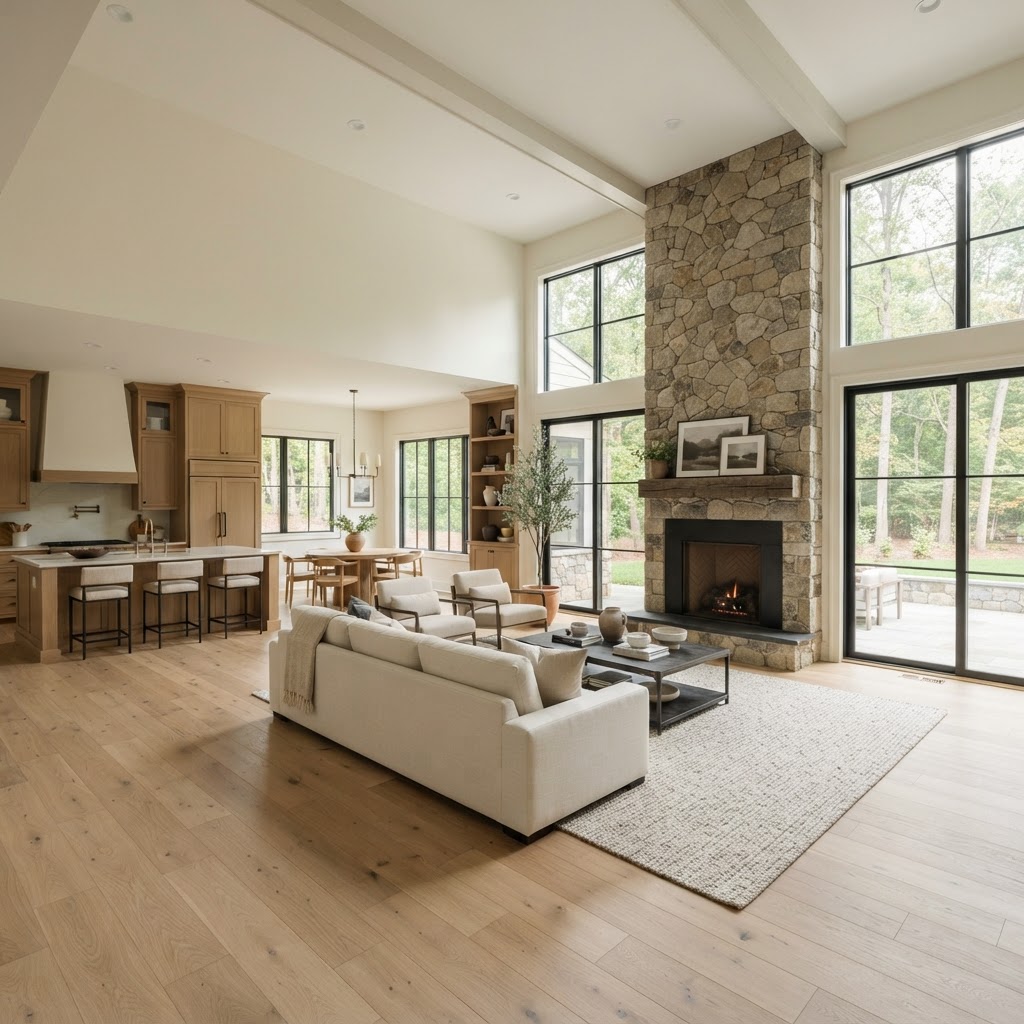
Wide-Plank White Oak Flooring: How to Choose the Right Width and Finish for Aldie and Northern Virginia Homes
How do you choose the right width and finish for wide-plank white oak flooring?
To choose the right width and finish for wide-plank white oak flooring, match plank width to the scale of the room and the sightlines of the home, choose a construction (solid or engineered) that your subfloor and climate can support, look closely at grain and cut, and select a finish and sheen that suits your light, your lifestyle and the look you want. In larger, open Aldie, South Riding, Brambleton, Ashburn and Leesburg homes with tall ceilings and long sightlines, wider planks usually look proportional and calm. In smaller rooms, very wide boards can feel out of scale. Quarter-sawn and rift-sawn white oak produce straighter grain, and plain-sawn white oak shows more cathedral pattern. Matte and satin finishes in natural or softly toned stains highlight the wood without glare. Floors and Beyond VA, a family-owned Northern Virginia flooring and remodeling contractor serving Fairfax, Loudoun, Prince William and Arlington counties since 1987, installs wide-plank white oak with in-house crews and no subcontractors, and we bring samples to your home so you can judge width, grain and finish in your own light.
White oak has become one of the most admired flooring woods in current design. It is hard, dimensionally stable for a hardwood, resistant to moisture damage relative to other oaks and takes stain and natural finishes beautifully. Its pale, subtle palette sits comfortably between the cool grays of recent years and the warmer tones now returning. Extra-wide planks, which show more of each board's character with fewer seams, are increasingly sought by homeowners who want a calm, expansive, European-inspired look. But plank width is a design decision with practical consequences, and choosing wrongly can lead to disappointment. This guide explains how width, grain, cut, construction and finish work together so you can choose with confidence. For related reading, see our article on engineered wide-plank flooring in Northern Virginia and our wood flooring page.
Why white oak?
White oak is prized for several reasons. It is a dense, strong hardwood that stands up to everyday wear. Its cellular structure includes tyloses, which block the pores and make it more resistant to water penetration than red oak, a trait historically valued in boatbuilding and barrels. It stains evenly and takes natural, bleached and darker finishes well. Its color is a pale, slightly cool-leaning tan with subtle olive or gray undertones in the raw wood, so it avoids the pink cast of red oak. And it is abundant in North America, which contributes to its availability.
White oak is not indestructible. It scratches and dents like any hardwood, and it moves with humidity. But it is a reliable, attractive choice for living spaces, and it is among the best species for wide planks because of its stability.
Understanding plank width
Plank width is the most visible design variable. Traditional strip flooring is narrow, and standard planks are broader. Wide and extra-wide planks continue the trend, giving a more open, less busy look.
Narrow planks create more lines and a more traditional, textured pattern. They suit classic homes, small rooms and historic properties.
Medium planks balance traditional and contemporary character and suit a wide range of homes.
Wide planks reduce visible seams and let the wood's grain and character dominate. They suit open-plan homes and larger rooms.
Extra-wide planks push this effect further, creating a bold, estate-like look. They need space to look proportional and rely on stable construction.
The right width depends on room scale, ceiling height, sightlines and style. In a spacious Aldie or Stone Ridge area home with tall ceilings and an open kitchen-to-family-room layout, wide planks can look generous and proportionate. In a modest bedroom, a narrower plank may feel better scaled. In a historic farmhouse near Aldie village, narrower or medium widths may respect the architecture, while wide planks reminiscent of old pine floors may suit rustic aesthetics. The proportions of the home matter more than any rule.
A useful method is to lay out large samples, or even a mock-up of several planks side by side, on your actual floor and look at them from the entry, across the room and at a distance. Planks look different at scale than they do in a hand-held sample.
Why wide planks need stable construction
As planks get wider, the effects of seasonal wood movement become more pronounced. Wood expands across its width as humidity rises and shrinks as it falls. A wide board moves more than a narrow one, so wide planks are more prone to gaps, cupping and crowning when conditions fluctuate.
Northern Virginia's climate, with humid summers and dry, heated winters, makes this a real consideration. That is why engineered construction is so popular for wide planks. Engineered white oak has a real white oak wear layer bonded to a layered core made of plywood or high-density material arranged in alternating directions, which resists movement. It generally performs better over concrete slabs, in many finished lower levels and over approved radiant heat, subject to manufacturer requirements. Solid wide planks are possible, but they require careful acclimation, stable indoor humidity and a suitable subfloor, and manufacturers often set limits on maximum widths for solid products.
The thickness of the wear layer on engineered planks determines how many times they can be refinished. Thicker wear layers can be sanded and refinished more than once. Thin veneers may permit little or none. Because quality varies widely, we help you evaluate the construction and not only the appearance. Our article on engineered wide-plank flooring in Northern Virginia goes into more depth, and our hardwood versus LVP comparison can help if you are weighing alternatives.
Grain, cut and character
How a log is sawn changes the look of the boards.
Plain-sawn. The most common cut, producing the familiar cathedral or flame patterns. It shows bold, flowing grain and is economical in its use of the log. Wide plain-sawn boards display dramatic, organic pattern.
Rift-sawn. Cut so the grain runs straight and linear, with minimal flake. It produces a quiet, consistent, contemporary appearance and is often chosen for minimalist or modern interiors. It is also more stable in many cases.
Quarter-sawn. Cut radially, producing straight grain with the distinctive ray flake that gives white oak its historic Arts and Crafts character. It is very stable and visually refined.
Mixed cuts. Many products blend cuts for a natural, balanced appearance.
Beyond the cut, the grade determines how much knots, mineral streaks and color variation appear. Clear grades are uniform and refined. Select and character grades include more variation, knots and natural markings, which can look rustic and authentic. Choose the grade that fits your taste. Some homeowners love visible character, while others prefer a calm surface.
Natural wood always includes variation in color and grain. Looking at several planks, not one, gives a more accurate idea of the overall look.
Finish: sheen, color and texture
Finish transforms white oak more than almost any other variable. Consider the following.
Sheen
Matte. Low reflectivity, a natural look and good at hiding scratches and dust. Popular for wide-plank white oak because it emphasizes texture and avoids glare.
Satin. A soft glow with slightly more reflectivity, easy to maintain and forgiving.
Semi-gloss and gloss. High reflectivity that shows every flaw and can feel dated in many contemporary homes.
Sheen is worth testing on real samples in your own light.
Color
White oak accepts many finishes. Natural finishes, using clear coats that preserve the wood's own tone, are widely sought. Bleached or lightened finishes create a pale, Scandinavian look. Soft warm tones add golden warmth. Medium and deeper browns produce a more traditional or dramatic look. Cerused or limed finishes emphasize grain with a pale filler.
Water-based finishes tend to remain clear and keep the wood pale. Oil-based finishes tend to amber over time, warming the color. Hardwax oils and penetrating oils create a natural, low-sheen look and are repairable in spots, though they may need more maintenance. Each system has different durability, odor, drying time and maintenance requirements.
Texture
Wire-brushing, light scraping and other textures emphasize grain, hide wear and give a more tactile look. Smooth finishes are cleaner and more refined. Texture also affects how floors show dust and scratches.
Site-finished or prefinished
Site-finished floors are sanded and finished in the home, allowing custom color and a flat, continuous surface. Prefinished planks are finished in a factory with durable coatings and have micro-bevels at the edges. Both can be excellent. Prefinished floors reduce on-site time and odor. Site-finished floors offer maximum customization. We help you choose based on your priorities.
Matching width and finish to room scale
A few practical principles help.
Large open main levels. Wide or extra-wide planks in matte or satin, with a natural or softly toned finish, create a cohesive, calm surface across kitchen, dining and living areas.
Foyers and entries. Wide planks make a welcoming first impression. Plan for wear and moisture with a strong mat system and a durable finish.
Bedrooms and offices. Medium to wide planks suit most rooms. Matte finishes feel soothing.
Kitchens. Wide planks work well but need a finish that resists spills and a plan for moisture around sinks and dishwashers. Our kitchen remodeling services coordinate floors with cabinetry.
Hallways and stairs. Plank width and direction should flow. Stair treads need careful fitting and matching.
Small or narrow rooms. Medium planks usually look better than very wide ones. Plank direction can help, since running planks along the longest dimension makes a room feel longer.
Historic spaces. Choose width in keeping with the home's architecture. Our historic home restoration services can help preserve and extend original floors.
Subfloor and installation considerations
Wide planks are less forgiving of subfloor imperfections. A wavy or out-of-flat subfloor leads to lippage, hollow spots and gaps. Subfloors should be flat, clean, dry and sound, and many require leveling. Over concrete slabs, moisture testing is essential. Radiant heat systems have specific requirements. Planks need proper acclimation and expansion gaps. Fastening or gluing methods must follow the manufacturer's instructions, and wide planks often benefit from glue-assisted or fully adhered methods for stability.
Layout matters too. We plan plank direction, starting lines and transitions so that the pattern looks intentional, taking into account sightlines from the entry and the main windows. We also avoid narrow slivers at walls by balancing the last row. Our flooring installation guide describes the process, and our guide to preparing your home for new floors explains how to get ready.
In newer Aldie neighborhoods with concrete basements and slab-on-grade foundations, understanding what lies beneath is critical. Our guides to flooring for the basement and the best flooring on concrete basements explain how moisture and slab conditions influence what you can install.
Living with wide-plank white oak
A few habits keep wide-plank floors looking their best. Maintain stable indoor humidity, using a humidifier in winter and dehumidification in summer if needed. Use entry mats and felt pads. Sweep or vacuum regularly with soft attachments. Clean with products recommended for your finish. Wipe spills promptly. Protect against direct sun if you want to minimize color change. Plan periodic maintenance, such as screening and recoating, to protect the finish before wear reaches the wood. Our floor care page provides practical guidance.
If you already have white oak or red oak floors that look dated, consider whether refinishing in a natural, matte or satin finish could give you the look you want. Our articles on whether your hardwood floors can be saved and whether refinishing is worth it, and our hardwood floor refinishing field guide, explain how.
What drives the scope of a wide-plank project
We do not publish costs in articles, but the factors that shape any estimate are clear. The construction and quality tier, including wear layer and grade. Plank width and length. Square footage. Subfloor flatness and preparation, which matter more with wider planks. Moisture testing over slabs. Finish system and customization. Stairs. Trim, molding and transitions. Removal of existing flooring. Furniture moving. And the company, including its crews, licensing, bonding and insurance.
At Floors and Beyond VA, we provide an honest, all-inclusive estimate, and what we quote is what you pay. Our estimates include old flooring removal, new materials, professional installation, furniture moving, transitions, molding and full cleanup. Our article on flooring cost factors in Northern Virginia explains why estimates differ.
Wide-plank white oak in Aldie area homes
Wide planks suit the scale of many Aldie, South Riding and Brambleton homes, where open main levels and tall ceilings give them room to look generous. In historic properties near Aldie village and Middleburg, a wider plank can echo the old-growth floors that once defined farmhouses, while narrower widths may respect more formal period architecture. Whatever you choose, remember that moisture and humidity are local realities, so stable construction and a flat, dry subfloor matter as much as the look of the plank.
Common mistakes with wide-plank white oak
The first mistake is choosing the widest plank available without considering room scale.
The second is ignoring construction, especially wear layer thickness and core stability.
The third is skipping subfloor preparation.
The fourth is choosing high gloss that exaggerates flaws.
The fifth is ignoring humidity control.
The sixth is choosing from a small sample without viewing a larger mock-up.
The seventh is overlooking grade, then being surprised by knots or mineral streaks.
The eighth is forgetting that finishes change color over time.
The ninth is laying out planks without planning sightlines.
The tenth is hiring an installer without wide-plank experience.
Frequently asked questions
What is the best width for white oak flooring? It depends on room scale and style. Wide planks suit open, spacious rooms, and medium planks suit most others.
Is white oak better than red oak? Neither is universally better. White oak is slightly harder, more moisture-resistant and cooler in tone, and red oak is warmer.
Should I choose solid or engineered for wide planks? Engineered construction is generally more stable for wide planks, especially over slabs. Solid is possible with careful conditions.
What finish is best for white oak? Matte or satin finishes in natural or soft tones are popular. The best choice depends on your light and lifestyle.
Do wide planks show gaps more? They can, because they move more with humidity. Stable construction and humidity control matter.
Can wide planks be refinished? Solid planks can. Engineered planks depend on wear layer thickness.
Is Floors and Beyond VA licensed and insured? Yes. We are fully licensed, bonded and insured for every project, and our in-house crews work with no subcontractors.
Do you serve my area? Yes. We serve Aldie, South Riding, Brambleton, Ashburn, Leesburg, Middleburg, Chantilly, Gainesville, Haymarket, Fairfax, McLean, Vienna, Reston, Herndon and Arlington, along with Fairfax, Loudoun, Prince William and Arlington counties.
Ready to choose your white oak flooring?
The right plank width and finish are best chosen with samples in your own home. Floors and Beyond VA brings nearly forty years of Northern Virginia experience, in-house crews with no subcontractors and a free in-home consultation with samples and precise laser measurements at no charge.
Request your free Aldie flooring estimate: https://floorsandbeyondva.com/Contact
You can also call (703) 906-5698.




