
Herringbone Hardwood Flooring: Where This Pattern Works Best in Aldie and Northern Virginia Homes
Where does herringbone hardwood flooring work best in Aldie and Northern Virginia homes?
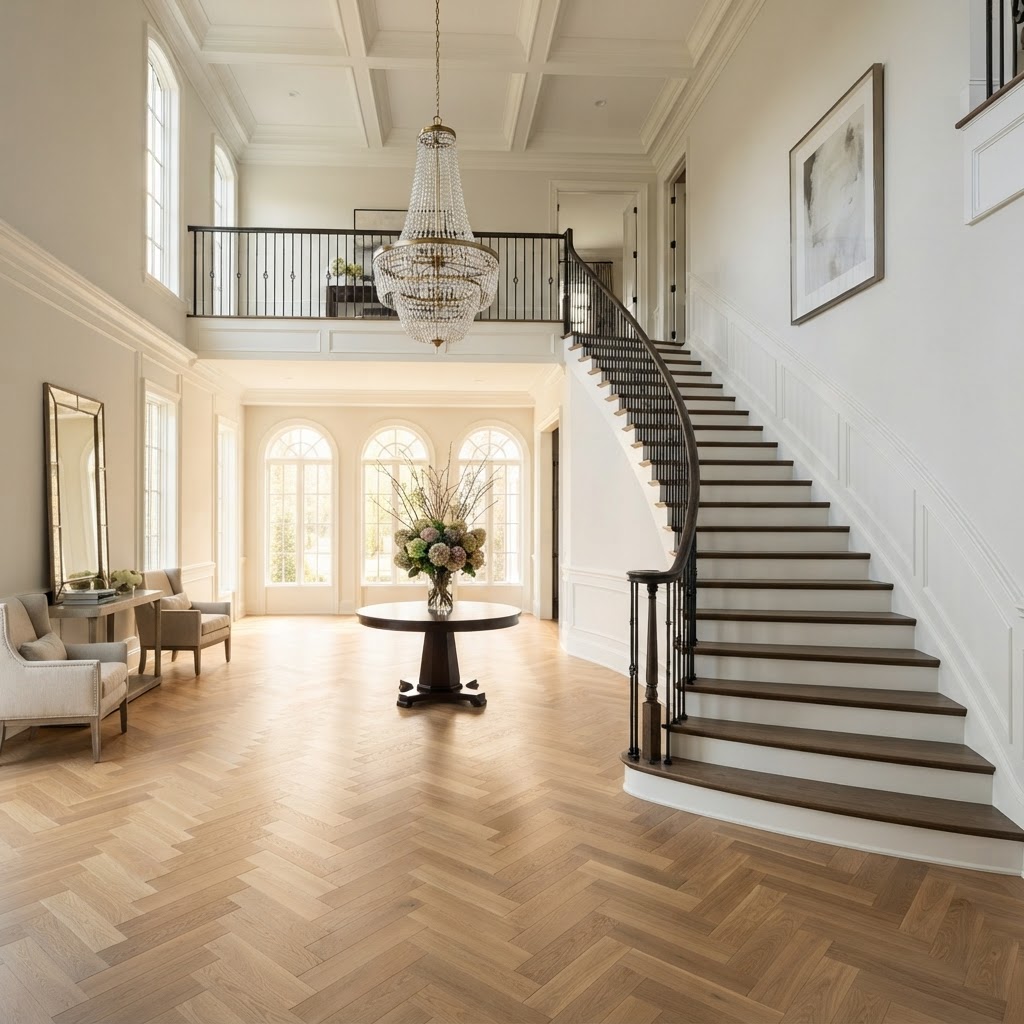
Herringbone hardwood flooring works best in Northern Virginia homes where the pattern can be seen, appreciated and installed on a sound, flat subfloor: foyers and entries, dining rooms, kitchens with open sightlines, hallways, libraries and studies, primary suites and large open living areas where it can serve as a focal point. In Aldie, South Riding, Brambleton, Ashburn, Leesburg, Middleburg and Chantilly, it is especially effective in new open-plan homes that need architectural character and in historic farmhouses and village properties where it echoes traditional European-inspired patterns. It works less well in small, heavily furnished rooms where the pattern disappears, in spaces with irregular walls that make layout difficult or over subfloors that cannot be made flat. Floors and Beyond VA, a family-owned Northern Virginia flooring and remodeling contractor serving Fairfax, Loudoun, Prince William and Arlington counties since 1987, installs herringbone and other patterned hardwood floors with in-house crews and no subcontractors, planning layout, subfloor preparation and finishing as a single craft.
Herringbone is one of the oldest and most recognizable floor patterns, with short rectangular boards arranged in a zigzag. After years of continuous plank flooring dominating new construction, patterned floors are returning as homeowners seek texture, craftsmanship and visual interest. New herringbone formats from manufacturers, including engineered products made specifically for the pattern, have made it more accessible than ever. But herringbone is also one of the more demanding patterns to install, and a poor installation is unforgiving, since a zigzag pattern exposes every misalignment. This guide explains what herringbone is and how it differs from chevron, where it works best in Northern Virginia homes, what installation requires, how to choose wood, size and finish, and how to maintain it. For our hardwood services, see our wood flooring page.
Herringbone, chevron and other patterns: what is the difference?
Homeowners often confuse herringbone and chevron, and the difference affects layout, material and installation.
Herringbone. Rectangular boards with square-cut ends are arranged so that the end of one board meets the long side of another, forming a broken zigzag. Each board is cut square, so the pattern is made by the arrangement, not by the cut. The effect is a broken, textured V-shape.
Chevron. Boards are cut at an angle, usually matched to form continuous V-shaped lines where the ends meet exactly. The pattern forms a clean, continuous arrow design. It requires precise cutting and alignment, and the result looks more linear and modern.
Basketweave, parquet and other patterns. Variations include basketweave, which arranges boards in alternating square groupings, and parquet patterns that combine small pieces into geometric designs. Historic homes sometimes have borders, inlays or medallions.
Both herringbone and chevron have a classical or contemporary feel depending on wood species, width and finish. Narrow, short boards in a warm tone suggest a traditional European look. Wider boards in a pale, matte finish feel modern and airy.
Where herringbone works best
Foyers and entries
An entry is the first impression, and a herringbone floor makes it memorable. Because entries are usually small enough to keep layout simple and visible from the front door, they are a favorite place to showcase the pattern. In Aldie and Loudoun County homes with two-story foyers, a herringbone floor can anchor a dramatic space. Entries do take heavy wear and moisture, so a strong mat system and a durable finish matter. In wet-weather entries, porcelain tile in a herringbone layout is a durable alternative. See our tile and stone page.
Dining rooms
Dining rooms are often lightly furnished with a table and chairs, so the pattern remains visible around and beneath the furniture. A herringbone floor adds formality and texture, and it is a classic choice for a room meant to feel special.
Kitchens and open living areas
In an open-plan home, a herringbone floor can unify the kitchen, dining and living areas and define a focal zone. Large open spaces give the pattern room to breathe. The key is balance: busy cabinetry or patterned backsplashes can compete with a patterned floor, so coordinate the visual weight of the room. Our kitchen remodeling services can plan the floor alongside cabinetry and counters.
Hallways and galleries
Long hallways showcase pattern direction and rhythm. A herringbone hallway can feel like a gallery, leading the eye through the home.
Libraries, studies and home offices
Smaller, quieter rooms with built-ins benefit from the craftsmanship of a patterned floor. Herringbone brings a sense of tradition and warmth to a study. Our home office design page describes workspace planning.
Primary suites
A herringbone floor in a primary bedroom or bath brings a refined, hotel-like quality. In bathrooms, tile herringbone patterns are especially popular and durable. See our primary suite remodeling and bathroom remodeling pages.
Historic and farmhouse properties
Aldie's historic village setting and the surrounding horse-country estates and farmhouses often invite classic, craftsman-driven details. Herringbone suits renovations that honor older architecture, and it can be used as a border or inlay within a field of plank flooring. Our historic home restoration services can help.
Where herringbone is a poor fit
Not every space suits the pattern.
Small, cluttered rooms. Furniture hides the floor, and the pattern gets lost.
Rooms with many angles and irregular walls. Layout becomes difficult, and awkward cuts multiply.
Spaces with constant moisture. Hardwood below grade or in wet areas is risky; consider tile or luxury vinyl plank.
Homes with out-of-level subfloors that cannot be corrected. Pattern floors depend on flatness.
Areas where you want maximum simplicity. Herringbone is a statement. If you prefer quiet, continuous planks, a wide-plank installation may suit better. Our article on engineered wide-plank flooring in Northern Virginia explains that approach.
Choosing the wood, size and finish
Species and color
White oak and red oak are the most common choices for herringbone. White oak offers a neutral, slightly cool-leaning palette and is stable. Red oak adds warmth. Walnut gives rich depth but shows scratches and dust more readily. Maple is pale and smooth. Consider your light, since pale woods in bright rooms may look washed out, and dark woods can feel heavy in low light. Our wood flooring page describes the species we install.
Board size and proportion
Board dimensions shape the character of the pattern. Short, narrow boards create a fine, intricate pattern with a traditional look. Longer, wider boards create a bolder, more contemporary design. The size should relate to the room: small rooms usually look best with smaller pieces, and large rooms can carry larger ones. Proportion matters more than rules, so test samples laid out in the pattern.
Solid versus engineered
Solid hardwood herringbone is classic and can be refinished many times. Engineered herringbone offers stability, a wider range of formats and suitability for slabs and many subfloors. Some engineered products are manufactured in left and right-hand pieces specifically for herringbone, designed to interlock cleanly. The wear layer thickness determines how often it can be refinished. We help you choose based on your subfloor and goals.
Finish and sheen
Matte and satin finishes hide scratches and look natural. High gloss emphasizes the pattern but also every flaw. Oil-based finishes ambering with age, while water-based finishes remain clearer. A site-finished floor allows custom color and sheen, while prefinished planks offer factory durability with no on-site finishing time.
What installation requires
Herringbone is a craft, and its demands explain why the quality of the installer matters.
A flat, sound, dry subfloor. The zigzag pattern magnifies imperfections, and any waviness appears as lippage or gaps. Subfloors often need leveling.
Precise layout. The pattern must be centered and square to the room's focal points. We establish layout lines from the main sightline, often the entry or the center of a primary room, and adjust to avoid awkward partial pieces at walls. Many installers begin from a center line and work outward.
Tight, consistent joints. Each piece must align exactly. Small errors accumulate across the pattern.
Appropriate fastening or adhesive. Depending on the product and subfloor, boards may be nailed, glued or both. Following manufacturer instructions matters.
Careful cutting at edges. Perimeter pieces are cut to fit, and borders may frame the pattern to give clean edges. A border of plank flooring around the room can simplify layout and give a framed look.
Transitions. Where herringbone meets another floor, the transition should be neat. Pattern direction matters at doorways.
Acclimation and moisture control. As with any hardwood, the wood must be at the right moisture content and the home at normal living conditions.
Our flooring installation guide explains our general process, and our guide to preparing your home for new floors describes how to get ready. Herringbone installations typically take more time than plank installations, because layout and cutting are more intensive.
Herringbone in new construction and renovation in Loudoun
In newer Aldie and South Riding neighborhoods, builders typically install plank flooring or carpet, and owners add pattern later. A common renovation approach is to replace entry and dining room flooring with herringbone while leaving the rest of the main level in plank, or to run herringbone through the kitchen and dining area. Care is needed where patterns meet planks, and a defined border or transition helps.
In renovations, flooring may need to be removed first, and the subfloor evaluated. If your existing hardwood is sound, consider whether refinishing meets your goals instead of replacement. Our refinish-first philosophy means we will tell you honestly. Our articles on whether your hardwood floors can be saved and whether refinishing is worth it explain how to decide.
For additions and larger projects, flooring planning should begin early. Our home additions and whole house remodels services coordinate framing, subfloor and finishes so patterned floors can align across old and new spaces.
Herringbone in lower levels and other materials
Finished basements in Northern Virginia homes are not good candidates for solid hardwood, but herringbone patterns are available in other materials. Porcelain tile and luxury vinyl plank can be laid in herringbone layouts, offering the visual effect with greater moisture tolerance. Moisture testing remains essential below grade. Our basement finishing services and our guides to flooring for the basement and the best flooring options for basements with moisture issues explain the options, and our vinyl flooring page describes vinyl installations.
Maintaining a herringbone floor
A herringbone floor is maintained like any hardwood floor, with a few pattern-specific considerations. Use entry mats and felt pads. Sweep or vacuum regularly. Clean with products recommended for your finish. Keep indoor humidity stable, since seasonal movement can open joints in a pattern more visibly than in a plank floor. Address spills promptly. Plan periodic maintenance, such as screening and recoating, before wear reaches the wood. Our floor care page provides practical guidance.
If a pattern floor is damaged, repair requires care: individual pieces can be replaced, but the pattern and finish must match. A skilled installer can weave replacements into place.
What drives the scope of a herringbone project
We do not publish costs in articles, but the factors that shape any estimate are clear. The wood species and format, including solid or engineered. Board size, which affects the number of pieces and cuts. Square footage and room shape. Subfloor flatness and preparation. Layout complexity, including borders and transitions. Removal of existing flooring. Stairs and landings. Finish system. Trim, molding and transitions. Furniture moving. And the company, including its crews, licensing, bonding and insurance.
At Floors and Beyond VA, we provide an honest, all-inclusive estimate, and what we quote is what you pay. Our estimates include old flooring removal, new materials, professional installation, furniture moving, transitions, molding and full cleanup. Our article on flooring cost factors in Northern Virginia explains why estimates differ.
Planning herringbone for Aldie, Loudoun and Northern Virginia homes
Homes across Aldie, Middleburg, Leesburg, Ashburn and Chantilly share a few conditions that influence a herringbone project. Many newer houses sit on concrete slabs or have finished lower levels, so the choice between solid and engineered construction often comes down to the subfloor and moisture conditions. Large windows and tall ceilings mean raking light, which shows the pattern beautifully but also exposes any unevenness. Open layouts mean the pattern will be seen from several rooms at once, so its direction and the way it meets other flooring deserve planning before work begins.
It also helps to decide early whether the pattern will run edge to edge or be framed with a border of plank flooring. A border simplifies cuts at walls, gives the room a finished, intentional look and makes it easier to transition into adjoining spaces. During a free in-home consultation, we walk the sightlines of your home, show herringbone layouts with samples and explain how each option affects the finished appearance.
Common mistakes with herringbone floors
The first mistake is underestimating subfloor preparation.
The second is choosing a pattern too large or too small for the room.
The third is starting the layout at a wall instead of planning from the main sightline.
The fourth is confusing herringbone and chevron, then ordering the wrong product.
The fifth is placing hardwood in wet or below-grade spaces.
The sixth is choosing a high-gloss finish that highlights every imperfection.
The seventh is ignoring transitions where pattern meets plank.
The eighth is competing with busy cabinetry, backsplashes and rugs.
The ninth is skipping sample layouts, so the pattern surprises you.
The tenth is hiring an installer with no pattern experience.
Frequently asked questions
Is herringbone hardwood flooring in style? Yes. Patterned floors are returning as homeowners seek texture and craftsmanship.
What is the difference between herringbone and chevron? Herringbone uses square-cut boards in a broken zigzag. Chevron uses angle-cut boards that form continuous V-shapes.
Does herringbone make a room look smaller? Not necessarily. Pattern, scale and color matter. Appropriately sized patterns in light tones can feel open.
Is herringbone harder to install? Yes. It demands precise layout, a flat subfloor and skilled cutting.
Can herringbone be refinished? Solid hardwood herringbone can be refinished. Engineered depends on wear layer thickness.
Can I have herringbone in a basement? Not in solid hardwood. Tile and luxury vinyl plank are available in herringbone layouts.
Is Floors and Beyond VA licensed and insured? Yes. We are fully licensed, bonded and insured for every project, and our in-house crews work with no subcontractors.
Do you serve my area? Yes. We serve Aldie, South Riding, Brambleton, Ashburn, Leesburg, Middleburg, Chantilly, Gainesville, Haymarket, Fairfax, McLean, Vienna, Reston, Herndon and Arlington, along with Fairfax, Loudoun, Prince William and Arlington counties.
Ready to explore herringbone for your home?
A herringbone floor is only as good as its layout and preparation. Floors and Beyond VA brings nearly forty years of Northern Virginia experience, in-house crews with no subcontractors and a free in-home consultation with samples and precise laser measurements at no charge.
Request your free Aldie flooring estimate: https://floorsandbeyondva.com/Contact
You can also call (703) 906-5698.




